Doubao "Hits the Wall" with WeChat: The Ecosystem War That All AI Phone Manufacturers Will Face Has Officially Ignited
The brief attempt of Doubao Assistant on WeChat illuminated the hidden reefs in the deep - water area of the industry like a lightning bolt. This mobile phone, priced at 3,499 yuan with a thousand - yuan premium, became a testing device for an era, testing the boundaries of technology and the tolerance of business.
On the 3rd, many Nubia M153 users found that when they used Doubao Mobile Assistant to perform tasks related to WeChat, WeChat would unexpectedly quit or even fail to log in.
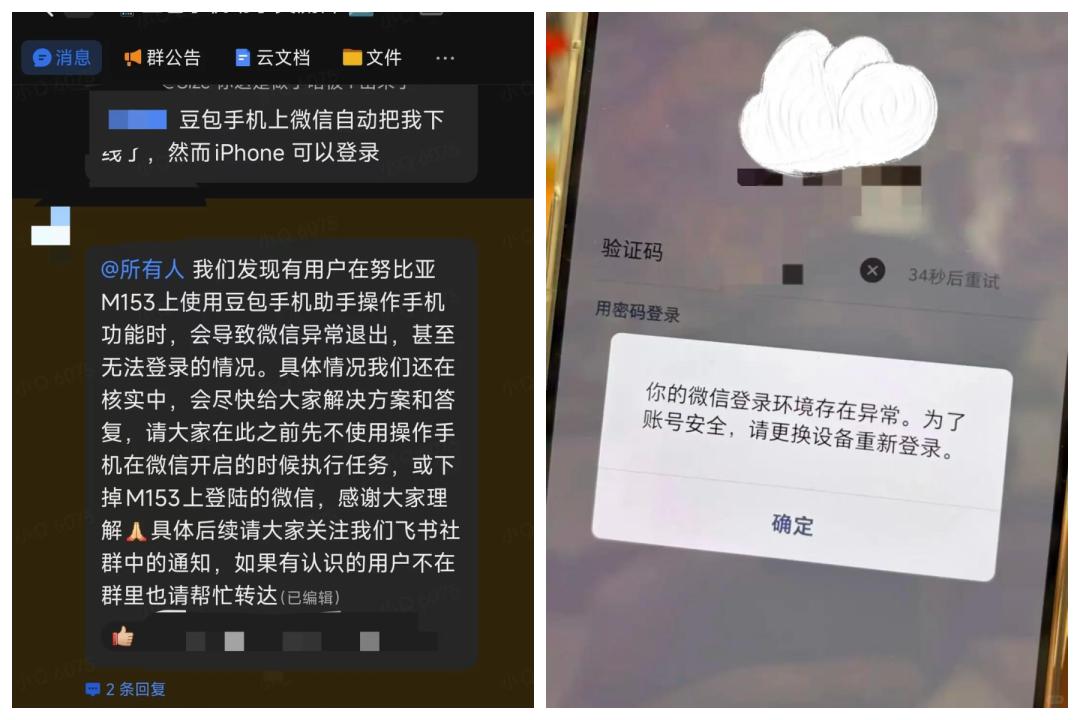
WeChat responded that "it might have triggered the security risk control", while Doubao announced that its mobile phone operation function "currently no longer supports operating WeChat".
This brief and intense confrontation, seemingly a technical compatibility issue, actually uncovered the battle for the boundaries of ecological control in the era of AI mobile phones.
Part.1 The Temptation and Cost of Permissions
The core reason why Doubao Mobile Assistant can achieve the cool demonstration of "comparing prices across the network and placing orders" is that it has obtained the system - level permission of INJECT_EVENTS.
This permission allows the application to simulate user operations such as clicks and swipes and automatically jump between multiple applications. However, it has always been regarded as a "high - risk operation" in the Android ecosystem. It breaks the sandbox isolation principle between applications, enabling one application to manipulate others.
Although the native assistants of mobile phone manufacturers such as Xiaomi's Xiaoai and Honor's Yoyo also have similar permissions, their usage scope is usually strictly limited within their own ecosystems.
The difference with Doubao is that it attempts to use this permission to schedule the entire mobile Internet ecosystem, including national - level applications like WeChat.
Thus, the conflict broke out. That is, on what basis does Doubao have the right to redraw the boundaries?
Part.2 WeChat's Fortress and Doubao's Ambition
WeChat's tough reaction was both expected and meaningful.
WeChat has built not only a social platform but also a complete ecosystem that includes payments, mini - programs, and official accounts. This ecosystem has its own rules, permission system, and data boundaries. When an external AI assistant tries to "intrude" into this ecosystem with system permissions, it not only triggers the alarm of the risk control system.
In the past, app stores were the toll - stations for traffic. Now, AI assistants aim to become the traffic dispatching centers. Behind this role transformation is a complete reconstruction of the value distribution system.
Doubao directly intervened in the core processes of third - party applications through system permissions without prior coordination. This approach is technically feasible but breaks the long - established tacit understanding in business.
A sharp observer pointed out: "This is very much in the style of ByteDance. First create user value, and then deal with business relationships."
However, when it comes to fundamental issues such as ecological control, the technology - first strategy has been tested by harsh reality.
Part.3 The Common Dilemma of All AI Mobile Phone Manufacturers
The Doubao incident exposed the three - fold dilemma that the development of AI mobile phones must face.
The first is the conflict between technical permissions and user privacy. System - level permissions mean that AI can access more user data and perform more user operations. While this ability brings convenience to users, it also poses unprecedented challenges to data security and privacy protection. How can users be sure that their chat records and payment information will not be misused?
The second is the contradiction between AI efficiency and the fairness mechanism. When an AI assistant can "make an appointment for a doctor with one click" or "intelligently grab tickets", the technological advantage may be transformed into de - facto privileges.
The third is the game between ecological control and open cooperation. If major applications fortify their services to prevent external AI dispatching, the vision of cross - application intelligent services will never be realized. But if the dispatching permissions are completely open, app developers are worried about losing control over their own service experiences.
These dilemmas are not unique to Doubao. They are questions that all manufacturers trying to build AI mobile phones must answer. Every technological breakthrough is accompanied by new ethical questions and business conflicts.
Therefore, the collision between Doubao and WeChat can be regarded as the coming - of - age ceremony for the concept of AI mobile phones. It marks that this field has entered the stage of real ecological game from the technology demonstration stage.
All AI mobile phone manufacturers will learn an important lesson from this incident. In the highly mature and interest - pattern - solidified ecosystem of the mobile Internet, any disruptive innovation is not just a technical issue but also an ecological, interest, and trust issue.
The problems that Doubao encountered, Xiaomi will encounter, Huawei will encounter, and OPPO and vivo will also encounter. And users' premium purchases of the "Doubao Mobile Phone" actually represent a vote for the future interaction mode with real money.
This conflict will not end with Doubao removing the WeChat function. As more AI mobile phones are launched, similar collisions will occur repeatedly. Every conflict is redrawing the boundaries, and every compromise is reshaping the rules.
The future will not be that an AI assistant of a single company replaces all applications. Instead, it will be a more complex, hierarchical, and dynamically balanced intelligent ecosystem.
When the smoke clears, what will remain on the battlefield is not just victory or defeat but also the entire industry's renewed understanding of the essence of intelligence.
This article is from the WeChat official account "TrueView". The author is Dilao, and the editor is Yong'e. It is published by 36Kr with permission.