New energy vehicle startups' sales rankings in November: Leapmotor maintains 70,000 units, AITO exceeds 50,000 units, and Xiaomi ranks third.
At the end of November, the delivery rankings of new car - making forces have changed dramatically after the "Golden September and Silver October", with the order being reshuffled.
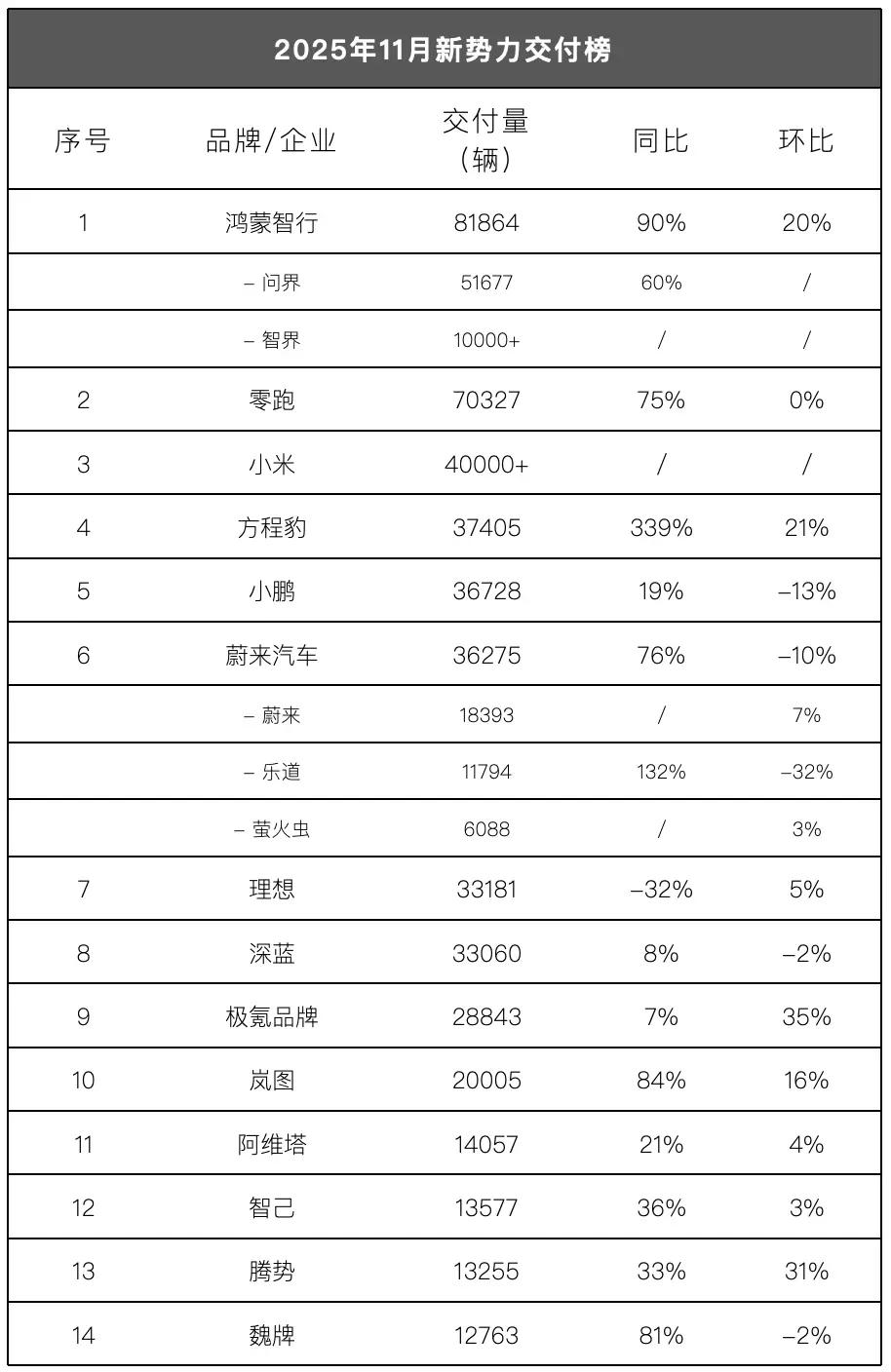
Charting by "Focus One"
First Echelon: Hongmeng Zhixing Tops the List, Leapmotor Ranks First Among Single Brands
Looking at the overall ranking, the biggest change this month comes from the top of the list. Hongmeng Zhixing delivered 81,864 vehicles across all models, a 20% month - on - month increase, becoming the "alliance leader" among new forces. Among them, the sales volume of the Wenjie brand was 51,677 vehicles, contributing 63% of Hongmeng Zhixing's total sales.
Leapmotor, with a delivery of 70,327 vehicles, retained the title of "single - brand champion" for the second consecutive month. The two - strong pattern remains, but Hongmeng Zhixing has overtaken in terms of total delivery volume and become the top - ranked brand.
Second Echelon: The Pattern of 30,000 - 40,000 Vehicles is Shuffled, Xiaomi Enters the Third Place
The competition in the range of 30,000 to 40,000 vehicles is the most intense. Xiaomi (over 40,000 vehicles) has risen to the third place; Fangchengbao under BYD (37,405 vehicles) has become the biggest dark horse. The subsequent ranking competition is particularly fierce, including XPeng (36,728 vehicles), NIO (36,275 vehicles), Li Auto (33,181 vehicles), and Deepal (33,060 vehicles).
Third Echelon: Zeekr Accelerates, Voyah Breaks Through 20,000 Vehicles
In the 20,000 - vehicle level, the Zeekr brand (28,843 vehicles) has become one of the brands with the fastest month - on - month growth, and Voyah (20,005 vehicles) has also exceeded the 20,000 - vehicle mark for the first time.
Fourth Echelon: Avatr, Denza, etc. Stabilize at 10,000 Vehicles
The delivery volumes of four brands, Avatr (14,057 vehicles), IM (13,577 vehicles), Denza (13,255 vehicles), and Wei brand (12,763 vehicles), are very close.
Throughout November, the rankings among the top brands are still changing, and the competition in the middle - tier is extremely intense. As the countdown to the vehicle purchase tax exemption policy begins, the year - end sprint in December will determine who can have the last laugh and will also affect the market pattern next year.
Hongmeng Zhixing Breaks Through 80,000, Leapmotor Holds Steady at 70,000
In November, the first - ranked new force is the "alliance army" Hongmeng Zhixing, which delivered 81,864 vehicles across all models, a 90% year - on - year increase and a 20% month - on - month increase. Behind this is the collective effort of the "Five Realms" matrix: Wenjie remains the absolute main force, while Zhijie and Shangjie have contributed a small amount of incremental volume, and Xiangjie and Zunjie are relatively stable.
Specifically:
More than 60% of the sales come from Wenjie (Seres). According to Seres' production and sales report, in November, the sales volume of Seres automobiles (mainly the Wenjie brand) was 51,677 vehicles, a 59.7% year - on - year increase. According to Liu Chi, a channel insider, among the Wenjie brand, the M9 and M8 models are the absolute main forces.
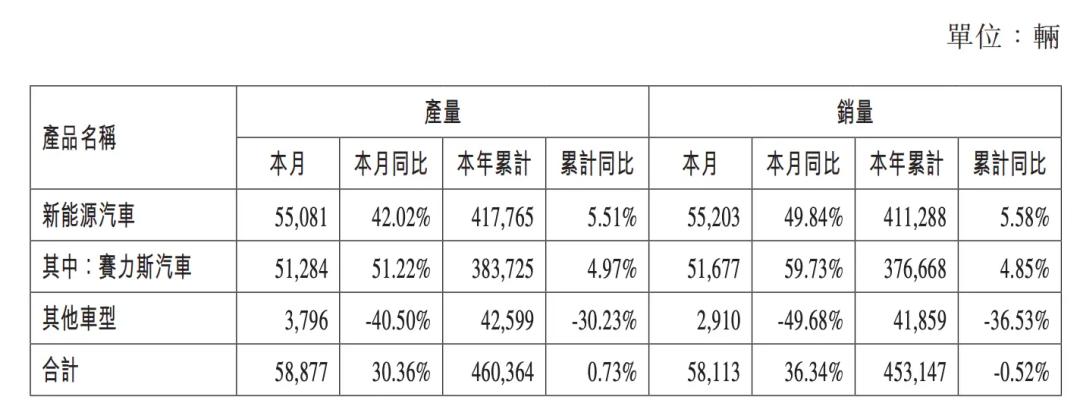
Source of the picture / Seres' November production and sales report
Zhijie (Chery) announced on November 28 that its November delivery exceeded 10,000 vehicles, and the main models are the S7 and R7.
Shangjie (SAIC) has not announced its delivery volume. Liu Chi said that as the entry - level model in the Hongmeng Zhixing family (targeting the market below 200,000 yuan), the Shangjie H5 continued to see an increase in sales in November.
Xiangjie (BAIC) has not officially announced its delivery volume, but according to Peng Lei, the product director of Huawei's selected cars, who revealed on Weibo, the Xiangjie series delivered 6,000 vehicles in November. This figure is basically the same as that in October (6,700 vehicles).
Zunjie (JAC) has also not announced its delivery volume. Limited by its million - level positioning and delivery speed, the S800 is expected to contribute little.
From 150,000 to 1 million yuan, Hongmeng Zhixing almost covers all mainstream price ranges. The record - breaking delivery volume in November can be regarded as a phased victory of the "deep - binding" model between the ecological player and automobile manufacturers.
However, before the release of this sales report, the market's focus this month was on Seres, one of Hongmeng Zhixing's most important partners. It landed on the Hong Kong stock market with the halo of "the biggest automobile stock IPO of the year", but its share price broke below the issue price on the first day of listing, and the share price fell by more than 8% throughout November.
This is regarded as a re - examination by the capital market of the "deep - binding with Huawei" model. Zheng Feng, an investor who has long been concerned about new forces, analyzed that Wenjie contributes more than 90% of Seres' revenue, but the high sales expense ratio makes the market worried about Seres' "independence" and bargaining power in the Hongmeng Zhixing ecosystem.
Following Hongmeng Zhixing is Leapmotor: It delivered 70,327 vehicles in November, marking the second consecutive month it has reached the high level of 70,000 vehicles.
Although the sales volume has been rising continuously, Leapmotor's share price fell by 9% in November. For Leapmotor, which relies on "cost - effectiveness to drive sales", the market also focuses on how it balances scale and profit.
According to Liu Chi's analysis, nearly half of Leapmotor's sales depend on the B series priced between 80,000 and 150,000 yuan, and another one - third comes from the C series priced between 150,000 and 200,000 yuan. These two price ranges are the most fiercely competitive "red - ocean markets", and the profit margins are extremely compressed. Although the proportion of entry - level models like the T03 is shrinking, the highly anticipated new car, the Lafa5, will not see a significant increase in delivery until the second quarter of next year. This means that the current delivery still relies on old models.
Although it sells a large number of cars, it is also difficult to make money: in the third quarter, Leapmotor's net profit was 150 million yuan, a 8% quarter - on - quarter decline. This figure was lower than market expectations and became the direct trigger for the share price decline.
In Zheng Feng's view, Leapmotor's coping strategy is becoming increasingly clear, that is, "using partial equity to leverage greater resources". Therefore, another focus of the market on Leapmotor is how it handles the balance between "openness and control".
Previously, the Stellantis Group took a stake and became its largest single shareholder (holding 21.26% of the equity). Recently, the market has spread the news that FAW Group may take a 5% stake. Chairman Zhu Jiangming responded that the equity cooperation with FAW is "still under discussion", but he hopes that the founding team can maintain actual control.
According to the financial report, as of June 30 this year, the founding team of Leapmotor (the founder group and persons acting in concert composed of Zhu Jiangming and his wife, and Fu Liquan and his wife) held a total of 25.8% of the shares, still being the largest shareholder.
For the relatively low - key Leapmotor, the basic skill of selling cars is no longer a problem. The difficulty lies in how to prove to the market that its "cost - effectiveness" business model also has considerable profit and growth space.
Xiaomi Fights the "Trust War", XPeng Attacks the "Range - Extended" Market
While Leapmotor and Hongmeng Zhixing are having a fierce competition, the battle in the second echelon is extremely intense. Let's first look at Xiaomi Auto, which has a differentiated sales volume and reputation:
On the one hand, the monthly delivery volume is stable at over 40,000 vehicles. According to Liu Chi's analysis, the current main delivery model of Xiaomi Auto is the YU7; the SU7 is basically in the inventory - clearing stage.
More importantly, Xiaomi Auto has made a profit - the third - quarter financial report shows that Xiaomi Auto (Xiaomi's intelligent electric vehicle and innovation business division) achieved an operating profit of 700 million yuan, becoming the "fastest - money - making" company among new forces.
However, the market sentiment is very gloomy: After Xiaomi Group's share price plummeted by 20% in October, it fell by another 7% in November. Lei Jun himself lost nearly 700,000 followers on his Weibo account within a month.
The reason is that a series of negative events have broken out concentratedly - safety accidents after collisions, the progress of the court trial on the "carbon - fiber front hood" controversy, and the loss of the deposit dispute case, etc., have had a significant impact on Xiaomi Auto's brand image.
To cope with the public opinion pressure and improve the delivery efficiency, Xiaomi opened a "ready - to - buy car" channel on December 1. Users can directly change their orders and pick up cars in the APP. The transformation from a situation where cars were in short supply to a situation where ready - to - buy cars are available is enough to show the great impact of public opinion pressure on Xiaomi Auto.
How to view this contradiction between sales volume and share price? Zheng Feng analyzed to "Focus One" that although Xiaomi Auto is in the trough of public opinion, fortunately, there are enough existing orders, and the current delivery volume has not been greatly affected. However, the market is really worried about two aspects:
One is the cost of restoring trust may be very high: Precedents like the "SU7 compensation case" may trigger a chain reaction, consume brand reputation, and even affect potential buyers waiting for delivery. It is unknown how much investment is needed in this restoration process.
The other is that the outside world begins to reflect on Xiaomi's "traffic model". Relying on topics and the founder's IP can quickly attract market attention, but in the automotive industry, which values safety and trust, any small problem may be magnified. This approach of "succeeding by traffic and being trapped by traffic" makes it more likely to become the focus in the public opinion field.
For Xiaomi, the next challenge is how to find a more sustainable way to communicate with the public as soon as possible while stabilizing the delivery and profit rhythm to reverse the brand image.
Source of the picture / pexels
Xiaomi is facing external trust pressure, while XPeng in the second echelon is in a critical strategic adjustment: it delivered 36,728 vehicles in November, a 18.9% year - on - year increase and a 12.6% month - on - month decrease. It is normal for the sales volume to decline after the "Golden September and Silver October" peak season, but the more core reason is that XPeng is in the product transition period.
On the one hand, although the highly anticipated range - extended new car, the X9, has a considerable number of pre - orders, it was just launched on November 20, and it will take some time for the production capacity to ramp up, so it has made limited contributions to the actual delivery in November.
On the other hand, the old main model, the MONA M03, has entered the stable sales period and is difficult to contribute a large amount of incremental volume; and the new P7 and G7 have not been able to shoulder the main responsibility.
Since the annual target has been achieved, XPeng can take a temporary breather in terms of sales volume. Therefore, in November, the market's focus on it is how to break through the growth ceiling of the pure - electric market with range - extended vehicles.
In the past, He Xiaopeng was well - known in the industry as a "pure - electric advocate" and had publicly stated many times that he would "not make range - extended vehicles". However, the market has voted with its feet. Especially in northern and inland cities where charging facilities are not perfect, the demand for range - extended vehicles is real. XPeng plans to launch three range - extended version models (G6, G7, P7+) in the first quarter of next year to enter the larger "co - existence of gasoline and electricity" market to compete for users.
Whether XPeng can succeed in this step from a single pure - electric route to a "pure - electric + range - extended" dual - line battle is more related to its market ranking in 2026.
NIO Strives for Profit, Li Auto Stabilizes the Basic Market
The last two in the second echelon are NIO and Li Auto.
NIO delivered 36,275 vehicles in November, a 76.3% year - on - year increase and a 10.1% month - on - month decrease.
In terms of brand composition, NIO's main brand delivered 18,393 vehicles, contributing half of the sales volume. Within the brand, high - end models (ES8, ES6) account for about 50%, which is crucial for improving the company's overall gross profit margin. In November, NIO successively announced that the cumulative delivery of the ES6 had exceeded 300,000 vehicles, and the new ES8 had exceeded 20,000 vehicles in 70 days after its launch. These two models have stabilized their positions in the markets above 300,000 yuan and above 400,000 yuan respectively.
The LeDao brand continued to see an increase in sales, delivering 11,794 vehicles, a year - on - year increase of more than 130%. The L90 has raised the average price of the LeDao brand to 260,000 yuan and has occupied a place in the mid - end market.
The Firefly brand delivered 6,088 vehicles this month, setting a new high for four consecutive months. This brand undertakes a dual mission: one is to "penetrate the market internally". Jin Ke, the president of the Firefly brand, said to the media recently that it may attract users in the 70,000 - 100,000 - yuan range through the vehicle - battery separation plan; the other is to "explore overseas markets". Currently, it has started deliveries in some European countries (such as the Netherlands, Norway, etc.) to gain experience for the company