"Fleeing from GitHub", developers lashed out after successive departures, criticizing that it is unfriendly to the front end, the experience has dropped significantly, and the internal engineering culture has "gone bad".
Looking back at 2018, when Microsoft acquired GitHub for $7.5 billion, many developers were once nervous, worried that this open - source code collaboration platform would be controlled by the tech giant, and their freedom would be restricted. Some even threatened to abandon GitHub. Years have passed, and Microsoft has basically maintained GitHub's open - source spirit, gradually reassuring most developers.
However, in August this year, GitHub CEO Thomas Dohmke announced his resignation, and GitHub will no longer have a CEO position. Instead, it will be directly taken over by Microsoft's AI team. This move has once again drawn external attention to the platform's future.
Against this backdrop, a new "migration wave" has quietly emerged: more and more developers are starting to move their open - source projects from GitHub to other platforms. These projects include lightweight browsers, game emulator projects, as well as well - known programming language projects like Zig.
What makes people curious is: did GitHub really "anger the crowd", or is it a problem with the developers themselves?

Zig Core Developer: GitHub's Priorities and Engineering Culture Have Been "Corrupted"
In this "migration wave", the Zig programming language project is the largest and has the widest influence.
Zig is a native compiled programming language still under development, but it has been adopted by some well - known projects, including the Bun JavaScript build tool. As of now, it has 42.5k Stars and 3.1k Forks on GitHub.

Not long ago, Andrew Kelley, the main developer of Zig, published an article titled "Migrating from GitHub to Codeberg" on the official community website, announcing that the Zig project would move to Codeberg, a non - profit Git hosting institution based in Berlin, Germany, which can be regarded as an alternative to GitHub.
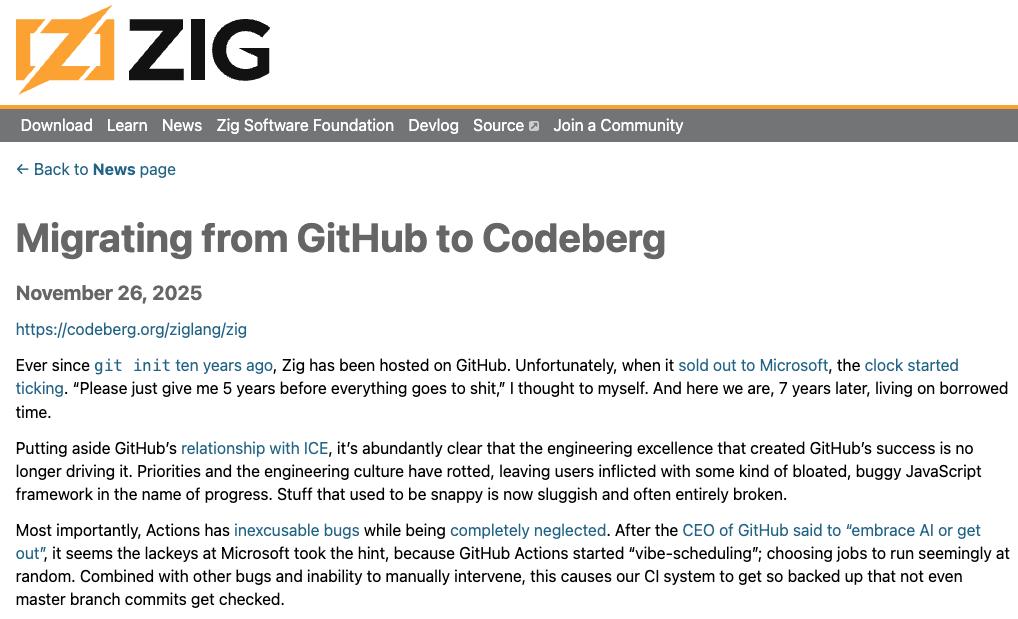
Kelley said bluntly in the announcement: "Since executing 'git init' ten years ago, Zig's code has been hosted on GitHub. Unfortunately, when GitHub was sold to Microsoft, the countdown started. I silently thought, 'Please give me 5 years and don't let everything go wrong.' Now, seven years have passed, and we are living on borrowed time."
He listed several reasons for the migration, with the core being that GitHub's engineering culture and service quality have changed.
Kelley pointed out that the engineering strength that once made GitHub successful no longer works. Its priorities and engineering culture have "gone bad". Users have to endure a bloated and bug - ridden JavaScript framework, and the official says it's for "progress". Things that used to be smooth are now slow, and many functions are even completely broken.
Among them, the instability of GitHub Actions is particularly serious. In Kelley's view, Actions is a key function for continuous integration and continuous delivery, but it is completely ignored within GitHub. The task running status seems to be randomly triggered.
He said: "The GitHub CEO once said, 'Embrace AI or get out', and Microsoft seems to have taken it literally. Actions started to schedule tasks randomly, jobs run randomly, and combined with other bugs and the inability to intervene manually, our CI system is seriously backlogged, and we can't even check the commits on the master branch."
Therefore, "Rather than spending donation money to buy more CI hardware to deal with this broken infrastructure, we decided to directly switch to another Git hosting provider," Kelley said.
In addition, Kelley opposes GitHub's excessive embrace of AI, as it conflicts with Zig's policy of banning the use of LLMs in issues, PRs, or comments. He mentioned that he has observed people violating this policy multiple times, and this situation is at least partly due to GitHub's continuous promotion of the "Submit Issue with Copilot" function.
Willing to Sacrifice Income
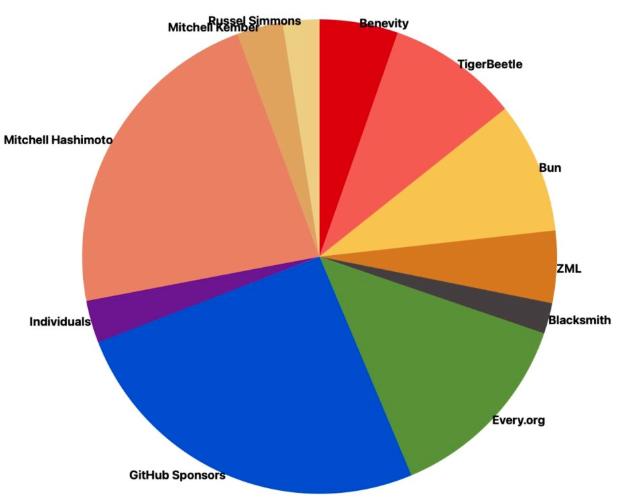
During the migration, Kelley was a little concerned about GitHub Sponsors. This function was the key to Zig's early successful fundraising and still accounts for a large part of the project's income. In 2024, GitHub Sponsors contributed more than $170,000 to the Zig Software Foundation, making it the largest source of income.
Regarding this, Kelley specially thanked Devon Zuegel, the former product manager of GitHub's open - source projects and the creator of the GitHub Sponsors function: "She appeared like an angel, making GitHub a reliable source of income for thousands of developers. Under her leadership, the future of GitHub Sponsors was bright, but she chose to pursue greater opportunities. Since her departure, this product has also been neglected and started to decline."
"We consider this a potential risk," Kelley also called on sponsors to switch to other donation channels, such as Every.org, which is also a non - profit organization.
Currently, Zig's GitHub repository has been set to read - only, and the canonical origin/master branch of the main repository has been migrated to Codeberg (https://codeberg.org/ziglang/zig.git).
The migration strategy adopted by Kelley is relatively simple: to avoid GitHub's aggressive vendor lock - in, he keeps the existing issues without migrating them, but starts counting from 30000 on Codeberg to keep the numbering clear.
Kelley said: "Please consider the still - open issues on GitHub as copies on demand. There's no need to migrate all of them unless you need to edit or add comments. We will still pay attention to the open Pull Requests and Issues, so please rest assured."
Overall, Codeberg currently hosts more than 320,000 projects and uses the self - hosted open - source software Forgejo. Using Codeberg is free, but it is only for open - source projects. Its terms of use only allow private repositories in limited cases, such as "content necessary for FLOSS (Free/Libre and Open - Source Software) projects, such as storing keys, internal team discussions, or temporarily hiding projects not ready for public release". In contrast, GitHub allows private repositories for commercial use even with a free account.
Open - Source Browser Developer: "GitHub Is No Longer the Ideal Choice"
Coincidentally, in addition to Zig, Rodrigo Arias Mallo, the developer of the minimalist lightweight browser Dillo, has also joined the migration from GitHub. He hopes to find a more friendly new home for Dillo that can solve existing problems.

Initially, Dillo's source code and website were uploaded to GitHub, but Rodrigo now believes that it is no longer the ideal choice.
Rodrigo Arias Mallo admitted that GitHub did help a lot in storing Dillo's various repositories and running CI tasks on multiple platforms (such as Windows, macOS, and some BSDs), "because I don't have machines for these platforms at hand."
However, over time, more and more problems have emerged on the GitHub platform, making it unsuitable as Dillo's main development platform, such as:
- Unfriendly front - end: GitHub's web pages are almost unusable without JavaScript, which makes it difficult for the Dillo browser, written in C++, C, HTML, and CSS, to view issues, pull requests, source code, or CI logs, which are essentially just ordinary HTML content. GitHub used to degrade gracefully, but it no longer does. At the same time, the page has high resource requirements, while most of the rendered content is just static text.
- Risk of single - point control: Rodrigo said, "GitHub is controlled by a single entity, and it can unilaterally ban our repositories or accounts at any time. In this way, we can't even notify the community of what happened on the original link. Without a complete local backup, this will result in data loss."
- Declining user experience: In terms of user experience, GitHub has become slower and slower, affecting the development process. It also requires a high - speed network connection all the time, which Rodrigo can't always achieve. In addition, GitHub emphasizes the "push model" - you will receive notifications as long as there are new changes in the project. Rodrigo said that he doesn't like this way and prefers the "pull model": getting updates only when he actively checks. This also allows him to work offline more easily. Unfortunately, many alternative platforms are now starting to imitate GitHub's push model.
- Inadequate community management: From the perspective of community management, it lacks sufficient user management tools, especially in projects where the number of non - technical users far exceeds that of developers. When the issues being discussed by developers are flooded with comments from users who have never contributed to the project, it is often more harmful than beneficial, and it will exhaust developers in the long run.
- Excessive embrace of AI: GitHub is following the trend of LLMs and generative AI, but this trend is destroying the remaining part of the open web. For Rodrigo, the impact is directly visible: many websites have set up JS walls or even browser fingerprinting to prevent LLMs from overloading, which also blocks Dillo users. Rodrigo said that he doesn't want to contribute to this trend anymore. "Although moving Dillo away won't stop GitHub from scraping our code, at least I won't continue to actively support it."
Finally, after investigating alternative platforms, Rodrigo decided to self - host Dillo, migrate important data to a Git repository, and create mirrors on multiple platforms. He bought the domain name dillo - browser.org, rented a small VPS, and the website is now accessible at https://dillo - browser.org/.
To view the repository in the Dillo browser, he chose the lightweight Git front - end cgit and adjusted the CSS. The bug - tracking system uses a C tool named buggy developed by himself, which parses Markdown files to generate static HTML pages, ensuring data security and offline editing. The relevant pages are accessible at https://bug.dillo - browser.org/. The email list archive is saved by three independent external services, and further backups are planned. The key data is now in the Git repository and can be mirrored to any code - hosting platform, reducing the risk of single - point failure.
Rodrigo said that the migration involves many changes and needs time to stabilize. The GitHub repository will still be updated during the migration and will eventually be archived without deleting any commits or old releases. He is satisfied with the results of self - hosting: "We built a completely independent project base at a relatively low cost and with minimal energy consumption, which can at least last for three years in the worst - case scenario."
"Migrating My Code to Codeberg Is a Protest Against GitHub"
Meanwhile, a developer named Eldred Habert also migrated the code repository of his open - source project gb - bootroms from GitHub to Codeberg, and he also shared his migration experience in full.

Regarding the reason for this decision, Eldred Habert wrote:
It's because GitHub is increasingly actively promoting AI solutions, and I don't agree with the ethical and ecological consequences it brings; combined with its cooperation with Elon Musk (now supporting Grok) and some other reasons.
I just don't agree with the platform's policies, so I want to quit, which can also be regarded as a form of protest. And I've also decided to practice what I preach: I'm now donating to Codeberg because they're not bad guys and are really trying to do the right thing, so they deserve support.
Although I wish I could "delete everything with one click without any errors", the reality doesn't allow it. The forked repositories originally hosted on GitHub must be kept to avoid breaking PRs (although I've deleted the outdated forks); at the same time, there are many online links pointing to my various repositories. Therefore, I chose to put a prompt in the migrated repositories to indicate that they have been migrated.
Netizens' Hot Discussions
The community has mixed reactions to Kelley's migration decision. Some developers are indeed dissatisfied with GitHub, mainly due to the deteriorating interface performance and the "flood" of AI functions.
However, some people think that this is just an individual choice of early sensitive projects.
Some netizens also commented:
- Different developers have their own preferred ways of working and collaborating. I doubt that the open - source community will converge on a single solution. I think we're in a "re - decentralization" stage, and developers will move their projects to platforms that can meet their personal or team needs in terms of control, hosting jurisdiction, corporate or community ownership, workflow, and uptime. This is because the competition among source - code hosting platforms is becoming increasingly fierce. Different niche needs can be met through preferred platforms, which is a good thing in itself, although it may be a bit inconvenient for developers who want to submit patches on less - well - known platforms.
- We're in a "discretization stage"; similar announcements keep coming, each pointing to a different GitHub alternative. I guess that in a few months, each community may converge on a dominant platform. I'm curious whether this platform will be an existing one or a brand - new one. Maybe a well - known company or individual will launch a new platform, do a good job in marketing, and then dominate the market.
Actually, as Microsoft tightens its AI control over GitHub, developers' trust in the platform's future is facing a new test. Do you think GitHub is still trustworthy? Will this migration wave accelerate, or is it just a temporary fluctuation?
References:
https://dillo - browser.org/news/migration - from - github/
https://eldred.fr/blog/forge - migration/
https://ziglang.org/news/migrating - from - github - to - codeberg/
https://news.ycombinator.com/item?id = 46096800
This article is from the WeChat official account "CSDN", author: Tu Min. It is published by 36Kr with authorization.