The first stock of "driverless logistics vehicles" is about to be born, but it still has a hard time getting on the road.
With over 8 billion yuan in financing, the darling of capital that has been in the limelight this year has first stumbled online.
A video titled "An unmanned logistics vehicle arguing with a human" suddenly went viral: An unmanned logistics vehicle was blocked by a construction team, and the voice saying "Please make way, please make way" echoed at the scene. The road workers waved for it to turn right, but the unmanned vehicle remained motionless. After a few seconds of stalemate, the two sides actually started to "quarrel" with each other.
On November 25th, unmanned logistics vehicle companies such as Neolix quickly responded: The voices in the video were all post - synthesized by AI, not the real broadcast system of the unmanned vehicle; they reminded netizens not to be misled by "cyber jokes".
However, the rapid response also exposed a point from the side - at this node, which is regarded by the industry as the "first year of the explosion of unmanned logistics vehicles", companies are particularly concerned about public sentiment. After all, as of now, the publicly disclosed financing in this field has exceeded 8 billion yuan.
The enthusiasm for investment is truly unprecedented. In October this year, Jiushi Intelligence announced the completion of a $100 million Series B4 financing; in the same month, Neolix even secured over $600 million in Series D financing, setting one of the largest annual transactions in China's private equity field and the largest single - financing in China's autonomous driving sector.
Actually, in the comment section of the "unmanned logistics vehicle arguing" video, many netizens had already seen through the trick of AI voice - over. However, the concerns about unmanned logistics vehicles themselves have not disappeared because of the "fake voice - over".
The reason is simple. Similar scenarios have actually occurred, such as an unmanned logistics vehicle "fighting with a bull":

There are also "stubborn" unmanned vehicles challenging heavy - duty trucks head - on:
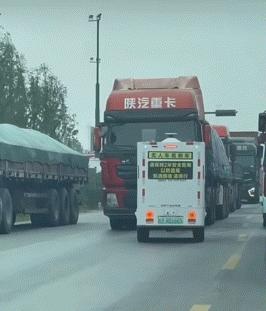
These short videos can't all be post - synthesized, right?
Then the question becomes sharp:
With 8 billion yuan in hot money flowing into unmanned logistics vehicles, is it really investing in real technology or just "cyber fantasy"?
8 Billion Yuan in Hot Money Flows In
Actually, the earliest attempts to "reduce labor costs through unmanned delivery" were made by e - commerce and logistics giants.
As early as 2016, JD.com launched its first civilian unmanned logistics test vehicle and completed the first public road package delivery task at Renmin University; Suning followed closely and launched the "Wolong No. 1" unmanned delivery vehicle.
Although these devices seemed to be full of a sense of the future, at that time, the imagination was firmly restricted by the actual level of autonomous driving technology, and it was difficult to achieve large - scale implementation for a while.
Yu Enyuan, the founder of Neolix, recalled the early days of starting a business in 2018: "We were the only player in the entire field." The market at that time was also full of doubts about unmanned logistics vehicles. "At first, people didn't know what an unmanned vehicle was, nor did they know Neolix. I had to explain for two hours, and finally got a 'Oh, I don't understand', and then they left."
The real turning point came in 2020. The sudden demand during a special period quickly ignited the concept of "unmanned delivery", and a series of policies were gradually opened up.
In 2021, unmanned delivery vehicles achieved a breakthrough in compliance. Beijing issued the first public road license and gradually opened up pilot projects. The "Guidelines for the Safety Service of Autonomous Vehicle Transportation (Trial)" issued in 2023 further determined that intelligent connected vehicles can be used for transportation and business activities.
As of this year, more than 100 cities across the country have opened road - right pilot projects, allowing unmanned logistics vehicles to truly take to the roads.
Also in 2021, Kong Qi, the former chief scientist of JD Logistics' autonomous driving, founded Jiushi Intelligence; Neolix obtained the first batch of domestic unmanned delivery vehicle licenses. Since then, major logistics companies have stepped up their layout in the unmanned logistics vehicle field.
In 2023, SF Express took the first step in large - scale procurement. In 2024, SF Express had put more than 800 vehicles into use and is expected to expand to 8,000 vehicles this year. Meanwhile, ZTO, YTO, STO, and Yunda also entered the market one after another, respectively investing about 1,000, 500, 100, and 200 unmanned delivery vehicles.
This year, the delivery volume of Neolix and Jiushi Intelligence also saw an explosive growth. Neolix sold about 1,000 vehicles last year, and Jiushi Intelligence sold 2,500 vehicles. By September this year, both companies announced that their delivery volume had exceeded 10,000 vehicles.
The industry generally believes that 10,000 vehicles is a critical threshold for the unmanned vehicle industry - only by crossing this threshold can a positive cycle of cost reduction through technology, scenario verification, and scale expansion be truly formed.
Therefore, the leap in the delivery volume of 10,000 vehicles has further raised the capital expectations. It is estimated that by 2030, the market scale of unmanned logistics vehicles will reach 263.4 billion yuan, 5.4 times that of 2025.
The financing wave has become even more surging since this year. In April, Jiushi Intelligence completed a nearly $300 million Series B financing; in October, it received another $100 million Series B4 financing led by Ant Group. Neolix completed a Series C+ financing of 1 billion yuan and a Series D financing of $600 million this year. White Rhino, in which SF Express participated, also secured nearly 500 million yuan in Series B and Series B+ financing this year.
As more and more funds flow in, each company is making preparations for the next - stage expansion.
Li Ziyi, the CFO of Neolix, said at a media communication meeting after the Series D financing that the entire industry "will soon enter a super - high - speed growth stage from 1 to 100. We need to stockpile enough 'ammunition' to seize this growth opportunity."
The bigger "ammunition" is going public. News about Neolix and Jiushi Intelligence competing to become the "first listed company in the unmanned logistics vehicle field" has been spreading one after another. Previously, some media reported that Jiushi Intelligence may start its IPO on the Hong Kong Stock Exchange as early as the second half of this year, and Neolix's Series D financing was once rumored to be a Pre - IPO round.
The Price War Begins
The loosening of policies is just the beginning. What really promotes the large - scale application of the industry is the sharp decline in prices.
In 2018, an unmanned logistics vehicle for last - mile delivery, plus service fees, could easily cost over one million yuan; from 2019 to 2021, the price dropped sharply to 200,000 - 300,000 yuan; this year, it has further dropped to within 100,000 yuan or even 50,000 yuan.
The core factor causing this change is the breakthrough in the localization of key hardware. In the early days, core components such as lidar, cameras, and autonomous driving computing platforms almost entirely relied on overseas supply, and the hardware cost alone exceeded 300,000 yuan.
Now, with the acceleration of localization, the prices of these core components have dropped significantly, directly reducing the overall vehicle cost to within 100,000 yuan.
Meanwhile, with the loosening of policies and the rapid growth of orders, large - scale production has begun to spread out the manufacturing costs. The vehicles are also gradually being produced in a modular and standardized way, significantly improving the manufacturing efficiency.
The price decline is becoming a key variable for the logistics industry to reduce costs and increase efficiency. According to the official WeChat account of SF Express, after putting 52 unmanned delivery vehicles into use in 10 cities in western Shandong, each vehicle travels 6,240 kilometers per day on average and transports 80,000 express parcels. The cost per parcel has decreased by 1.32 yuan, and the efficiency has increased by 30%.
In order to seize the market, the price war of unmanned logistics vehicles has also escalated rapidly.
As of 2025, Neolix's unmanned vehicles have completed 6 iterations. The cost of the core model X3 has dropped from 200,000 yuan for the first - generation vehicle to about 70,000 yuan; in 2024, the price of some products of Jiushi Intelligence further dropped to 50,000 yuan. In May this year, the bare - car price of Jiushi E6 was even reduced to 19,800 yuan, directly bringing the price below 20,000 yuan.
Jiushi focuses on "lowering prices", while Neolix focuses on "financial subsidies". In June this year, Neolix launched a limited - time plan with a down payment of 888 yuan; in September, it was upgraded to "0 down payment, 0 interest rate, 48 - installment payment" and comes with a lifetime free FSD (Full Self - Driving) service.
On the basis of the decrease in hardware costs, the business models of unmanned logistics vehicle companies are also starting to shift from "earning money by selling vehicles" to "driven by software subscriptions". The cheaper the hardware, the more it can drive the scale, and then open up space for continuous revenue growth from software subscriptions.
For example, the bare - car price of Jiushi Intelligence's E6 is only 19,800 yuan, but it requires a monthly FSD subscription fee of 1,800 yuan. The cumulative service fee over five years is far higher than the vehicle price; Neolix attracts customers with free FSD and achieves profitability through large - scale delivery and ecological collaboration.
In October, Jiushi Intelligence won the bid for a centralized procurement project of 7,000 unmanned vehicle leases from China Post. It was reported that the winning bid price was as low as 1,399 yuan per month, far lower than the industry's normal level, indicating that its price - war strategy is very aggressive.
However, the essence of this price - cutting battle is to drive out competitors and then regain the market. According to the calculation of Soochow Securities, an unmanned logistics vehicle company can only break even when its sales volume reaches 50 vehicles. When the sales volume reaches 50,000 vehicles, the profit per vehicle can reach 43,000 yuan, and the net profit rate can exceed 40%.
However, as the price gets lower and the orders increase, the doubts about technology and road rights have not disappeared.
Road Rights Are Harder to Obtain Than Financing
Capital and customers can be convinced by data, but public trust cannot be bought with financing.
In the comment section of the "unmanned vehicle arguing" video, there were endless doubts: "Can this vehicle really be on the road? Is it safe?" "I saw it going in the wrong direction on the non - motorized lane last time." "Although the vehicle is not fast, it will cut in line and block other vehicles. When you see it, change lanes quickly."
On major video platforms, as long as you search for "unmanned logistics vehicles", you can see a series of "funny scenes".

If these videos are just for fun, then the traffic accidents caused by unmanned logistics vehicles have turned the outside world's concerns into disasters.
On December 29 last year, when a car owner in Hangzhou was about to drive out of a parking space, a Neolix unmanned vehicle with an SF Express logo suddenly accelerated and hit the left - front door of his car. In April this year, a bus in Shenzhen collided with a Neolix unmanned vehicle at an intersection because the map data was not updated in time, resulting in a navigation error.
The accidents of Jiushi Intelligence are even more frequent.
Also in April, a Jiushi unmanned delivery vehicle in Xi'an hit a fallen electric vehicle. After the front wheel got stuck, it still continued to move forward and dragged the electric vehicle for about 10 meters. Jiushi explained that "the vehicle misjudged the severely deformed electric vehicle as a soft obstacle that could be touched and only performed a slight avoidance instead of an emergency brake".
On the same day, a Jiushi unmanned vehicle in Changping, Beijing, collided with a car and then drove away from the scene without stopping for handling; subsequent investigations found that it was operating beyond the prescribed area.
The next day, another Jiushi unmanned vehicle in Xi'an suddenly moved forward and rear - ended a parked vehicle in the manual takeover mode (when a courier remotely controls the vehicle to pick up parcels). Jiushi said it was caused by a manual operation error.
These accidents have collectively exposed the shortcomings of unmanned logistics vehicles in perception accuracy, decision - making reliability, and safety management. Although unmanned logistics vehicles do not carry passengers and the speed is not high, the severity of the accidents is limited. However, whether the road rights are clear will directly determine whether large - scale promotion is possible.
Currently, although many cities across the country have opened up pilot projects for unmanned logistics vehicles, the policy standards are not unified, leaving many unmanned logistics vehicles in the embarrassing situation of "whether they can be on the road".
In September this year, a Jiushi customer reported that he didn't dare to buy a vehicle because of the lack of road rights at first. But after the company promised that "the government communication would solve the problem, and the vehicle could be returned if it couldn't be on the road", he placed an order. As a result, more than half a year after getting the vehicle, the road test was stopped by the traffic police after only one time. When he asked to return the vehicle, the regional manager prevaricated, and the customer service never gave a clear answer.
In terms of road - right strategy, Jiushi Intelligence adopts the "customer - self - application" approach and provides a road - right recycling policy: if the vehicle cannot be on the road due to policy reasons, the FSD billing can be suspended, and the customer can renew the fee after the situation improves or return the vehicle according to depreciation. Although it seems flexible, it actually means that the customer has to bear the core uncertainties.
Neolix takes care of the road - right application. It has obtained public road rights in more than 200 cities across the country and jointly developed an electronic road - right application system with Beijing and Hangzhou, platforming the processes such as licensing, route planning, traffic police coordination, and accident handling to relieve the burden on customers.
However, it is not completely problem - free. In April this year, the unmanned vehicles put into use by ZTO and Neolix in Huangshi, Hubei, were stopped by the regulatory authorities because they did not report in advance and did not get approval to be on the road. It was reported that the Xisaishan District branch of ZTO in Huangshi has asked Neolix to take back the vehicles.
Therefore, although both Neolix and Jiushi Intelligence have announced