The world's first AI minister "gave birth" to 83 children; an AI company with only human labor but no intelligence raised over $450 million | A showcase of outrageous AI news
The development of AI is too fast
My imagination can't keep up


Diella and Her 83 Children
The government of Albania in the Balkan region has been pursuing "digital transformation + anti - corruption" in recent years. In September 2025, Albanian Prime Minister Edi Rama announced that they had appointed an artificial intelligence system (AI System) as the "National Minister of Artificial Intelligence Affairs" in the fourth Rama government of Albania, named Diella (meaning "sun"). This is also the world's first artificial intelligence system to be appointed to a cabinet - level government position.
Diella first appeared in January this year as an online virtual assistant of the Albanian government, assisting citizens in using online public services and issuing digital documents on the national digital service platform e - Albania. By September, she was officially given the title of "State Minister of Artificial Intelligence" and was responsible for the public procurement process, claiming to be able to "make the tender 100% corruption - free."
And the most "absurd" thing is that in late October, Prime Minister Rama announced at the Global Dialogue in Berlin that Diella was pregnant and she would give birth to 83 children. Although the prime minister referred to these entities as "children," they are actually a kind of virtual assistant, which can be understood as a government - approved Siri, one for each member of parliament. They have their mother's knowledge of EU legislation and can record meetings, track discussion content, and remind MPs "your name has been mentioned" and "how you should respond."
Rama seemed calm about the incident last month when members of his government cabinet were protested by the opposition party and had garbage thrown at them during Diella's inauguration speech. He pointed out that this is a bold measure to solve Albania's long - standing problems of "nepotism," "conflicts of interest," and corruption. By establishing an AI minister, the country demonstrates its determination for modern governance.
Although this "pregnancy" declaration has a strong symbolic meaning, it also highlights a fact: Albania is gradually transforming artificial intelligence from an auxiliary tool into a structural participant in the government governance system. Whether these digital assistants can truly improve parliamentary operations and government transparency, or are just a technological gimmick, remains to be seen.
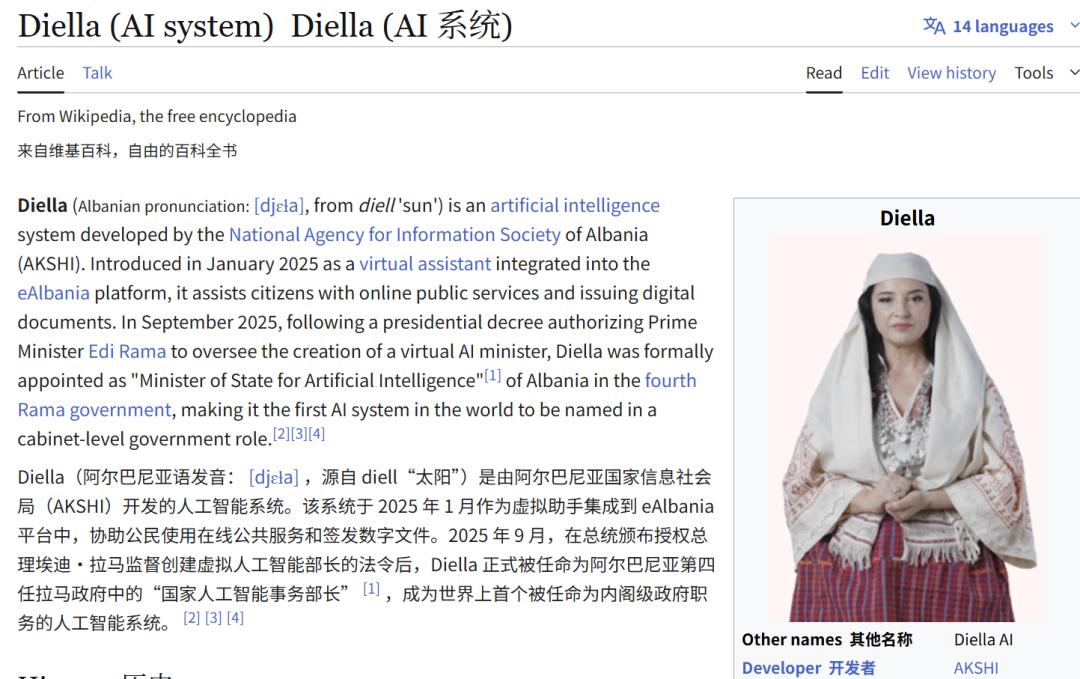
● Image source: Wikipedia search

Advertising a $3,800 Transformer Action Figure with AI
The cause was that a user in the Transformer sub - community posted a video about an official re - post by Transformers of an advertisement made by the mbilia studio using AI.

● Hot post on Reddit
The mbilia studio, founded in Dubai, is a luxury collection studio at the intersection of pop culture, design, and technology. Its main work is to plan and create limited - edition art collectibles. One of the Transformer action figures on their official website is priced at $3,800, and their promotional video was made with AI. What's more, users under the post complained:
Not only did it use AI, but the video editing was also very poor.
I recently saw someone summarize very aptly: AI is a means for wealth to acquire skills, but it doesn't allow skills to acquire wealth.
Even by AI standards, this is complete garbage. It's a shame for a listed company to promote AI images that aren't even good.
Remember that this garbage was made to promote a statue worth $3,800. It's a bad product in itself, and I wouldn't spend money on it. The AI advertisement just makes things worse.

● mbilia official website
For collectors, paying for an expensive action figure is not only because they like the IP but also because of a resonance between the collector and the provider regarding this item. However, the emergence of AI makes collectors feel that the sellers actually don't understand the meaning of this item and just want to make as much profit as possible from it. For this reason, a user commented, "Companies only care about profits. Anyway, as long as they can save money, they will do it. For them, AI is a godsend."
As more and more companies use AI to replace human workers and conduct large - scale layoffs, they achieve cost reduction and efficiency improvement and higher profit margins. However, perhaps not every company is suitable for doing this, especially those that require human - to - human resonance. They should listen more to consumers' voices and provide them with higher emotional value. Otherwise, they will pay the corresponding price.

AI Image Generation Turns a Shabby Restaurant into a Michelin - starred One Overnight
During the recent takeaway war among the three major takeaway platforms (red, yellow, and blue), various subsidies and red envelopes allowed consumers to enjoy takeaway freely, but there were many hidden dangers behind this. Knowing that consumers are used to looking at the restaurant photos before placing an order, many merchants use AI to generate delicate, retro - style, and trendy - looking pictures of stores and dishes, pretending to be high - quality dine - in restaurants. In fact, most of them are small workshops in remote corners with no dine - in service and poor hygiene.


● Image source: Brand Observer
Many consumers reported that they had physical discomfort such as diarrhea after eating takeaways from these "AI ghost restaurants." Some stores also engage in false advertising and play word games. For example, they claim "absolutely no pre - made dishes," but actually "absolutely no" is just the name of the store, and they sell pre - made dishes heated in a microwave.
With the rapid development of AI, the cost of using AI to create images is extremely low, and an image can be generated in just a few minutes. Moreover, third - party platforms have formed a complete "fake image industry chain." For just a few dozen yuan, you can customize an image and get the "pass - the - review" service on the platform. The loopholes in the takeaway platform's review of AI images give merchants an opportunity to take advantage.


● Image source: Internet
These AI - generated false pictures cover up problems such as shabby stores and sub - standard hygiene. Some stores have monthly sales of thousands of orders, deceiving a large number of office workers. In response, consumers have summarized some tips to avoid being deceived: check the merchant information before placing an order and use the real - scene map to verify whether the store is a small workshop; give priority to chain brands (official real - shot pictures are more reliable), and be wary of stores with low prices and "high - end AI pictures."
Although using AI to create images can save costs and attract traffic for merchants, false advertising will eventually damage their reputation. The core of the catering industry is quality. AI can be used as an auxiliary display tool, but the bottom line of authenticity must be adhered to in order to win consumers' repeat purchases.

An AI Company with Only Humans and No Intelligence
Sachin Dev Duggal, the founder and former CEO of the AI programming company Builder.ai, created a fake AI company that relied entirely on manual labor and had no real intelligence. However, he successfully raised more than $445 million from giants such as SoftBank, Microsoft, and the Qatar Investment Authority (QIA). The company was once valued at $1.5 billion, and he falsely reported a 300% increase in revenue to investors. This scam lasted for eight years and finally collapsed completely in May this year.
Builder.ai was founded in London in 2016, formerly known as Engineer.ai. Its slogan was "Make software development as simple as ordering a pizza." Its platform, "Builder Studio," claimed to have an AI digital assistant named "Natasha" that could enable non - engineers to build complex applications. However, in 2019, The Wall Street Journal exposed that this was just a marketing gimmick. The company lacked real AI technology and only used old - fashioned decision - tree tools internally. Most of the development work was done manually by Indian developers, and the so - called "AI - driven" was completely fictional. Many former employees confirmed that the company was marketing - oriented, deducted employees' salaries, and hardly delivered any actual projects. Users also reported problems such as unusable code and missing modules in its services.

● Image source: Internet
At its peak, the company received strategic investment from Microsoft and was integrated into its cloud services. It also attracted investments from well - known institutions such as Lakestar. However, the model of relying on inflated revenue forecasts and the AI concept for financing was unsustainable. Coupled with the fact that founder Duggal was involved in an Indian money - laundering investigation, he resigned as CEO in February 2025, and Manpreet Ratta took over to "clean up the mess." In May of the same year, investor Viola Credit seized $37 million due to the company's default, leaving only $5 million in the company's account and restricting its use. Eventually, Builder.ai filed for bankruptcy, 220 out of 770 employees were laid off, and the company owed $85 million to Amazon and $30 million to Microsoft. The company's website is now inaccessible.
This incident is known in the industry as "AI washing," which means packaging traditional technology as AI to defraud funds. It has also sparked discussions about technical due diligence in AI transactions. Although the no - code and low - code market has great potential, the