Why should rice be blamed for the protein deficiency among Chinese people?
When "high protein" changes from a "niche need for fitness enthusiasts" to a "standard for everyone's daily food", the problem of protein intake among the Chinese people will naturally be solved.
Do we actually lack protein?
Last year, there was a news report saying that the per capita protein intake of the Chinese people had exceeded that of Americans, which sparked extensive discussions.
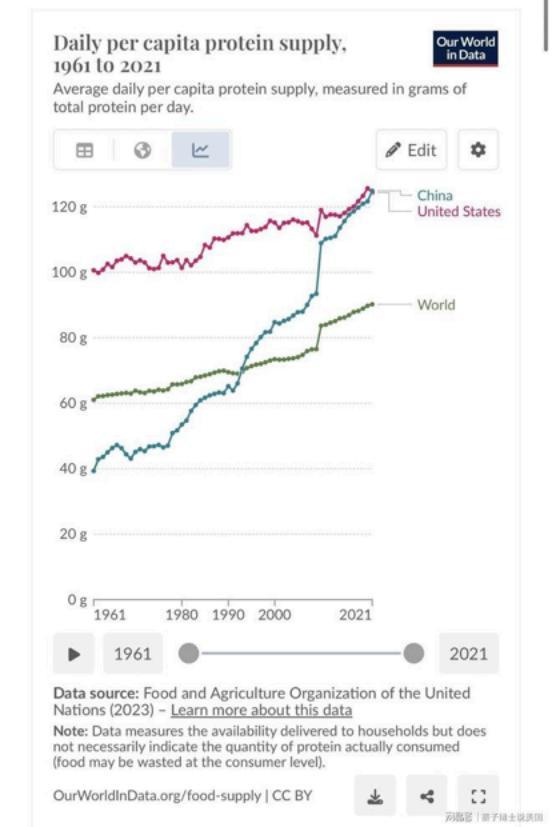
Many people thought, "Hey, something's not right. Haven't we always been told that Americans eat meat every day and that our intake of meat, eggs, and milk is insufficient? How come our protein intake is even higher?"
In fact, many media outlets made a mistake. This data actually measures the per capita protein supply, not the intake.
According to our country's own statistics from previous years, our per capita protein intake is approximately between 65 - 85 grams. It has reached the recommended standard, but there is still a slight gap compared to developed countries.
Regarding the gap between the supply and the actual intake, many people often attribute the problem of protein utilization to our dietary structure.
01
The claim that "Chinese cuisine lacks protein" generally refers to our low consumption of "meat, eggs, and milk".
However, nowadays, beef costs twenty or thirty yuan per catty, and eggs and milk are even cheaper. The insufficient protein intake is not actually due to scarcity but more of a matter of eating habits.
Is it really scientific to directly copy the "European and American diet"?
The American diet is indeed high in protein, but it is also "high in fat" and "high in sugar", which contains both healthy and unhealthy factors.
Another important source of protein for Americans is a large amount of dairy products.
However, we can't directly adopt this because about 70% - 90% of the East Asian population has varying degrees of lactose intolerance.
Not to mention the "high - protein diet" invented based on nutritional principles, such as boiled chicken breast with broccoli. In the end, this is a purely functional diet, a "short - term solution" adopted to achieve specific goals, and it is destined to only be popular among a small group of people.
What we need to explore is not for a niche group or for occasional indulgence, but for the three meals a day, all year round, of billions of people.
It's difficult to ask a nation accustomed to "delicious food with good color, aroma, and taste" to collectively abandon such rich and diverse cooking pleasures and embrace a "functional" and tasteless nutritional diet just to supplement protein.
In my opinion, asking the Chinese people to completely change their eating habits is simply a false proposition because, in essence, this is actually a problem of the food industry.
To address the protein deficiency among the Chinese people, it's not about asking them to abandon Chinese cuisine and switch to steak, but rather relying on the progress of the food industry.
Think about it. If the body lacks iodine, would we ask the whole nation to eat kelp for three meals a day?
No. The real solution is iodized salt.
In the 1990s, there were iodine deficiency problems in many regions of our country, and the incidence of endemic goiter (commonly known as "big - neck disease") was high. In 1994, the state officially launched the "National Iodized Salt Project" - you can still eat what you usually eat, and you can supplement iodine just by adding salt when cooking. In just a few decades, the incidence of iodine deficiency diseases across the country has decreased by more than 90%.
Similar examples include adding folic acid to flour (to prevent neural tube defects in newborns), adding vitamin D to milk, and adding fluoride to tap water... The common feature of these measures is: Don't change what people eat, but quietly supplement what the body lacks in the daily diet.
Applying this idea to protein is the same - if protein can be quietly added to the food we eat every day, just like iodine, so that you can supplement protein without even realizing it while enjoying your food, how wonderful would that be?
This is not a fantasy but is becoming a reality.
02
The food industry has recently found a breakthrough - yeast protein.
As the name suggests, yeast protein refers to the protein isolated and purified from yeast.
Yeast is a single - celled fungus that humans have used for thousands of years to make bread, brew beer, and leaven dough. For example, Angel Yeast, which is commonly used when making homemade noodles, is a type of yeast used for fermenting noodles.
However, yeast also has a great value. That is, yeast cells contain up to 40% - 60% high - quality protein, and its amino acid composition is similar to that of animal protein.
Using brewer's yeast as a raw material, through technologies such as enzymatic hydrolysis, that is, using biological enzymes to gently "break it apart" and extract, "break the walls" of yeast cells, and then separate and purify the protein.
Like whey protein and soy protein that we are familiar with, it is also a protein that can provide amino acids for the human body and is the raw material for muscles, the immune system, and organ tissues.
The difference is that yeast protein is more like a third path: it is neither of animal origin nor of plant origin, but a microbial protein.
This means that it doesn't require grazing cattle or large areas of arable land to grow beans. It relies on microorganisms in fermentation tanks - just like brewing beer, through controlled cultivation, the yeast is "fattened up", and then the high - purity protein is extracted.
This means it has great cost advantages and sustainable supply advantages.
The amino acid composition of yeast protein is comparable to that of whey protein. It contains all 9 essential amino acids for the human body. It is even more balanced in some essential amino acids, and its digestion and absorption rate is as high as 96%.
In addition, it is also rich in dietary fiber, B - group vitamins, and trace elements such as zinc and selenium, which makes it closer to a "fully - nutritious" protein.
According to the announcement and industry standards of the National Health Commission regarding it as a "new food raw material", the protein content of yeast protein needs to be as high as over 70% (g/100g).
In comparison, the protein content in chicken breast is about 10% - 20%; the protein content in an egg is 13% - 15%; and the protein content in beans, known as "plant - based meat", is 20% - 30%.
It seems that the protein content of at least 70% in yeast protein is indeed very efficient.
03
However, this is not its most "revolutionary" aspect.
The greatest advantage of yeast protein is that it can be "invisible". It doesn't need to be consumed by additional rehydration like traditional protein powder but can naturally blend into various foods.
Yeast protein itself has a neutral flavor and almost no odor.
This means that protein can be "secretly" added to bread, beverages, or sauces without changing the original taste of the food.
In contrast, whey protein has an obvious milky smell, and soy protein has a beany smell, which makes it difficult for them to completely disappear in daily foods. This means that you can still enjoy the familiar home - cooked taste while supplementing with top - notch protein.
Currently, the yeast protein market is in its early stage, but the growth trend is very obvious. In a market surrounded by international yeast protein brands, Chinese yeast protein brands are also making efforts.
From a bag of baking powder in the kitchen to today's nutritional technology enterprises, they have always been using the simplest way to make "eating better" a reality.
Angel AnPro yeast protein is derived from natural brewer's yeast and is extracted through advanced biological fermentation technology. It has a protein content of over 80%, an amino acid composition comparable to that of whey protein, is lactose - free, rich in dietary fiber and B - group vitamins, is gentle on the stomach, and has a high absorption rate.
It's worth noting that many people are worried about the purine problem of high - protein foods, but in fact, AnPro yeast protein is a protein after nucleic acid removal. After being rehydrated, it is definitely a low - purine food.
Even better, it has almost no taste but a hint of natural freshness.
You can add it to steamed buns, porridge, noodles, soy milk, cookies, and tangyuan soup - it won't change the taste but can "secretly" enhance the nutrition.
Angel AnPro yeast protein is a new protein solution tailored for the Chinese food industry. It is believed that there will be more and more products using yeast protein in the future, which can supplement protein more smartly and easily without changing eating habits or severing cultural ties. With just a spoonful, the daily dining table can be truly upgraded in terms of nutrition.
When "high protein" changes from a "niche need for fitness enthusiasts" to a "standard for everyone's daily food", the problem of protein intake among the Chinese people will naturally be solved.
Only then can we say that the problem of insufficient protein intake among the Chinese people has finally been solved. It's not through changing the food culture but through the technological upgrade of the food industry; not by making consumers adapt to products but by making products adapt to consumers.
This is truly people - oriented, and this is the ultimate mission of the food industry.
This article is from the WeChat official account "IC Laboratory" (ID: InsightPlusClub), author: IC Laboratory, published by 36Kr with authorization.