Revelation of Animated Comics: The Worst Business on the Internet Might Be the Best Business for AI
Recently, people have been deeply worried: Will this round of trillions of dollars in AI capital expenditure ultimately lead civilization to a new industrial revolution, or will it turn into the biggest tech bubble in history?
AI, however, smiles enigmatically and casually unveils a brand - new application track worth tens of billions: comic dramas.
The current boom in the comic drama track is hard to ignore: The daily revenue has exceeded 30 million yuan, and the annual market is expected to reach 20 billion yuan. This new growth curve, with its steep slope, is leaving traditional content forms far behind: This figure is already close to half of China's movie box - office revenue, and "short dramas," regarded as the crystallization of human creativity, are quickly being outpaced.
What's even more shocking than the paper data is the "supply - side revolution" behind it: AI has compressed the production cost of comic dramas to 1,000 - 2,500 yuan per minute and shortened the production cycle to 10 - 13 days. A team of 6 - 8 people is sufficient to handle the full - process adaptation of top - tier IPs.
This is no longer just about "cost reduction and efficiency improvement"; it fundamentally shakes the "production function" of the content industry.

The wheels are rolling, comic dramas are in the spotlight, and traditional comics are becoming a thing of the past
Throughout the contemporary content industry, its business model has always adhered to the principle of "light assets, heavy creativity." From Sanrio's Hello Kitty to Pop Mart's Molly, from Elvis Presley's music to Jay Chou's song library, and from "Harry Potter" to "Honor of Kings" - once a sustainable product is formed, it's like creating a commercial "money - printing machine."
However, its vulnerability lies precisely here: Apart from IP accumulation and social stickiness, the content itself has no "addictive" moat, and changes in user preferences are the norm in the industry. To counter this vulnerability, the content industry has long been spiraling upwards between "content is king" and "channels are king": On one hand, it pursues stable industrialized output, and on the other hand, it seeks more efficient ways to reach users.
Until AI arrived with comic dramas, announcing that this spiral climb has entered a new dimension - the full - link reconstruction from production to dissemination has officially begun, and the underlying logic of the content industry is being subversively reshaped.
01 A Spring for "IQIYI, YOUKU, AND TENCENT VIDEO"
1. From PGC to UGC to AIGC, Decentralization Is Intensifying
For a long time, content production has been plagued by the pain points of high costs and long cycles: Traditional animation requires a team of hundreds of people and takes months, and film and television production costs often run into tens of millions. The birth of blockbusters often depends on luck. Therefore, the first iron law for breaking the deadlock in content production has long been defined as "industrialization."
Reflected on the supply side, we often see:
On one hand, high - quality and scarce content is being sold at sky - high prices. For example, in major sports event leagues in Europe and the United States, the cost of sports copyrights has been rising year by year. Even though the ratings of the NBA have been continuously declining, it has signed a sky - high broadcasting contract worth 75 billion US dollars. In sports events, there is a dilemma where sports stars make money, but clubs and broadcasting channels do not.
What's even more fatal is that from China to overseas, the content industry is undergoing the same change. Only "short, flat, and fast" content can capture users' fragmented usage time.
Short - video platforms and interest communities have pioneered the decentralized UGC (User - Generated Content) model, which solves the cost problem of content. Then, they use recommendation algorithms to match user interests, improve content quality (increase user time), and make profits through advertising and e - commerce.
AIGC (AI - Generated Content) takes it a step further. Compared with PGC and UGC creation methods, AIGC is a more advanced model. Its potential advantages include high creation efficiency, low cost, wide applicability in multi - modality, and the ability to meet more personalized content consumption needs.
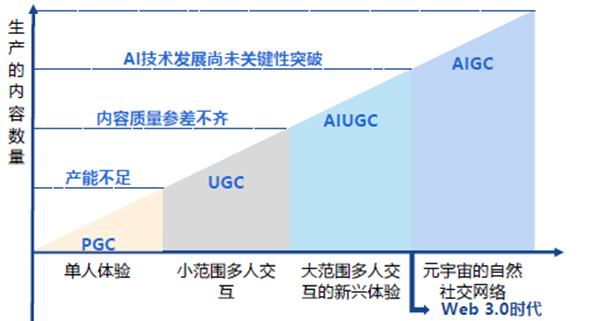
Figure: The Transformation of Content Production Methods. Source: Guohai Securities
2. Intelligent Alternative Solutions for Cost Reduction and Efficiency Improvement
The primary value of AI in the production process is to replace repetitive manual labor as an auxiliary tool:
● For example, the application of AI in the field of code generation is already very mature. The industry even jokes that programmers have invented tools to replace themselves. The recent large - scale layoffs at Meta and Amazon are evidence of this.
● In addition, text generation is also quite common in translation application scenarios. Although generating language with a "human touch" is still challenging and there are deficiencies in professionalism and logic, it has already been quite excellent as an assistant for text producers.
● In the field of audio production, TTS (Text - to - Speech) technology is already quite mature and has become an indispensable tool for many creators. It is widely used in customer service, hardware robots, audiobook production, voice announcements, etc.
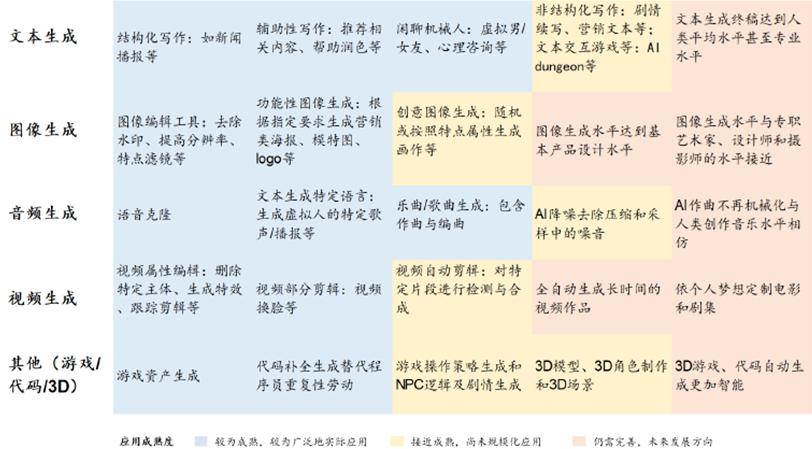
Figure: Main Downstream Application Scenarios of AIGC. Source: Huatai Securities
Of course, what really has room for imagination in AIGC is image and video generation, as well as cross - modality applications.
In the video industry, the global market space for movies, TV shows, and streaming media combined exceeds 300 billion US dollars, but it urgently needs to be rescued from the quagmire of costs. As reported by LatePost, Iqiyi, Youku, and Tencent Video have invested more than 100 billion yuan in total over the past decade, but the returns are still far off. The ARPU value of more than 10 yuan also shows that users are not paying for these astronomical investments. In the end, only top - tier artists have made money.
In the global game industry worth nearly 200 billion US dollars, links such as character modeling, scene design, and special - effect rendering rely on a large amount of artistic manpower, resulting in rising R & D costs for enterprises. Taking NetEase Games, a global leading company, as an example, its R & D expenses have soared from about 10 billion yuan to more than 17 billion yuan.

Data Source: Wind
As large - model technologies mature (such as GAN, VAE, Flow - based, and diffusion models) and the unit cost of computing power decreases, the wave of AI's subversion of the content industry will eventually reach the video field, and a strange phenomenon is emerging: The worst business on the Internet may instead become the best business in the AI era.
The cost - reduction effect of AI in the comic drama track is the most intuitive. Traditional dynamic comic production requires manual frame - by - frame processing of pictures and matching of sound effects. The cost of a single 80 - 120 - minute work often exceeds 500,000 yuan. However, AI technology, through tools such as dynamicizing static comics, automatic dubbing, and intelligent editing, compresses the total cost to 100,000 - 300,000 yuan, only 1/2 - 1/5 of the traditional model.
More importantly, the production cycle is shortened. For example, Jiangyou Culture has controlled the production cycle of a single comic drama within 10 - 13 days using AI tools. Even for some meticulously produced works, it only takes about a month, which is comparable to the cycle of live - action short dramas. Recently, live - action short - drama companies such as Zhongwen Online and Dianzhong have transformed into comic dramas, presumably because they have taken a fancy to the high - turnover and low - cost advantages brought by AI.
The cost revolution in the film and television industry is also showing signs. The award - winning work "Diving into the Dream Sea" in the "AIGC Unit" of the 2025 Shanghai International Film Festival was completed by a team of 4 people in just one week: Through Midjourney to generate storyboards in seconds, AI virtual shooting to replace real - scene construction, and open - source face - swapping technology to achieve character performances, it finally presented a blockbuster - level effect, with the production cost controlled within 10,000 yuan, only 1% of the traditional real - shooting model.
As such, the drastic elimination of supply - side thresholds will surely bring a tsunami of creativity. It can be expected that "Iqiyi, Youku, and Tencent Video" will eventually have their spring.
3. Expand Capability Boundaries and Create New Content
It must be said realistically that the above - mentioned applications of AI in content production currently play more of an auxiliary rather than a subversive role, limited by technological levels and application scenarios. In the short and medium term, we also believe that many areas in the content industry will still operate in the existing models. For example, in long - form videos, AI technology still has serious hallucinations; music has a strong expert and IP attribute; live - streaming e - commerce has a high social content; sports and concerts rely on real people; and offline entities such as theme parks.
But in the long term, the subversion of the content industry by AI still has more room for imagination in breaking through the capability boundaries of traditional creation - whether it is in terms of theme selection or content form, it is no longer limited by the shortcomings of human resources and technology.
At the theme level, AI enables themes that are impossible to achieve with real people to be realized. The fantasy and infinite - flow themes in the comic drama track are typical examples:
These themes require a large number of fantasy scenes (such as immortal cultivation secret realms and interstellar battlefields) and special - effect elements. Real - person shooting is not only extremely costly but also difficult to restore the imagination of online novels. However, AI can quickly generate fantasy scenes through text - to - image tools and then bring the pictures to life through dynamicization technology, perfectly matching the characteristics of online novel IP themes.
AI can achieve cross - modality content generation, blurring the boundaries between literature, comics, film and television, and games. That is, AI acts as a screenwriter and director.
For example, for the top - tier IP "My Healing Game," which has many fans, AI can directly generate comic drama storyboards from the novel text and then automatically convert them into dynamic comics. This cross - form ability allows IPs to be no longer limited to a single carrier and can be quickly adapted into various forms such as comic dramas, short videos, and mini - games.
More importantly, AI lowers the professional threshold for content creation, allowing non - professional creators to participate in content production and breaking the traditional industry's monopoly on professional qualifications.
For example, AIGC micro - short dramas do not require professional storyboard artists and directors. Ordinary people can complete the entire process from script generation to video production through AI tools. Dynamic comic production no longer depends on professional animators, and online novel authors can use AI to convert their works into dynamic content and directly reach readers.

Figure: Application of AI in Each Link. Data Source: China International Capital Corporation
Assuming that the penetration rate of AI in different content industries ranges from 10% to 60%, in the content industry in China alone, the market space for AIGC is estimated to exceed 100 billion yuan.
02 "The Next ByteDance"
The core contradiction in the content industry has always been the contradiction between "excessive content supply" and "scarce user attention." Traditional dissemination models rely on channel hegemony and scatter - gun marketing, which are inefficient and costly. Therefore, whoever can innovate channels can create huge commercial value.
The global success of short - videos is due to UGC and recommendation algorithms - content is the channel.
Another more representative example is Spotify. As the absolute leader in the global digital music industry, its emergence in 2006 even saved the struggling music industry. Spotify does not produce content but only innovates in the way of dissemination and channels.
Through digital means, it has realized the "cloudification" of music, featuring "instant playback and official authorization." Users are freed from the constraints of playback devices and have shifted from the buy - out system to the subscription system. Due to the significant reduction in the usage threshold, the number of global subscribers is nearly 300 million, and the company's market value has exceeded 120 billion US dollars.
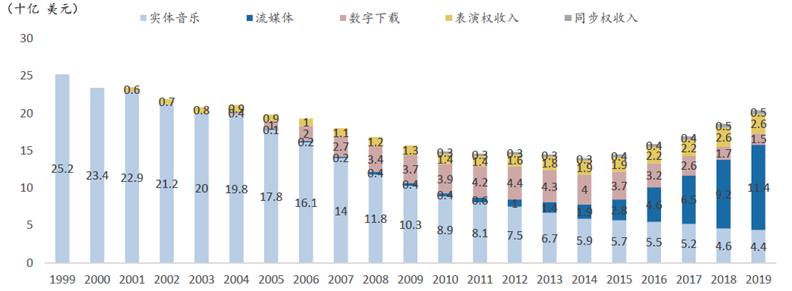
Figure: Spotify's Innovation in the Dissemination Model Saved the Music Industry (Global Recorded Music Market Size). Data Source: IFPI, GF Securities
The potential of AI in content dissemination is still seriously underestimated. The next "ByteDance" may be brewing here: Through user portrait analysis, intelligent recommendation algorithms, and scenario - based adaptation, AI can achieve precise links between content and users, greatly improving the efficiency of content reach, and ultimately generating new business models and industrial platforms.
This is not a fantasy. Some real - world cases have already shown us the real penetration of AI in dissemination:
1. Precise User Portraits: From Group Labels to Individual Portraits
Traditional dissemination's understanding of user portraits remains at very broad group labels, such as "males aged 18 - 24" and "with a bachelor's degree or above," unable to capture individual differences. AI constructs more detailed individual portraits by analyzing users' behavioral data (such as viewing time, interaction frequency, and payment preferences), making content dissemination more targeted.
Taking the comic drama track as an example, through AI analysis, platforms have found that 90% of early comic drama users are males, mainly prefer fantasy and suspense themes, and are concentrated in third - tier cities and below, with a daily viewing time of 1 - 2 hours.
Based on this portrait, some platforms have adjusted their traffic distribution strategies for comic dramas - tilting the recommendation of fantasy - type comic dramas towards male users in third - tier cities and introducing a premium policy for male - oriented theme revenue sharing to attract production companies to focus on such content. Data