Silicon Valley's humanoid robot companies go bankrupt. Has Zhu Xiaohu's "spoiler" come true?
The humanoid robot startup K-Scale Labs in Silicon Valley has gone bankrupt.
This company was not among the top players in the humanoid robot field. It neither had the high - profile launch like Figure nor the exposure of Tesla's Optimus.
However, within Silicon Valley, K - Scale's engineering passion, open - source potential, and demonstrable demos were once regarded as a golden combination for robot startups.
However, by the time the prototype was finally polished, the market environment outside had changed. Investors who were originally willing to pay for the "grand vision" began to turn to reality: Who exactly are you selling your robots to? Can the cost structure hold up? Is there any cash flow?
Ultimately, the company stopped due to a broken financing chain and the dispersal of the team. But its downfall is far more than just the failure of an ordinary startup. It's more like an industry signal: In Silicon Valley, the narrative of humanoid robots is moving from the "dream stage" to the "accounting stage."
Looking back at Zhu Xiaohu's judgment at the beginning of the year - many CEOs of humanoid robot companies "imagined their customers themselves," so they would "exit in batches." At that time, it attracted a lot of criticism and was considered "short - sighted." Now, when the first humanoid robot startup in Silicon Valley has truly fallen, this once - mocked view seems more like an early "spoiler."
What exactly does the bankruptcy of K - Scale mean? Is it an isolated incident or the first domino under the shrinking capital chain? Will Zhu Xiaohu's so - called "batch exit" come true in Silicon Valley first?
The "First" Bankrupt Humanoid Robot Company
K - Scale was quickly recognized in the industry mainly because it chose a different path - to create an "open - source humanoid robot."
Many companies in the industry follow a closed - source approach, but when K - Scale announced its closure, it chose to publicly disclose all its hardware designs and development tools at once, completely open - sourcing its robot project.
Therefore, although most of Silicon Valley's attention was occupied by star companies like Figure, Optimus, 1X, and Boston Dynamics, in the technology community, K - Scale still emerged as a new star. It was small in scale but had big ambitions, with a bit of the "old Silicon Valley hacker spirit."
The real story began in 2024. Benjamin Bolte left Meta and founded K - Scale, bringing with him his experience in building robots at Tesla and Meta.
His resume fit the typical profile of a "robot unicorn founder." He had written the core vision model code for Optimus at Tesla and conducted research on robot self - learning at Meta.
The two co - founders who joined him - Matthew Freed from Lockheed Martin and General Dynamics, and Pawel Budzianowsk, a Ph.D. from the University of Cambridge and an expert in dialogue systems - also helped K - Scale stand out among the projects in the YC Winter 2024 batch and eventually secured a $500,000 seed investment from YC.
In February of the same year, K - Scale received a $4 million seed round led by Fellows Fund. In April, Nat Friedman and Daniel Gross added another $250,000. In June, a wholly - owned subsidiary of Taotao Vehicle Industry also invested $2 million and signed a strategic cooperation agreement.
These funds constituted all the "fuel" for K - Scale's early R & D.
Many Silicon Valley startup stories start in a garage, but K - Scale's version was more extreme. They rented a large house in Atherton, converted the garage into a printing room, and turned the main house into an assembly area. Team members slept in cloakrooms, attics, and temporary compartments, with a fixed schedule from 10 a.m. to 3 a.m.
Bolte later described this as a "filter mechanism" that could keep those who were truly willing to bet their lives on robots. K - Scale's sense of mission was quickly taking shape in this compressed - space rhythm - they wanted to "sell robots to real users."
Precisely because of this, K - Scale's product strategy initially seemed very counter - intuitive. Instead of starting with high - performance large robots, they began with a little guy called Z - Bot that cost less than $1,000 and was only 46 cm tall. It was cheap, programmable, and developer - friendly. It even became a topic of discussion when a video of its "dab" move was taken and shared on WeChat during a hackathon.
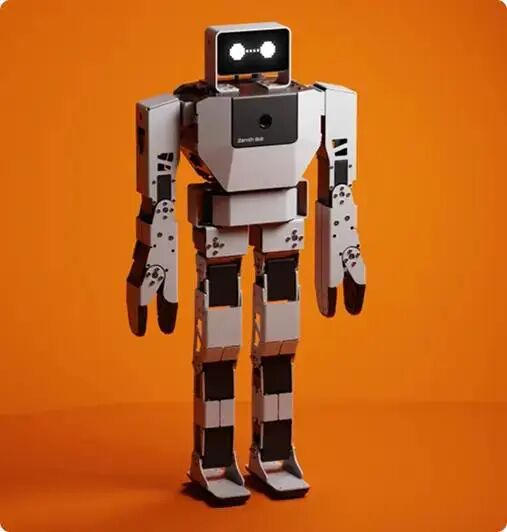
▲The Z - Bot robot. Image source: K - Scale Lab
In the US market, there is no strong local supply system for the small humanoid robot segment yet. Chinese companies are quickly rising with their supply - chain advantages and large - scale potential, seizing the opportunity. For example, low - cost but high - performance robots like Unitree's G1 and AgiBot have become a trend.
Against this background, the launch of K - Scale's Z - Bot was particularly significant. It aimed to fill the gap in the "small humanoid robot" market in the US, hoping to be adopted by domestic developers and researchers with its more affordable price and open design.
Logically, Z - Bot should have been launched first, and then the cash flow could have been used to support the development of larger robots. This "start small, then go big" approach was stable and the only viable business route for K - Scale.
However, K - Scale's fate did not unfold according to this logic.
The turning point came from a conversation with an investor. Bolte later admitted that he was lured by a narrative. A VC he highly respected told him that if they could get 100 pre - orders for the more advanced, $8,999, 1.4 - meter humanoid robot K - Bot, they would offer a $20 million Series A investment.
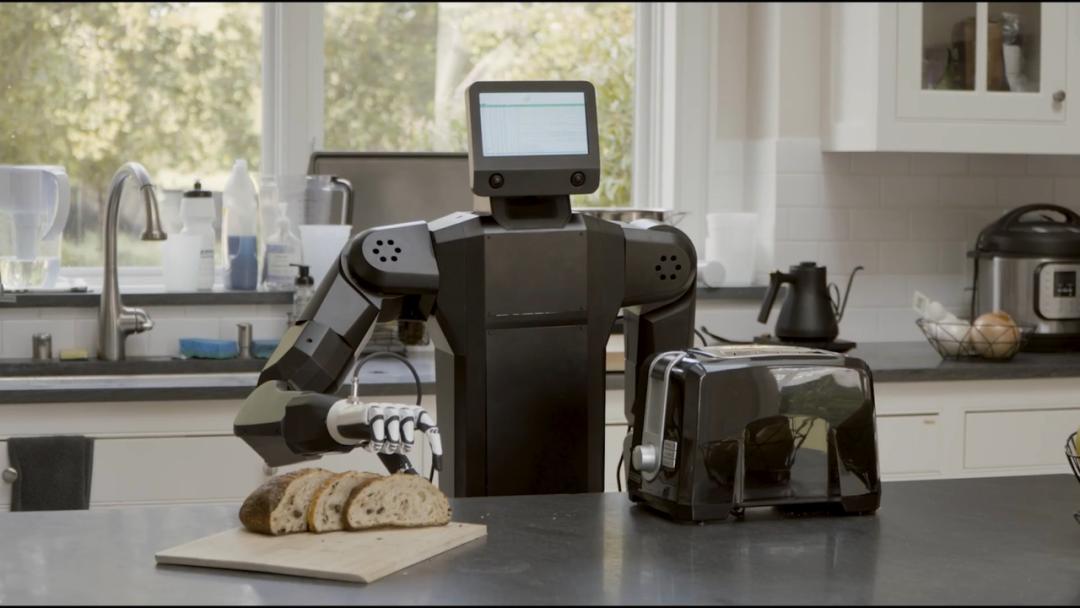
▲The open - source humanoid robot: K - Bot, developed by K - Scale Labs. Image source: K - Scale Labs
For a startup with tight resources, an expanding team, and almost depleted funds, such a promise seemed like a shortcut to turn K - Scale from a "project" into a "company."
So, there was a sudden change in strategy. The priority of Z - Bot was downgraded to the second tier, and the team began to concentrate its core resources on K - Bot. The reason sounded very Silicon Valley - like: Larger robots are more like a "serious company," similar to Figure and Tesla, which can tell a billion - dollar story. Z - Bot is too cheap and might make people think K - Scale is a "toy company."
Bolte later admitted, "This was a major mistake... probably the primary one."
Because, compared with small robots, "large robots are extremely difficult to ship, and the cost is also extremely high."
Here, K - Scale's narrative and reality diverged for the first time. The narrative told them: Build large robots, and you can be part of the industry story.
Reality, however, quietly reminded them: What you can really sell might be Z - Bot.
The team continued to work at a high - intensity pace. The actuators, structural parts, and accessory systems of K - Bot were iteratively improved, and the lights in the house were always on. Z - Bot still had updates, but it was no longer the "future" of the company.
On the surface, it seemed like a technical team was operating at full speed. But at the underlying level, it already implied a serious risk - all the company's survival possibilities were pinned on an unproven assumption: 100 pre - orders.
Moreover, Bolte's dependence on financing grew as the investment increased. He publicly emphasized many times that "nothing could be done without money" and regarded financing as the only way to achieve productization.
However, the market sentiment did not change according to the startup's rhythm. When K - Bot was finally ready to be launched, investors had switched from "looking at demos" to "looking at shipment volume and cash flow," and the VC's promise naturally was not fulfilled.
The cumulative result was that Z - Bot didn't have time to be commercialized. K - Bot was stuck in the mass - production dilemma due to supply - chain limitations. Financing couldn't be obtained, engineers began to leave, and the team culture quickly collapsed. It was not a technical failure or a product failure but an irreversible situation caused by the misalignment of rhythm, narrative, and cash flow.
All of this started from that turning moment - from Z - Bot to K - Bot, from "selling to users first" to "completing the financing story first," from the real - world path to the narrative path.
Ultimately, K - Scale fell, with only $400,000 left on its books. It wasn't because it wasn't cool enough but because it was too much like the story Silicon Valley expected and too little like a company that could survive.
Did Zhu Xiaohu's Prediction Come True?
If we consider the bankruptcy of K - Scale as an isolated incident, it might seem like just an accident in the Silicon Valley startup cycle.
However, in the context of the overall humanoid robot track in the past year, K - Scale is more like an "early - emerging sample." Multiple clues within the industry are all pointing to the same conclusion: Cash flow and real customers are becoming the new lifelines.
At the beginning of the year, Zhu Xiaohu's statement in "China Venture Capital" explained the logic behind this change.
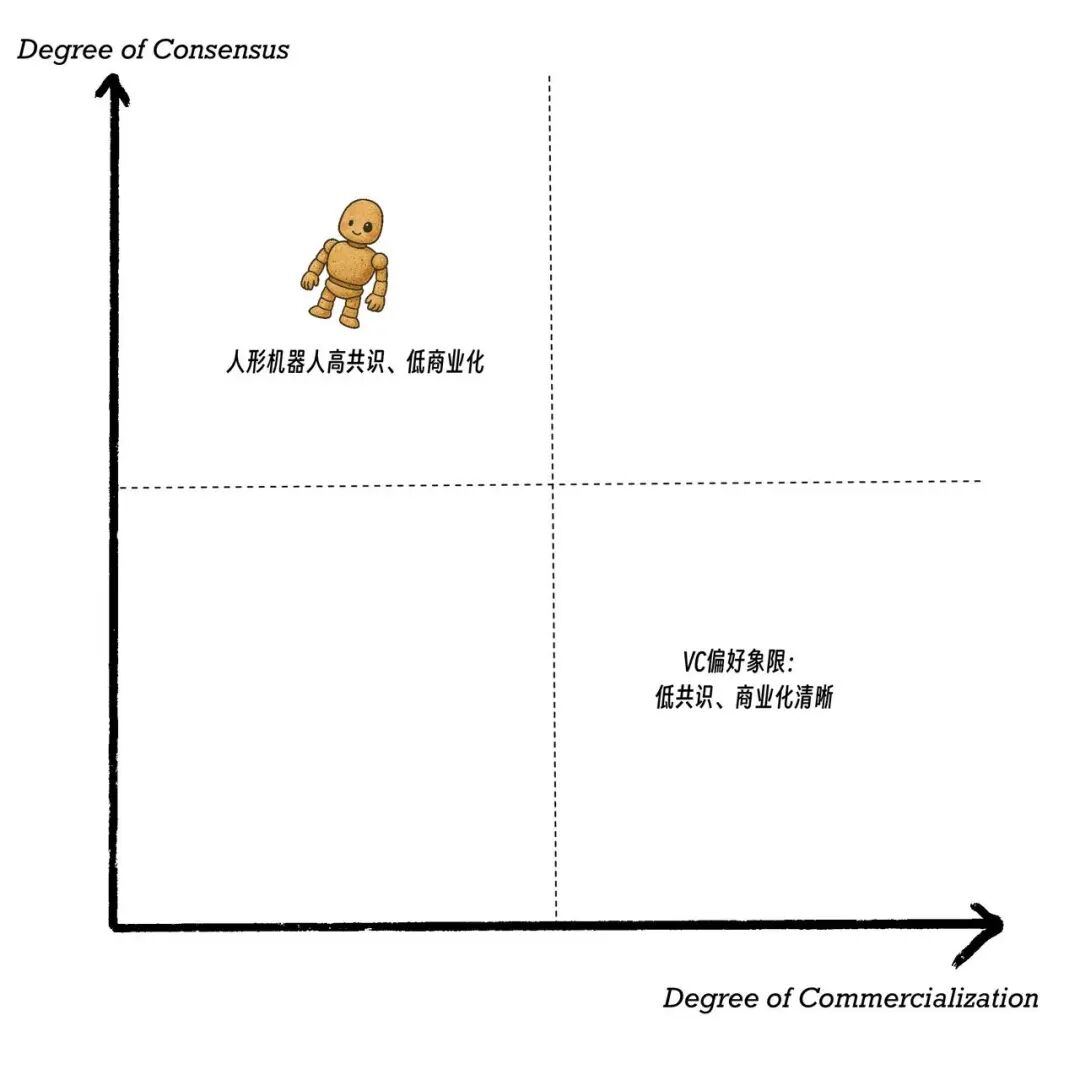
In that interview, Zhu Xiaohu placed humanoid robots in the quadrant of "high consensus but unclear commercialization," while his investment principle was the opposite: "Low consensus but clear commercialization." The reason was straightforward - in the several embodied - intelligence projects he contacted, "many customers were imagined by the CEOs."
The doubts came quickly. Zhang Ying, the founding partner of Matrix Partners China, refuted on social media the same day, believing that "the robot track is large enough, and bubbles are normal" and hinting that such remarks would make high - quality projects reluctant to contact him. Xinghaitu and Songyan Power even directly "responded by name." Zhao Tongyang, the founder of Zhongqing Robot, said in a video that "taking such capital's money is a disgrace."
At the height of the hype, this debate seemed like a clash of views rather than an industry trend. But half a year later, when K - Scale in Silicon Valley fell first, Zhu Xiaohu's view was no longer just a harsh prediction but was gradually being confirmed by reality.
What's more noteworthy than K - Scale is that it's not the only robot company "stuck in commercialization," nor is it the first to fall.
In the past year, many projects with impressive demos and strong R & D capabilities, whether in logistics robots, agricultural robots, or social companion robots, have all been stuck in the same place: the step before mass production.
The most typical example is Dextrous Robotics in the United States. Its unloading robot can quickly grab cartons from trucks - this is one of the most obvious and "should - have - customers" scenarios in the logistics field. But at the point of preparing for mass production, the company publicly admitted that it couldn't raise the funds needed to start production. The technology was fine, and the scenario was real. All it lacked was the first batch of customers willing to pay.
The Small Robot Company in the UK faced almost the same dilemma. This company develops small agricultural robots and is quite popular in the UK agricultural technology circle. Its products have undergone multiple rounds of testing. However, the company finally admitted in a statement that it couldn't obtain the funds for the next - stage commercialization. It wasn't that there was no market but that it couldn't prove that "the market would form real orders at a fast enough pace."
On the consumer side, Embodied in the United States provided another clue. It focused on children's companion robots and was one of the few star projects that received investment from large companies. However, high costs, low repurchase rates, and difficulty in generating continuous revenue ultimately led the company to announce the cessation of operations at the end of the year. The technology itself was not a failure, but the business structure couldn't support its survival.
Looking at these cases together, a common point is very clear:
It's not that the technology is not advanced enough, nor that the scenarios don't exist. It's that they can't convert their demos into "stable, predictable customers who can generate cash flow."
The industry is telling everyone with one failure after another - this closed - loop must be truly completed, not just talked about.
The founding team of K - Scale wrote very directly in the bankruptcy email: Humanoid robots need to rely on large - scale production to reduce costs. "If we can't reduce the unit economic cost through financing and large - scale amortization like Unitree, Booster, Engine AI, and Noetix, we can't make our products work."
In other words, without orders, there is no financing. Without financing, the cost can't be reduced. Without cost reduction, no orders can be obtained.
Once this closed - loop is broken, the company will quickly enter a "death spiral."
Looking at the capital side, the problem is even clearer:
From 2024 to 2025, investment has been concentrating on a very small number of leading companies.
Star projects like Figure, 1X, Apptronik, Unitree, and Agility Robotics have received large - scale financing from giants and funds. For mid - tier and lower - tier companies, the financing cycle has generally lengthened, valuations have adjusted downward, and cash flow has become tight. For VCs, humanoid robots with "large conceptual space but unclear customers" are no longer a track "worth betting on in advance."
So, a new hierarchical structure has emerged in the industry:
Leading companies have already established a mass - production rhythm (Agility's factory, Unitree's shipments, and Figure's pilot with BMW);
Mid - tier companies are still at the demo stage and need the next round of financing to maintain R & D;
Companies below the mid - tier can hardly attract orders even with their demos and can only rely on limited risk funds to "stay alive."
The situation is the same in China. Except for companies like Unitree that have established a foothold based on their shipment volume, the order sources of most humanoid robot projects are highly similar: exhibitions by state - owned enterprises, laboratory purchases, mutual purchases among peers, and media shootings. Zhu Xiaohu's so - called "imagined customers" do exist in many projects.
This is why K - Scale is not an isolated incident but a signal that the "accounting logic" is starting to replace the "dream logic" in the industry.
The bankruptcy wave of humanoid robot companies is no longer a question of whether it will happen but a matter of time.
Conclusion
If the fall of K - Scale is like a magic mirror, what it reflects is not the fate of a single Silicon Valley company but the more common risk structure in the humanoid robot track:
It's easy to build a big narrative, but it's hard to start a business.
This structure also exists in China.
What K - Scale inspires us at this time is to reflect on