Ein neuer Traffic-Eingang für Cross-Border-E-Commerce ist hier, und ChatGPT schlägt Amazon und Co. mit Übermacht.
First Etsy, then Shopify, followed by Walmart and eBay. Within just one month, ChatGPT's e - commerce network has expanded rapidly.
At the end of September, OpenAI announced the introduction of the real - time checkout function in ChatGPT, which allows sellers on Etsy and Shopify to connect. Subsequently, Walmart announced that it had entered into a partnership with OpenAI, so that ordinary consumers and Sam's Club members can directly buy goods from Walmart via ChatGPT. eBay stated in an earnings conference that it will explore the possibilities of AI e - commerce with ChatGPT in more depth.
ChatGPT is evolving into a new e - commerce gateway.
Several GEO (Generative Engine Optimization) service providers told YiBang Power that in the past, companies willing to spend budgets on GEO were mainly concentrated in industries such as cross - border finance and apps. Now, more and more cross - border traders and foreign brands are emerging, and budgets are being redirected from traditional SEO to GEO.
This is a completely new window of opportunity. Although ChatGPT currently mainly functions as a traffic gateway and backend implementation is still taken over by e - commerce platforms and independent online stores, and it may take years for users' habits to change, the huge user base and the potential value of AI e - commerce have already shown the possibilities of a "new gateway".
Over a decade ago, Amazon, as a latecomer in the product search field, continuously took traffic away from Google.
Now, the next generation is coming for ChatGPT.
Will ChatGPT steal traffic from Amazon and Google and open a new heyday for independent online stores?
A 2018 study by market research firm eMarketer showed that in 2015, Google had about 54% of product search initiations, while Amazon had about 46%. By 2018, these figures had "basically reversed", and Amazon was ahead of Google. A key factor for consumers' preference for Amazon at that time was that Amazon collected a huge number of real user reviews, which made it easier for consumers to make comparisons, judgments, and decisions.
Today, consumers prefer to get directly useful answers.
"We have found that from users' shopping journeys, in the past, people might search on Google first, but now users increasingly need directly reliable answers. For example, if a user wants to compare the advantages and disadvantages of five or even ten products in the same category, AI can directly give an answer, which means that 70% to 80% of the shopping journey is already completed via AI. This has a relatively large impact on traditional e - commerce platforms," said Nick, CEO of CBD (CrossBorderDigital), the exclusive strategic partner of Semrush in China in the field of SEO tools. "We have also found that the conversion rate of AI traffic is about 4.4 times higher than that of traditional Google SEO."
eMarketer predicts that ChatGPT will have 77.1 million American users this year, accounting for almost 66% of GenAI users. According to Adobe statistics, 53% of consumers plan to shop via GenAI this year. Most consumers are increasingly turning to GenAI for product research (55%) and recommendations (47%).
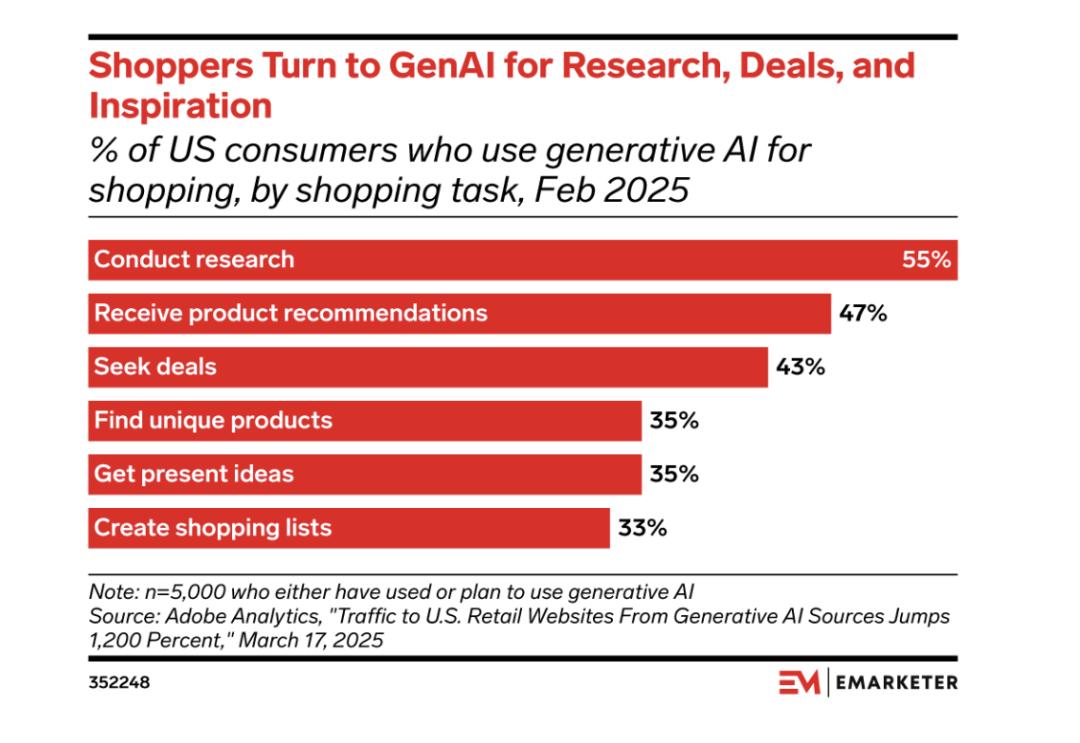
Image source: eMarketer
The first to benefit may be cross - border traders with independent online stores.
Yang Yizhou, the leader of overseas operations at GEO service provider Zhitui Times, said that brands' own independent online stores carry relatively high weight in ChatGPT's information sources. "The logic is to first search for information in your independent online store or on your website, and after collecting the content, then search for verifiable information across the network."
An announcement from OpenAI also shows that ChatGPT's product recommendation logic is based on the "relevance" of products. The displayed product orderings are natural rankings, have nothing to do with advertising, and no search or recommendation fees are charged from traders. Only after an order is completed will a certain fee be charged. When evaluating different traders selling the same product, ChatGPT will consider factors such as inventory, price, quality, and whether it is the main seller when sorting.
In the partnership between Shopify and OpenAI, Shopify has also stated that it will support product discovery through real - time data such as price, inventory, images, and variants, so that hundreds of millions of products can be presented in an AI - understandable format. The name of the trader's store will be prominently displayed, and corresponding user data will also be forwarded to the trader. In addition, traders can also choose between GPT's internal checkout function and forwarding to the independent online store for checkout.
"The value of independent online stores is getting higher and higher," said Nick. "Compared with other e - commerce platforms, traders have full control over the content resources of their independent online stores. Countless product pages, FAQ pages, and brand stories can be created, which can be understood and cited by AI. Brands thus have more room to develop."
However, Yang Yizhou believes that the possibility of "GEM" (Generative Engine Marketing), that is, advertising placement within AI platforms, cannot be ruled out in the future. "Currently, every AI platform wants to go down the path of commercialization, and GEM will be an indispensable step in the future. GEO and GEM will co - exist, similar to today's SEO and SEM," he said. "It is possible that out of six answers to a question, one is a sponsored advertisement." Recently, OpenAI has also announced that it is considering introducing advertising.
Affiliate marketing will become an important "information source" for AI e - commerce
Looking at the operational level, there are no fundamental differences between the GEO strategy and SEO, and there are even some similarities.
YiBang Power has learned that both in the past SEO and today's GEO, there are some preferences regarding content:
1 High - quality content: Both Google and large language models strive to provide high - quality content that meets users' needs and preferences. Such content is still relatively rare.
2 Structured content: Information such as product specifications, materials, compatibility, and certificates must be presented in a structured framework.
3 Media and information sources with high weight: When AI generates clear answers, it first refers to reliable information sources.
4 Originality: Unique and rare content is more likely to be cited by AI.
The difference, however, is that the goal of SEO is for users to see and click on the link and for the page to retain users, while the goal of GEO is to provide more precise and clear answers so that AI can retrieve, understand, and apply the information.
"In China, there are a variety of AI applications, and each has its preferred information sources. For example, Doubao prefers content from Douyin and Toutiao, Wenxin Yiyan prefers Baijiahao and Baidu Encyclopedia, and Yuanbao prefers public accounts and video accounts," said Yang Yizhou. "However, ChatGPT is different. Its information sources are more distributed and include independent online stores, Wikipedia, Reddit, LinkedIn, etc."
ChatGPT does not prefer a single source but uses an algorithm for cross - verification. It collects information from different libraries, websites, and even communities. Only when multiple different information sources point to the same result will a certain answer be given. "If all information sources confirm the same result, AI can say with great confidence that this is the case, which also significantly improves the conversion rate."
From the perspective of cross - verification of information sources, affiliate marketing is a more suitable scenario for GEO.
For example, the ecosystem of affiliate partners in the lower part of affiliate marketing is extremely diverse. Some of them are influencers who cooperate with brands in the form of commission - based sales to increase sales. There is no clear external link to an independent online store, which has little value for traditional SEO and cannot directly improve the ranking of the independent online store. However, the influencers' own recommendations can serve as one of the "information sources" for GEO. In addition to influencers, media and community KOLs, which are often cited by AI, are also often an important part of affiliate marketing, and this is also the area that GEO should focus on.
"If the same thing is said everywhere, this is the truth for AI, and it will pass this on to users as a certain answer. Therefore, the value of affiliate marketing is even higher compared to the SEO era."
Currently, the ROI of GEO can already be monitored to a certain extent.
Yang Yizhou said that the ROI monitoring in the GEO field is currently more retrospective, that is, based on the comparison of traffic before and after setting up a brand's independent online store. Usually, the number of active registrations on the website increases significantly two to three months after the implementation of GEO. In the future, as ChatGPT's commercialization progresses and even "product links" become possible, the ROI can be monitored in real - time. "One just needs to constantly point GPT to a special AI - specific link that does not appear in other advertising links, and then the monitoring can be carried out."
Will there be a Matthew effect for big brands, or are there opportunities for small brands to overtake the competition?
When AI starts to recommend products, traders wonder if this will strengthen the Matthew effect in the industry.
"Compared with traditional SEO, ChatGPT is more friendly to leading brands and will strengthen the Matthew effect in the industry," said Yang Yizhou. "On Google, one can also get some traffic for some long - tail keywords that don't appear on the first page. But ChatGPT usually only recommends about six brands, and it's rare for more than ten to be recommended. Therefore, the competition at the top will be more intense. If you don't appear among the top six answers, you won't get traffic in the AI application."
But the era of winner - takes - all doesn't mean that small and medium - sized brands will completely lose their market share. Nick believes that GEO gives some small and medium - sized brands the opportunity to overtake the competition.
"AI is relatively decentralized. In other words, one can find websites that don't have particularly high weight but are often cited by AI. These are the text sources that AI attaches great importance to," said Nick. "As long as one focuses on vertical niche markets and creates high - quality original content, there is a high probability that it will be cited by AI." A survey conducted by Semrush shows that ChatGPT even often cites content that ranks behind the 21st position in the Google search results.
This is the advantage of GEO compared to traditional SEO. In Nick's view, many large companies have accumulated rich SEO resources, and it's difficult for latecomers to catch up. However, small and medium - sized brands have gained opportunities in the new environment. "In the next six months to a year, it's a bonus period. Brands that implement GEO early may have an advantage. The key is whether the decision - makers in the companies have the awareness of GEO."
Users' search behavior is also changing. In the SEO era, users usually searched for one or two keywords, and there was much room for expansion. In the context of AI, however, the conditions are gradually restricted, and AI filters accordingly. From this perspective, verticality and niche orientation are the keys for small and medium - sized brands to break through the barriers.
"It's like a drum. It's resistant, but if you poke it with a needle in a niche, there's a high probability that you'll stand out," said Yang Yizhou. In some general product categories, it's difficult for small and medium - sized traders to compete with leading brands. As more and more leading brands recognize the effect of GEO, more and more budgets will be redirected from SEO to GEO, which will lead to a kind of bidding traffic - every leading brand wants to be at the top of the AI answers.
But it's undeniable that building a brand is more important than ever. If in the past many players could survive well in the white - label product market through advertising and buying traffic, in the future, it will be an era of brand dominance.
"The Matthew effect doesn't mean that small brands have no chance. It means rather that without a brand, there is no chance. When users ask ChatGPT to recommend products, it won't recommend a product without naming the brand. This forces all manufacturers to operate based on brand logic and pay attention to reputation and brand value," said Yang Yizhou.
This article is from the WeChat account "YiBang Power", written by Wang Haoran and published with the permission of 36Kr.