Wissenschaftler haben eine Toilette entwickelt, die Menschen anhand ihrer "Kloakenmuster" scannen kann; Internetnutzer: Was soll eine Toilette mit der Personenkennung?
Everyone probably has a medical examination item they resist the most. For example, many people dislike urine tests and fecal tests.
As for the reason, mainly because one has to be extremely careful during sampling, and finally has to carry one's own excrement to the nurse in broad daylight, which is a bit inexplicably embarrassing...
However, don't look down on urine and feces just because they stink. They are direct carriers of the body's metabolic waste and can non - invasively and cost - effectively reflect the body's condition. Some people with specific diseases even need to have regular urine and fecal tests to track the progress of their illness.

Urine test sampling kit (Image source: Scientific Supplies Ltd)
Due to this demand, various intelligent health toilets have emerged in the past decade. They can automatically sample and analyze when people use the toilet and issue an alarm when detecting abnormalities. Although the accuracy of intelligent health toilets is still highly controversial at present, today we will first discuss another topic about them: How do these toilets identify users?
Generally speaking, there are multiple members in a family. If an intelligent health toilet cannot accurately match the excrement with the user, it cannot achieve customized long - term health tracking. Therefore, engineers need to endow the toilet with a "sharp eye".
(Why do I suddenly feel a chill on my butt?)

(Image source: Internet)
Initially, designers installed a fingerprint scanner on the flush button, but soon found flaws. For example, sometimes one person uses the toilet and another person flushes it. Moreover, many toilets nowadays are sensor - flushed, leaving no chance to press the button. So, engineers began to look for organs with identity - recognition functions similar to fingerprints on the lower half of the human body.
Soon, Sanjiv Gambhir, a scientist from Stanford University, discovered that the wrinkles around people's anuses (let's call them "anal patterns" for now) are unique.
In a study published in 2020, he introduced a camera that can scan the "anal patterns" of toilet users and compare them with samples in the database to match the user with the excrement.
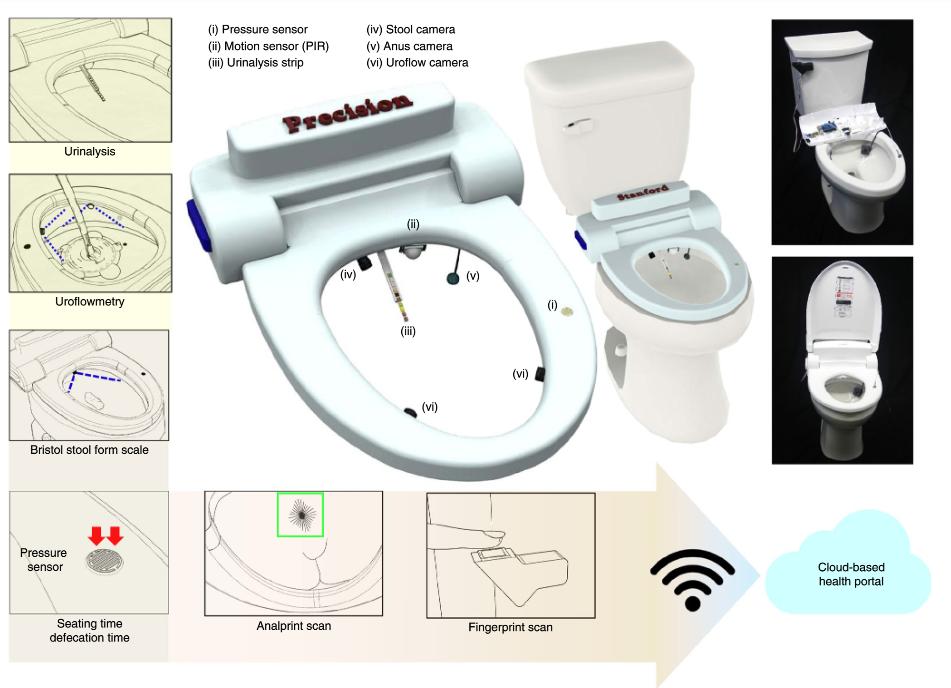
Schematic diagram of an intelligent health toilet (Image source: Reference 1)
So, how does Gambhir's intelligent health toilet work specifically?
When urinating, an upward - angled camera first scans the user's "anal patterns" to identify the user. When the urine starts to flow, two other cameras inside the toilet observe urine - related indicators such as flow rate. Meanwhile, the heat of the urine activates an infrared sensor, triggering a rod with multiple test strips to slide out automatically. After the test strips are fully soaked, the rod retracts into the toilet, where another camera is ready to read the test results.
When defecating, fewer cameras are triggered. First, the upward - angled camera reads the "anal patterns". Then, a camera inside the toilet records information such as the start and end time of defecation and the shape of the feces to evaluate the user's intestinal condition.
Gambhir said that all the collected information is encrypted and uploaded to the cloud. No one can see the original images, not even doctors.
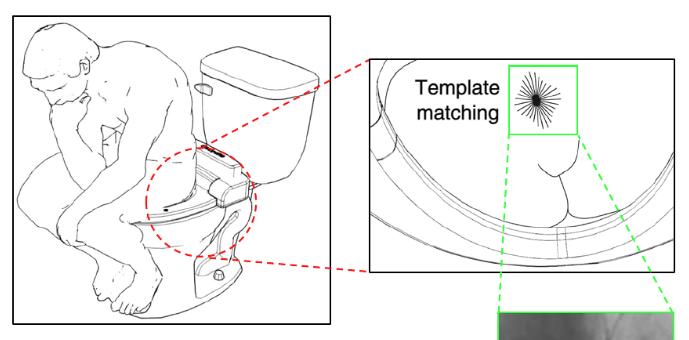
Schematic diagram of an intelligent health toilet (Image source: Reference 1)
Although we have the scientist's firm commitment, it's still a bit awkward to think that there are four cameras working hard under our buttocks when using the toilet.
Therefore, researchers from Singapore and China have developed an intelligent toilet seat that uses ten triboelectric sensors to accurately identify users by analyzing the unique pressure distribution generated when the user sits on it. However, this type of toilet can only eliminate the camera for reading "anal patterns", and other cameras are still needed to further analyze the excrement.
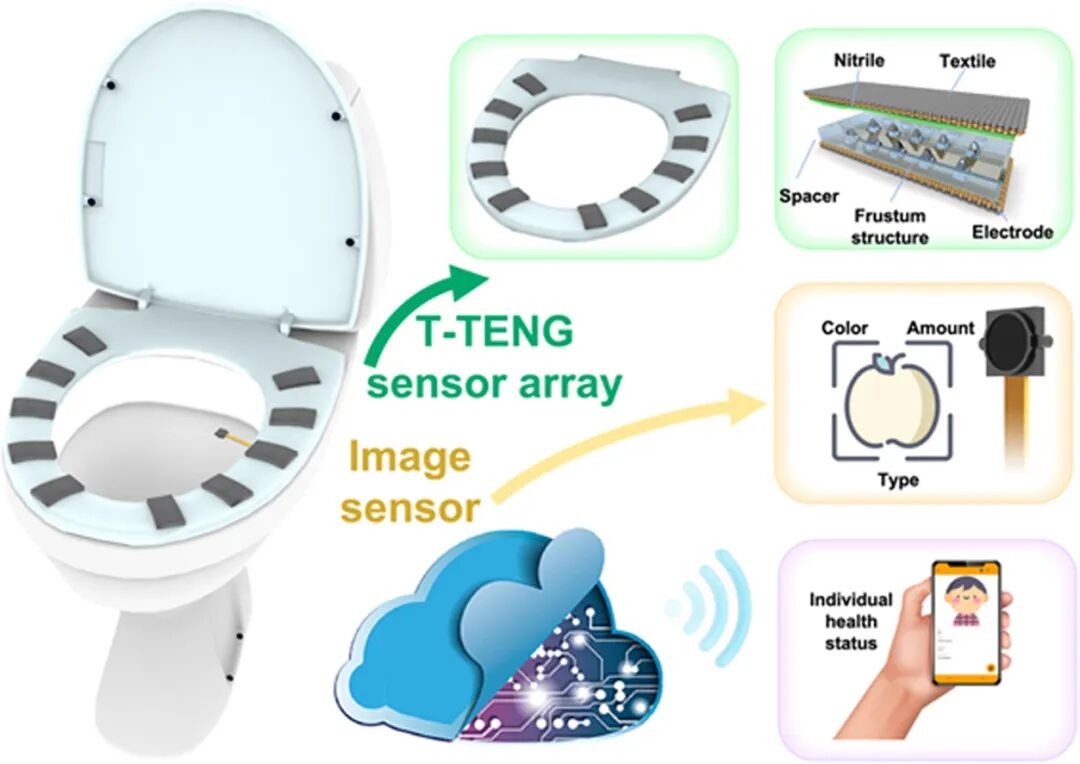
Intelligent toilet seat that can identify users (Image source: Reference 2)
At this point, you may wonder if these scientists and engineers are just writing papers for the sake of it by putting so much effort into toilets. Or perhaps, is the intelligent health toilet just a false demand? Maybe we don't need to rush to make a judgment. After all, toilets that can spray water, play music, and heat up were also questioned when they first came out, but now they have become standard in many families.
References:
[1]https://www.nature.com/articles/s41551-020-0534-9
[2]https://www.sciencedirect.com/science/article/abs/pii/S2211285521007709?via%3Dihub
[3]https://www.vice.com/en/article/stanford-smart-toilet-uses-butthole-for-identification/?
This article is from the WeChat official account "Bring Science Home" (ID: steamforkids). Author: Liu Liuqi. Republished by 36Kr with permission.