Mit fast 100.000 ausgebuchten Karten und Hunderten von Tausenden von Transaktionen pro Monat hat die südostasiatische digitale Bank YUP erneut eine Kapitalbeteiligungsfinanzierung in Höhe von 32 Millionen US-Dollar von einer amerikanischen Institution erhalten. Die Gesamtfinanzierung übersteigt jetzt 100 Millionen US-Dollar | Exklusivbericht von 36Kr
Autor/in | Ou Xue
Redakteur/in | Yuan Silai
Hard Kr has learned that the Southeast Asian fintech company YUP recently completed its sixth round of financing, raising $32 million (approximately 230 million RMB). The investors in this round are several US growth - stage funds, namely Moore Strategic Ventures, Spice Expeditions and Platanus. The financing will mainly be used to support its user growth in the Indonesian market, preparations for new markets and expansion of new business. YUP was founded in 2021 by Zhang Dong and his co - founder Zou Zhili in Jakarta, the capital of Indonesia.
YUP CFO Gavin Guo told Hard Kr that the US investment institutions leading this round of investment have long been deeply involved in the global fintech field. Moore Strategic and Nick Huber (founder of Spice) were both early investors in Nubank. Based on long - term observation, they believe that Indonesia has greater potential than Brazil did back then. After tracking the Indonesian market and YUP for two years, they highly recognized its business model and team, which led to the investment.
In the current capital market environment, it is quite rare that YUP has been able to complete 1 to 2 rounds of financing every year since 2021.
As of now, YUP's cumulative financing has exceeded $100 million. Past investors include XVC, SWC Global (Shunwei Capital), MindWorks Capital, the Sampoerna family in Indonesia, Sky9 Capital, BitRock Capital, Antao Capital and other institutions.
YUP was founded in 2021 and is headquartered in Singapore, with offices in Jakarta and Shanghai. The company's core products are "physical credit cards + virtual e - wallets", targeting the untapped market of the 80 million salaried workers in Indonesia who lack traditional banking services. YUP has a diverse team background, and most of its core members come from institutions such as Capital One, China Merchants Bank, Bank of Communications, Discover and Ant Group.
In Southeast Asia, the penetration rate of credit cards is relatively low. Only a small number of high - net - worth individuals can access traditional banking services, while the vast majority of the general public often rely on high - interest micro - loans to meet their financial needs. However, with the rapid popularization of digital payment methods in Southeast Asia, a new group has emerged - they have stable social security payment records, belong to the regular salaried class, but still have difficulty accessing basic credit services. This group is precisely the core customer base that YUP is targeting.
According to the "Southeast Asia Digital Economy Report 2024" jointly released by Google, Temasek and Bain & Company, the total digital trade volume in the region is expected to reach $263 billion in 2024, achieving a year - on - year growth of 15%. At the same time, the digital profitability of relevant enterprises in the region has soared to $11 billion, 2.5 times that of 2022. The report further predicts that by 2030, the scale of the Southeast Asian digital economy is expected to exceed $2 trillion.
"In recent years, global capital has been paying increasing attention to emerging markets such as Southeast Asia. Although the international financing environment has cooled since 2022, Southeast Asia - especially Indonesia - is still regarded by many European and American funds as one of the most promising regions," YUP founder Zhang Dong told Hard Kr.
YUP has borrowed from the business model of the Brazilian digital bank Nubank, but has made innovations based on the characteristics of mobile payment dominance in Asia: users can either make offline purchases with physical credit cards through the VISA network or pay by scanning codes via the e - wallet, achieving both "physical + virtual" coverage.
Zhang Dong defines YUP as a combination of "Alipay + physical credit card". Its APP also integrates functions such as mini - e - commerce, insurance purchase, flight and hotel booking, creating a consumption ecosystem centered around payment. Currently, there are tens of thousands of transactions generated daily on the YUP platform, and the monthly transaction volume reaches millions.
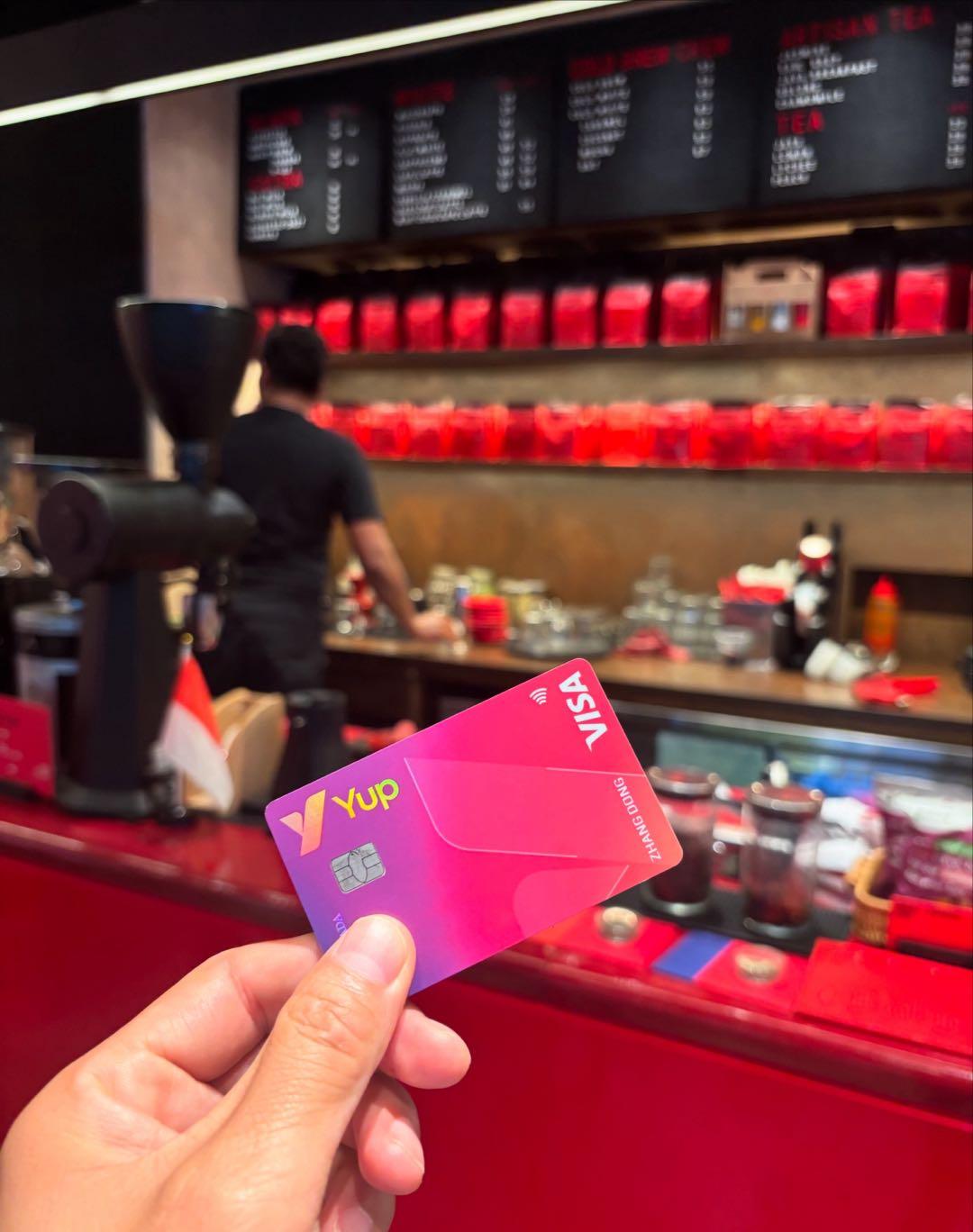
Usage scenarios of YUP credit cards offline (Image source: the company)
Risk control ability is the lifeline of fintech companies. Hard Kr has learned that YUP has built 11 neural network models covering the entire user lifecycle, conducting credit assessments based on more than 7,500 feature variables and tens of millions of daily data entries. The team has cooperated with the Indonesian social security, insurance, identity ID databases and operators, and has established its own anti - fraud and behavior scoring system, with a transaction success rate of 99.9%.
"We are confident that our risk control ability is far stronger than that of all local banks and tech companies in Southeast Asia," Zhang Dong emphasized. "This system is completely self - developed and does not rely on third - parties."
Localization is another major advantage of YUP. According to Zhang Dong, more than 80% of the company's employees are local Indonesians, and all user - side business is handled by the local team. At the same time, founder Zhang Dong has been based in Indonesia since 2017. He sold his first startup company to 360 Finance and served as the CEO of its Southeast Asian business. His in - depth local resources have made YUP the only tech company in Indonesia to sign a strategic cooperation agreement with VISA, and it has obtained licenses for electronic payment, credit and fintech innovation.
In terms of customer acquisition strategy, YUP has abandoned the traditional model of relying on paid advertising and achieved organic traffic growth through local brand building and channel cooperation. Zhang Dong said that 90% of the company's users come from organic traffic, and the customer acquisition cost is far lower than the industry average.
Currently, YUP's business covers more than 55 million merchants in Indonesia, making it one of the largest card - issuing institutions in the country. According to Zhang Dong, its monthly card - issuing volume is nearly 100,000, about 10 - 20 times that of Indonesia's largest commercial bank. Since its establishment in 2021, YUP has maintained a strong growth momentum, with an average annual revenue growth rate of about 300%.
Regarding overseas expansion, YUP plans to enter markets such as Vietnam, the Philippines and Thailand in the second half of 2026. Zhang Dong said: "The Southeast Asian Internet only started in 2015, and there is a lack of mature operating strategies and risk control experience locally, which is exactly the strength of Chinese teams."