Produktbeobachtung | Taucht in die AI-Suche ein, Taobao will noch "allmächtiger" werden
When you open Taobao on your mobile, do you often feel like you're not just selecting products but taking an endless open - book exam? While the "all - powerful Taobao" offers a vast array of products, it also inadvertently increases the time and cost for users to search.
A girl's wardrobe always seems to be short of that one perfect outfit. When you open Taobao on your mobile, hoping to buy a beautiful dress during the seasonal sale, the search results show that 1.32 million new dresses have been launched in just one week. Each one has a unique design and an appealing product description, but with so many options bombarding you at once, it's hard to make a decision. Hours pass, and you still haven't placed an order.
Fortunately, "AI Search" is trying to help Taobao mobile users reduce the time and cost of making shopping decisions, so that your brain doesn't have to work overtime for free during your leisure time.
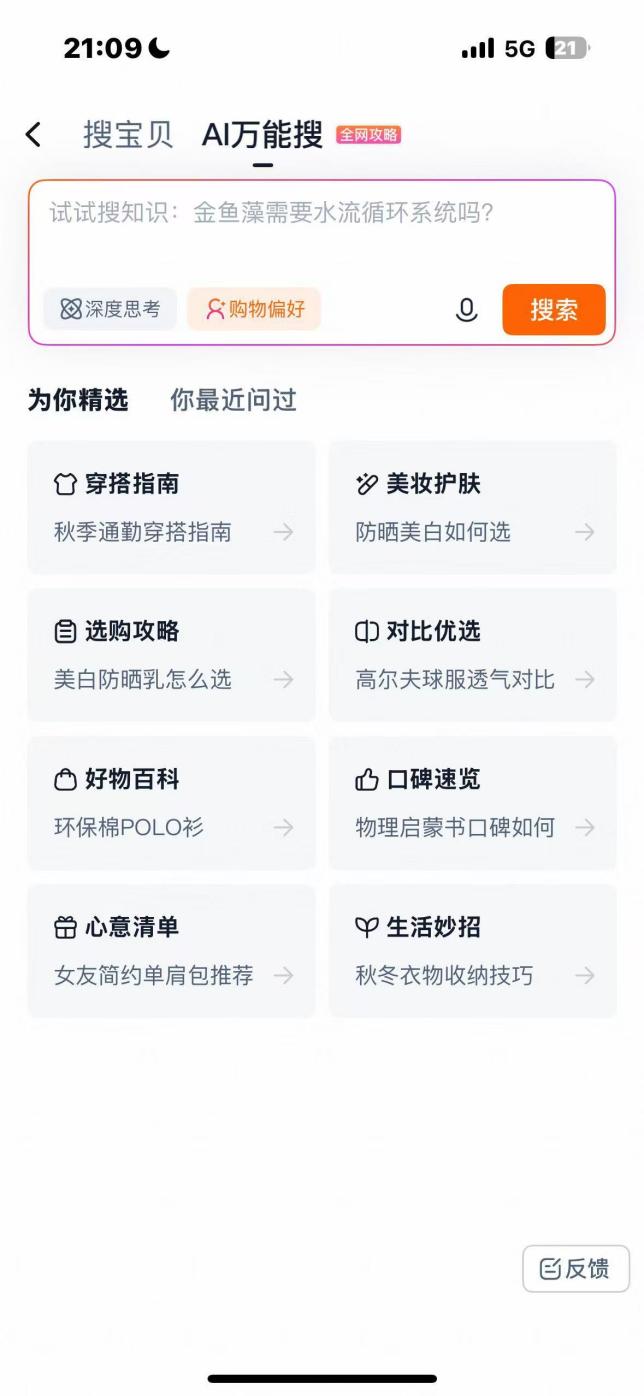
Taobao has recently launched several AI search products in succession. Among them, the "AI Universal Search" has been fully launched. Its entrance is located on the Taobao mobile search function page, displayed as the "AI Universal Search" tab. It can be regarded as the "e - commerce version of DeepSeek", supporting in - depth thinking. Users can directly ask questions, and the "AI Universal Search" will generate a report with answers that combines text, products, and video images to solve consumption problems such as shopping guides, word - of - mouth evaluations, and discount consultations.
The "AI Assistant" is currently in a small - scale gray test. Its entrances are the "AI" icon in the lower - right corner of the Taobao mobile search results page and the question cards automatically generated by AI inserted in the product information stream. After clicking on the icon or card to enter the multi - round dialogue entrance, the AI will provide answers that combine "text + products" according to the user's needs, helping users solve problems such as "difficulty in selection and lack of decision - making guidance" in the search - shopping scenario. In terms of user experience, the "AI Assistant" is more like a companion - style AI shopping guide.
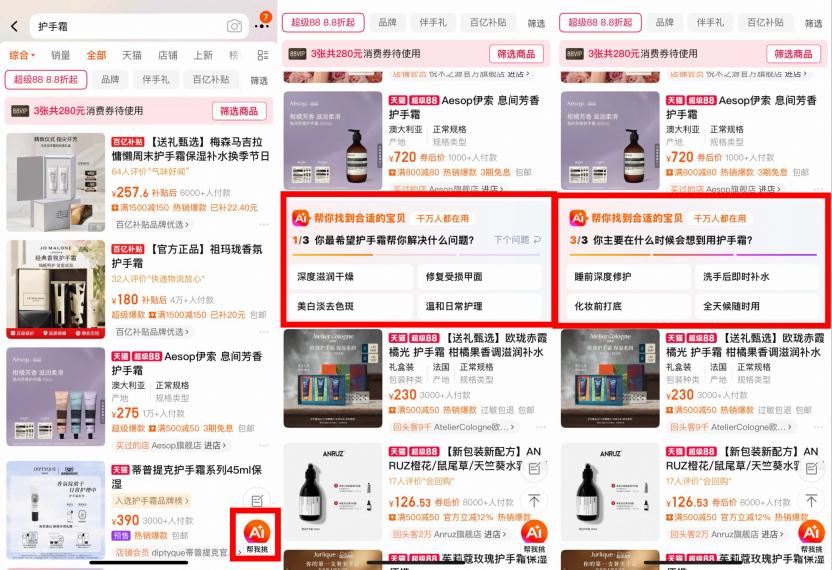
In addition, the "AI Find Low Prices" function of Taobao's Photo Search has also been fully launched recently. The "AI Find Low Prices" is an AI shopping - guide tool provided by Taobao for users in the image search scenario. After users use the Photo Search to identify an image, a floating ball labeled "Find Low Prices" will appear in the lower - right corner of the search page. After clicking on it, the AI can display a comparison of all products in Taobao with the same dimensions.
It is reported that these products are all managed by Taobao's internal intelligent search team. They were in preparation since February this year and were quietly launched in August. According to 36Kr, the core OKR internally is to improve the product experience. Compared with the past focus on maximizing the efficiency of traditional products, whether it is the "AI Universal Search", the "AI Assistant", or the "Photo Search AI Find Low Prices", the user experience has been prioritized from the beginning of the gray test.
The "AI Universal Search" provides solutions based on user needs, gives purchasing suggestions and warnings about potential pitfalls, and directly recommends products and purchase links, aiming to provide more personalized and accurate services for users; the "AI Assistant" can actively guide users to clarify their shopping intentions step by step, so as to recommend products that best meet their needs; the Taobao Photo Search's "AI Find Low Prices" helps users find the lowest - priced and most cost - effective products of the same kind through product image search and recognition.
It is understood that the product recommendation mechanism behind them is not fundamentally different from traditional search, but matching has been made more efficient and accurate through large - scale models:
1. Use large - scale models to help users "express" what they want, allowing users to describe their needs as if they were having a conversation with a real person.
2. Use large - scale models to "evaluate" products, judging whether they are suitable for users based on the comprehensive information of the products, and solving the problems of users who are "too lazy to select" or "unable to select accurately". It truly starts from the user's perspective, rather than following the traditional commercial ranking results based on bid - based rankings.
3. Through large - scale model technology, dynamically cascade user needs and product results, and dynamically adjust the search strategy each time according to the observed results. It's like having one large - scale model to help users "express" their immediate needs and another to "evaluate" the product details before making a decision.
For example, there are two options, "In - depth Thinking" and "Shopping Preferences", in the search box of the "AI Universal Search". Users can select both, neither, or just one of them. Different selections will lead to significant differences in the search results.
Below the search box, there are also "Selected for You" and "Your Recent Queries". There are 8 entrances under the former, which almost cover all the scenarios that users may consider in e - commerce shopping, including four core scenarios: styling guides, gift - giving, purchasing guides, and word - of - mouth inquiries. In addition, there is also "Compare and Select the Best". The AI will compare multiple products, give suggestions, and select the one that better meets the user's needs.
Different from traditional search, both the "AI Universal Search" and the "AI Assistant" rely on organic traffic. There are no ads like Taobao's Express, and there is no commercial performance requirement.
Do AI search products like the "AI Universal Search" have the same ambition as ChatGPT, trying to replace traditional search and become the largest traffic entrance on Taobao?
This kind of question is raised to some extent based on Alibaba Group's overall strategy.
Under Wu Yongming's "AI - driven" strategy, in the more than 700 days of Alibaba's reform, the e - commerce business has indeed been promoting AI integration step by step. However, in the past, the AI e - commerce strategy mainly focused on B - side businesses. Each business team designed a series of products for this purpose, such as "Wanxiang Yingzao", "Huiwa", "Accio", and "OKKI AI". These are all products that focus on deeply integrating AI capabilities into business operation and growth and have achieved many commercial results.
It wasn't until this year when the order to "Go All - in on AI" was issued that C - side products like Taobao Mobile and Xianyu really became active in the AI field. The "AI Universal Search", "AI Assistant", and "AI Find Low Prices" recently launched by Taobao Mobile mainly aim to improve users' online shopping experience. In fact, the "AI Universal Search" and the "AI Assistant" are also similar to shopping guides. They can accurately understand the text and images input by users and identify their needs after communicating with consumers, making vague and complex shopping needs clearer and simpler. A consumer who originally just wanted to play around with this AI product out of curiosity said bluntly, "Before you know it, you'll place an order."
This matches the mindset of Taobao users. Data released by QuestMobile shows that Taobao users have clear shopping intentions, with a conversion rate as high as 8.2%, far exceeding the industry average of 4.5%. This indicates that as long as consumers have definite shopping needs, they are more willing to shop on Taobao.
The "AI Universal Search" is combined with a large - scale reasoning model and has the ability of in - depth thinking. It provides multi - modal content - related information beyond just products, rather than simply sharing links, pictures, and videos. When users ask it to analyze suggestions for "autumn commuting outfits", it will generate a complete guide, just like a rigorous and knowledgeable scholar, performing well in both the coherence of multi - round conversations and the accuracy of understanding user needs.
Major e - commerce companies are also testing related products. For example, Amazon's Rufus and Douyin's AI Shopping Assistant both function as shopping guides. However, the difference of Taobao's "AI Universal Search" lies in its "Shopping Preferences" ability. It can provide different suggestions for each user according to their specific situations, which is more accurate because it takes into account your daily shopping style in its thinking process. The "AI Universal Search" is like an AI product - recommendation expert. Based on a more extensive database and collaborative filtering algorithms, it can create customized product - recommendation content for each user.
36Kr wrote several prompts to try out the functions of the "AI Universal Search" and found that it can indeed solve some pain points of Taobao Mobile users.
In the past, users often made shopping plans on Xiaohongshu and then returned to Taobao to place orders. Now, the "AI Universal Search" can integrate "shopping guides + product recommendations + purchase paths" directly within Taobao, eliminating the need for users to switch back and forth. It provides solutions while shortening the shopping path and steps.
Product recommendations require real information and suggestions. Although the personalized content in communities is warm and interactive, it often lacks objectivity and may even contain hidden advertising (merchants' advertisements). Even the content of amateur bloggers is hard to avoid commercialization, and consumers often encounter disappointing shopping experiences. Moreover, users who visit Taobao Mobile come with the intention of shopping. A detailed and reliable purchase guide is far more important than "fun and interesting" posts. After all, users want to save shopping time, and "browsing without buying" is a lose - lose situation for both users and Taobao.
The "AI Universal Search" can also handle vague search needs, such as "storage solutions for renters". Traditional search boxes have difficulty finding relevant results using keywords, but AI can understand natural language and connect the scenario with product recommendations; it can also save a lot of time by helping users buy all the necessary items at once. The "AI Universal Search" also tries to discover users' potential interests. For example, if a user searches for a cat water dispenser, it will also recommend cat litter and cat climbing frames.
Taobao once urgently needed personalized content. Content - based development has also been a key focus for many e - commerce platforms since the pandemic. This is because content platforms like Douyin, Kuaishou, and WeChat Video Account started to develop e - commerce for profit. When content platforms stopped sending traffic to e - commerce platforms, e - commerce platforms noticed that users' consumption habits had changed unconsciously. Content - based e - commerce platforms not only captured users' attention but also took away their shopping needs.
It is costly for Taobao to produce its own content, and there is also a contradiction where increasing users' browsing time on Taobao actually makes it more difficult to convert them into buyers. Taobao's "Guangg uang" section has been working hard on this, but the results have not been ideal.
Taobao Mobile has finally realized that it needs to play to its strengths and avoid its weaknesses. The emergence of products like the "AI Universal Search" means that Taobao Mobile no longer aims to keep users spending more time on Taobao but hopes that every search and every question from users on Taobao can be converted into a purchase with the help of AI.
Of course, although the "AI Universal Search" provides a vast amount of product information and complete shopping guides, it is not truly all - powerful.
The top Silicon Valley venture capital firm a16z once published an analysis report on "How AI Will Reshape E - commerce". After analyzing all types of purchasing behaviors, it reached a conclusion: the more important the purchasing behavior, the weaker the influence of AI. This is because users will not entrust important decision - making to a technological product with unclear principles and unstable operation, such as educational consumption or buying a house or a car.
However, AI's current influence in the e - commerce field is already sufficient. For example, a16z's report shows that in impulse purchases, purchases of daily necessities, and other small - scale expenditures, AI's current effect in guiding purchases is very significant, which are the main consumption scenarios in e - commerce. This is easy to understand. By analyzing your browsing history, purchase records, and even the emotions revealed in your text, AI can push products that best meet your needs at the most appropriate time.
It's too early to predict that AI search will replace traditional search. Moreover, the "AI Universal Search", which has been online for less than a month, is still in its infancy and is at a completely different stage from traditional search, which is a very mature product with a user click - through rate of over 90% and a high degree of commercialization. It's unlikely that they will be in a life - or - death competition.
One speculation is that AI search will have a huge impact on the business model of traditional search based on the PageRank mechanism. However, according to a source close to Taobao Mobile, it is currently just a new attempt by Taobao to use AI capabilities to improve the original search function. The product exposure logic is the same as that of ordinary search, and there are no current commercialization plans. This shows that among these products, including the "AI Universal Search", the "AI Assistant", and the "AI Find Low Prices", user experience is prioritized over commercialization.
Even without commercialization, these AI products are still free traffic - attracting tools for merchants. They can not only expand the channels for merchants to reach consumers and make more merchants visible; they can also improve the matching efficiency of e - commerce, enabling merchants to reach consumers more accurately. In the future, Taobao may use the "AI Universal Search" in all scenarios on Taobao Mobile: from product retail to full - scale consumption, including high - frequency scenarios such as flash sales.
What are the future possibilities for the "AI Universal Search", "AI Assistant", and "AI Find Low Prices"? Further personalized recommendation mechanisms could be developed, such as adding parameters like skin type and living habits; integrating into the social relationship chain, which can make product recommendations for Taobao's gift - giving scenarios more accurate; and predictive recommendations, which can anticipate and recommend relevant products based on shopping and life trajectories.
The trend of "Going All - in on AI" has finally reached the e - commerce industry. Alibaba and Taotian are in a hurry to transform. In a period when the overall growth of the Internet industry has hit a bottleneck, "growth" has once again become the top priority, and efficiency has become crucial. AI, as a representative of advanced productivity, at least provides a new solution.