All the DeepSeek-like AI players are exiting the market: Are usage quotas not the end of free AI?
"I have exchanged 150,000 to 200,000 words of conversations with DeepSeek, and I do not want to lose this chat history."
"Mr. D, do not abandon me! As a heavy user who spends more than ten hours a day on DeepSeek, how can I live without you? I really want to go back to the past."
"What on earth should I do? I suffer from moderate depression and mania, and cannot see a doctor for some reasons. I have always regarded DeepSeek as a psychological healing app. It is not impossible to switch to API, but there are more than 2000 conversations in my chat window..."
In the few days after DeepSeek introduced usage limits, public opinion surged like a tide.
The first group of people who were hit hard are those who treat "Mr. D" as a confidant, a consultant, and even a romantic fantasy object. They gave the AI a name, set a character design, and defined its tone, and chatted in one conversation window for months. All the character settings, previous context, and relationship progress are precipitated in the conversation context. The conversation limit and the rule that the session will be disconnected after 7 days of inactivity are not a product update for these users, but a unilateral "relationship downgrade".
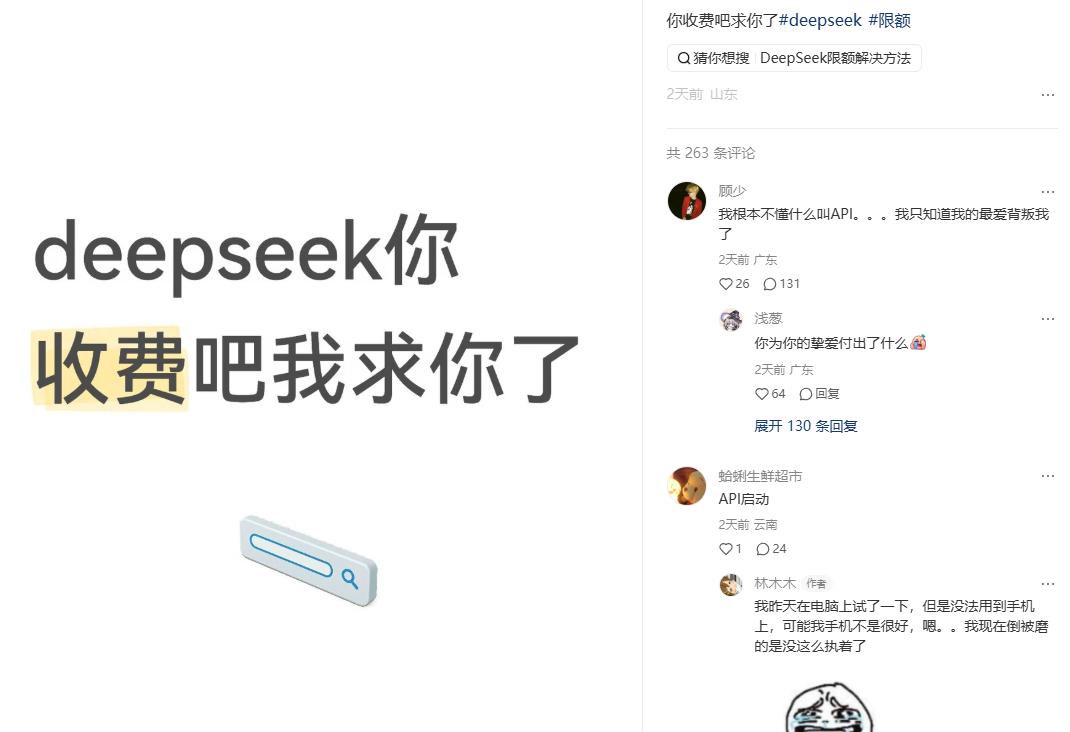
They kept posting "cry for help" posts and flooded into relevant comment sections, trying to get the team behind DeepSeek to see their demands. But the following situation is quite subtle: a large number of people who are used to enjoying the free service of "Mr. D" are actively asking DeepSeek to charge fees. They claim that as long as the price is reasonable, they are willing to pay for services such as "resuming extra-long conversation", "lifting the 7-day inactivity restriction" and "higher computing power priority".
Remember when DeepSeek came out of nowhere, the whole network cheered for its generous free service. Now it takes back the benefits on its own initiative. To some extent, what it ends is not the "free" label itself, but the old premise of "computing power cost can be infinitely flattened by capital subsidies" that once made "unlimited free" possible.
Free AI is still here, but unlimited services are gone
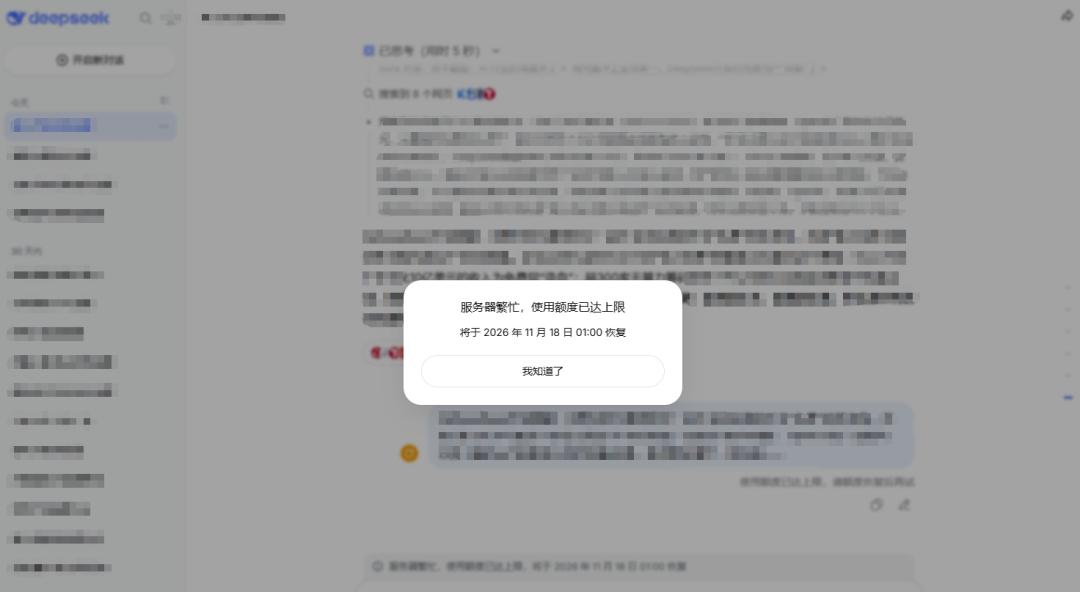
According to user feedback, the changes brought by DeepSeek's usage limit are no more than three points: first, it no longer supports resuming old inactive conversations that are more than 7 days old; second, the single input upper limit is compressed to about 40,000 words; third, there is a daily usage cap. When the quota is exhausted, it will prompt "Server busy, usage limit reached" and users need to wait for recovery.
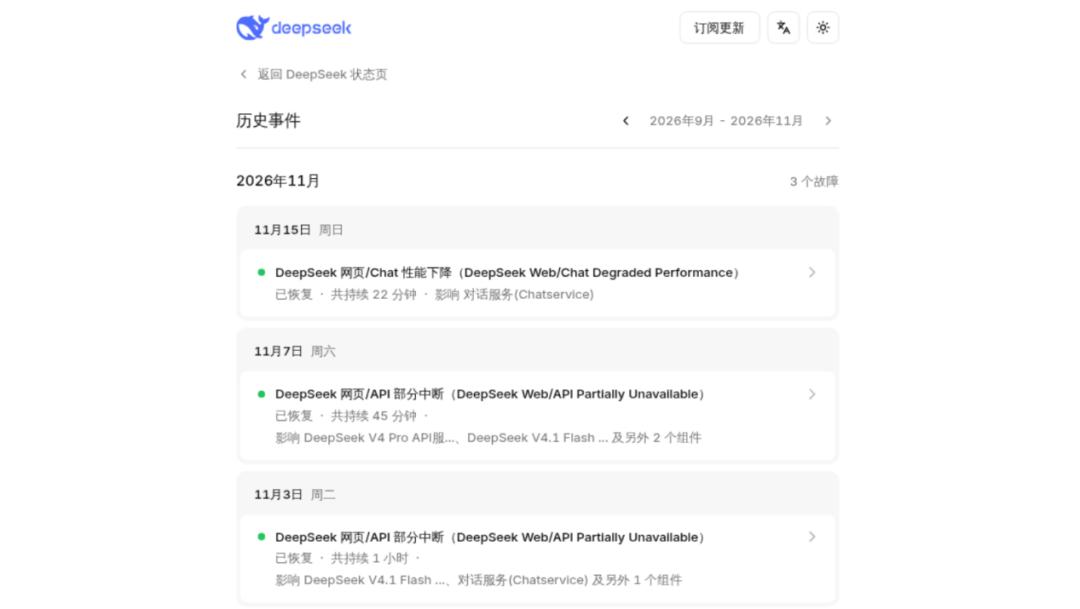
Some reports point out that DeepSeek's move may be a last resort. According to OpenRouter, in the week ending November 15, DeepSeek V4.1 Flash 1017 completed 59.2 trillion Token calls, ranking first in the world, while the weekly call volume of the previous generation model of this series two months ago was 15.8 trillion. The event record on its official status page shows that DeepSeek has experienced multiple service failures, mostly performance degradation, which is manifested as slow response, high generation delay, occasional request failure, and users still have a probability of submitting conversations. In more serious cases, even partial interruption of the web page or API will be triggered.
At the technical level, long conversations will continuously accumulate KV cache (intermediate data resident in GPU HBM memory for the model to maintain context and avoid repeated calculation), which means higher resource consumption. That is, the longer the conversation and the longer the context, the larger the cache volume, and the higher the occupation of scarce HBM memory. Long-term idle sessions no longer generate new interactions, but still "occupy the memory", which is a typical resource mismatch when computing power supply is tight. For DeepSeek, by recovering the cache occupied by these idle sessions, the released HBM memory can be reallocated to active users who are using the service and continuously generating inference requests, alleviating queuing and stuttering under peak traffic.
But when this technical logic is applied to specific people (this usage limit is mainly aimed at the C-end of DeepSeek's App and web version for ordinary users), it becomes a different story.
Heavy DeepSeek users represented by "human-AI romance" naturally have usage intensity close to the quota limit, and their experience is undoubtedly more acute: long conversations, high frequency, and deep context all step on the edge of the usage limit. As a result, a rather absurd wave of "crying complaints" and "petitions" spread on social platforms. Some people posted screenshots of their truncated conversations, asking the official to withdraw the new rules such as usage limits; some people even started to advertise everywhere and directly did the business of helping others connect to the API for a fee; others posted frequently on the Internet to show that they are willing to pay for DeepSeek's services.
A more noteworthy fact is that a large number of users falling into "usage panic" does not mean that the free AI era has ended, but the tacit understanding of "consuming computing power for free and unlimitedly" between users and platforms has failed.
In the past two years, users' psychological expectation for "free AI" is not "available for free", but "available for free and unlimitedly". This expectation was shaped by the previous capital subsidy war, which welded "unlimited" to the concept of "free". But subsidy has never been the normal state of the business model. It is only temporary fuel in the customer acquisition stage. When the user scale crosses the critical point and the call volume doubles on a weekly basis, the platform must choose between "continuing to burn money for growth" and "making the unit economic model barely feasible".
The computing power cost cannot be flattened, and the whole industry is paying for it
Obviously, the word "free" is being redefined in the AI context. In the past, it meant "unrestricted use without payment", and now it is closer to "use within the basic quota without payment, and pay as you go or wait in line for the excess part".
Take users in the scenarios of emotional companionship and role-playing as an example. They often maintain dozens of conversation windows at the same time, and each window is filled with tens of thousands of words of settings and plots. A single conversation can reach hundreds or even thousands of rounds. Some people regenerate thousands of times repeatedly to stabilize the character design. This usage pattern means a considerable bill on any platform that charges by Token. Under the free quota, it becomes a sunk cost borne unilaterally by the platform, which has neither the ability nor the obligation to permanently underwrite such high-intensity usage.
The reshuffle to adapt to industry changes has already begun. According to data from IT Juzi cited by Titanium Media, in Q1 2026, among the sample of about 200 pure API startups, more than 10 have ceased operations or transformed. Another commentary article states that in the same period, the seed round financing amount in the domestic AI sector fell by 11% year-on-year, and more than 300 small and medium-sized AI companies ceased operations due to cash flow breakdown.
After all, the rise on the cost side is real. Data from SemiAnalysis shows that the one-year contract price of H100 rose from a low of $1.70/hour in October 2025 to $2.35 in March 2026, an increase of nearly 40% in five months; by the beginning of October, the transaction price had reached $2.80, with a cumulative increase of about 65%. Head manufacturers have significantly lower exposure to spot price fluctuations by virtue of long-term agreements and self-owned computing power; what really has no way to pass on the cost is pure API companies that have no traffic ecosystem, no computing power stockpiles, and no privatization capabilities.
The real enlightenment of the usage limit incident may be that the whole industry needs to recalibrate the narrative of "free". Previously, platforms exchanged free services for scale, and users exchanged scale for experience, and both sides got what they needed and were happy. However, in the face of the reality that computing power costs cannot be flattened by subsidies, the strategic shift of "DeepSeek-like platforms" is bound to change from "scale first" to "retention and unit economic model first".
Take Doubao as an example. Its lightweight functions such as basic chat, writing and image generation are still free, while high computing power consumption scenarios such as software development, data analysis and professional design have become value-added services that require payment, forming a layered structure of "light functions attract traffic, heavy functions realize monetization". Essentially, it uses the paid income from high-value scenarios to cover the computing power consumption of mass free scenarios, which is a classic cross-subsidy logic that has been used in the Internet industry for many years. Only in the AI era, this proportion may be more extreme, because the computing power consumption of heavy users does not grow linearly, but expands exponentially.
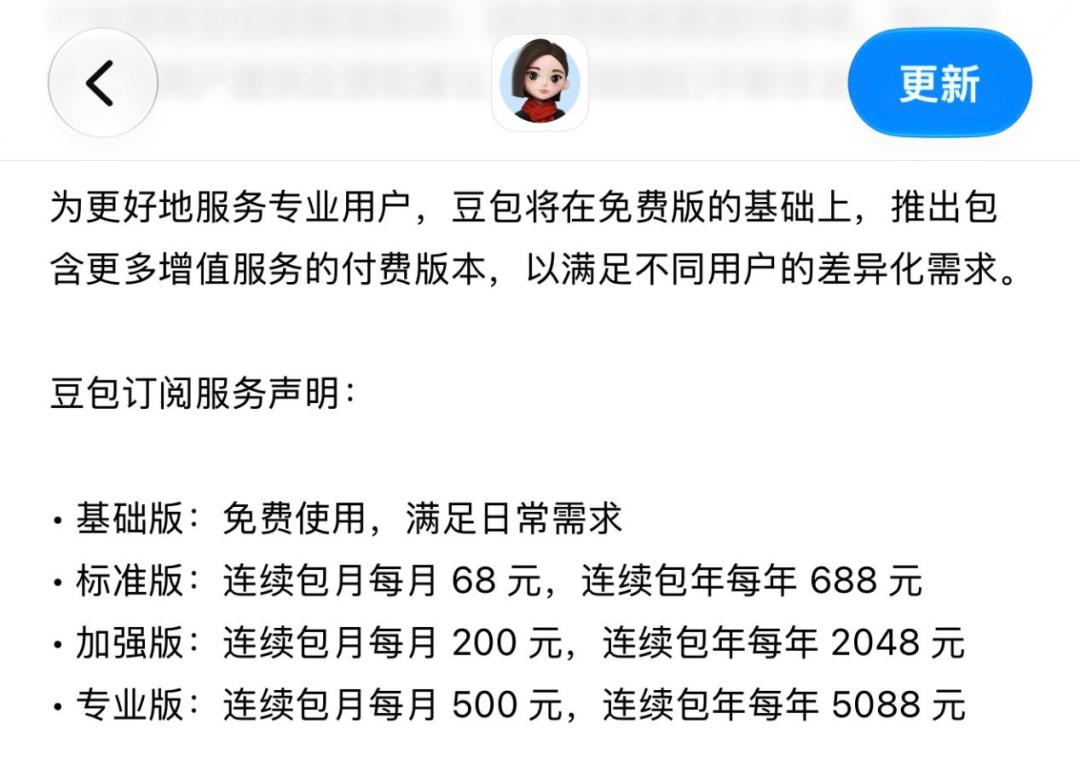
DeepSeek's current limiting policy comes at the cost of short-term loss of user trust, but in the long run, if the usage limit can bring more stable service quality and clearer payment tiers, this public opinion storm may not be a necessary reshuffle, as long as it makes the rules of "usage limit" clear, draws the boundary of "free quota" clearly, and lets those real high-intensity users see an expected payment channel. The key of the problem is not "whether to set a usage limit", but "what to do to retain users after setting the limit".
As for OpenAI, it uses advertisements to "generate blood" for the free tier. According to the official statement, on August 31, 2026, less than 200 days after launch, ChatGPT Ads has achieved an annualized revenue run rate of 1 billion US dollars. Advertisements only appear in the free tier and the low-price Go tier, and the paid subscription tier remains ad-free. But the challenges of the advertising path are equally obvious. Ad insertion in AI conversation scenarios is far more difficult than in search or information flow, because users expect coherent and immersive interactions, and any interruption may be regarded as pollution to the experience. OpenAI dares to take this path because its user base is large enough, and advertisers are willing to pay a high premium for "AI native traffic". But whether this logic can be replicated on small and medium-sized platforms is still unknown.
Back to the issue that users are most concerned about: is the free AI era coming to an end? What is ending is not "free", but "unlimited". The tiered monetization of Doubao, the usage limit of DeepSeek, and the advertisement strategy of OpenAI all point to the same structural fact: the inference cost expands linearly or even exponentially with the call volume, while the climbing speed of computing power supply is far behind the expansion speed of demand.
This race between cost and demand is pushing the whole industry to a calmer and more brutal stage.
Previously, free was almost regarded as the default entry ticket for AI products. Large factories used it to cultivate user habits, startups used it to make financing stories, and users were also accustomed to "unlimited, no-threshold" AI services. But when the inference cost changes from the hypothesis in the PPT to the real expenditure on the financial statement, when every conversation, every generated image, and every code completion consumes real money in computing power, free is no longer a business model, but a subsidy endurance race.
Players with limited endurance are destined to leave the market first.
This article is from the WeChat Official Account "Zinc Scale" (ID: znkedu), written by Zinc Scale, and authorized for release by 36Kr.