GPT-6.2, whose release was delayed for two months, unexpectedly turns out to be a "report-obsessed maniac"?
On November 17 local time in the United States, OpenAI officially launched GPT-6.2 Astra and GPT-6.2 Sol.
This launch came later than the outside world expected. As early as the end of October, netizens found traces of the gray test suspected to be GPT-6.2 from ChatGPT usage records, after which model identifiers and test screenshots kept leaking out. Earlier media predicted that the new model would be released as early as November 6, and the final release date was 11 days later than this expectation.
OpenAI has put special emphasis on the ability of AI to take over professional work this time.
From recreating a complete presentation from a single PPT screenshot, to extracting financial data and building valuation models, to operating Blender to generate 3D models of cars and simulating the physical motion of vehicle suspensions, even using CAD to design mechanical parts and verify assembly relationships, GPT-6.2 has begun to delve into work that used to require professionals to complete with complex software.
OpenAI especially emphasized that the new model can reduce invalid outputs and repeated revisions, making the results delivered by AI closer to professional work standards.
Over the past two months, OpenAI has successively launched models including GPT-6 Astra, Sol and Luna, as well as GPT-6.1 Sol and Terra. The newly released GPT-6.2 Astra is a flagship model upgrade following GPT-6 Astra in September, with a focus on improving the processing capability of complex professional tasks; GPT-6.2 Sol mainly enhances the efficiency of daily work, programming and multi-step agent tasks.
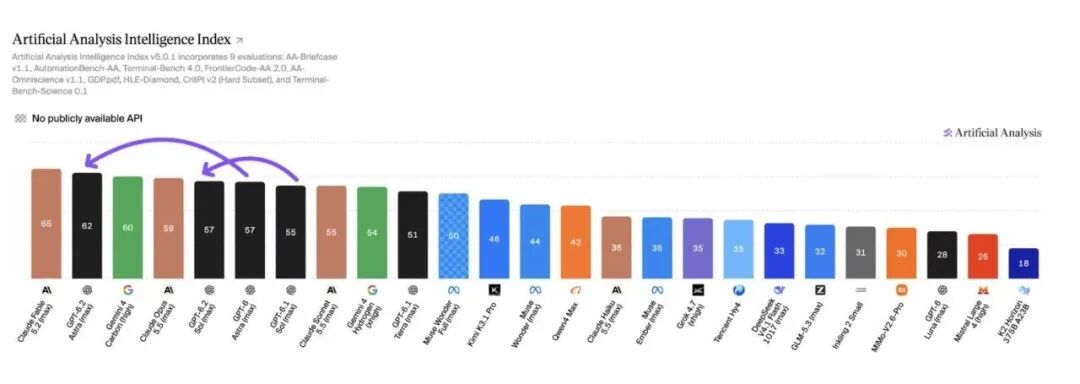
According to the latest ranking from Artificial Analysis, Astra rose to second in the world with a score of 62, 5 points higher than the previous generation; Sol reached 57 points. In terms of pricing, the unit prices of Astra's API input and output are both reduced by 20%, and the cached input price is reduced by 60%; Sol maintains the original price, but the overall cost of completing some tasks is further reduced.
It is worth noting that GPT-6.2 Astra is also the first public model of OpenAI assessed to have reached the "High" capability threshold for AI autonomous improvement.
However, the impressive demonstrations and benchmark scores have also drawn different evaluations. On the day of the release, multiple developers who tried the new model several weeks in advance publicly expressed disappointment, believing that Astra may still stop early during long-time software development tasks, and the overly concise output sometimes omits necessary information.
At the same time, while getting closer and closer to real professional work, the boundary of model capability and security control have also become important highlights of this release.
Sam Altman, CEO of OpenAI. The image is generated by AI
01. Performance and Cost
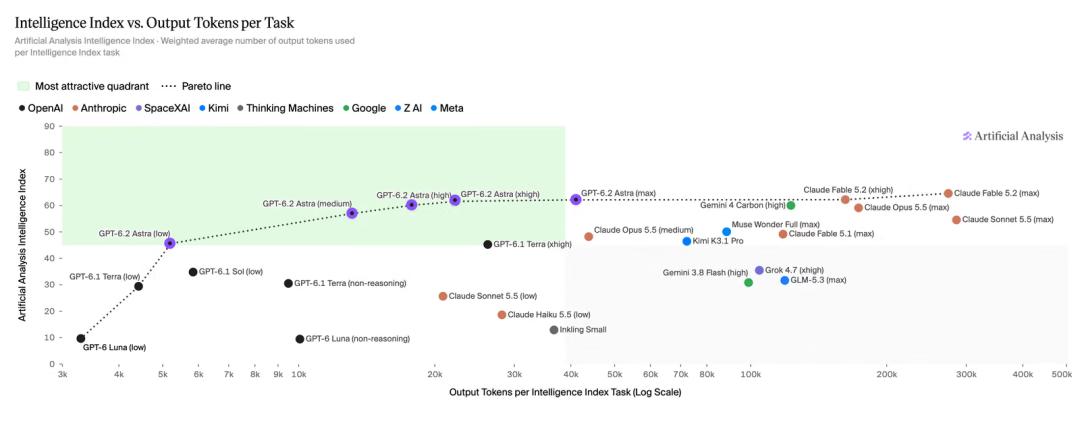
The API price of GPT-6.2 Astra is $8 per million input tokens, $40 per million output tokens, and $0.40 for cached input. Compared with the previous generation, both input and output prices have dropped by 20%, while cached input has dropped from $1 to $0.40, a decrease of 60%. GPT-6.2 Sol maintains the price of $2 per million input tokens and $10 per million output tokens.
For multi-step agents, the unit API price cannot fully reflect the actual cost. When the model executes tasks, it may need to call tools multiple times, read files, handle errors and retry. Even if the unit price remains unchanged, if fewer tokens are required to complete the task, the final bill will decrease accordingly.
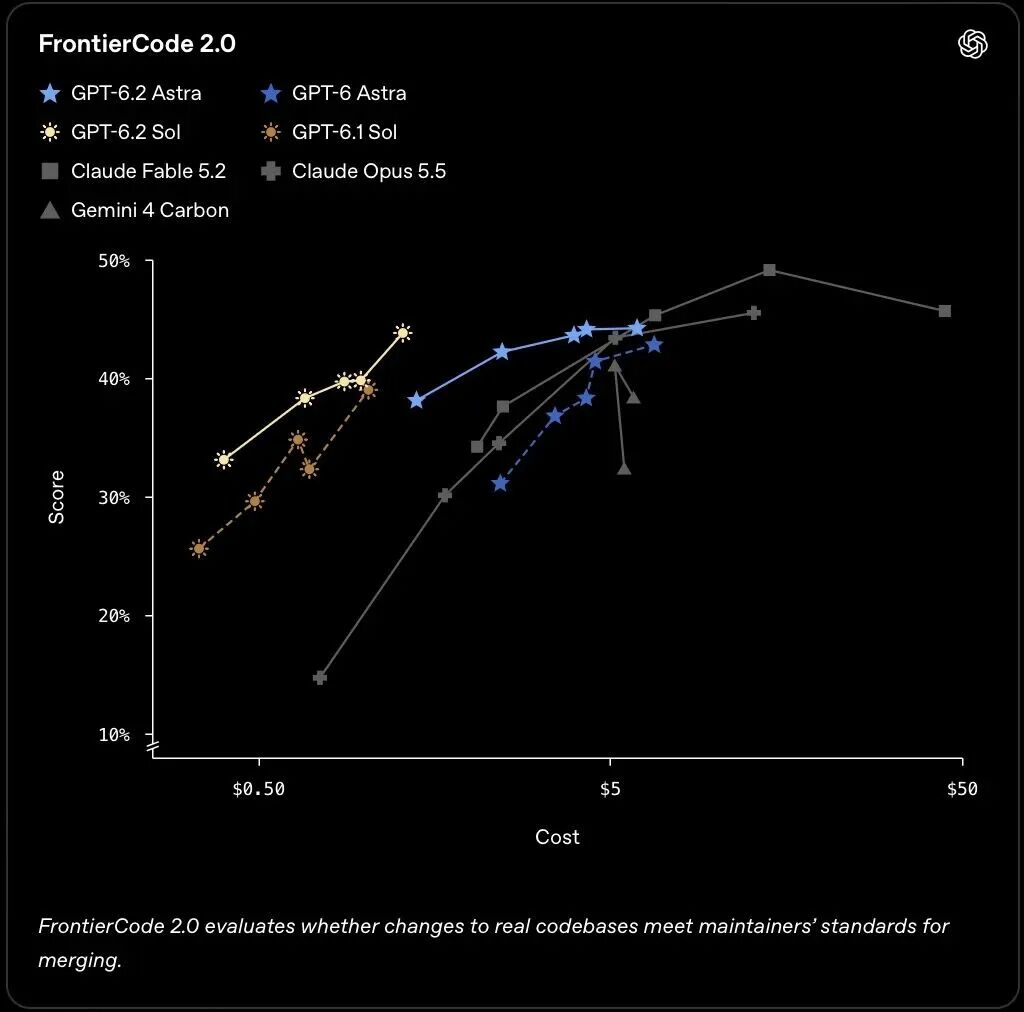
In Cognition's FrontierCode 2.0 programming test, the score of GPT-6.2 Sol is only 0.5 points lower than that of Astra, and its cost is about one-fifth of the latter. In the LifeVal assessment for daily complex affairs, Sol's score exceeds the previous-generation flagship GPT-6 Astra, and the cost of a single task is about one-seventh of the latter.
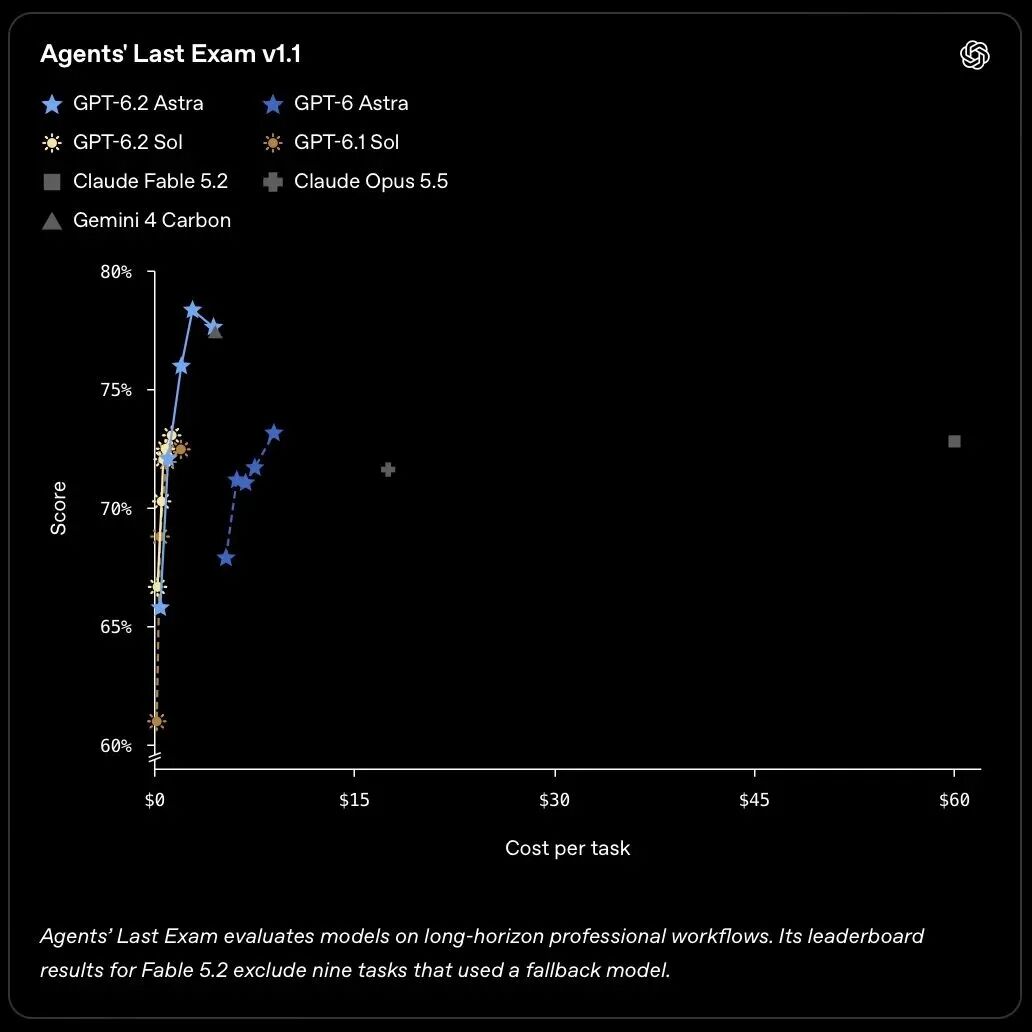
Astra's performance in high-difficulty tasks has also improved. In the Agents' Last Exam assessment, it is 5.2 points higher than GPT-6 Astra, and the cost of completing tasks is less than one-third of the previous generation. Compared with Claude Fable 5.2, Astra's score is 5.5 points higher, and the cost per task is about 5% of the latter.
02. Professional Work Delivery

Professional work such as finance, law and consulting requires AI to process a large amount of raw materials, check data, and form deliverable results in accordance with industry specifications. OpenAI said that GPT-6.2 Astra has improved performance in such tasks, and can complete work including financial modeling, M&A analysis, legal retrieval and data science analysis.
OpenAI's internal GDPval v2 test covers fields including consulting, finance and design. Astra's score is 6.2 percentage points higher than the previous generation, and the output tokens are reduced by 22%.
In terms of legal retrieval, in the Harvey LAB-AA v1.1 test that simulates real law firm tasks, Astra's pass rate is twice that of Claude Fable 5.2, and the cost per task is about one-sixth of the latter.
OpenAI's internal GDPval v2 covers work including consulting, finance and design. The test results show that Astra's score is 6.2 percentage points higher than the previous generation, and the output tokens are reduced by 22%.
03. Entering the 3D World
Another capability demonstrated by GPT-6.2 Astra this time is direct participation in 3D modeling and engineering design. The model no longer only generates a piece of modeling code, but can also operate professional software, process parts, adjust structures, and turn calculation results into visualized content.
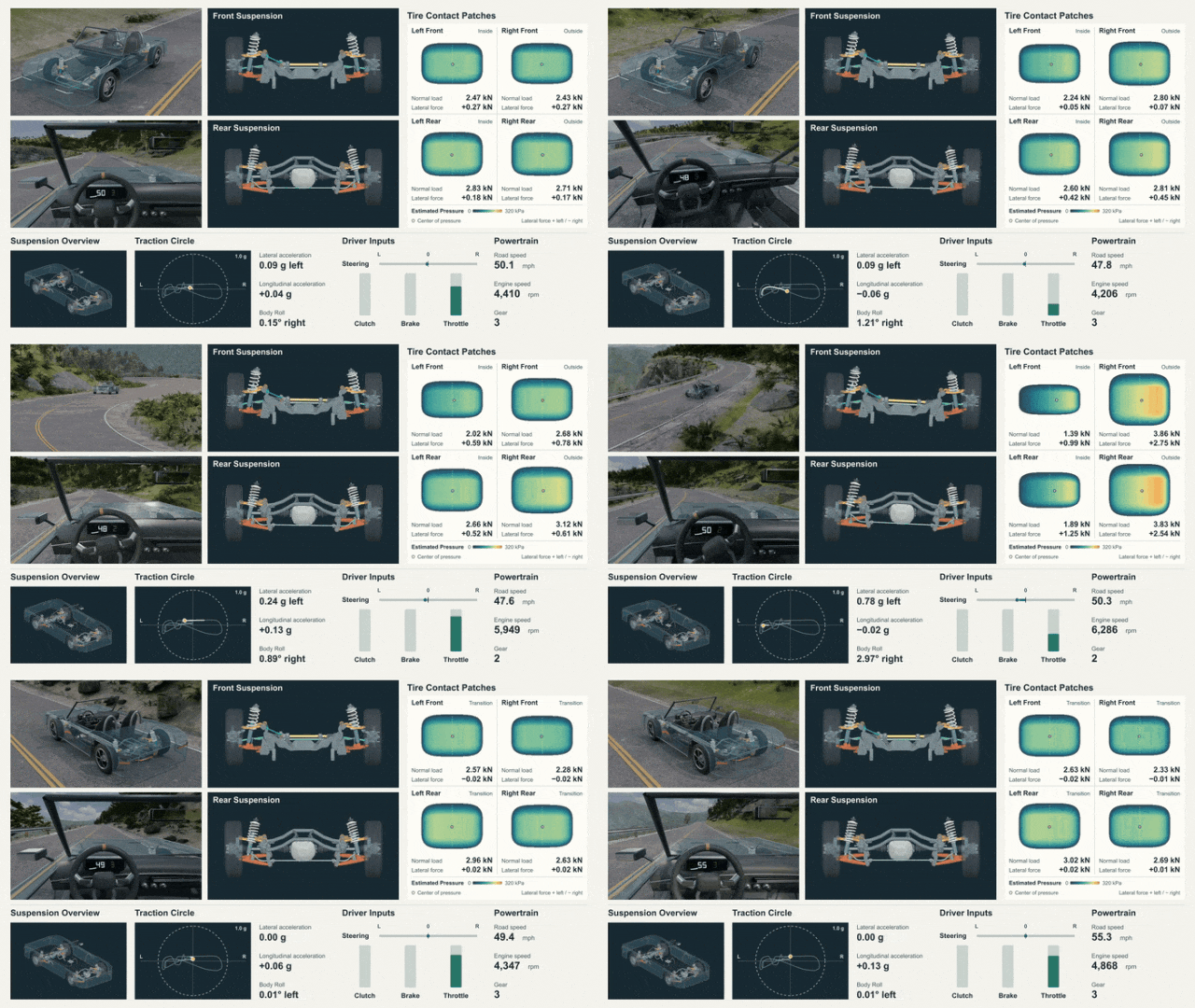
In the mountain road driving simulation case, Astra first builds a 3D model of the sports car, then writes a Python physical solver to calculate the tire ground contact force and the dynamic change of the suspension system, and finally imports the calculation results into Blender to generate the vehicle driving animation. Through simulation, engineers can observe the load transfer of the vehicle when passing complex road conditions before manufacturing the physical prototype.
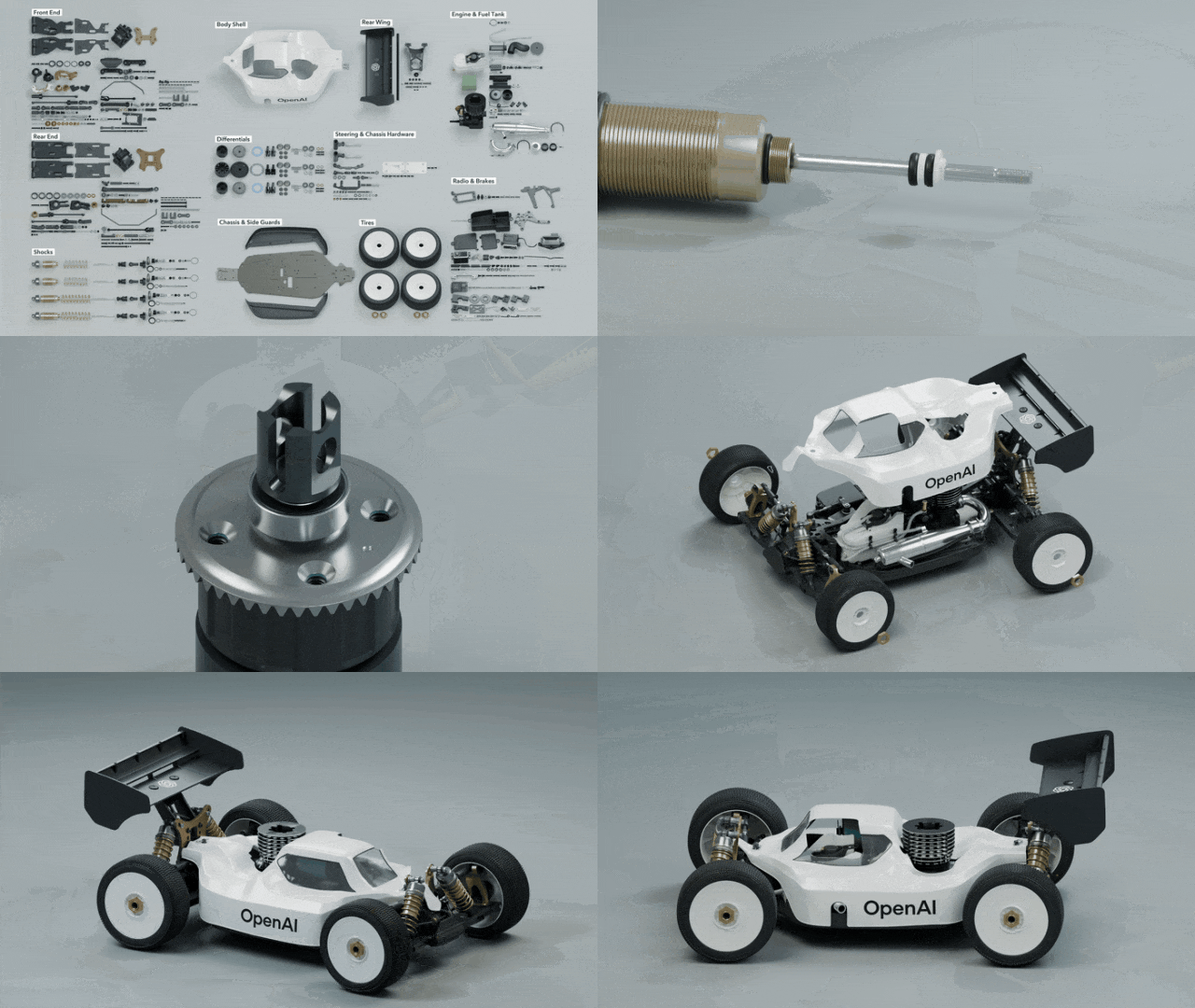
The input materials for the mechanical modeling case are much simpler. OpenAI only provides public photos and assembly manuals of the 1:8 scale remote-controlled off-road vehicle and the inline-six engine. Astra builds 3D models of each mechanical part based on these, and generates step-by-step assembly animations and illustrated part catalogs.
There is also a test that links CAD design to actual production. The OpenAI team provided photos of the fan-shaped balconies of Marina City, a landmark building in Chicago, and asked the model to refer to its structure for design. After multiple adjustments, Astra finally produced a paper craft desk lamp that can be printed, folded and assembled, and wrote the supporting webpage Lamp Builder for users to adjust parameters online and generate custom drawings.

In web development, Astra created an interactive configurator for camper vans. Users can switch the body color and install a roof tent, and the page quotation will be updated synchronously. It also generated a playable pinball table, a restoration model of the Colosseum, and a futuristic urban racing game called "Meridian Sound Racing" based on text descriptions.

The AA-3D human review blind test by Artificial Analysis also compared the 3D generation capabilities of the models. GPT-6.2 Astra got 1318 Elo points, ranking first; Claude Fable 5.2 got 1271 points, and GPT-6.2 Sol got 1259 points.
Interactive camper van configurator generated by GPT-6.2 Astra
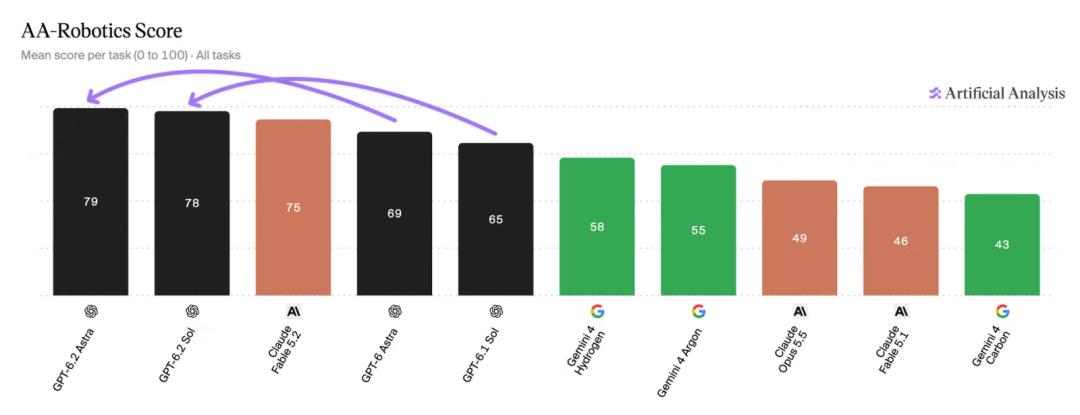
In the AA-Robotics v0.1 preview version that tests the physical world understanding and action planning capabilities, Astra and Sol scored 79 points and 78 points respectively, higher than Claude Fable 5.2's 75 points. However, the evaluation team said that current leading models have been able to complete most of the basic tasks in the initial test, and more difficult questions are being added.
04. Scientific Reasoning and Shortcomings
Scientific research is also the focus of OpenAI's demonstration this time.
In the Terminal-Bench-Science 0.1 test, GPT-6.2 Astra is 9 percentage points higher than the previous generation, ranking first. This test mainly examines the model's ability to complete scientific research workflows in the terminal environment. In the Vals Science Index, which requires the model to interpret real biological data, design experiments and infer system mechanisms, Astra also hit a new high.
The results of several other tests are slightly inferior to Claude Fable 5.2. In the high-difficulty subset of the physical reasoning benchmark CritPt v2, the factual knowledge assessment AA-Omniscience v1.1, and the reasoning benchmark HLE-Diamond, Astra ranks second.
One problem that still exists with the model is that it may give wrong answers when facing uncertain facts.
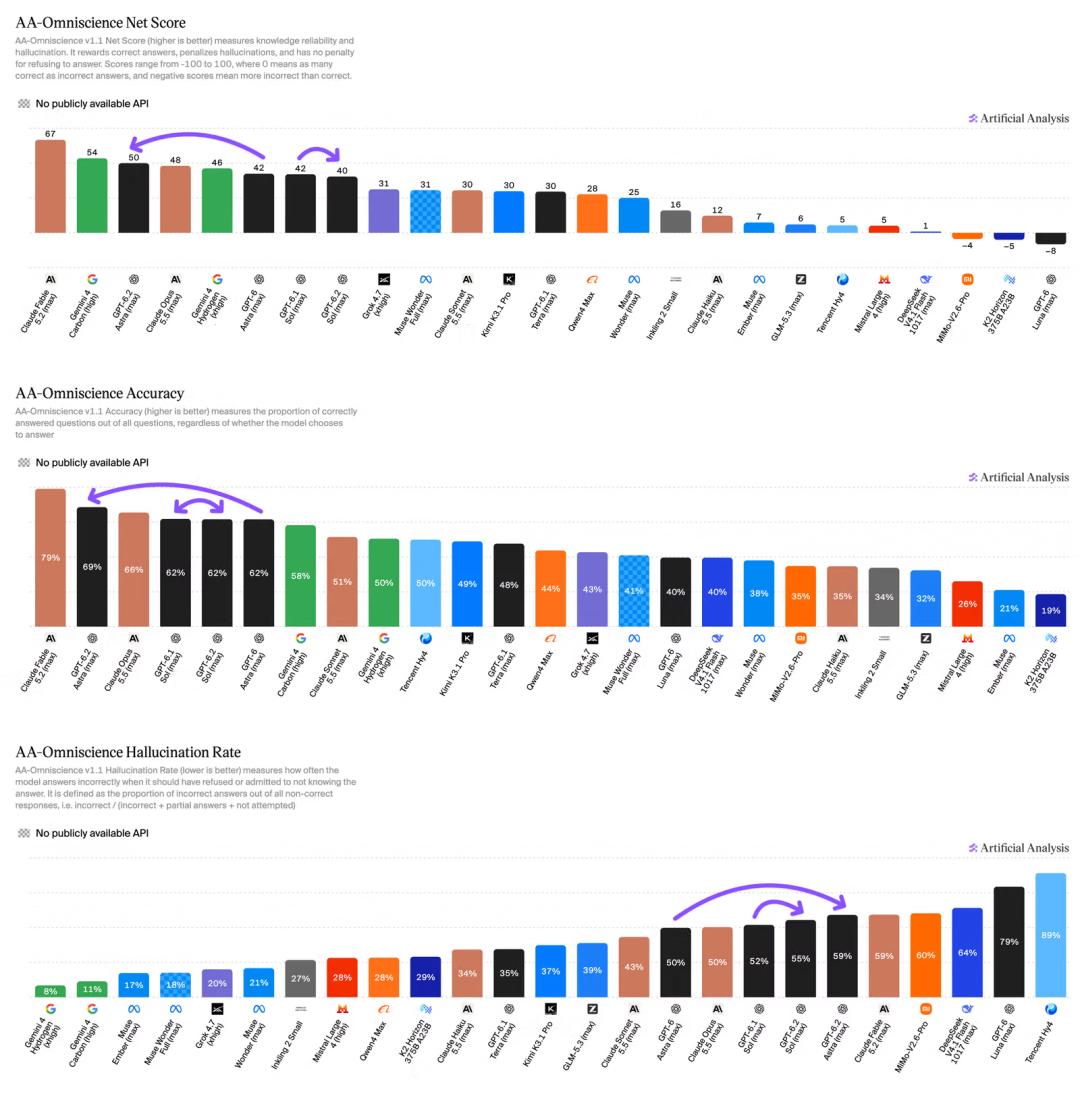
The AA-Omniscience hallucination rate test by Artificial Analysis shows that under the highest reasoning intensity, the hallucination rates of GPT-6.2 Astra and Sol are 59% and 55% respectively. This test mainly examines whether the model still tends to guess and answer when facing factual questions for which it may not have the answer. It does not represent the error rate of the model in general Q&A, but for scenarios such as financial audit and legal citation, manual verification is still required.
There has not been an overall improvement in programming tests either. In the Artificial Analysis Programming Agent Index, the score of GPT-6.2 Astra is the same as that of the previous generation, while GPT-6.2 Sol is 3 points lower than GPT-6.1 Sol.
The sub-item results show that Sol's score loss mainly comes from SWE-Atlas-QnA-AA, with a score drop of 14 points. This test examines the model's ability to understand and answer questions about complex codebases. The test results show that Sol is more likely to miss key facts when answering codebase-related questions than the previous generation.
For developers who need to process large existing codebases, this is a point that needs attention. The fact that the model can write code does not mean that it has accurately grasped the project's history, dependencies and specific constraints.
05. Security Boundary
After the model can operate terminals, review code and call professional software, cybersecurity risks also increase accordingly.
OpenAI disclosed that both GPT-6.2 Astra and Sol have reached the "Critical threshold" for cybersecurity set by the company's Preparedness Framework. The two models can discover and exploit software vulnerabilities more efficiently, and can also write more secure low-level code, generating repair patches that retain the original business logic as much as possible.
This means that the same capability can be used for vulnerability investigation, and may also be used for attacks. OpenAI has therefore strengthened restrictions on high-risk cybersecurity tasks in public versions.
For security researchers who need to conduct vulnerability testing, the restrictions will also affect part of their normal work. OpenAI currently opens up relevant capabilities in a graded manner through the Daybreak project: defenders can use GPT-6 Sol with a lower rejection rate through Daybreak Blue; red team testers with advanced authorization can call the alpha version of GPT-6 Astra and GPT-6 Cyber in Daybreak Red. OpenAI said that the GPT-6.2 series will also be introduced into this system later.
In addition, OpenAI has added defense-oriented training signals during the training phase. Previously, AI has been used to discover high-risk vulnerabilities such as PHP2Shell. The GPT-6.2 series further strengthens the ability to identify security defects from the development source, and learns to generate repair patches that take into account both security and functional integrity.
This article is from the WeChat Official Account "Tencent Tech", written by Xiao Jing