AI is eyeing your wallet
AI is starting to touch the most sensitive part of ordinary people's lives: how much money is left in their bank cards, how much bills they need to pay next month, and where all this money will eventually go.
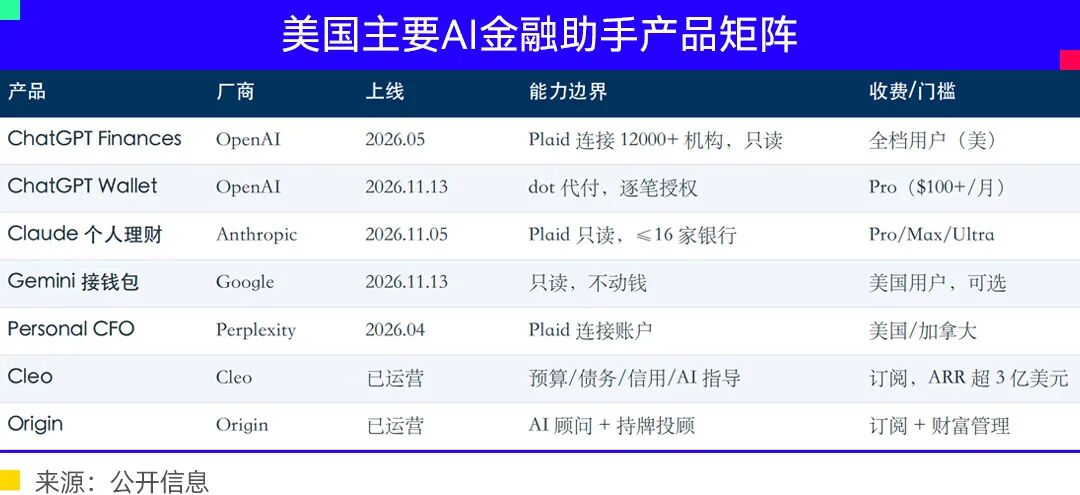
At the beginning of November, Anthropic launched the beta version of Claude Personal Finance. Soon after, OpenAI correspondingly released ChatGPT Wallet. The former helps users check their accounts by connecting to accounts, while the latter already allows agents to complete shopping payments after user confirmation.
The two have different functions, but they are striving for the same kind of trust — the trust that people dare to give their money to AI.
When people are willing to let AI understand their income, liabilities, consumption habits, and even investment needs, the companies behind AI are more likely to intervene in people's daily financial decisions.
This is certainly a market that Chinese AI companies can hardly ignore. But the problem is that when the chat window starts to connect to residents' savings, the product needs to answer not only whether the model is smart enough. Who provides these financial services, who makes the suggestions, who operates the funds, and who is responsible for the problems will all become a series of complex challenges.
01
Actions
Looking closely at the moves of the two leading US AI companies, there is a very specific starting point: helping users handle complex financial affairs scattered across different financial institutions.
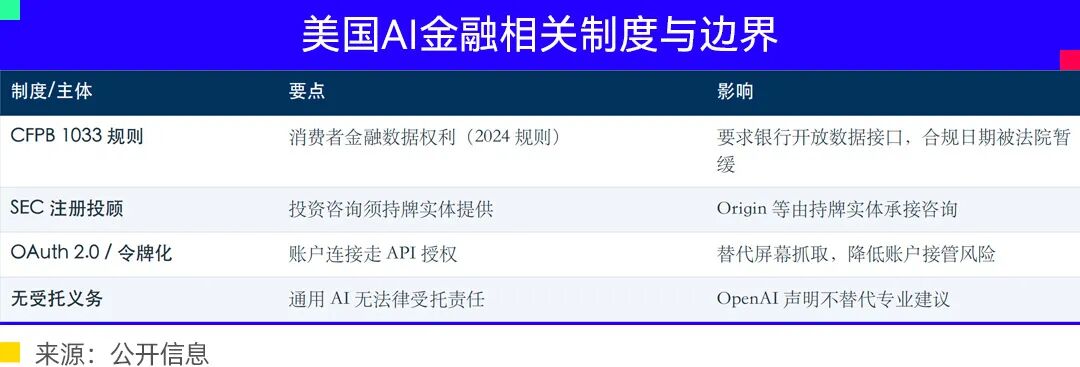
Some paid US users of Claude can connect their accounts via Plaid, aggregate balances, transactions and pending bills, and find duplicate deductions and abnormal charges. It currently only has read permissions and cannot transfer money or make investments; conversations in the personal finance section are not used for model training, and the section contains no ads or paid recommendations.
OpenAI is exploring two paths at the same time. Finances is used to organize expenses, assets and debts, and it also cannot trade on behalf of users. The newly launched Wallet connects to the payment network, which is first opened to adult Pro users in the US on dots. Users check the products, amount and bank card, and the payment will be made after passing security verification.
Account checking, advice provision and fund operation are being split into different permissions. The two companies have not directly handed over the entire family finance to a freely acting model, which means the whole matter is still in a relatively early stage.
This is related to the particularity of the US market: a person's salary account, credit card, loan and investment account may belong to multiple institutions, and each platform can display its own data, which is quite scattered.
The opportunity for AI lies in that it can turn these complex and scattered bills into a more understandable family financial arrangement: what expenses will be deducted before payday, what subscriptions can be cancelled to reduce expenditure, and what impact will reserving cash for a large consumption have.
The anxiety of ordinary people at the level of financial management can fully support a paid business. The startup Cleo combines budgeting, debt management, credit services and AI guidance into different subscriptions, and its official website states that its annual recurring revenue has exceeded 300 million US dollars.
Another company, Origin, is moving closer to wealth management. Its terms of service clearly stipulate that investment advice related to AI advisors and professional financial planning services is provided by its investment advisor entity registered with the U.S. Securities and Exchange Commission.
These two paths illustrate that personal financial assistants can not only make money through user subscriptions, but also enter the existing financial service system. Large model companies have a huge user entry, and what they are striving for is the most valuable position in this track: the first inquiry window for users, which can directly provide systematic service capabilities.
There are also clear regulatory responsibility boundaries in the US, but the specific situation will be significantly different from that in China.
02
Similarities and Differences
China's AI financial sector is not a blank slate, and the difference is more reflected in the organization of services.
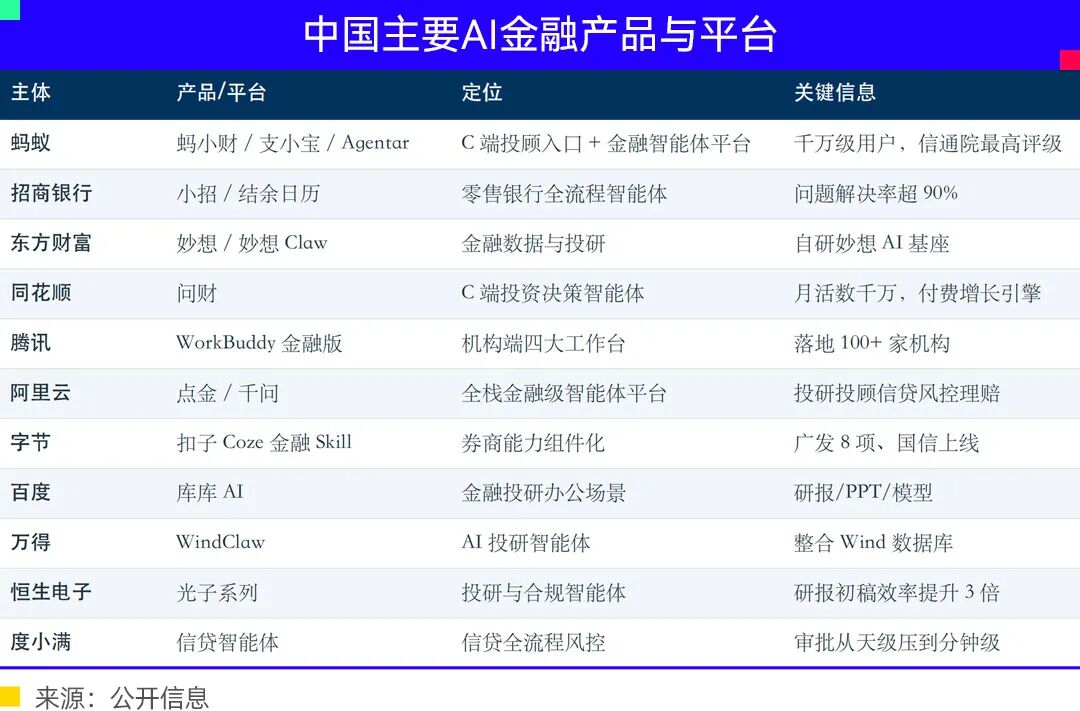
The representative product of Ant Group is "Ma Xiaocai", which provides services such as market interpretation and fund analysis, and emphasizes that professional services are provided by cooperative licensed institutions; China Merchants Bank has added a balance calendar, intelligent account retrieval and the "Xiao Zhao" intelligent service in its own App; Eastmoney's "Miaoxiang" focuses on financial data, charts and investment research analysis.
These cases all point to a more implementable path: financial platforms and institutions hold the relationship between accounts, products and services, and AI is embedded in them to help users understand and handle business. The difficulty faced by domestic general assistants lies in how to step out of the original scope of information services and enter the financial business legally.
The first boundary is service qualification.
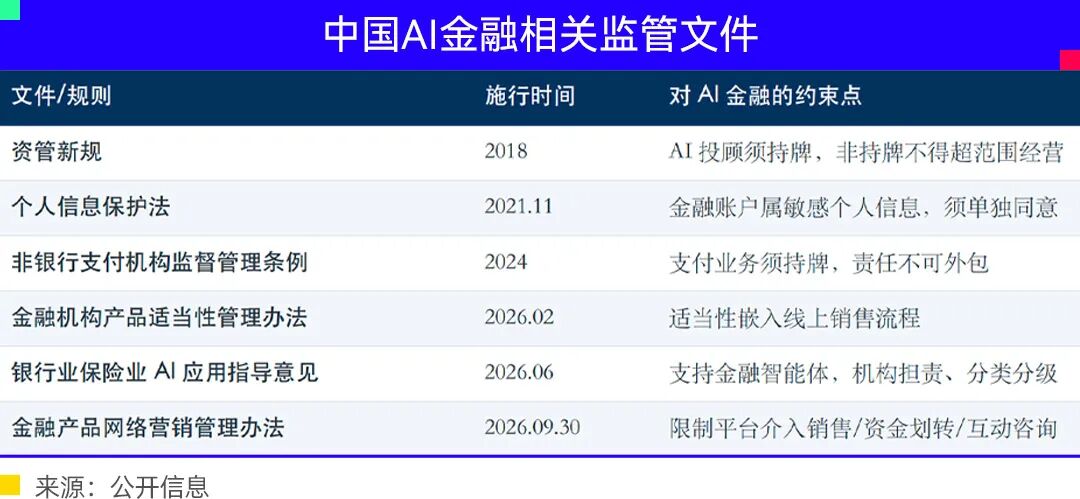
As early as 2018, the new regulations on asset management clearly stipulated that the use of artificial intelligence to carry out investment advisory business requires corresponding qualifications, and non-financial institutions cannot use intelligent investment advisory to operate beyond the scope or carry out asset management in disguised form.
Conveying the specific situation of a fund to users is different in nature from providing specific investment advice for a specific user. The fact that a model can write a configuration plan does not mean that the company operating this model is qualified to operate the corresponding business, and the high threshold of financial business has not disappeared on large models.
In addition, the new regulations this year have also brought more new constraints directly to the financial products of technology enterprises.
The Administrative Measures for the Online Marketing of Financial Products, which came into effect on September 30, requires third-party platforms to accept the entrustment of financial institutions to carry out marketing in accordance with the law. Article 20 clearly restricts platforms from illegally intervening in links such as sales contracts, fund transfer, and suitability assessment, and prohibits them from conducting interactive consultations with consumers and investors on financial products.
For AI companies that are used to connecting all services through conversations, this regulation is quite specific. If an assistant collects marketing fees from financial institutions and explains and recommends specific products to users in the chat, it is equivalent to intervening in the specific business at a deeper level.
The meaning of the regulation is very clear: it is difficult for AI companies to take charge of the whole process of recommendation, consultation and transaction only with a cooperation entry.
The second boundary is the protection of personal data.
The Personal Information Protection Law lists financial accounts as sensitive personal information, requiring that processing must have specific purposes and full necessity, and strict protection measures must be taken; separate consent from users is required for processing. In addition, if data is involved in outbound transfer, corresponding obligations shall be performed in accordance with applicable rules.
The fact that users want AI to understand them does not mean that key information such as bank statements can be unconditionally handed over to any model for use. In practical applications, the security boundary of user financial data will be a complex issue.
What is more feasible to implement first in China is that institutions provide services within the legally held data and approved business scope. For technology companies, making a reliable assistant for banks and large financial institutions is often more realistic than independently aggregating all bank accounts and directly operating family wealth management.
The third boundary is decision-making and execution.
The Measures for the Administration of Product Suitability of Financial Institutions, which came into effect in February this year, requires applicable institutions to embed suitability management into online sales processes, and match product risks with customers' affordability.
When a user says "help me increase the return", they have not completed the risk tolerance assessment, nor have they stated whether the money needs to be used to pay the rent next month. The more convenient it is to assign tasks through chat, the more the system needs to fill in the missing information, instead of interpreting every nod from the user as "unlimited authorization".
There are independent thresholds for fund operations. The Regulations on the Supervision and Administration of Non-bank Payment Institutions clarify the licensing requirements for payment business. AI can provide technical assistance within the scope of compliance interfaces and authorizations. The entities that actually engage in payment business still need corresponding qualifications, and the responsibilities of accounts, verification and transactions cannot be erased by a chat interface.
After several boundaries are superimposed, the form of China's AI financial products will inevitably be different. It can be predicted that financial explanation and risk reminders for the public will become more popular, and services involving specific products will be more concentrated in qualified institutions.
AI assistants are responsible for guiding users' demands to specific products, licensed institutions complete the corresponding business execution, and technology suppliers obtain service income, which will be a more feasible and smoother commercial path.
This also changes the competitive conditions. The barriers of financial AI include not only the model, but also user data, financial qualifications, business systems obtained through compliance means, and the corresponding ability to take responsibility.
03
Inevitability
Regulatory boundaries will affect the speed and sequence of AI entering the financial sector, but it is difficult to eliminate this demand.
The digitization and programmatic trading of banks and insurance have clearly demonstrated the ability of technology to change financial work. Large models further lower the threshold for understanding complex information, allowing some services that originally required reservation, payment or professional knowledge to reach ordinary families more frequently.
For users who do not have much assets, wealth management may first be to avoid overspending: understand the total cost of loans, know what exclusion clauses an insurance policy has, and identify whether several funds in hand are highly overlapping.
If AI can continue to do these things that are beneficial to users, its product value is also real.
Chinese regulators are also leaving room for development for compliant applications. In June this year, the State Administration of Financial Regulation issued the guiding opinions on the safe development and application of artificial intelligence in the banking and insurance sectors, supporting the exploration of financial agents, while emphasizing that the using institutions shall take responsibilities and strengthen classified and hierarchical management.
The improvement of the capabilities of financial assistants can not only help users, but also make the sales of financial products more efficient.
An AI that masters income, liabilities and sources of anxiety can remind users to reduce unnecessary borrowing earlier, and can also more accurately find the moment when he is willing to accept a certain loan. The fact that the answer is friendly and personalized enough does not prove that it represents the interests of users, and rejection is a more valuable suggestion among them.
Charging users, charging technical service fees to institutions, and obtaining income from product sales will form different incentives. Which part of the income technology companies want to obtain is the ultimate judgment of their own positioning.
In addition, security needs to be implemented in checkable links. Balances and bills must be traceable to original records, calculations are completed by reliable systems, and the model is responsible for explanation; clear confirmation and permission restrictions are retained for important operations; when errors occur, records can be found, execution stopped, and the responsible subject identified.
These arrangements will make some operations seem not smooth enough, but they are also the premise for ordinary people to dare to use them. A successful account connection and a family's assured use for many consecutive years are two levels of product capabilities.
From the perspective of existing products and systems, leading general AI companies in the US are more actively extending from user entry to financial services, while China emphasizes more on allowing AI to operate within licensed institutions and their responsibility systems. This is a difference in development paths, which cannot be deduced as that the US does not value safety, or that risks will not naturally arise in China.
Both paths eventually need to make up for the other side — US companies need to prove that the convenience of cross-account and cross-service can be continuously credible, while Chinese institutions need to make the compliance process truly transformed into user-friendly services. What residents need is to pay less unnecessary money, avoid risks and make more appropriate decisions, and safety is even more important than efficiency.
04
Conclusion
The entry of AI companies into user wallet management comes from, on the one hand, the real needs of users, and on the other hand, the profit-seeking motivation from their own development.
There are different qualification and responsibility requirements between reading balances, recommending products and operating funds. Even the most radical commercial institutions will understand the differences among them.
In China, regulators are more likely to promote technology companies to enter this market in a cooperative way, rather than "handle" everything on their own and transfer risks to users and the entire financial system.
The future competition in the financial sector depends not only on how many things AI can do for users, but also on whether it can restrain the impulse to sell, retain user choices, and take due responsibilities when errors occur. Obtaining permissions is only the beginning, and maintaining long-term trust from users will determine how far this business can go.
This article is from the WeChat Official Account "JuChao WAVE", author: Yuyang Gu, editor: YANG Xuran, published with authorization from 36Kr.