RICHARD MILLE That Rejects Chasing the Industry Benchmarks, The Anti-Scale Narrative of Luxury Watches
High watchmaking once followed the iron rule that the longer its history and the more precious metals it uses, the more valuable a timepiece will be.
Centennial watchmaking brands have built their industry discourse power through heritage, complex functions and precious metals, and time itself serves as a high entry threshold. RICHARD MILLE was not founded until 2001, with no stories of antique movements to talk about, nor does it pursue production capacity expansion, yet it has steadily stood at the top of the luxury Swiss watch retail sector.
According to reports from LuxeConsult and Morgan Stanley, in 2025, RICHARD MILLE recorded annual sales of less than 6,000 units, but its estimated wholesale sales reached about 1.75 billion Swiss francs (approximately 14.3 billion RMB), with an average retail unit price close to 290,000 Swiss francs (approximately 2.37 million RMB), ranking fifth on the sales list of Swiss watch brands.
When the entire track is locked by both historical legacy and production scale, what does a "latecomer" rely on to build long-term competitive advantages that do not depend on output or attach to traditional industry rules?
01 Born to Be Rebellious
No description fits the starting point of RICHARD MILLE better than "born to be rebellious".
At Baselworld 2001, a move by Richard Mille, the founder of the brand, shocked the entire watchmaking industry. He picked up the first tourbillon watch at his booth, and threw it to the ground in front of the passing crowds. The watch remained intact, and the tourbillon movement operated normally. In that era when precision movements had to be carefully taken care of, this was almost an open provocation.
But provocation itself was not the purpose. A newly founded brand with no archives to refer to and no antique movements to promote had to answer a question in full public view: Who am I?
Turn the clock back a hundred years. In 1900, in the small village of Les Breuleux in the Swiss Jura Mountains, Ali Guenat took over a small watchmaking workshop. For more than a century afterwards, the Guenat family went through the entire golden age of mechanical watchmaking, the impact of the quartz crisis, and the renaissance of mechanical watches in the 1990s, and watchmaking became a business passed down from generation to generation in the Guenat family.
Dominique Guenat, who took over the business in 1991, was originally supposed to follow this path steadily, stick to the family workshop and continue doing what the family had done for a hundred years. Until the turn of the century, he met Richard Mille.
Richard Mille himself is not a watchmaker in the traditional sense. He once worked in sales and managed operations in the luxury industry. What was on his mind was not "how to replicate an antique movement", but a more radical idea: Why are none of the high-end watches the way he wants them to be? Why can't we integrate material science, structural engineering and extreme performance into a watch just like what we do for sports cars?
A workshop with a century-old manufacturing foundation meets an outsider who wants to rewrite the narrative logic. This combination itself determines the brand's genes: the manufacturing capability is ready, but the way to tell stories has to be built from scratch.
The Guenat family's history is rarely mentioned, because it does not belong to the RICHARD MILLE brand. But it needs to be emphasized that when the brand launched its first work in 2001, a century-old watchmaking family was already standing behind it.
This also explains the sudden emergence of the RM 001 tourbillon watch. It was unexpected, but not accidental.
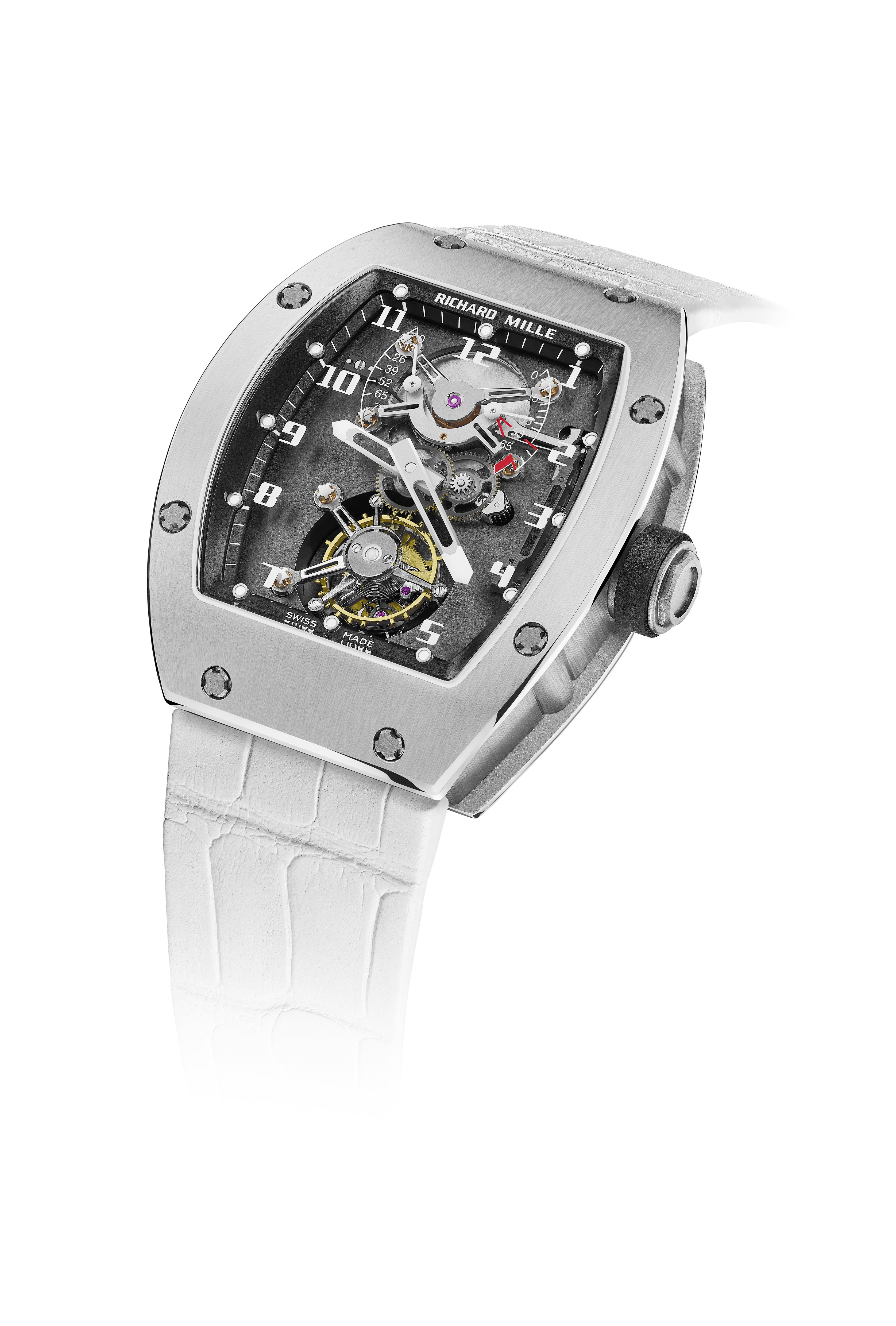
This watch was almost an outlier at that time. The curved barrel-shaped case, exposed structural screws, fully skeletonized movement, high-tech materials, plus its subversive impact resistance performance overturned the default rules that high watchmaking had followed for hundreds of years, such as round cases, closed structures and fragile movements.
These are not deliberate novelties in aesthetics. The exposed structure means every single screw has to withstand close inspection, and the skeletonized movement requires all internal parts to have both functional and ornamental value. In other words, the more rebellious it looks visually, the harder it is to make in terms of engineering.
What supports this radical approach is a development logic that runs counter to the entire industry. RICHARD MILLE will first ask "what do we want to achieve", and then find corresponding materials, technologies and engineering solutions, instead of calculating costs first and then compromising the design for cost reasons. This also means that as long as the engineering and design team can realize the technical concept, there is no budget limit.
This is the "No Compromise" engraved in the brand's genes.
Richard Mille himself put it more directly: "I hoped to launch my own brand a long time ago, to build a new business model completely different from traditional marketing strategies. My goal is to create a brand new and advanced luxury market segment in the high-end watchmaking industry, and I can't wait to see what kind of situation it will create."
02 Lab on the Wrist
The future Richard Mille longed for is never just a nice slogan.
He sent the watches to two places that are most unsuitable for precision machinery to survive: professional tennis courts and the seats of racing cars. He wanted to prove that precision machinery is no longer a collection that can only be displayed, but a high-performance tool that can withstand high-intensity confrontation.
As the "King of Clay" who has won 14 French Open championships, Rafael Nadal has been wearing RICHARD MILLE to compete in professional events since 2010. Unlike many athletes who only wear cooperative brand watches when attending activities after matches, Nadal wears RICHARD MILLE on his wrist every time he swings, slides and dives to save the ball.
To make this happen, the brand had to create a watch that is light enough, shock-resistant enough, and equipped with a tourbillon at the same time. As Nadal's Grand Slam record keeps being refreshed, the cooperation with RICHARD MILLE has continued from the first RM 027 to this day. This series of works has continuously broken the performance boundary of manual tourbillons. By the RM 27-05 launched in 2024, the entire watch weighs only 11.5 grams (excluding the strap), the movement weighs only 3.79 grams, and it can withstand an impact of more than 14,000 g acceleration.
Nadal's dedication to breaking limits is highly aligned with Richard Mille's innovative philosophy. The two have built a trust beyond ordinary cooperation: Nadal calls Richard Mille "a progressive who always pushes the watchmaking industry forward", and Richard Mille defines this cooperation as a lifelong commitment.
Racing is another testing ground for RICHARD MILLE.
As we all know, F1 represents the global benchmark for engineering technology. Its unremitting pursuit of lightweight, structural efficiency, material performance and reliability is naturally aligned with RICHARD MILLE's watchmaking philosophy. Richard Mille once said bluntly: "Only by reaching the R&D investment level of F1 racing cars and realizing the perfect unity of visual design, performance and technical strength, can a product be qualified to become an element of RICHARD MILLE."
It is worth mentioning that in 2004, the brand developed the RM 006 tourbillon for Felipe Massa, the then Ferrari F1 driver. This Brazilian driver almost became the brand's watch tester, wearing it in every race. The RM 006 weighs only 42 grams, barely heavier than a bank card. But during the qualifying session of the 2009 Hungarian Grand Prix, Massa hit the tire barrier at a speed of 120 miles per hour, suffered a serious head injury and almost lost his life, while the watch remained completely intact.
The reason why this incident is convincing is precisely because it was not under the brand's control. The competition field does not cater to any narrative, it only presents results. But results never come out of nowhere. Behind a watch that "survived" the accident are batches of prototypes that were scrapped during tests.
The RM UP-01 watch jointly created with Ferrari is also a product of this logic. Its independently developed movement is only 1.18mm thick and weighs 2.82 grams, yet it can withstand an acceleration impact of 12,000 g. It has become an ultra-thin watch that can be truly worn daily, breaking away from the opportunistic path of traditional ultra-thin watches that use the case back as the movement baseplate, and fully retaining mechanical performance and durability in the millimeter-level space.
For example, during the R&D process of the RM 027 worn by Nadal, 4 prototype watches were damaged. Every damage meant disassembling the structure, locating the failure point, improving the design, and then making a new prototype. This testing method based on destruction is the norm for the RICHARD MILLE Laboratory department.
This is one of the most distinctive departments in RICHARD MILLE, which is mainly responsible for testing the performance of watches under different physical conditions and extreme environments, including impact resistance, waterproof performance, acceleration shock, movement calibration, simulated aging and so on. Every prototype watch has to go through a complete set of physical and environmental tests. At RICHARD MILLE, testing is no longer the last step before leaving the factory, but the first input in the design process.
From the perspective of time scale, in RICHARD MILLE's workshop, when all parts are ready, the assembly of an ordinary watch takes 1 to 2 days, and a complex watch with functions such as Rattrapante takes 2 to 3 days. Tourbillon watches are of another magnitude: the pure assembly time alone takes 6 weeks, and with testing and verification, the entire cycle lasts 2 to 3 months.
Moreover, the brand implements a highly clear personal responsibility system. The assembly of a tourbillon watch from the first part to the last screw is completed and signed by the same watchmaker. However, the number of such watchmakers is very limited, and they usually need 15 to 20 years of working experience with superb skills.
What the market sees as scarcity is the huge gap between RICHARD MILLE's demand and its annual output of about 6,000 units. But this is not the result of "hunger marketing", but the unique physical boundary of the complex manufacturing system composed of batches of scrapped prototypes, monthly-level assembly cycles, and a very small number of senior watchmakers.
But to this day, RICHARD MILLE no longer only represents a brand, it is also a symbol of cutting-edge engineering technology and elite status.
03 The Order of Scarcity
For the luxury watch industry, the current period is full of challenges. The Swiss watchmaking industry has transformed into a value-centered rather than volume-oriented industry, and the head effect is intensifying.
Earlier this year, a Morgan Stanley report showed that the top four brands occupy more than 50% of the entire Swiss watch market. RICHARD MILLE has become the brand that comes right after Rolex, Patek Philippe and Audemars Piguet, and is structurally isolated from the turmoil that has affected almost all other brands. At the same time, among about 450 Swiss brands, only 6 brands had wholesale sales exceeding 1 billion Swiss francs in 2025, and RICHARD MILLE is one of them.
Its barrier is not the victory of a single technology or a single product, but the victory of the coupling relationship between design recognition, material and engineering capability, vertical manufacturing depth, channel control and competition field verification. This interlocking system allows the brand to jump out of the traditional watchmaking framework of competing on history, output and channel coverage, and establish an independent value evaluation standard.
To safeguard this value system, RICHARD MILLE has also built two layers of moats at the institutional level.
The first layer is the fully direct-operated channel system. 100% of global sales are directly operated, and the number of boutiques is strictly controlled. In a multi-brand distribution system, scarcity can easily be diluted by allocation logic and the profit-seeking nature of channels.
Some limited-edition and high-complexity works of RICHARD MILLE are produced in extremely small quantities. For example, a certain ceramic diamond-set limited watch is produced in only about 40 units in a single batch, while the global boutique network has about 42 stores. Therefore, even if each boutique is theoretically allocated one unit, it cannot guarantee that all stores can get the full quota, and some stores may not even get a single unit.
Maintaining independent operation is another institutional guarantee for the success of the RICHARD MILLE model. It does not need to face the short-term performance pressure of listed companies, which allows the brand to actively adjust production during periods of fluctuating demand, instead of blindly expanding for the sake of revenue statements.
Since 2022, the new generation of managers from the two families have taken over the business. Alexandre Mille, son of Richard Mille, serves as the brand's commercial director, and his daughter Amanda Mille is in charge of brand friends and partners. Cécile Guenat, daughter of Dominique Guenat, is responsible for the R&D and design of the brand's products, and her son Maxime Guenat serves as the general manager of the watchmaking factory. The smooth continuation of the governance structure ensures that the scarce competitiveness does not depend on the will of a single generation.
RICHARD MILLE may be a maverick brand in the field of high watchmaking, but its influence is revolutionary. It has also successfully proved that there is never only one narrative track for high watchmaking. When most brands look for discourse power in their century-old heritage, instead of catching up with the standards set by predecessors, it is better to focus on the whole set of engineering systems, long-term governance and self-restraint.
This is the scarcity order of RICHARD MILLE.