Chinese electric motorcycles at EICMA Milan: Ninebot Segway makes its debut, and the overseas expansion of Chinese two-wheeler industry enters its second half.
The scene of Audrey Hepburn and Gregory Peck riding a scooter through the old town of Rome is widely regarded as the most classic depiction of a romantic holiday in film history — two-wheeled riding is not only a travel demand, but also a lifestyle.
EICMA, held annually in Milan in late autumn, is the annual "Italian Holiday" for the global two-wheeler industry. This time, more Chinese faces have stepped into the spotlight.
On November 3, the 2026 Milan International Motorcycle and Accessories Exhibition (EICMA) opened. The exhibition, spanning 10 pavilions and bringing together more than 2,000 brands from over 50 countries, is officially billed as the largest edition ever. Amid thousands of brands exhibiting side by side, the debut of SEGWAY electric motorcycles under Ninebot still drew extensive attention and coverage from visitors and overseas electric two-wheeler industry media. Ninebot is also the first electric two-wheeler enterprise in the industry to receive full-length news coverage from three CCTV news channels, namely CCTV-13, CCTV-4 and CCTV-2.
The concentrated release of three new models marks the official entry of Ninebot into the global professional electric motorcycle market. Against the backdrop of rising export volume and prices of Chinese two-wheelers and accelerated global electrification of mobility, the focus of industry competition is shifting from shipment volume to technological and brand discourse power. Ninebot's electric motorcycle debut in Milan provides an excellent observation sample.
Three New Products, Ninebot's Globalization Puzzle Unveiled in Milan
At this year's EICMA, Ninebot Segway took the theme of "Fear No Place", covering three scenarios including future technology exploration, professional off-roading and urban mobility with three product lines.
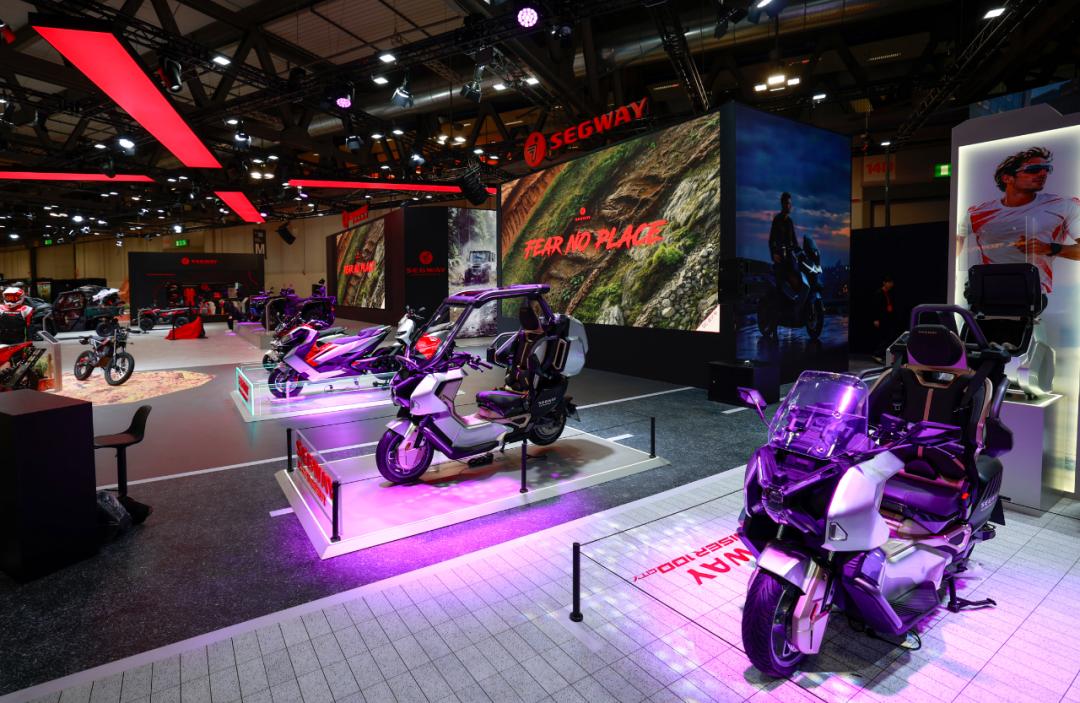
As the core concept product on the booth, the SEGWAY ORCA CONCEPT fully presents Ninebot's technological exploration for the next-generation high-performance electric maxi-scooter.
The appearance of this product is co-designed by Ninebot and Hardline27, a studio founded by designer Sasha Selipanov. In terms of engineering, it adopts an 800V high-voltage platform, a battery close to 20kWh and an electric drive with a maximum power of 60kW, and applies self-developed CTB integrated all-aluminum body, front and rear multi-link suspension and CDC multi-mode adaptive shock absorption. According to current laboratory engineering targets, it delivers a range of 300km, a top speed of over 180km/h, 0-100km/h acceleration in 4.5 seconds, and is compatible with automotive-level AC and DC charging, with a maximum DC power of 48kW.
Although Ninebot's official notes that these figures do not represent mass production specifications, for maxi-scooter products where range and energy replenishment remain core purchase concerns, the value of this set of parameters lies in marking the upper limit of technology.
The X-series, which takes the Dakar Rally as its technical starting point, is Ninebot's mass-produced solution to enter the professional off-road market.
As the engineering development platform of the X-series, the SEGWAY XABER X1000 has consecutively participated in the 2025 and 2026 Dakar Future Mission 1000 challenges. The vehicle has a curb weight of about 200kg, a 15kWh battery, a peak power of 50kW, and a top speed of over 140km/h. The mass production platform has launched three models according to market consumption, regulations and other demands: the XABER 350 has been launched in Chinese mainland, equipped with a 72V 54Ah battery and a mid-mounted flat wire motor with a peak power of 23kW; the XABER 300 has been launched in North America, with a peak power of 21kW, targeting professional off-road users; the upcoming XABER 300 DS to be released in Europe is tuned according to local regulations, for both road and off-road use.
The three models share an aluminum alloy frame, 270mm ground clearance and Marzocchi suspension, and are standardly equipped with TCS, electronic clutch, hill hold, AirLock intelligent unlocking and full-vehicle OTA. Splitting the same platform by regulations and scenarios is a rare practice in the off-road vehicle segment.
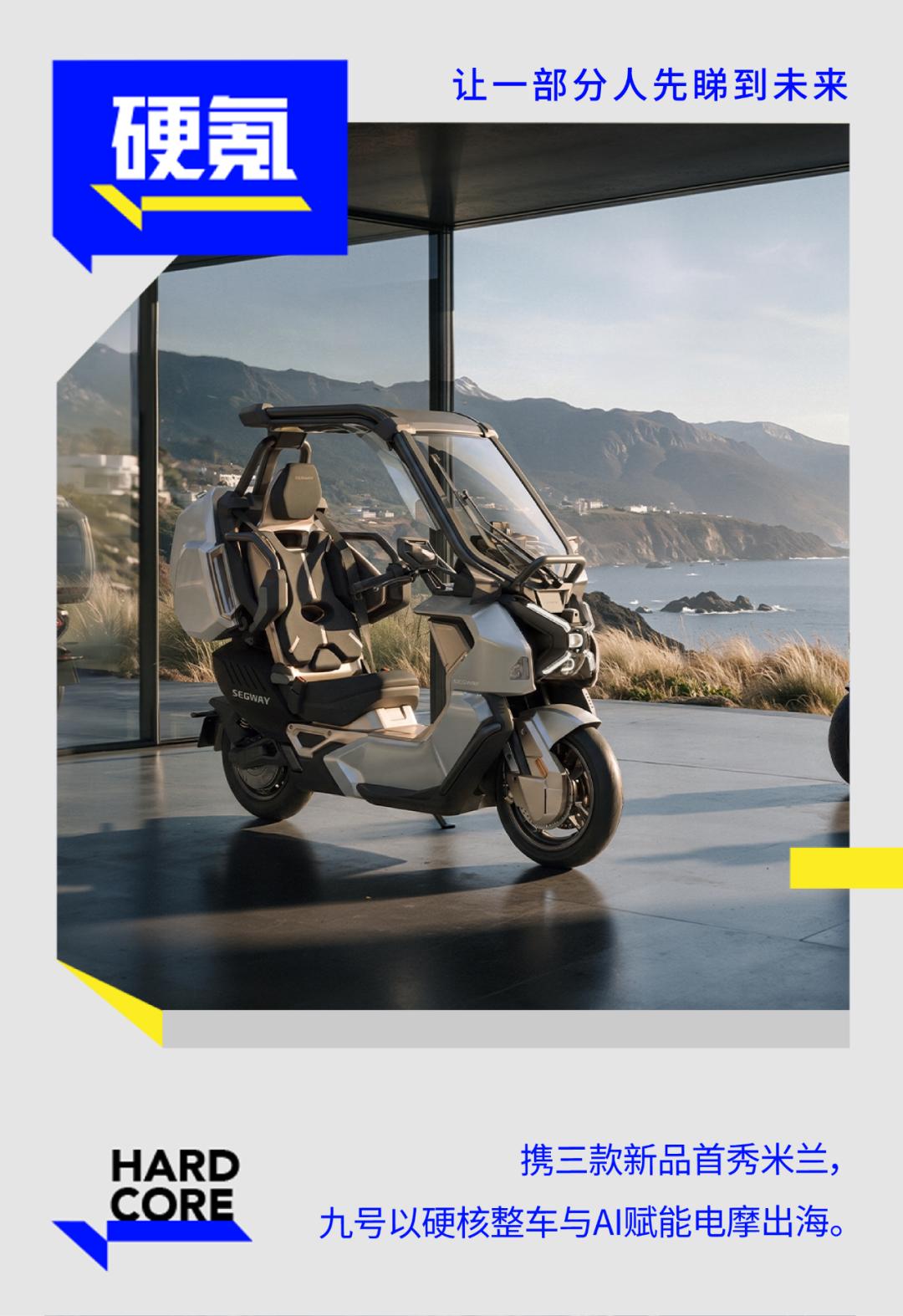
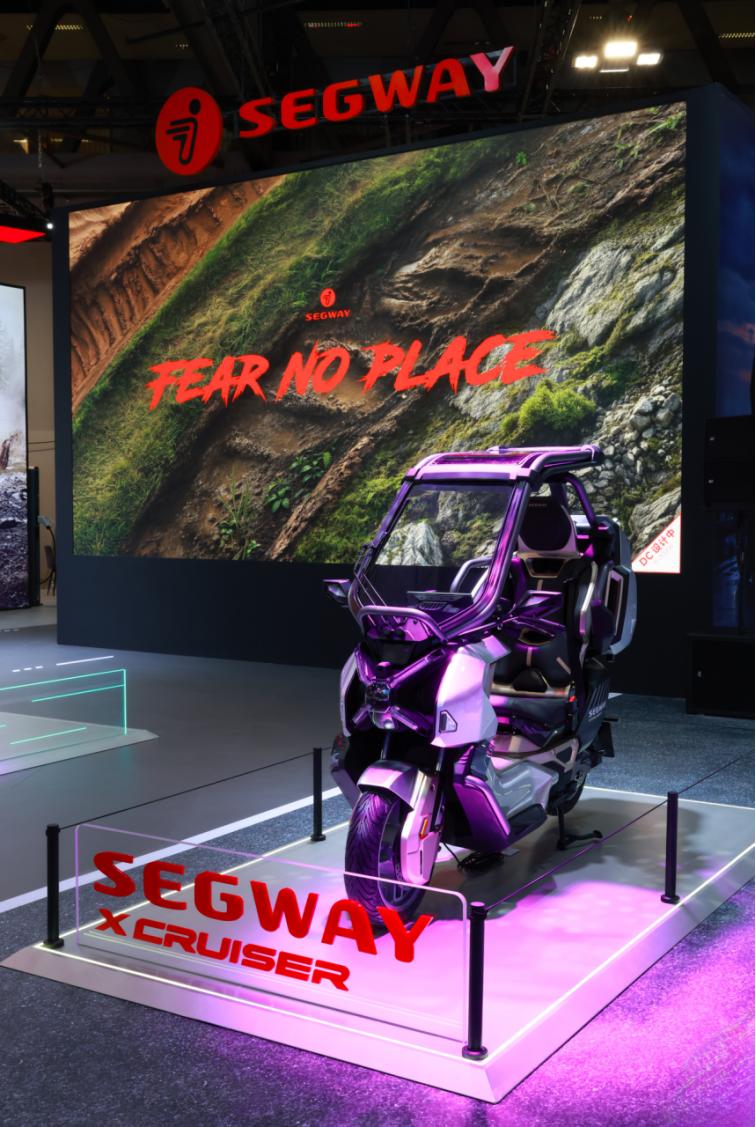
The SEGWAY X CRUISER, designed for urban commuting and medium-short distance motorcycle trips, brings automotive crash safety design methods to two-wheelers: it is forward-designed based on automotive crash conditions, and improves rider protection through cage or semi-cage body, four-way crash protection, graded energy absorption and seatbelt restraint. For active safety, it is equipped with BSD blind spot monitoring and LCW lane change warning. This series integrates two-wheeler intellectual property and proprietary knowledge authorized by the BMW Group, with Ninebot responsible for full vehicle development, certification and launch. The entire line is equipped with ABS and TCS, a 10.25-inch TFT dashboard and dual-channel audio, fitted with Michelin City Grip tires, and has a planned range of nearly 200km based on CTB (Cell to Body) battery-body integration.
To adapt to different scenarios, this series has launched three different models: the 100 City targets short-distance trips in European cities, adopts L1e-B regulatory classification and is equipped with a five-point seatbelt; the 350 GT serves two-person trips and medium-short motorcycle trips in China and Europe; the 350 GT Ultra adopts an integrated roof rain shelter, and a 55L electric rear box is optional. The three models are expected to be launched in China and Europe between 2027 and 2028.
In addition to the three new product lines, Ninebot also brought its globally sold products to Milan, covering continuous scenarios from commuting to field exploration.
Ninebot's dual-brand and globalization strategy has been laid out in previous arrangements.
At the 2026 User Conference held last January, Ninebot released a strategic upgrade centered on "dual brands, globalization, and electrification replacing fuel": Ninebot serves the mass market, while SEGWAY focuses on the professional and high-end segments, with a unified technology base supporting both brands to go global.
Wang Ye, Founder and CEO of the company, judges that global two-wheeled mobility is on the eve of the electrification revolution. At that time, the penetration rate of electric two-wheelers in Southeast Asia was only about 5%, and European users' acceptance of green energy and intelligent mobility was on the rise. According to the strategic plan, Ninebot will promote the experience of intelligent electric two-wheelers to surpass that of internal combustion engine two-wheelers in the next ten years.
Dakar and Michelin: "Professional Discourse Power" in Extreme Scenarios
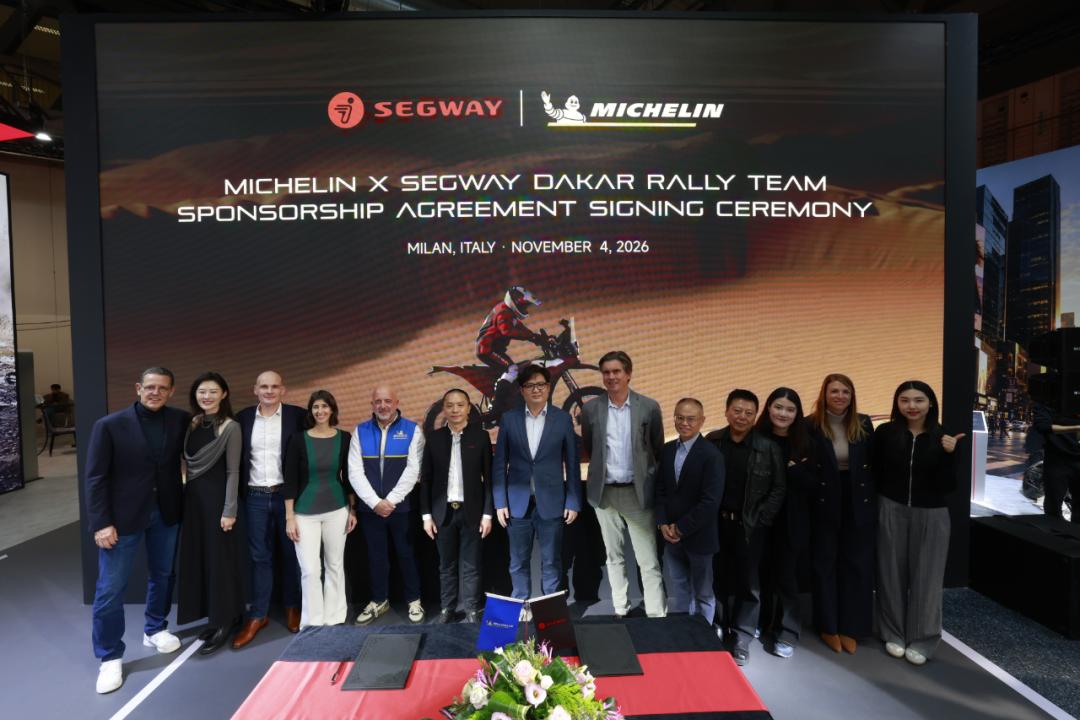
In addition to exhibiting three series of new products, Michelin officially became the official technical sponsor of the SEGWAY Dakar factory team at the exhibition site, which marks the first time that Michelin has officially sponsored a new energy electric motorcycle Dakar team.
The cooperation between the two sides has a clear direction: taking the long distance, high load, temperature changes and varied terrains of the Dakar Rally as a joint R&D and real verification platform, to systematically evaluate the feasibility of the electric powertrain system under extreme working conditions, as well as the matching, durability and energy efficiency performance of tires and the whole vehicle.
In addition to verifying performance through "extreme challenges", supporting cooperation at the mass production end guarantees the implementation of this link. On October 23, Ninebot and Michelin signed a strategic cooperation framework agreement at Ninebot's Changzhou base, to collaborate on original equipment matching, tire R&D, after-sales replacement and offline service network. Segway also plans to prioritize Michelin original equipment tires on its mass-produced high-end performance motorcycles.
Previously, Segway's Dakar experience has been accumulated for two consecutive years. In 2025, 19-year-old rider Benjamin Pascual drove the XABER X1000 to win the championship of the Future Mission 1000 motorcycle category. For electric off-roading, the value of the Dakar Rally lies not only in rankings, but also in the fact that motorcycles can only verify the boundary limits of a series of underlying solutions such as battery thermal management, electronic control calibration, and energy replenishment strategies after being driven in real desert conditions.
From Dakar verification to mass production launch, competition in the electric motorcycle industry is shifting from paper parameters to the competition of the whole vehicle system.
Behind this is the incremental space reflected by market trends. According to data from the European Association of Motorcycle Manufacturers (ACEM), from January to September 2026, motorcycle registrations in the five major markets of France, Germany, Italy, Spain and the UK reached 944,100 units, a year-on-year increase of 14.6%. Italy ranked first with 313,000 units, and Europe is at the intersection of a recovering two-wheeler market and accelerated electrification.
The considerable incremental market provides a market foundation for Ninebot to layout its electric motorcycle product lines for diverse usage scenarios. Entering the professional electric motorcycle segment from the short-distance mobility track, Ninebot is not starting from scratch, but leveraging its long-accumulated technology base to migrate mature capabilities to new categories.
The technological accumulation that Ninebot has polished in its short-distance mobility products, such as electric drive systems, battery management, intelligent electronic control, full vehicle interconnection, OTA upgrades and human-machine interaction, can be continuously reused. On this basis, Ninebot continues to complement professional capabilities including high-performance power platforms, body structure, suspension and braking, dynamic safety, overseas regulatory certification and extreme working condition event verification, and gradually builds a complete full-vehicle system covering concept R&D, extreme scenario testing and mass production implementation.
Competing on AI After Scale: The Next Variable for Chinese Electric Motorcycle Exports
By the end of September this year, the cumulative domestic shipment of Ninebot's intelligent electric vehicles has exceeded 14 million units.
Meanwhile, according to customs data counted by the China Motorcycle Chamber of Commerce, from January to July 2026, China's total motorcycle exports reached 11.6487 million units, a year-on-year increase of 11.56%, with an export value of 7.811 billion US dollars, a year-on-year increase of 19.58%. The growth rate of export value is significantly faster than that of export volume. The export structure is showing a change of "maintaining scale in developing countries and improving value in developed markets".
Electrification is the steepest growth curve — China's electric two-wheeler exports exceeded 26.7 million units in 2025, with an export value of 6.829 billion US dollars. In the first quarter of this year, the export of electric motorcycles from private enterprises increased by more than 30% year on year.
Reflected in the operating performance of relevant enterprises, taking Ninebot as an example, its 2025 annual report shows that the company's overseas revenue reached 7.928 billion yuan, a year-on-year increase of 37.35%, accounting for 37.26% of total revenue, and the gross profit margin of overseas sales reached 36.01%. This shows that overseas business has become an important source of Ninebot's growth and profitability, and going global has been upgraded from a channel supplement to a strategic main line.
In addition to the changing sales structure, AI is also becoming another variable in this collective wave of Chinese electric motorcycles going global.
On the one hand, China's large model training capabilities, computing power supply and data base allow Chinese enterprises to embed models into products and organizations earlier and faster. At the product end, they can directly call ready-made models for voice interaction, range prediction and fault diagnosis to improve driving experience. At the enterprise end, these capabilities can be used for battery safety, quality management and supply chain collaboration, blazing a path that traditional European motorcycle manufacturers cannot replicate in the short term.
For example, for the products Ninebot exhibited at EICMA this time, the entire XABER line is standardly equipped with full-vehicle OTA and AirLock intelligent unlocking, the X CRUISER makes BSD blind spot monitoring, 10.25-inch dashboard and intelligent cockpit standard configurations across the whole line, and the N5 and M5 200 are equipped with RideyFUN, RideyGo intelligent driving system and active accident distress call. Behind the successive launch of these functions is a mature end-side AI and interconnection supply chain: from sensors, automotive-grade chips to communication modules and cloud platforms, the maturity of domestic supporting resources makes "adding intelligence" no longer equal to "adding cost", and enables two-wheelers to have the capability of annual iteration for the first time.
On the other hand, what is more noteworthy than intelligent configurations is the change of competition metrics. As two-wheelers evolve from "alternatives to fuel vehicles" to "intelligent mobility nodes", range and power are being rapidly equalized. What truly creates gaps is the speed of software iteration, data accumulation for active safety and cloud collaboration. This is exactly the strength of Chinese brands compared with traditional European motorcycle manufacturers, and it is also the part that the latter cannot make up for in the short term — the key to victory in the second half of going global may not lie in how many more vehicles are sold, but in who can define the product standards of "intelligent electric motorcycles".
Chinese electric motorcycles departing from Milan are undergoing the transition from scale to intelligence. Ten years ago, Chinese two-wheeler exports relied on cost and supply chain efficiency; today, new power brands represented by Ninebot take the lead in entering the global professional electric motorcycle track with a complete product matrix, self-developed technology base and intelligent capabilities, opening up a new paradigm for domestic two-wheeler exports. The dimension of industry competition has thus shifted from the competition of orders and prices to the contest of technical standards and industrial discourse power.
The spotlights in Milan will eventually go out. For Ninebot, which has just completed its electric motorcycle debut, the real test is not on the exhibition booth, but on the European streets after 2027.