Piercing through the fog of public opinion, which side of Universal Beijing Resort is the real truth?
Lu Yan | Author
LIU Xuehui | Editor
Lishi Business Review | Production
1 The Huge Contrast Between On-site Reality and Online Public Opinion
On a weekday in mid-November, the temperature at Universal Beijing Resort located in Tongzhou, Beijing, has dropped to a level where down jackets are a necessity. In the cultural tourism industry, this period is usually referred to as the off-season, and many well-known cultural tourism projects that used to charge admission fees have opened to tourists for free one after another, to maintain the basic passenger flow required for catering and retail businesses in the park.
However, on this weekday, when the author visited Universal Beijing Resort, a different scene unfolded. From 10 a.m. until late at night, the entire park was packed with people, showing no signs of the coldness typical of the off-season. During peak seasons, Universal Beijing Resort is even more crowded with surging crowds.
The booming popularity of Universal Beijing Resort is not just the author's subjective perception, and data reports from third-party institutions have also confirmed this point. Themed Entertainment Association's "2025 Global Experience Index" shows that Universal Beijing Resort received 9.804 million visitors in 2025. Starting from about 4.3 million visitors in 2022, it has achieved four consecutive years of growth and hit a record high. According to official park disclosures, the number of visitors entering the park in August and September 2026 once again refreshed the historical record, and the visitor reception volume in the third quarter achieved double-digit growth.
In sharp contrast to the booming passenger flow in the park is the pessimistic public opinion about Universal Beijing Resort that has continued to appear on the Internet in the past month. Since Comcast, one of the shareholders of Universal Beijing Resort and the party that consolidates its financial statements, released its third-quarter financial report showing that as of September 30, 2026, its assets related to Universal Beijing Resort included in the consolidated statement were approximately 7.7 billion US dollars, while its liabilities were approximately 7.8 billion US dollars. As a result, a number of articles using gimmicks such as Universal Beijing Resort having "negative net assets" and "insolvency" have been widely spread on the Internet.
On one side is the booming on-site tourist flow, and on the other side is the pessimistic public opinion on the Internet, which makes a large number of the public quite confused: what is the truth? To figure out the real logic behind this, the author conducted a detailed study on the financial and operational status of Universal Beijing Resort. After the research, the author found that Universal Beijing Resort is not only in good operating condition, but its unique business model and core capabilities may be important clues to understand the long-term operating potential of Universal Beijing Resort.
2 The Truth Behind the Financial Figures
Among the financial information of Universal Beijing Resort disclosed by Comcast, the indicator that confuses the public most is "net assets". However, readers familiar with corporate finance and value evaluation will know that "net assets" has very little reference value when measuring the true value of an enterprise. For example, in the capital market, there are countless companies whose market value is several times or even dozens of times their net assets, because enterprise value depends on the discount of future cash flow and the core capabilities that support the enterprise's future cash flow.
For a project like Universal Beijing Resort, where hundreds of billions of yuan are one-time solidified into buildings, equipment, scenes and land, the distortion of net assets is particularly obvious. The vast majority of its investment will form fixed assets in the financial statements, recorded at construction cost, and then depreciated year by year. On the contrary, Universal Beijing Resort's differentiated business model, core capabilities, location scarcity, user reputation and nearly 10 million annual tourists mostly do not constitute recognizable assets in accounting. On the financial statements, the asset side only records the part where money is spent, not the truly most valuable part.
In addition, according to the provisions of the current leasing accounting standards, long-term operating leases of enterprises are not only included in the current expenses, but the total rent obligations to be paid in the remaining lease period shall be recognized into the balance sheet on the lease commencement date. In the financial statements of Universal Beijing Resort, a considerable proportion of liabilities are lease liabilities, which means that it has included the long-term lease expenses to be paid in the future into the liability side in advance, further widening the gap between the book figures and the operating reality.
With the continuous operation of the enterprise, depreciation will eventually come to an end. After the depreciation and amortization of major facilities are completed, the same income corresponds to lower costs, and the book profit will improve significantly; after the syndicated loan is repaid as planned, financial expenses will also decrease year by year. At that time, Universal Beijing Resort is expected to usher in profit release and a significant improvement in its balance sheet. However, for large heavy-asset projects, it often takes a long operating cycle from the huge upfront investment to the gradual release of profits.
It is precisely for this reason that when evaluating a super-large heavy-asset resort project that has just opened for five years, we cannot make judgments solely based on the current book losses. The outside world often compares Universal Beijing Resort with Shanghai Disneyland, which "turned a profit in the first year of opening", but this is actually a misreading. A simple breakdown of the public caliber will show that Shanghai Disneyland's "profit" back then was not a positive accounting net profit, but an operating-level "break-even" - at that time, the depreciation of fixed assets and loan interest amounting to tens of billions of yuan were still under the book, suppressing the net profit. Aligned to the same set of operating logic, Universal Beijing Resort also disclosed "its first quarterly operating profit" via Comcast in the third quarter of 2022 (just one year after opening), and its adjusted EBITDA has remained positive for multiple statistical periods thereafter, once reaching about 200 million US dollars, and still remained positive at about 100 million US dollars in the past 12 months as of the end of September 2026. In other words, before deducting depreciation, interest and income tax, the operating cash flow of both parks in the early stage has already been realized. Just like Shanghai Disneyland back then, the huge book losses of Universal Beijing Resort at this stage are only the projection of the "concentrated release period of depreciation and interest" that super-large heavy-asset projects must go through in the first five years of opening, rather than operational failure.
In addition, there is never a simple linear relationship between passenger flow and book profit. Even for Shanghai Disneyland, which has been in operation for ten years, the number of park visitors increased from about 14 million to 14.7 million between 2023 and 2024, but the consolidated net profit of its Chinese shareholder, Shen Di Group, dropped from 2.211 billion yuan to 1.858 billion yuan, and further dropped to 1.281 billion yuan in 2025. The profit of Shen Di Group is not equal to the profit of Shanghai Disneyland itself, but this comparison is sufficient to show that drawing a conclusion for a heavy-asset theme park based on the net assets or net profit of a single year is prone to deviation.
From the perspective of the two core shareholders, Beijing BTG and NBCUniversal, the financial and operating status of Universal Beijing Resort is not only not a cause for concern, but it is also a crucial core asset for both of them. One of the two shareholders gains industrial value and urban value, while the other gains long-term strategic value.
Among them, as a state-owned cultural tourism enterprise, the core mission of Beijing BTG is to promote the development of Beijing's cultural tourism industry, and Universal Beijing Resort has completed this strategic mission beyond expectations in driving employment, tax revenue and regional development. Public data from Beijing shows that from 2021 to 2025, the added value of the cultural, sports and entertainment industry in Tongzhou District increased by more than 10 times, and its proportion in the district's GDP rose from 0.5% to 4.7%; in the summer vacation of 2026, the order volume of homestays around the resort increased by 93% year-on-year, and the proportion of orders for two nights or more reached 39%. A resort directly and indirectly drives tens of thousands of jobs, a considerable part of which are skilled jobs that require long-term training, and these will all precipitate into the underlying capabilities of the urban cultural tourism industry. For state-owned shareholders, these outputs cannot be measured by current profits, nor should they be judged by the net assets of a single year.
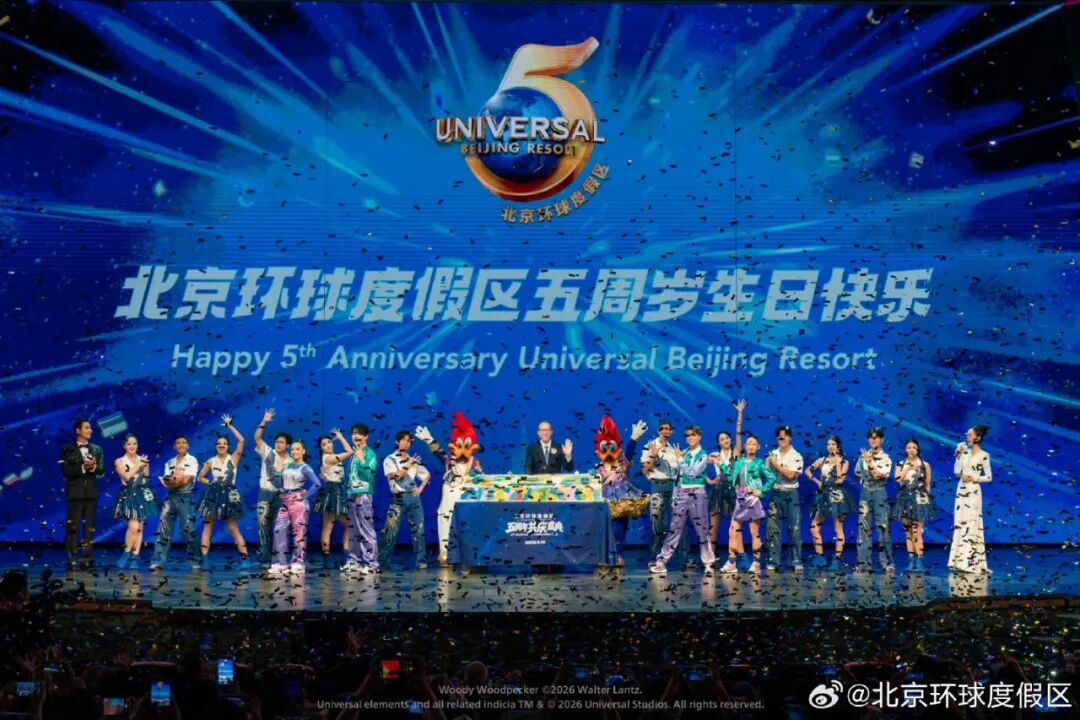
For NBCUniversal, Comcast made it clear at its financial report meeting that the current unfavorable factors are short-term and cyclical, and it remains confident in the long-term growth of its theme park business. This year marks the fifth anniversary of the opening of Universal Beijing Resort, which has announced that it will create two brand new experiences - Asia's first "Fast & Furious" indoor themed ride experience and the Lagoon Blue night entertainment show, proving its long-term confidence in the Chinese market and its firm willingness to invest with practical actions.
3 Misinterpretation of IP Cooperation and the Truth of the Open Ecosystem
Financial statements present the operating results of an enterprise in a specific period. To further understand the long-term competitiveness of a theme park, we also need to study what it is doing. At this level, the biggest doubt the outside world has about Universal Beijing Resort is: "The IPs are not self-owned. Relying on external cooperation not only fails to build a moat, but also pushes up content costs and further exacerbates losses." The author has long focused on the operation paths of theme parks such as Universal Studios Japan Osaka and Shanghai Disneyland. Among them, the successful practice of Universal Studios Osaka expanding its content boundaries through IP cooperation is particularly worthy of study.
When Universal Studios Osaka opened in 2001, it took the worldview of Hollywood movies as its core, but its initial performance was not ideal, and the passenger flow dropped sharply in the second year of opening. The real turning point came with the strategic shift around 2012. Universal Studios Osaka gradually broke through the content boundaries of Hollywood movies, incorporated more excellent IPs such as local Japanese animations and games into themed entertainment development, and brought world-class entertainment experiences to tourists. Later, the opening of the Wizarding World of Harry Potter area in 2014 became a strong shot in the arm, followed by Super Nintendo World (2021) and Donkey Kong Country (2024) one after another.
This is exactly the operating logic of the "open IP ecosystem": it does not rely on a single IP for long-term support, but continuously introduces different IPs to create "a reason to visit again" for users. One Piece has been holding themed performances at Universal Studios Osaka since 2007, and later it has continuously added more local Japanese and global IPs such as Jujutsu Kaisen, Detective Conan, and Frieren: Beyond Journey's End. In January 2026, Universal Studios Osaka and The Pokémon Company announced that they will launch a Pokémon experience.
The case of Universal Studios Osaka at least illustrates one thing: the long-term vitality of a theme park does not only depend on "how many self-owned IPs it has", but also on "how strong its ability to turn popular IPs into real experiences is". From Hollywood movies to Harry Potter, from Nintendo to Pokémon, the IP content of Universal Studios Osaka continues to expand, and it continues to create "a reason to visit again" for tourists.
In contrast to Universal Studios' model of "self-owned IP development + IP ecosystem cooperation" is Disney's "self-owned IP closed-loop" model, where all its IPs come from films and animations of Disney itself or acquired companies (Pixar, Marvel, Lucasfilm), and then exported to the parks, making it difficult for external popular IPs to enter this closed loop. The limitation of this model lies in the capacity and incubation cycle of the self-owned IP library. The advantage of the Universal Studios model is that it is not constrained by the capacity of the IP library, can gather the most outstanding IPs of each era, and has the ability to transform them into excellent on-site experiences. So some comments say, "Disney's parks are the terminal of self-owned IPs, and Universal's parks are converters of popular IPs."
An early cooperation case between Universal Studios and Marvel intuitively reflects the characteristics of these two models. In 1994, Universal Studios signed an agreement with Marvel to obtain the exclusive right to use Marvel characters in its theme parks in Florida. After Disney acquired Marvel in 2009, due to this pre-existing contract (its scope of application covers the area east of the Mississippi River), Disney still cannot use characters such as Spider-Man at Walt Disney World in Florida to this day, while Universal Orlando's Marvel Super Hero Island is still in operation.
In the author's long-term business research process, it is found that excellent enterprises often have strong "self-growth" capabilities. The same is true for Universal Studios. It started from Hollywood studio tours, and through its parks in Orlando, Japan and Singapore, it has accumulated core capabilities covering IP understanding, creative production, spatial design, performance arrangement and large-scale park operation. If this core capability is the "1" of Universal Studios' business model, then its ongoing "open IP cooperation strategy", the ability to transform more excellent external IPs into excellent on-site experiences is the "0", thus realizing the long-term imagination of Universal Studios from 1 to 10, and from 10 to 100.
China, where the Universal Beijing Resort project is located, has rich content supply, and a number of leading IPs in the fields of online literature, domestic animation, mobile games and other fields have accumulated a considerable scale of user groups. In its first five years of opening, Universal Beijing Resort has combined "open IP cooperation" with professional IP experience development capabilities as an important direction for content innovation, trying to continuously create new reasons for tourists to visit.
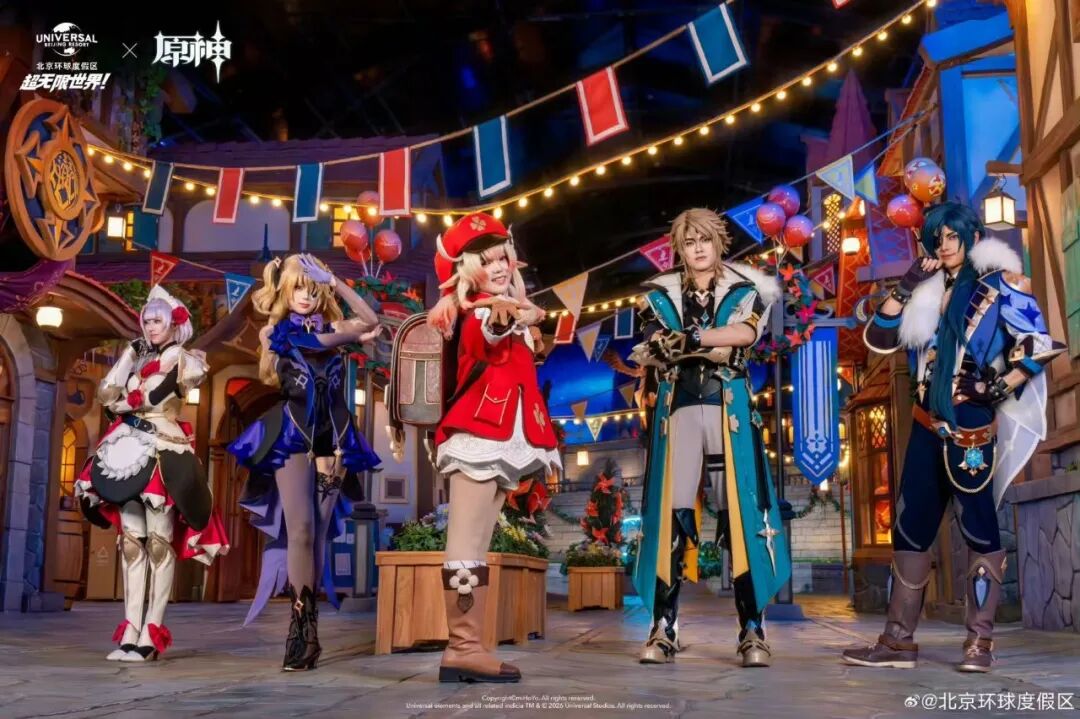
For example, in 2026, Universal Beijing Resort successively linked with multiple well-received IPs in China in recent years, such as Chang An, The Longest Day, Genshin Impact, The Lost Tomb and Identity V, covering animation, games, novels and films. Among them, Chang An, The Longest Day was transformed from the silver screen into an immersive themed restaurant "Tang Song Banquet", where characters such as Li Bai and Gao Shi interact with tourists on site; The Lost Tomb and Identity V were made into immersive experiences in the autumn "Frightfully Fun Universal" event, adding different forms of experience content to the park.
The most notable one is Genshin Impact. The two parties cooperated for the first time in 2025, and the park launched the interactive themed restaurant "Floral Banquet Under the Moon", 89% of the participating tourists were Genshin Impact players, the experience satisfaction rate reached 98%, and the relevant topics on social platforms received more than 45 million views within three months. In 2026, the cooperation between the two parties was further upgraded to the immersive interactive zone "Mondstadt", where tourists incarnate as "Travelers" to walk into the scene and interact with characters such as Klee. According to public reports, the overall tourist satisfaction rate of the interactive themed zone is 92%, and the core dimensions such as theme presentation, character and scene restoration, on-site performance and atmosphere all exceed 94%.
Around the same IP, a restaurant was built in the first year, and a whole city was built in the second year. The significance of this upgrade is not only the expansion of the cooperation scale, but also that Universal Beijing Resort tries to transform the IP worldview, character relationships and fan expectations into accessible scenes, participatory interactions and sustainably operated entertainment products. How to restore the scene to a tangible level, how characters interact, how actors respond to unexpected questions, and how tasks in the game are transformed into real-life experience routes, all require the collaboration of creative development, spatial design, performance arrangement and on-site operation.
However, as mentioned earlier, the outside world generally worries that such cooperation will increase the content cost of Universal Beijing Resort, which is a misunderstanding. The most expensive cost of Universal Beijing Resort is the one-time opening cost invested to build a unique business model and core capabilities. After the opening, cooperating with excellent external IPs is actually a very cost-effective investment.
On the one hand, through professional creative production