Wall Street: The next round of financing in the computing power ecosystem will be more difficult and more expensive...
In recent years, behind the AI boom there has always stood a "lender of last resort" who sells chips and also writes checks. Now, the man in the leather jacket has left the "AI central bank" NVIDIA, and the checkbook has been temporarily handed over to a financial officer whom he once called "a deer in the headlights".
Over the past few years, NVIDIA has been selling chips while making aggressive investments in all links of the AI industry chain. As of July 26 this year, the book value of its equity investments reached 990 billion U.S. dollars, covering AI labs, emerging cloud service providers, customers and upstream suppliers.
The largest of these is the 300 billion U.S. dollar investment in OpenAI. In addition, NVIDIA has reached a Groq licensing deal worth about 200 billion U.S. dollars, and plans to acquire the open-source AI platform Hugging Face for 129 billion U.S. dollars. Many of the invested enterprises have in turn become buyers of NVIDIA's chips, so NVIDIA is also known as the "AI central bank".
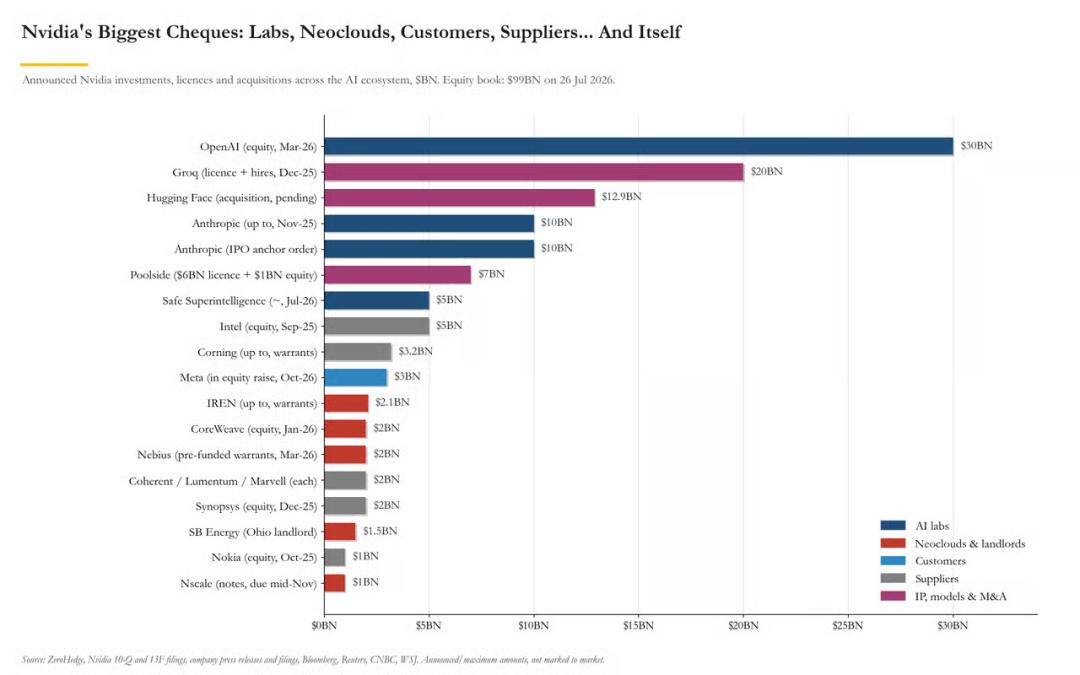
Note: NVIDIA's main investments in the AI industry chain; dark blue represents AI labs (OpenAI, Anthropic), purple represents licensing and M&A (Groq, Hugging Face)
Equity investment is just the tip of the iceberg. As of July 26 this year, its future commitments such as chip procurement, cloud services, data center leasing, computing power repurchase, plus various guarantee limits, totaled about 5305 billion U.S. dollars.
Among them, the chip and production capacity procurement commitments reached 2790 billion U.S. dollars, and the guarantee provided for OpenAI's Ohio data center reached 1050 billion U.S. dollars.
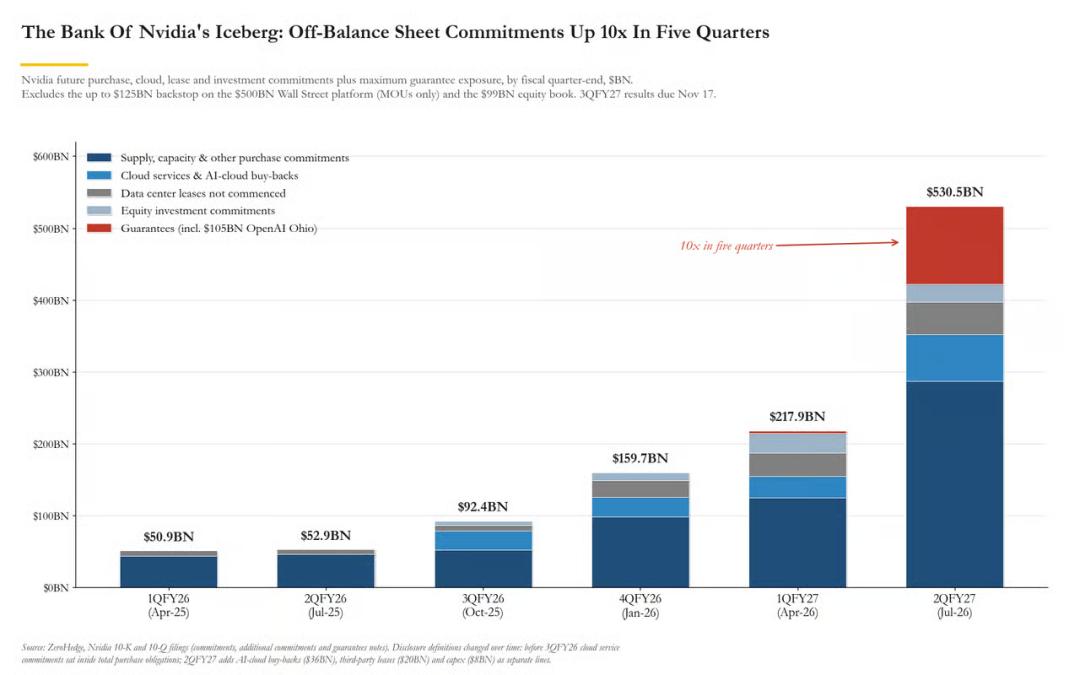
Note: The composition of NVIDIA's approximately 5305 billion U.S. dollars in commitments and guarantees; dark blue represents procurement and investment commitments (chip production capacity procurement, pending equity investment contributions), red represents guarantees (OpenAI Ohio project, cloud service provider site and power supply)
After losing "Jensen Huang's vision, influence and appeal"...
According to local media reports on November 13, Goldman Sachs analyst James Schneider released a report after Jensen Huang's resignation, maintaining NVIDIA's "Buy" rating but lowering the target price from 300 U.S. dollars to 220 U.S. dollars.
Schneider expects NVIDIA to fulfill all previously announced commitments, but believes that without Jensen Huang's vision, influence and appeal, it will be more difficult to facilitate multi-party cooperative investments of the same scale.
He pointed out that NVIDIA's stock price previously traded at a significant discount to the broader market, one of the reasons being that investors were worried that once companies like NVIDIA no longer provided financing, the growth of AI infrastructure could slow down sharply.
UBS analyst Tim Arcuri also listed financing as the area most affected by Jensen Huang's departure. He believes that even if the new leadership continues the original strategy, NVIDIA's willingness and ability to push forward such transactions may experience a "pause" in the short term.
UBS estimates that a large part of NVIDIA's quarterly free cash flow has been reinvested back into the AI industry chain, once a pause occurs, more than 500 billion U.S. dollars may be withdrawn from the entire ecosystem at least temporarily, which comes at a critical time of rising interest rates and tightening liquidity in some credit markets.
Sebastien Naji, an analyst at U.S. investment bank William Blair, believes that signed contracts will not be affected by the CEO change, and the real risk lies in the next round of transactions, NVIDIA's market share in 2027 and beyond may face greater impact from competitors such as Broadcom and AMD.
According to reports, a cloud service provider has stated that the uncertainty brought by Jensen Huang's departure has made it reconsider switching to chips from Google or AMD.
The reason why NVIDIA's guarantees are critical is that many borrowers themselves have poor credit. Money-burning AI labs and small cloud service providers can hardly borrow cheap money on their own. With the guarantee of the company with the highest market value in the world (previously), lending institutions are willing to lend at lower interest rates.
Reports point out that the AI computing power financing market has already shown pressure: Australian AI cloud service provider Firmus withdrew its IPO in October this year, and CoreWeave's euro bonds can currently only be traded at a discount of about 20%.
Sunaina Sinha Haldea, Global Head of Private Capital Advisory at U.S. financial services firm Raymond James, said, Jensen Huang's departure gives all parties reason to re-examine the terms of transactions.
She believes that capital will not withdraw, but lenders may demand higher returns for uncertainty, and will also more strictly question who exactly bears the risk, and this kind of scrutiny will spread to the entire AI infrastructure financing market.
Financing is already under pressure: no one wants a 25% backstop
According to media reports this week, the 5000 billion U.S. dollar AI financing platform launched by Jensen Huang in August this year in partnership with six Wall Street asset management institutions has not closed a single transaction in the three months since its launch.
The platform is designed to help enterprises borrow money to buy chips using GPUs as collateral, and NVIDIA promised to provide a backstop of up to 1250 billion U.S. dollars for it.
Media reports pointed out that the problem lies in the backstop ratio. NVIDIA promised that if the mortgaged GPU depreciates and causes losses to the loan, it will bear up to 25% of the risk of each transaction. But over the past month, some customers and Wall Street partners have demanded an increase in this proportion, because competitor Broadcom's backstop support is much stronger.
Broadcom guaranteed 300 billion U.S. dollars for a 350 billion U.S. dollar debt transaction of Anthropic in May this year, and is currently providing a guarantee of about 72.5%, or 430 billion U.S. dollars, for another 630 billion U.S. dollar transaction.
According to reports, NVIDIA may announce the platform's first transaction as early as January next year. Whether this timetable can be fulfilled after Jensen Huang's departure remains to be seen. At present, what NVIDIA has signed with the six asset management institutions is only a preliminary letter of intent for cooperation, and the formal agreement has not yet been finalized.
Kress: "A deer in the headlights"?
Some media reports said that Colette Kress, who now manages NVIDIA's investment and guarantee decisions, has always been relatively cautious about such transactions.
According to reports, during the financing expansion previously led by Jensen Huang, Kress once questioned how to screen transactions, how to value guarantees, and how to calculate returns, and tried behind the scenes to restrict the financing projects led by Jensen Huang's son-in-law Nico Caprez.
The report also pointed out that it was Kress who readjusted the terms of the OpenAI Ohio project, cutting NVIDIA's initial commitment in half.
At an internal meeting in August this year, Jensen Huang once interrupted Kress's presentation and said she was like "a deer in the headlights" (a phrase used to describe someone who is stunned and at a loss what to do).
However, Kress has publicly defended these transactions. In late August, she said: "We know some people will call it circular financing, but we see it differently", adding that the returns on these investments will be excellent.
It can be seen that her prudence as CFO is more reflected in transaction terms and risk control, rather than denying the strategy itself.
NVIDIA will release its third-quarter financial report on November 17 Eastern Time, which will also be Kress's first time facing the market as interim CEO. At that time, the progress of the 5000 billion U.S. dollar financing platform and subsequent guarantee policies will likely be the focus of analysts' questions.
This article is from the WeChat official account "Sci-Tech Innovation Board Daily", written by Li Ying, and published with authorization from 36Kr.