The latest financial reports of the four global IVD giants have revealed a secret.
The world's four leading medical diagnostics giants, namely Abbott, Danaher, Roche Diagnostics, and Siemens Healthineers, have successively released their latest financial results.
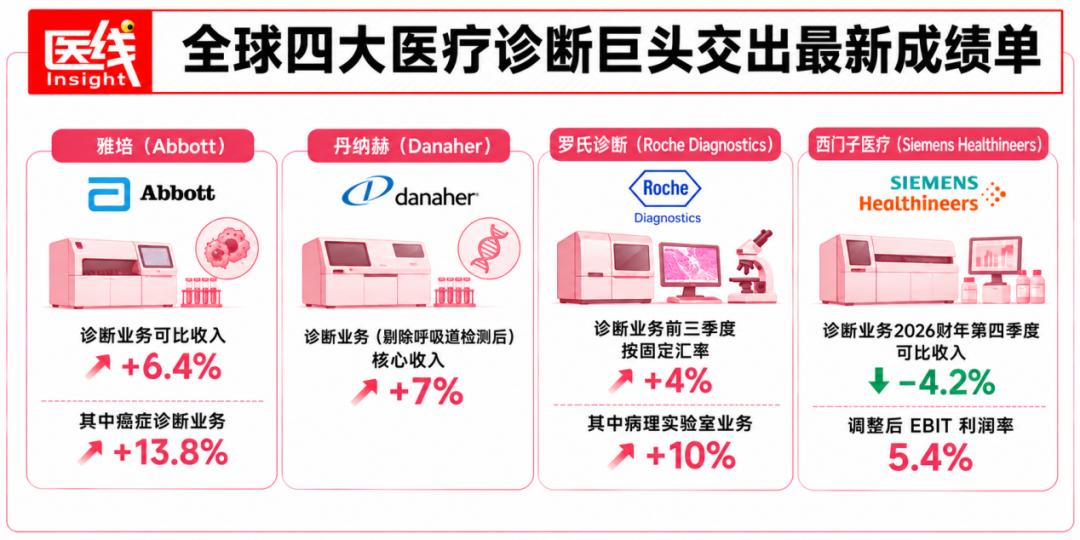
From the perspective of diagnostic business, the four enterprises present different growth curves (it should be noted that the financial report statistical cycles of the four enterprises are not completely consistent: Siemens Healthineers adopts the fiscal year caliber; meanwhile, there are slight differences in the revenue calculation caliber due to different financial reporting standards).
Abbott's comparable revenue from its diagnostic business increased by 6.4% in the third quarter, of which the oncology diagnostic business grew by 13.8%.
Danaher's core revenue from its diagnostic business, excluding respiratory testing, increased by 7%.
Roche Diagnostics' revenue in the first three quarters increased by 4% at constant exchange rates, with its pathology laboratory business growing by 10%.
Siemens Healthineers recorded a 4.2% year-on-year decline in comparable revenue from its diagnostic business in the fourth quarter of fiscal 2026, with an adjusted EBIT margin of 5.4%.
Behind these figures, a common industry signal is revealed: the Chinese market is becoming a key variable affecting the growth of international IVD (in vitro diagnostics) enterprises.
Relying on technology, brand, installed volume of high-end instruments, and continuous repurchase of supporting reagents and consumables, international IVD giants had built relatively solid competitive advantages in the Chinese market before.
However, with the reform of medical service prices, centralized volume-based procurement, hospital cost control, and the improvement of domestic enterprises' technical capabilities, the original growth model is being challenged.
At the same time, the four enterprises are also seeking new growth space through product structure adjustment, business portfolio optimization and organizational structure reform.
When brand and technological advantages are no longer sufficient to support the past growth rate, multinational enterprises must answer the core proposition of "how to find a sustainable growth mode in the new Chinese medical market".
The price system is changing, and the high-end pricing logic of IVD enterprises is being challenged
The changes in China's IVD market first occurred in the price system.
For hospitals, testing equipment is not only related to the accuracy of test results, but also involves long-term quality control, equipment maintenance and reagent supply. Therefore, brand and product performance often have high weight, and international IVD enterprises benefited from brand and technical advantages in the past to achieve rapid market occupation.
However, in recent years, with the advancement of medical service price reform and centralized procurement of testing reagents, hospitals' procurement logic is changing.
On August 14, 2026, the National Healthcare Security Administration officially issued the *Guidelines for the Establishment of Testing Medical Service Price Items (Trial)*, covering clinical testing, blood transfusion and blood type, microbiology and parasitology, molecular diagnostics, biochemistry and immunology and other fields, with a total of 662 main items, 114 surcharge items and 7 extended items.
One of the most important changes in this document is to promote the testing service to gradually shift from the previous separate pricing according to different testing methods in some regions to a service-output-oriented price item specification.
This means that the space for forming charging price advantages solely by relying on differences in testing methods may be affected.
At the same time, centralized procurement of testing reagents is also changing the hospital procurement environment. As more testing items are included in regional alliance procurement and product price transparency increases, hospitals pay more attention to procurement costs and equipment use efficiency.
International IVD giants have begun to feel this change.
Roche clearly stated in its performance announcement for the first three quarters of 2026 that its diagnostic business achieved 4% growth at constant exchange rates, and the growing demand for core laboratory and pathology solutions offset part of the impact brought by China's medical service price reform.
However, in terms of regional performance, the revenue of Roche's diagnostic business in the Asia-Pacific region decreased by 4% at constant exchange rates, which the company attributed to China's medical service price reform.
This set of data shows that even if the global business still maintains growth, price changes in the Chinese market have become an important factor affecting its regional performance.
The situation of Abbott is also noteworthy. In the first three quarters of 2026, the revenue of its core laboratory diagnostics business increased by 4% year-on-year after excluding the impact of exchange rates. However, the company pointed out in its quarterly report that affected by the continued pressure on the local market environment, the sales of core laboratory diagnostic products in the Chinese market have declined, partially offsetting the growth contribution from markets such as the United States, Europe and Latin America.
The pressure faced by Siemens Healthineers is even more obvious. Its diagnostic business revenue decreased by 4.2% in the fourth quarter of fiscal 2026, with an adjusted EBIT margin of 5.4%. The company had previously listed the structural changes in the Chinese market as an important reason for the pressure on its diagnostic business.
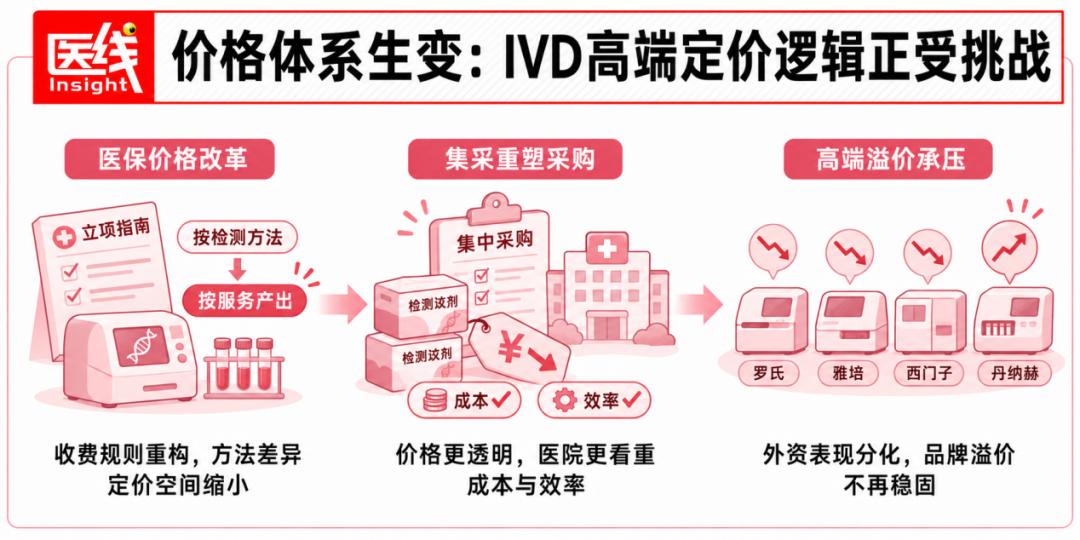
However, not all international enterprises are under the same pressure in the Chinese market.
Danaher disclosed at its third quarter earnings call that its overall business in China achieved high single-digit growth, with all three business segments growing. The management also stated that the diagnostic business is gradually emerging from the impact of changes in China's medical policies.
This shows that policy changes do not mean that all foreign-funded IVD enterprises will continue to decline. Product structure, customer base, channel capabilities and the degree of enterprises' adaptation to the local market will all affect the final business performance.
But one trend is relatively clear: the model of maintaining high-end pricing by relying on technology and brand is being tested by both cost and efficiency.
In the future, international IVD enterprises not only need to prove that their products are more advanced, but also need to prove that their products can bring higher clinical value and better input-output ratio to hospitals.
Beyond routine testing, IVD giants begin to target high value-added markets
When the price space of traditional testing items is squeezed, international IVD enterprises begin to look for new sources of growth.
Judging from the business layout of the four enterprises, an obvious trend is that tumor diagnosis, pathological diagnosis, precision testing and new disease screening scenarios are becoming the key directions for their layout.
Of course, this does not mean that routine laboratory testing has lost its market value. On the contrary, the core laboratory is still an important source of revenue for international IVD enterprises.
However, in terms of growth rate and business structure, enterprises are looking for more differentiated growth drivers.
First, let's look at oncology diagnostics.
In March 2026, Abbott completed the acquisition of Exact Sciences, a US cancer diagnostics enterprise, and incorporated its Cologuard colorectal cancer screening product and precision oncology diagnostics business into its own diagnostic business system.
This acquisition further extends Abbott's diagnostic business to the fields of early tumor screening and precision oncology diagnosis.
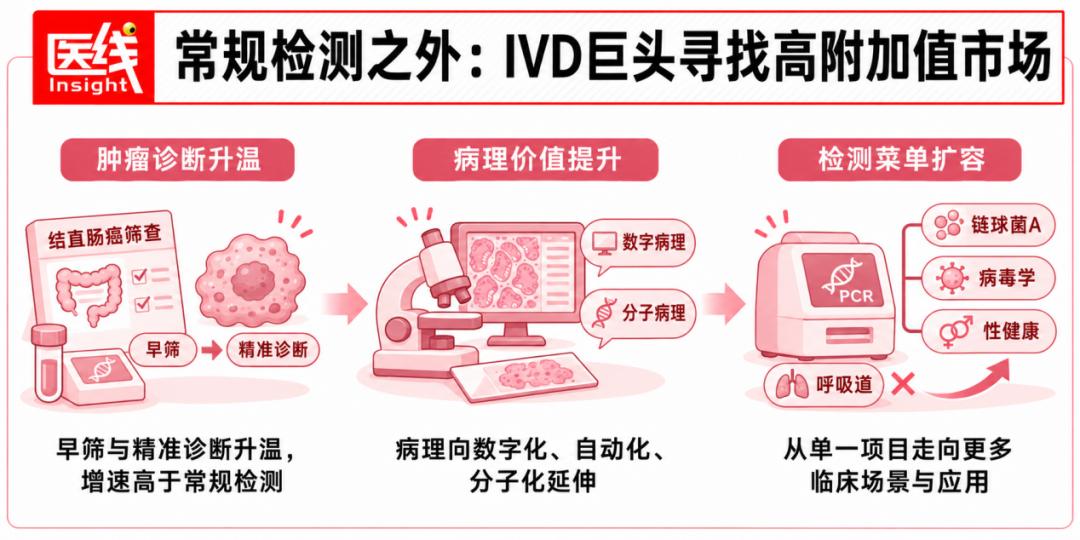
Judging from the third quarter financial report, Abbott's comparable revenue from oncology diagnostics business increased by 13.8%, significantly higher than the 5.4% growth of its core laboratory business.
Corresponding to oncology diagnostics is the growth of the pathological diagnosis business.
Roche Diagnostics' revenue from its pathology laboratory business in the first three quarters increased by 10% at constant exchange rates, higher than the 5% growth of its core laboratory business and the 3% growth of its molecular laboratory business.
The value of pathological diagnosis lies in that it not only undertakes the function of disease detection, but also is closely related to clinical links such as tumor typing, treatment plan selection and prognosis evaluation.
With the development of precision medicine, pathological diagnosis is extending from traditional morphological analysis to automation, digitalization and molecular pathology, which also provides new growth space for international IVD enterprises.
Leica Biosystems, under Danaher, also showed this trend in the third quarter. The company mentioned on its earnings call that the digital pathology and advanced staining business performed well and became an important growth driver for the diagnostics segment.
From a global business perspective, pathological diagnosis is becoming an important direction for international IVD enterprises to increase product added value.
Another noteworthy growth path is the extension from a single testing product to a richer testing menu and clinical applications.
Danaher's core revenue from its diagnostic business in the third quarter, excluding respiratory testing, increased by 7%, of which the clinical diagnostics business achieved mid-single-digit growth, and its Beckman Coulter Diagnostics business also recorded its best core revenue growth quarter in more than two years.
At the same time, its Cepheid non-respiratory molecular diagnostics business achieved low double-digit growth, mainly driven by Streptococcus A, virology and sexual health testing items.
This data shows that current molecular diagnostics enterprises need to gradually reduce their dependence on respiratory testing demand and look for more stable and diversified testing scenarios.
For the Chinese market, opportunities for high value-added testing also exist.
With the aging of the population, the increasing demand for tumor screening and the development of precision medicine, early disease screening, tumor diagnosis, pathological testing and molecular diagnostics are all expected to gain more clinical application opportunities.
However, the problem is that technological innovation does not equal commercial success. Whether a new testing product can enter a hospital requires not only regulatory approval, but also clear clinical value, a reasonable charging path and sufficient testing demand.
Especially under the background of medical cost control, if a testing item cannot prove its clinical necessity and economic value, even with leading technology, it may not be able to quickly form large-scale revenue.
Therefore, when international IVD enterprises look for the second growth curve in the Chinese market, they cannot only rely on launching more new products, but also need to promote new technologies to truly enter the clinical application system.
After the competition logic changes, who can better adapt to the Chinese market?
The changes in the price system and the adjustment of growth drivers reflect the transformation of the competition logic in China's IVD market.
For a long time, international IVD giants have built strong competitive advantages in China's mid-to-high-end clinical testing market by virtue of leading technical performance, stable product quality, mature product system and long-accumulated brand awareness. Under this model, technical level, product performance and brand influence are important foundations for enterprises to acquire customers, maintain price premium and expand market share.
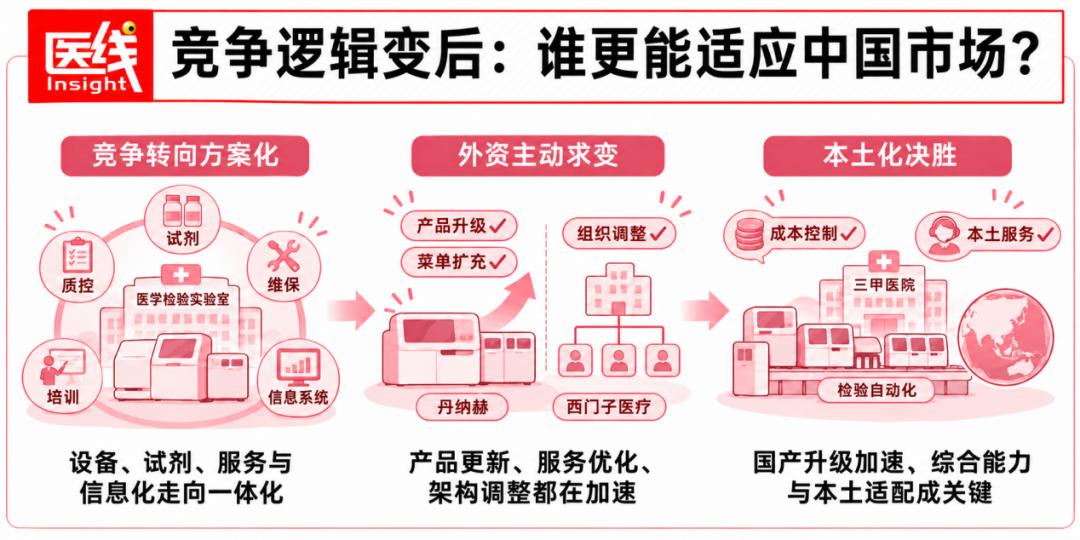
But for hospitals, instrument procurement is only part of the construction of the testing system. After the instruments are put into use, supporting support such as reagents, quality control products, equipment maintenance, personnel training and information systems are also required to ensure the stable development of testing work.
Therefore, in procurement decisions, hospitals are paying more and more attention to the overall operation efficiency and long-term use cost of the testing system, in addition to considering the technical performance of the products themselves.
This makes the competition among IVD enterprises shifting from single equipment and single reagent to the entire laboratory solution.
For international enterprises, this is both a challenge and an opportunity to re-establish competitive advantages.
Danaher's performance in the Chinese market is a case worth observing. In the third quarter, the company's overall business in China achieved high single-digit growth, with all three business segments growing.
The management believes that the diagnostic business is gradually emerging from the main impact brought by previous changes in China's medical policies.
At the same time, the market performance of Beckman Coulter's new-generation DxI 9000 immunoassay platform also provides growth momentum for the diagnostic business.
There is no doubt that in the face of changes in the Chinese market, international enterprises do not have to only maintain market share by cutting prices. Product updates, expansion of testing menus and customer service capabilities can also become important factors driving business growth recovery.
For Siemens Healthineers, organizational structure adjustment has become a way for it to regain competitiveness.
On November 5, 2026, Siemens Healthineers announced the launch of the spin-off process of its IVD business, and plans to develop this business into an independently operated entity named Olyrian Diagnostics, with the transformation expected to be completed by mid-2028.
This adjustment means that Siemens Healthineers is repositioning its in vitro diagnostics business, hoping that it can participate in market competition in a more independent organizational form in the future.
From an industry perspective, this also reflects that large medical device groups are re-examining the business model and resource allocation methods of different business segments.
However, the business spin-off does not mean withdrawing from the Chinese market, nor does it mean that Siemens Healthineers has completed the sale of its diagnostic business. During the transition period, Olyrian still belongs to the Siemens Healthineers system, and the existing product and service arrangements remain unchanged for the time being.
Compared with the business adjustments of international enterprises, domestic IVD enterprises are facing another kind of opportunity.
Benefiting from the continuous iteration of domestic biochemistry, immunology, molecular diagnostics and other products, domestic enterprises are no longer limited to the low-end and mid-end markets, but gradually extend to high-level hospitals, high-end testing platforms and laboratory automation fields.
Enterprises such as Mindray Medical, Autobio Diagnostics and Snibe Diagnostic are improving their competitiveness in the hospital market through instrument upgrading, expansion of reagent menus and construction of laboratory solutions.
However, the real difficulty of domestic substitution is that if they want to truly enter the high-end market, they urgently need to build a complete product system and long-term service capabilities.
In other words, the competition in China's IVD market in the future will no longer be just price competition between foreign brands and domestic brands, but a comprehensive competition of overall solutions, cost control and localized service capabilities.
At the same time, the latest performance of the four international IVD giants has revealed the depth of changes in the Chinese market.
Roche, Abbott and Siemens Healthineers have felt varying degrees of operational pressure, while Danaher has shown certain growth resilience. Facing the same medical cost control, centralized procurement and domestic substitution, the performance of different enterprises has diverged, which also shows that the Chinese market is far from losing growth opportunities, but the days of relying on brand advantages and high-end pricing to achieve growth in the past are becoming increasingly unsustainable.
This change will continue to spread deep into the industrial chain. Hospitals are controlling testing costs more and more precisely, but their requirements for testing quality and efficiency will not decrease. As competition deepens, the space to compete for the market solely by price will become more and more limited.
But the market never lacks growth opportunities, what is lacking is the ability to adapt to changes.
When the industry gradually bids farewell to the era of high premium, enterprises will eventually win the market by solid clinical value and operational efficiency.
This article is from the WeChat official account "Medline Insight"