Pork has dropped to 4 yuan per 500 grams, and the market trend is truly about to reverse this time.
Can you imagine that the pork price has returned to the era of 4 yuan per jin?
Although the "4 yuan per jin" here refers to the purchase price of live hogs, not the pork price you buy in the wet market, 4 yuan per jin has hit the historical bottom of hog prices in the past 20 years, which is equivalent to returning to the hog price level in 2005.
What is more interesting is that the sharper the hog price falls, the more sharply the stock price of pork-related stocks rises instead.
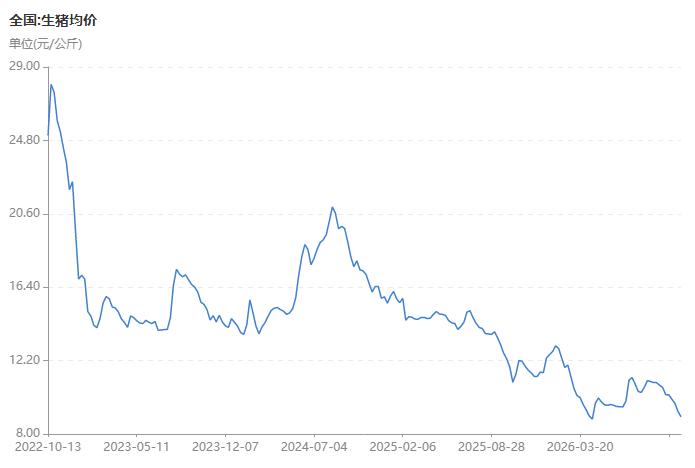
Since July, the live hog price has plummeted sharply, with the average live hog price dropping from 11.23 yuan per kg to 8.98 yuan per kg, pushing the pork price back 20 years. However, pork stocks have risen instead: over the same period, Muyuan Co., Ltd. rose by 36%, and the CSI Animal Husbandry Index also rose by 10% against the trend amid the market correction.
The contrast between hog prices and stock prices stems from the fact that hog prices are regarded as a signal of the hog cycle reversal.
Since 2022, the hog cycle has entered a long bottom-grinding stage. Finally, after leading enterprises with the lowest breeding cost saw their cash flow turn negative in the first and second quarters of this year, the industry has reached the inflection point of capacity decommissioning.
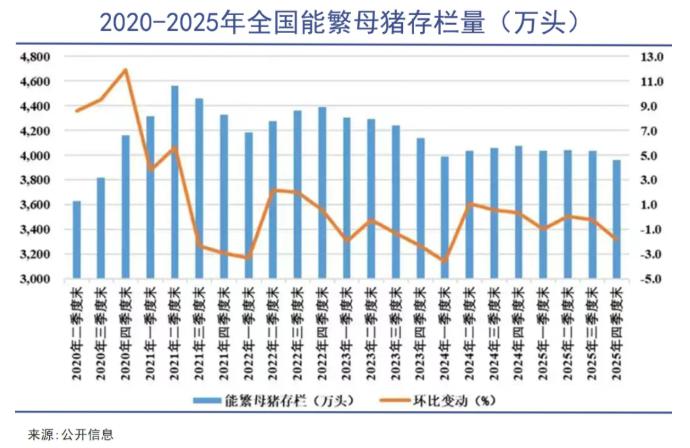
Breeding sows are the core indicator of capacity decommissioning, and the change in their inventory will be transmitted to the slaughter of hogs 10 months later. In the third quarter, the number of breeding sows decreased by 10.7% year-on-year, and the current inventory of 36.02 million heads is equivalent to 96.0% of the normal inventory. At this time, the market believes that the lower the hog price, the faster the capacity decommissioning and the faster the inflection point will come; if the hog price remains at a low level for a long time, it may delay the exit of production capacity instead.
Of course, the story of "the wolf is coming" has been staged many times in the past few years. The bottom-grinding period of this round of hog cycle has exceeded 47 months, far higher than the average 22.8 months of the bottom-grinding period of the previous 4 cycles. Many people therefore believe that with the expansion of large-scale breeding enterprises, the hog cycle is disappearing.
But a more accurate statement is that the hog cycle has been extended and blunted.
Large-scale breeding brings cost reduction: from 2021 to 2026, the total cost of self-breeding and self-raising has been reduced from 18-19 yuan per kg to 13 yuan per kg. Although the price drop has plunged the industry into losses, leading enterprises have seen their cost reduction speed faster than the downward speed of selling prices for a long time, still making profits, so the capacity decommissioning is naturally slow.
But now, the improvement of breeding efficiency has hit a bottleneck, the price of upstream agricultural products has gradually stabilized, and there is little room for cost reduction, so the support for leading hog enterprises to maintain production capacity no longer exists.
However, although the cycle will reverse and the industry will return to profitability, the previous super upward cycle is gone.
/ 01 / The faster the hog price falls, the stronger the signal of reversal
The hog price is still falling. Why has capital already poured into breeding stocks?
This is because stock prices are traded based on future profit expectations. For the current hog cycle, the lower the hog price, the greater the loss of the industry, the faster the capacity clearing, and the faster the profit inflection point will come; if the hog price stays sideways at a low level, it will slow down the pace of production capacity exit instead.
Of course, the fall of hog price is only a necessary but not sufficient condition for cycle reversal. During most of the downward cycle, the fall of hog price is regarded as a pressure on the profits of hog enterprises, which is negative for stock prices. For example, in the first half of the year, the hog price also fell below 9 yuan per kg, but pork stocks fell along with it at that time.
This time, pork prices are falling but pork stocks are rising, because the market has seen the signal of capacity clearing.
The core indicator of capacity clearing is breeding sows. Breeding sows are like the foundation of a house. PSY, MSY, slaughter volume, and piglet prices all grow from this foundation. If the foundation shrinks, the supply on top will shrink sooner or later; if the foundation does not shrink, no matter how much adjustment is made on the upper layer, it will be in vain. Therefore, the core of trading the hog cycle is to focus on breeding sows.
Since the fourth quarter of 2025, the number of breeding sows has been decommissioned for 4 consecutive quarters, and the trend is accelerating. At the end of the third quarter, the national inventory of breeding sows was 36.02 million heads, down 10.7% year-on-year and 4.7% month-on-month, with a decline larger than 1.4% in the first quarter and 3.2% in the second quarter.
After continuous decommissioning, the inventory of 36.02 million heads is equivalent to 96.0% of the normal inventory. The change in the inventory of breeding sows will be transmitted to the hog slaughter 10 months later; when the market sees the decline in sow inventory, it will price the hog price one year in advance, instead of waiting for the current profit to improve.
Although the inventory has dropped to the normal level, some investors worry that the improvement of reproductive efficiency may offset the decommissioning of the number of breeding sows. This concern is reasonable, but it will not prevent the reversal.
For one thing, the target line of normal inventory was just lowered in May this year. The production capacity regulation plan revised by the Ministry of Agriculture and Rural Affairs adjusted the normal inventory from 39 million heads to about 37.5 million heads. When lowering the target line, the regulator has most likely taken the improvement of reproductive efficiency into account.
More importantly, even if the current decommissioning degree is still offset by the improvement of reproductive efficiency, the industry will continue to decommission. The logic is that leading enterprises have moved from the state of profit loss to the state of cash loss.
Profit loss refers to the situation where revenue is lower than the total cost (including depreciation). To raise pigs, you need to spend money to build pig houses, purchase equipment and cultivate breeding pigs first. These costs have been paid in full at that year, but in accounting, they will be apportioned and deducted slowly over many years in the future. Therefore, although the enterprise is at a loss on the financial statement, the selling price of pigs is still higher than the cash cost, so the industry has low willingness to decommission capacity.
Cash loss refers to the situation where revenue is lower than cash cost (excluding depreciation). At this time, without considering accounting depreciation, the cash cost of raising pigs is higher than the selling price, and hog enterprises are in a state of losing money for every pig sold, which gives the industry a strong driving force for capacity decommissioning.
In the first two quarters of this year, Muyuan's operating cash flow turned negative for two consecutive times. Although Muyuan's negative cash flow is not entirely caused by the fall in hog prices, most of this year, Muyuan's cash cost is lower than the selling price, and its negative cash flow is more of a cash expenditure rhythm problem caused by "feed stockpiling". However, the negative cash flow of the leading enterprise still reflects the cash flow pressure of the whole industry, and most hog enterprises other than Muyuan have entered the state of cash loss.
Seeing this, some investors may still feel uncertain. After all, the story of "the wolf is coming" has been staged many times in this round of hog cycle. At this time, we need to look at the differences between this cycle and the previous ones.
/ 02 / There is no more room for cost reduction, this time it is a real reversal
Since 2006, 4 complete hog cycles have been completed, and the current one is in the downward bottom-grinding stage of the 5th cycle.
In the previous 4 cycles, the average decommissioning period of the downward bottom-grinding stage was 22.8 months; while based on the high point in December 2022, this round of hog cycle has experienced 47 months of bottom grinding so far.
Many people believe that with the expansion of large-scale breeding enterprises, the hog cycle is disappearing. But a more accurate statement is that the hog cycle has been extended and blunted — reflected in the data, in this round of hog cycle, each round of hog price rise is only a phased rebound lasting about half a year, and then with the re-release of supply, it enters the downward bottom-grinding stage again.
Many people attribute the reason why large-scale breeding extends the hog cycle to the capital side — enterprises are more capable of withstanding losses. But the more core reason lies in the cost side: the continuous cost reduction of breeding leads to the lack of strong driving force for capacity decommissioning.
From the perspective of the total cost of raising one pig through self-breeding and self-raising (raising sows by themselves and fattening pigs by themselves), the total cost of self-breeding and self-raising in 2021 was about 18-19 yuan per kg; by 2026, the average total cost of the industry has dropped to 13 yuan per kg, and the total cost of Muyuan Co., Ltd. in June has been reduced to 11.7 yuan per kg.
With the cost reduction, the break-even point of hog enterprises is also moving down.
In this process, although many high-cost breeding enterprises drag the whole industry into losses, enterprises whose cost reduction speed is faster than the downward speed of hog prices are still making profits. From 2022 to 2025, Muyuan suffered losses only in 2023 when the cost had not yet decreased, and made tens of billions of profits in other years. With profits, it is naturally difficult to decommission production capacity.
But costs will not keep falling, and now the industry's cost reduction is close to the bottleneck. Muyuan used to convey the expectation of "continuing to significantly reduce costs" to the market most of the time, but it has cooled down this year, and its statement has changed to: "In the future, the production efficiency of the whole industry will continue to improve, but there is no clear outlook for the speed and extent of the improvement."
Looking back at the past, the decline of breeding cost mainly depends on two reasons. First, the price of corn and soybean meal, which account for more than 80% of the feed cost, continued to fall after 2023. By the end of 2024, the feed cost has decreased by 40% from the highest point. But bulk agricultural products will not fall forever, and the prices of corn and soybean meal have stabilized this year.
Second, the improvement of breeding efficiency. Since 2022, the industry has introduced new breeding pig strains. The industry's PSY (number of weaned piglets per sow per year) has risen from about 18 in 2021 to 24.5 in 2025, and Muyuan's PSY has reached 28.3, which is at the same level as the United States. There is little room for cost reduction brought by the improvement of breeding efficiency in the future.
There is no room for cost reduction, so the ability of the hog cycle to continue grinding down the bottom no longer exists.
/ 03 / The elasticity after reversal is gone
The hog cycle will most likely achieve profit reversal, but the elasticity of reversal may be weaker than before.
At the beginning of this month, Zhu Zengyong, the chief analyst of the whole pork industry chain of the Ministry of Agriculture and Rural Affairs, gave a judgment: it is difficult for China's live hog industry to have a sustained sharp rise cycle again, and there will be more phased market dividends and phased recovery in the future. The average price of 15 yuan per kg or above in 2027 predicted by Goldman Sachs and Changjiang Securities is far lower than the cycle highs of 21.1 yuan per kg in 2016 and 40.98 yuan per kg in 2019.
Institutions are cautious about the prediction of the hog cycle elasticity, because the logic of the industry has changed, shifting from demand growth to supply regulation.
For a long time in the past, pork has always been the core source of animal protein for Chinese residents, and the demand has strong total volume support: even if the supply is in surplus in stages, as long as the economy recovers, festivals come or consumption picks up, pork demand can still form obvious support for prices.
But today, this foundation is changing. With the increase of income and the strengthening of the concept of healthy diet, consumers have more and more diverse choices of protein sources. Chicken, beef, aquatic products, eggs, milk and various deep-processed foods are diverting pork consumption. The proportion of pork consumption has dropped from 62.1% in 2018 to 57.9% in 2025. Pork is no longer an absolutely dominant protein source, but a conventional category in the diversified meat consumption structure.
At the same time, the aging of population and the change of young people's eating habits are also continuously weakening the growth elasticity of pork demand. On the whole, pork demand has entered a state of long-term and slow weakening.
If weak demand suppresses the ceiling of cycle reversal, the stronger regulation capacity on the supply side further restrains the speed and extent of pork price rise.
In the past, one of the important reasons why the hog cycle was prominent was that the supply side was highly dispersed for a long time. A large number of small individual farmers decided to restock or decommission according to the current hog price, and the market was easy to form a cycle of "chasing up and killing down": once the price fell below the cost, individual farmers withdrew quickly, the supply shrank accordingly, and the cycle had greater elasticity.
But in this round of hog cycle, China's live hog breeding industry has undergone fundamental changes in the past decade. From 2019 to 2026, the total number of small-scale live hog farms in China that have exited has exceeded 10.4 million households, and the proportion of individual farmers has dropped from 68% to 32%. The supply side has entered the industrial production state of large-scale breeding and standardized pig houses. This means that the supply is more stable, and once the price recovers, they can catch up with the production capacity faster.
The cycle will reverse, and hog enterprises can also make profits, but the era of making huge profits in the upward cycle is gone.
Disclaimer: This article (report) is written based on publicly available information or information provided by interviewees. However, Read Finance and the author of this article do not guarantee the completeness and accuracy of such information. Under no circumstances shall the information or opinions expressed in this article (report) constitute investment advice to any person.
This article is from the WeChat official account "Read Finance", author: Du Du Jun, published by 36Kr with authorization.