A clear $10 billion market and the unsolved STAT6
A promising next-generation novel target for Th2 inflammation that has been red-hot in the autoimmune therapy track has suffered a setback.
A few days ago, the clinical development of STAT6 degrader SAR448272 was suspended. This drug only entered Phase I clinical trial in August this year, and the whole process from patient enrollment to suspension took only more than two months, pouring a basin of cold water on the continuously heating STAT6 track.
As the core transcription factor downstream of the IL-4/IL-13 pathway, STAT6 is regarded as an "ideal target" that can block two classic Th2 inflammatory pathways at the same time. Coupled with the drug discovery breakthrough of protein degradation technology, this target once attracted a large number of domestic and foreign pharmaceutical companies to make layouts, and Kymera even predicted that the market size will exceed 27 billion US dollars by 2030.
However, the failure of SAR448272 once again confirms the iron law of innovative drugs: the establishment of the target mechanism does not equal the success of drug development. The failure of a single molecule will not extinguish the heat of the whole track. Only from high degradation rate to clinical benefit, STAT6 still needs more clinical data to prove its value.
The ideal target on the "all-star" pathway
The R&D value of STAT6 comes from its position in the Th2-type inflammatory signaling network.
Although IL-4 and IL-13 have different receptor binding modes, they can finally activate the JAK-STAT6 signal. IL-4 transmits signals through receptors composed of IL-4Rα and common γ chain or IL-13Rα1, while IL-13 mainly exerts its effect through receptors composed of IL-4Rα and IL-13Rα1. After the receptor is activated, JAK kinase promotes STAT6 phosphorylation, which further dimerizes and enters the nucleus to regulate Th2 cell differentiation.
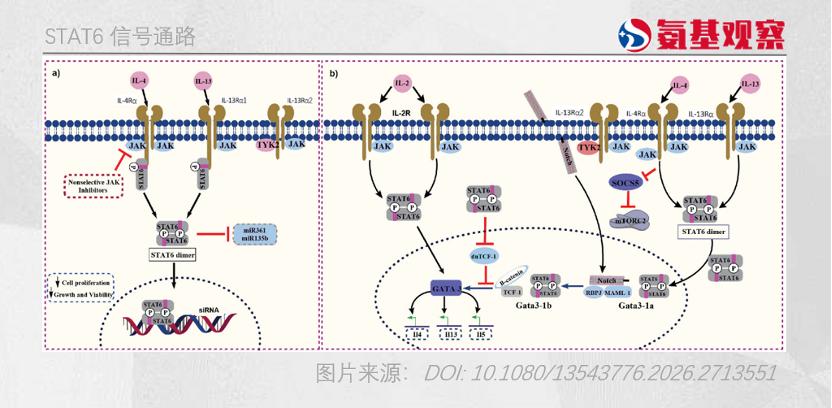
This means that targeting STAT6 is expected to simultaneously block the downstream signals of the two pathways, covering a wider range of Th2-type inflammatory diseases, and the market imagination space is far larger than upstream single-target drugs.
At present, upstream IL-4, IL-13 and their receptors have given birth to drugs such as Dupixent and Tralokinumab, and further downstream JAK has also seen small molecule drugs such as Upadacitinib and Abrocitinib approved.
However, existing therapies still have shortcomings: single-target antibodies have limited ability to eliminate diseases in some severe chronic diseases, and most of them are injection formulations, leading to low patient compliance; JAK inhibitors have broader safety concerns due to selectivity issues.
Based on the huge patient base and the substitution trend of oral formulations for injections, Kymera, which owns STAT6 degraders, once estimated that the potential patient population covered by the STAT6 target exceeds 140 million people, and the corresponding market size will exceed 27 billion US dollars by 2030.
Real money from pharmaceutical companies is also pouring in rapidly. On January 11, 2025, Gilead and Leo Pharma reached a cooperation on the oral small molecule project of STAT6, covering small molecule inhibitors and targeted protein degraders. According to the agreement, Leo Pharma can receive up to 1.7 billion US dollars in payments, including 250 million US dollars in upfront payment and tiered sales royalties.
The reaction of the capital market is equally straightforward. In December 2025, after Kymera announced positive Phase Ib data of its STAT6 PROTAC pipeline KT-621 for the treatment of atopic dermatitis, its stock price surged 42% on the same day.
From mechanism logic to market space, and then to the double recognition of industrial capital, the status of STAT6 as a star target has long been established.
The tortuous road to drug development
The perfect narrative on the mechanism is never a guarantee of successful drug development. The molecular structure characteristics of STAT6 destined it to be a hard nut to crack.
Different from targets with clear active pockets such as kinases, STAT6 mainly functions through the interaction between proteins and the binding between proteins and DNA, lacking the hydrophobic binding pockets utilized by traditional small molecule drugs.
The key component SH2 domain is also tricky. After STAT6 is phosphorylated by JAK, it needs to recognize the phosphorylated tyrosine site (Tyr641) on another STAT6 molecule through the SH2 domain to form a dimer, so as to enter the nucleus to regulate gene expression. However, the binding interface of the SH2 domain is extremely polar, and it is difficult for traditional small molecules to take into account binding activity, cell permeability and family selectivity at the same time, and it has long been difficult to break through the druggability bottleneck.
The maturity of protein degradation technology has brought the possibility of breaking the deadlock for STAT6.
Different from traditional inhibitors that mainly rely on continuous occupation of targets, PROTAC does not need to bind to the functional pocket of the target, only needs to bind to the accessible site on the surface of the target protein, then can recruit E3 ubiquitin ligase to label the target protein, and clear the target protein through the ubiquitin-proteasome pathway, thus weakening its biological function.
This technical path bypasses the core obstacle of STAT6's traditional druggability, bringing the dawn of industrialization to this "undruggable" target. However, the solution of the druggability problem is only the first step of a long march. The rapid suspension of SAR448272 has sounded the alarm for the whole track.
On November 4, this STAT6 degrader that had only entered the clinic for more than two months was announced to suspend development. The two-month clinical cycle is not enough to judge the efficacy, and Nurix also released a statement saying that the reason for the suspension comes from the specific properties of the molecule itself, and has nothing to do with the mechanism of the STAT6 target.
The specific reason is still unclear at present, but existing literature and studies have prompted the potential instability of STAT6 degraders.
The first risk points to the "non-specific" targeting of degraders. Due to the certain structural homology between different members of the STAT family, how to avoid unintended effects on other proteins such as STAT1, STAT3, and STAT5 is a problem that needs to be considered in the development of degraders.
The second instability is about the conversion between protein degradation and target function inhibition.
In February 2026, ACS Medicinal Chemistry Letters published a Patent Highlight, which systematically sorted out a number of STAT6-related patents published by Gilead, including both small molecule inhibitors and degraders. In the article, the author pointed out: "Despite these advances, the patent application documents for degraders also reveal some important limitations. The downstream functional consequences after degradation are still largely speculative, and the persistence of in vivo efficacy has not been determined."
The third risk comes from the balance of immune safety. STAT6 is in an important position in the immune regulatory network, and the depth, duration and tissue distribution of degradation need to be carefully controlled. If the drug produces too extensive and persistent STAT6 degradation in multiple tissues, it may affect the normal immune response.
The failure of SAR448272 further amplifies the uncertainty of the STAT6 track, but at the same time, it also accumulates experience and lessons for subsequent players.
The exploration is still ongoing
The haze of failure has not covered all the hopes of the track. Multiple STAT6 targeted drugs around the world are still advancing in clinical research, and some candidate drugs have delivered impressive early clinical data.
Among them, the fastest progressing one is KT-621 developed by Kymera. As the world's first STAT6 PROTAC degrader entering the clinic, KT-621 is an oral preparation taken once a day, and its Phase Ib clinical data has initially verified the potential of this technical path.
In a Phase Ib study for patients with moderate to severe atopic dermatitis, a total of 22 patients received 28 days of treatment. The results showed that the average EASI score of the patients decreased by 62.6%, the median degradation rate of STAT6 in the blood reached 97.5%, and the median degradation rate in the lesional skin tissue reached 93.6%. No treatment-related adverse events, no serious or severe adverse events were reported in the study, and no dose-dependent trend of adverse reactions was observed.
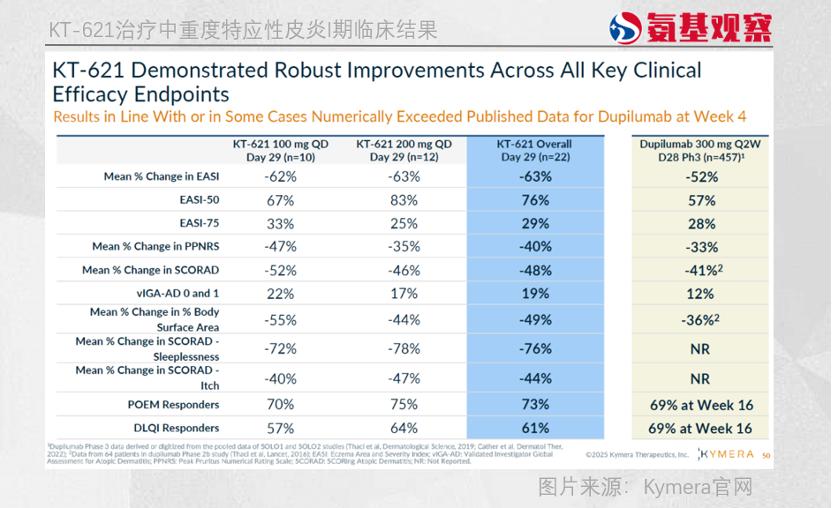
Kymera believes that its 4-week efficacy is comparable to Dupixent's historical data in the same cycle. However, it should be noted that this is still a single-arm, open-label early study with only 22 patients and a 4-week course of treatment, which is not sufficient to establish efficacy, and cross-study comparisons also need to be interpreted with caution.
At the same time, analysis shows that after KT-621 treatment induces STAT6 degradation, multiple type 2 inflammation-related biomarkers such as TARC, Eotaxin-3 and IL-31 decrease, which once again indicates that the target has a wide range of influences, indicating a potentially larger broad market.
At present, KT-621 has entered the key Phase IIb verification stage. The BROADEN2 study for moderate to severe atopic dermatitis has completed enrollment, and the company expects to release data at the end of 2026, and launch Phase III in mid-2027 if the progress goes smoothly. Meanwhile, the Phase IIb BREADTH study for moderate to severe eosinophilic asthma is also underway, and data is expected to be released in the second half of 2027.
The domestic market is also bustling.
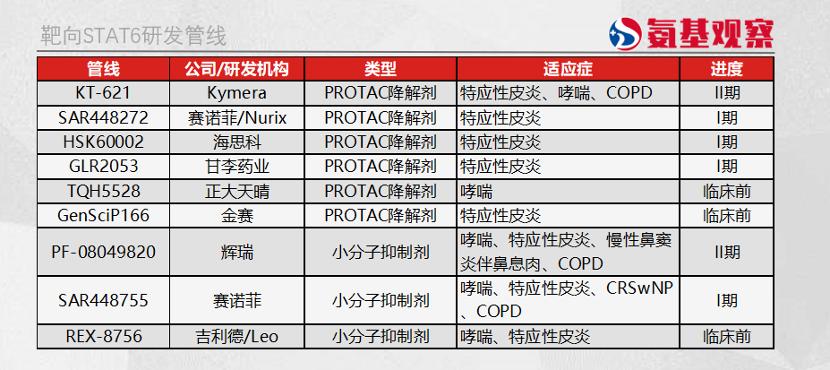
HSK60002 from Haisco and GLR2053 from Gan & Lee Pharmaceuticals have successively entered Phase I clinical trials, with the proposed indication both being atopic dermatitis. In addition, the market speculates that the preclinical autoimmune asset that Haisco licensed out overseas in August under the NewCo model is exactly HSK60002.
GenSciP166 from GenSci Pharmaceutical is also an oral STAT6 degrader, which was selected as a "Latest Breakthrough Abstract" at the 2026 SID Annual Meeting and disclosed data for the first time. In preclinical studies on mouse atopic dermatitis models, oral administration of low-dose GenSciP166 can achieve near-complete degradation of STAT6 in animal tissues, and effectively inhibit the levels of Th2 inflammatory biomarkers in vivo.
TQH5528 from Chia Tai Tianqing released preclinical research data at the 2026 European Respiratory Society Annual Meeting: in non-human primate studies, TQH5528 can achieve rapid, deep and sustained STAT6 degradation with a degradation rate of over 95%.
In addition to degraders, large overseas pharmaceutical companies are also placing bets on the side of small molecule inhibitors. Large pharmaceutical companies including Pfizer and Sanofi are all carrying out autoimmune clinical research on related pipelines.
The popularity of STAT6 is essentially the dual expectation of the autoimmune field for "better oral therapies" and "next-generation core targets". The failure of one early project is not enough to deny the value of the entire track.
However, as mentioned earlier, the theoretical advantages of the target can never be equated with clinical success. There are still many thresholds that STAT6 degraders need to cross, from molecular selectivity to degradation-efficacy conversion, and then to long-term immune safety.
Next, the Phase IIb clinical data of KT-621 will be the key touchstone for the STAT6 track; at the same time, the clinical advancement of domestic pipelines will also bring more possibilities to this track.
Risks always coexist with opportunities. In the world of innovative drugs, all "star targets" have to go through a long trial from theory to reality. It is expected that STAT6, this rising star target, can bring more good news.
This article is from the WeChat official account "Anji Observation" (ID: anjiguancha), written by Anji Jun, authorized for release by 36Kr.