As the high growth momentum in the retail sector ebbs, who will underpin the incremental bank credit?
The credit landscape of the banking industry is accelerating its reversal: the retail track, where banks once competed to expand their presence and spare no effort to grab market share, has entered a contraction phase, while corporate credit has taken over as the main driver of growth.
Recently, Caijing sorted out the personal and corporate loan data of 35 A-share listed banks (6 large state-owned banks, 5 national joint-stock banks, 15 city commercial banks, and 9 rural commercial banks) and found that: as of the end of September, the personal loans of the 35 banks decreased by about 325.7 billion yuan from the beginning of the year to 56.95 trillion yuan, with the year-on-year growth rate turning from positive to negative. In comparison, in the first nine months of 2025, these 35 listed banks still recorded an increment of 1.02 trillion yuan in personal loans.
On the other side of retail credit contraction, corporate credit is expanding steadily. As of the end of September, corporate loans of the 35 listed banks increased by 9.36 trillion yuan from the beginning of the year, reaching 111.82 trillion yuan, representing a growth rate of 9%. Although this growth rate has declined slightly from 10% in the same period of 2025, it is still higher than the overall 6% loan growth rate of the above sample banks, and has become the main force driving credit growth.
Between the contraction and expansion, the credit structure of listed banks is undergoing in-depth reshaping. Under policy guidance, the financing demand in key areas of the real economy continues to be released, and corporate credit has become the core starting point for banks to expand their balance sheets and find new growth points. Meanwhile, residents' willingness to increase leverage is sluggish, coupled with banks' prudent attitude towards retail asset risks, the growth of retail credit continues to face pressure.
The trend of credit differentiation has become clear, which is not a phased strategic adjustment of some banks, but a global structural change in the credit market. At the same time, some banks are exploring against the trend to seek a "new solution" for rebalancing among scale, revenue and risk.
Credit Landscape Differentiates, Banks Face Varying Operating Conditions
In the first three quarters, the corporate and retail credit of listed banks showed a differentiated trend, with the growth path rising and falling respectively. Under this overall pattern, the credit structures of different types of banks also show differentiated trends.
On the retail side, joint-stock banks and city commercial banks follow the general trend of retail "ebb tide" and continue to be in the negative growth channel. As of the end of September, the total personal loans of 5 joint-stock banks amounted to 11.12 trillion yuan, a decrease of 297.3 billion yuan from the beginning of the year, representing a decline of 2.6%, which is further expanded from the 0.83% decline in the same period of 2025. The personal loans of the 5 joint-stock banks all declined from the beginning of the year, among which Minsheng Bank (600016.SH) saw the largest decline in retail credit at 6%.
The trend of China Merchants Bank (600036.SH), known as the "retail benchmark", is quite representative. As of the end of September, the bank's retail loans amounted to 3.67 trillion yuan, a decrease of 47.5 billion yuan from the beginning of the year, representing a decline of 1.28%. The proportion of retail loans (retail loan amount / total amount of loans and advances) dropped from 52.92% at the beginning of the year to below 50%.
The decline of retail credit of city commercial banks also remained high, reaching 2.6%, which widened significantly compared with the same period in 2025. As of the end of September, the total personal loans of 15 city commercial banks amounted to 2.99 trillion yuan, a decrease of 79.4 billion yuan from 3.07 trillion yuan at the beginning of the year; while in the same period of 2025, the personal loans of this group of city commercial banks only decreased by 11.9 billion yuan from the beginning of the year, with a decline of 0.38%.
The operating conditions are also uneven among city commercial banks. Among the 15 statistical samples, 9 saw their retail credit decline from the beginning of the year; the other 6 achieved growth against the trend, namely Bank of Ningbo (002142.SZ), Bank of Nanjing (601009.SH), Bank of Shanghai (601229.SH), Bank of Chengdu (601838.SH), Xiamen Bank (601187.SH), and Bank of Guiyang (601997.SH).
Among them, Bank of Nanjing has the largest growth rate of 3%; Xiamen Bank and Bank of Guiyang rank next, both exceeding 2%. However, the growth rates of Bank of Nanjing and Bank of Guiyang have slowed down compared with the same period in 2025.
Large state-owned banks and rural commercial banks have shown different trends, with retail credit growing against the trend and highlighting business resilience. Data shows that as of the end of September, the total personal loans of the six large state-owned banks amounted to 42 trillion yuan, an increase of 74.3 billion yuan from the beginning of the year, representing a growth rate of 0.18%, but a significant decline from the 3% level in the same period of 2025.
Rural commercial banks performed particularly prominently: as of the end of September, the total personal loans of 9 sample rural commercial banks amounted to 834.277 billion yuan, an increase of 4.27% from the beginning of the year, and the growth rate increased by nearly 3.8 percentage points compared with the same period last year.
On the other side of the retail credit "ebb tide", corporate credit continues to "shoulder the main responsibility". As of the end of September, the corporate credit balances of 6 large state-owned banks, 5 joint-stock banks, 15 city commercial banks, and 9 rural commercial banks were 84.52 trillion yuan, 15.71 trillion yuan, 9.81 trillion yuan, and 1.78 trillion yuan respectively, increasing by 6.83 trillion yuan, 1.15 trillion yuan, 1.21 trillion yuan, and 175.704 billion yuan respectively from the beginning of the year, with growth rates of 8.8%, 7.9%, 14%, and 10.9% in sequence.
Although corporate credit of all types of banks has generally achieved growth, compared with the same period in 2025, the trend has differentiated. The corporate credit growth rate of large state-owned banks and city commercial banks has declined, and their growth rates at the end of September 2025 were 9.8% and 16.9% respectively. Joint-stock banks are squeezed by large state-owned banks and regional banks on both sides, with weak corporate growth momentum and basically flat growth rate.
In comparison, the corporate credit growth rate of rural commercial banks rose by 1 percentage point against the trend, showing the operating resilience of deeply cultivating the regional economy. As of the end of September, the corporate credit of the 9 sample rural commercial banks all exceeded 9% from the beginning of the year.
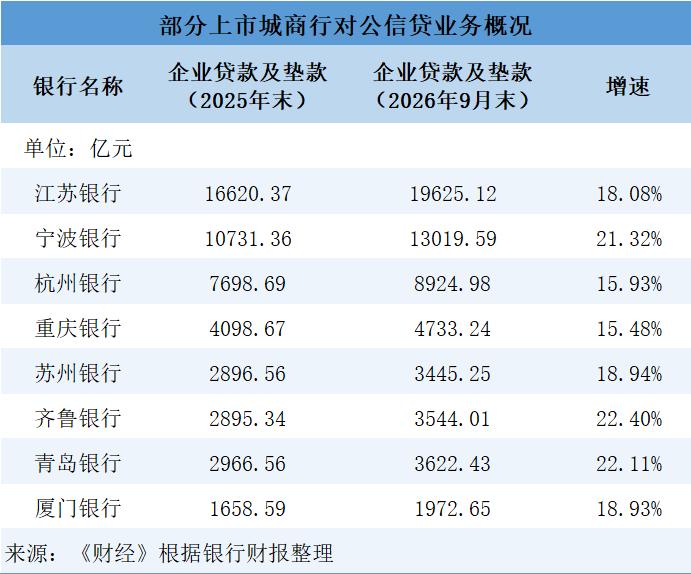
It is not difficult to find that although the corporate credit growth rate of city commercial banks has declined year-on-year, it is still the bank sector with the fastest corporate balance sheet expansion rhythm. Wind shows that in the past five years (from 2021 to 2025), the corporate credit of listed city commercial banks has continued to maintain high growth, with annual growth rates of 13%, 15%, 18%, 17%, and 18% respectively, higher than other types of banks in the same period.
Among them, listed city commercial banks rooted in economically active regions such as the Yangtze River Delta and Chengdu-Chongqing region generally have stronger momentum for corporate credit balance sheet expansion. As of the end of September, a total of 8 listed city commercial banks have a corporate credit growth rate of more than 15% from the beginning of the year, namely Bank of Jiangsu (600919.SH), Bank of Ningbo, Bank of Hangzhou (600926.SH), Bank of Suzhou (002966.SZ), Bank of Chongqing (601963.SH), Qilu Bank (601665.SH), Bank of Qingdao (002948.SZ), and Xiamen Bank.
Between "Contraction and Expansion", What Are the Driving Factors?
Retail and corporate credit show completely different trends. What are the driving factors behind this structural differentiation?
For a long time, retail credit, relying on relatively higher loan pricing, has been an important starting point for banks to optimize their asset income structure and promote retail transformation. Interviewees in the industry believe that affected by multiple factors such as the repair of residents' balance sheets, banks' active optimization of credit structure, and adjustment of risk-return balance, the growth logic of retail credit is undergoing profound changes.
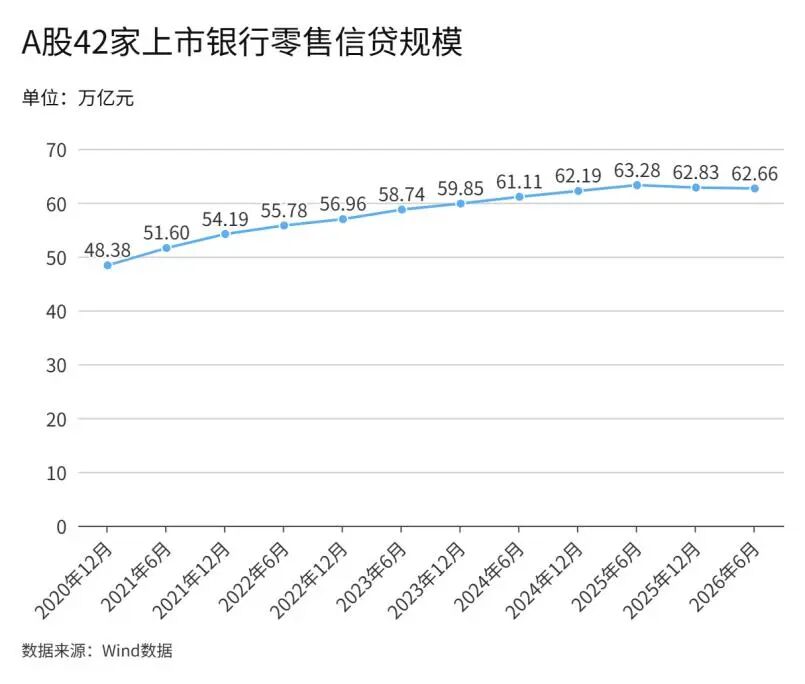
From a longer time dimension, Wind data shows that in the past five years (from 2021 to 2025), the stock scale of retail credit of 42 listed banks has been rising all the way, and began to fall after reaching a high of 63.28 trillion yuan at the end of the first half of 2025; as of the end of the first half of 2026, the stock scale was 62.66 trillion yuan.
Lou Feipeng, a researcher at Postal Savings Bank of China, told Caijing that residents actively deleverage, the scale of passive mortgage release and early repayment brought by second-hand housing transactions remains high, and provident fund loans replace part of commercial loans. In addition, the basic retail credit mortgage loans continue to grow negatively, resulting in overall weak demand on the demand side of retail credit.
"High-quality customers with strong solvency generally tend to repay loans in advance, and banks continue to face the pressure of early repayment." A sub-branch president of a joint-stock bank has a deep understanding of the weakening demand for resident retail credit.
The active contraction on the supply side is also one of the important reasons for the reduction of retail credit. Lou Feipeng believes that the risk exposure of retail credit has a strong lag. "The non-performing ratio of retail credit has been rising unilaterally for many consecutive years, and the risks of consumer loans, credit cards, and operating loans continue to be exposed. Banks have to tighten access and raise pricing from the perspective of risk control."
"Not only is it difficult to grant loans, but the overdue pressure is also high, and the burden of post-loan management is very heavy." A personal loan customer manager of a national joint-stock bank sighed to Caijing recently that the current business focus has shifted to high-quality large customers with high mortgage limits, and for some operating loan customer groups with weak risk resistance, they rarely take the initiative to expand.
A sub-branch president of a listed city commercial bank told Caijing that in the past, the focus was on expanding scale, but now the core is to ensure quality, and the old path of relying on high returns to cover bad debts is no longer feasible. "Currently, retail credit approval requires both the first and second repayment sources of customers to have sufficient guarantees. The focus of risk control has also shifted from front-end application approval to penetrating verification of post-loan capital flow; the risk control logic has bid farewell to the general model applicable to all scenarios, and shifted to layered and grouped management, dynamic credit granting, and refined post-loan operation."
In contrast, the retail credit of some large state-owned banks, city commercial banks and rural commercial banks has achieved growth against the trend. On the one hand, banks have increased investment in expanding domestic demand and promoting consumption, and on the other hand, it benefits from the recovery of the property market in some cities, driving the recovery of mortgage loans.
For example, China Construction Bank (601939.SH) actively implements housing loan interest discount and promotes special consumer finance actions, and personal consumer loans maintain double-digit growth. Bank of Shanghai focuses on scenario-based consumer finance. As of the end of September, the balance of housing mortgage loans was 165.306 billion yuan, an increase of 1.17% from the end of 2025, and the balance of mortgage loans in Shanghai region increased by 5.51%; the balance of new energy vehicle consumer loans increased by 20.57% from the end of 2025.
Under the switch of retail credit operation logic, corporate credit is undertaking the important task of supplementing credit growth through "offsetting price with volume". Wind data shows that in the past five years (from 2021 to 2025), the corporate credit growth rate of 42 listed banks has remained above 9%, continuously underpinning credit growth.
Ming Ming, chief economist of CITIC Securities, told Caijing that "supported by fiscal policies, industrial policies and structural monetary policy tools, there is still financing demand space in key project construction, scientific and technological innovation, industrial upgrading and other fields, which provides support for the growth of corporate loans."
Ming Ming further stated that the current corporate credit growth is more supported by the production and operation of enterprises and capital turnover demand, while the growth of financing related to fixed asset investment is relatively slow. The supporting role of short-term financing demand in the current corporate credit expansion is relatively prominent.
While corporate loans have become the main force of new credit, their internal structure is also continuously adjusted: the credit growth rate of traditional heavy asset industries has slowed down, while credit investment in scientific and technological innovation, green transformation and other fields maintains rapid growth.
According to the 2026 Q3 China Monetary Policy Implementation Report released by the People's Bank of China on November 11, as of the end of September, technology loans, green loans, inclusive loans, pension industry loans, and digital economy industry loans increased by 12.0%, 13.0%, 6.5%, 16.2%, and 15.7% year-on-year respectively, continuously higher than the growth rate of all loans.
Under the above trend, listed city commercial banks and rural commercial banks in some economically active regions mainly rely on local industrial characteristics to continuously optimize the direction of corporate credit resource allocation.
Under Pressure on Both Sides, Exploring the Path to Re-balance
Generally speaking, the current retail credit of banks has bid farewell to the high-speed expansion cycle and entered an adjustment stage of shrinking volume and quality pressure; corporate credit "takes over" to shoulder the incremental task under policy guidance, but at the same time faces multiple constraints such as capital consumption, declining pricing, and local risks.
In this regard, how can commercial banks, which are undergoing profound reshaping of credit structure, seek a new balance among scale, pricing, risk and capital, and solve the development problems of both retail and corporate sides?
Facing the rising non-performing risks, listed banks continue to strengthen retail credit risk control and non-performing disposal efforts. The social financing data released by the People's Bank of China shows that in the first three quarters, financial institutions wrote off 1.27 trillion yuan of loans, a year-on-year increase of 23.3%, and the write-off in the single third quarter was 464.6 billion yuan, a year-on-year increase of 34.5%.
Li Hongwei, deputy general manager of the Credit Management Department of Agricultural Bank of China (601288.SH), said at the bank's 2026 Q3 performance briefing that for overdue retail loans, they will increase the frequency and intensity of collection, and make every effort to improve the loan recovery rate.
However, it should be noted that the entry of retail credit into the downward channel does not mean that the strategic value of retail business declines. Under the background of the overall slowdown of credit growth, retail business is still the customer base cornerstone of wealth management, and wealth management is the core track of current commercial bank competition.
"The development focus of retail credit should shift from scale expansion to value operation, that is, to drive the growth of the retail business line more by relying on income quality and customer value." Zeng Gang, dean of Tianfu Liyan Financial Research Institute, believes that for example, in terms of customer groups, optimize the customer structure of consumer and operating loans, use data models to accurately identify high-quality customers