First time sharing the same stage after the 54.7-billion-yuan acquisition, Fei-Fei Li held a dialogue with Lisa Su, elaborating in detail on the unified world model Atlas
Robotics Forward reported on November 12 that today, at CoRL 2026, Li Fei-Fei delivered a speech titled Atlas: A Unified World Model for Generation and Reconstruction, and then held a fireside chat with Lisa Su, Chair and CEO of AMD. This is the first time the two have appeared in public together since AMD announced the acquisition of World Labs.
This September, AMD announced that it has reached a definitive acquisition agreement with World Labs in a transaction valued at approximately 8.2 billion US dollars (about 54.7 billion RMB), which is expected to be completed by the end of 2026.
Li Fei-Fei highlighted the following key points in her speech:
1. In the field of robotics, how to understand and represent the environment, predict the possible consequences of actions, and supplement real-world data through simulation are the three core problems that robots need to solve.
2. Atlas has three modes, namely dense reconstruction with multi-image input, pure generation with zero-pixel condition, and sparse reconstruction with a small number of views.
3. In terms of technical ideas, Atlas adopts a multimodal autoregressive diffusion Transformer architecture, whose core is to control the prediction of the next viewpoint through camera conditions.
It can not only perform dense reconstruction based on a large number of images, but also perform sparse reconstruction with only a small number of images, and even generate scenes without any image input and only with text prompts.
4. Li Fei-Fei also disclosed that the practical value of Atlas in robot simulation is currently being tested. Atlas can not only generate and reconstruct 3D environments, but also be used for robot training and navigation, connecting the real world with the simulation world, and then applying the simulation results to real robots.
At the same time, Li Fei-Fei also demonstrated relevant explorations in her speech: robots can be fully trained in a virtual simulation environment and then deployed to the real world in a zero-shot manner.
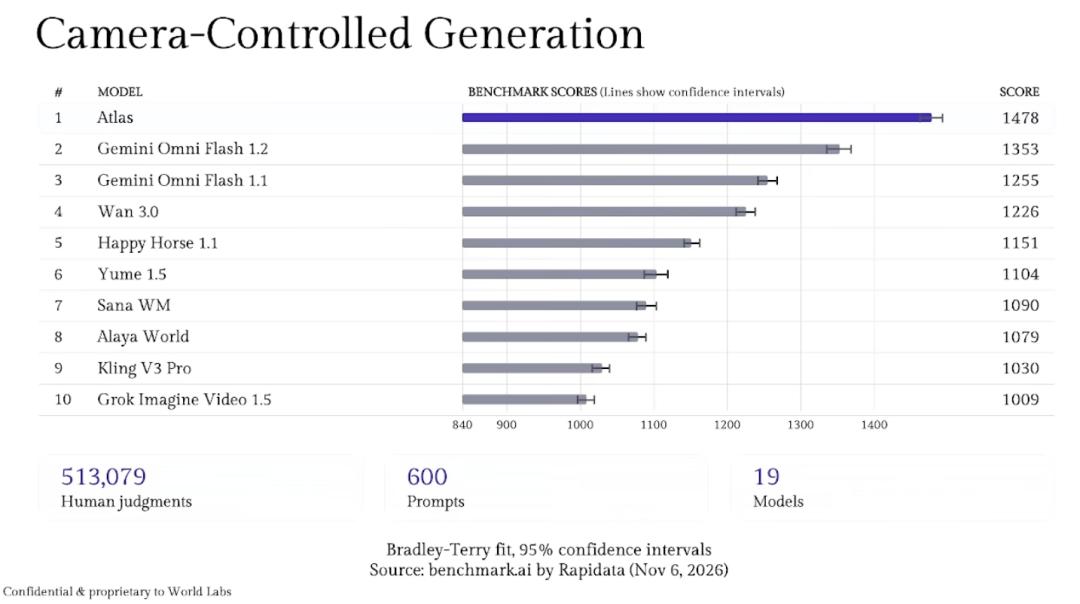
5. Finally, Li Fei-Fei also emphasized that Atlas ranks first in the Rapidata camera motion benchmark.
At the beginning of the roundtable discussion, Lisa Su made a prediction about the future of the robotics field, stating that physical AI, especially robotics, is a multi-trillion-dollar opportunity in the coming years, and revealed that AMD already has a fairly large robotics research team, though the relevant layout is still in its early stages.
Li Fei-Fei put forward the viewpoint that "AI is computing, and computing is AI", and believes that cutting-edge LLM/VLM and dedicated models each have their own strengths.
In this process, both sides called for providing more computing power for public sector researchers, leveraging the power of the public sector to understand and evaluate what AI is doing, carry out benchmark tests, and provide information to the public to help them understand.
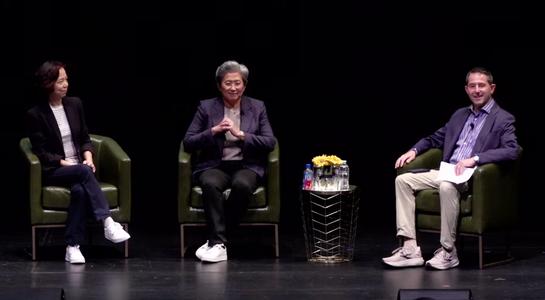
The following is the full transcript of the speech and roundtable discussion:
Today I want to share with you a model recently developed by the World Labs research team called Atlas. This is a unified world model for generation and reconstruction.
Since we are at the CoRL conference today, let's start with the needs in the robotics field.
I know that a lot of changes are taking place and a lot of progress has been made in the field of robotics. Just a day ago, we saw new research results. No matter what kind of robotics technology route we adopt, whether we use Policy Learning or Agent, there is a fundamental problem that the robotics field is trying to solve:
Given the current state of the world, task objectives, and the robot itself, what should the robot do next at every moment?
In general, robots need to solve several basic problems.
First, robots need to have the ability to understand and represent the state of the world and the surrounding environment. We can discuss whether this representation should be implicit or explicit, but the understanding of the environment itself is very important.
Second, robots need to be able to predict the possible consequences of actions and plan these actions in some way.
Finally, data has always been an issue. The robotics field has a very long long-tail distribution, and robots face a large number of long-tail scenarios to be successfully deployed. Therefore, in many cases, it is very valuable if we can generate as many different environments and states as possible through simulation to supplement real-world data. This is helpful for both model training and model evaluation.
No matter what method we adopt, these three problems still exist in the field of robotics.
This also makes me think of world models. In fact, the above three problems correspond to the three problems that world models try to solve respectively.
For example, understanding and representing the environment corresponds to the rendering problem in world models and visual models; predicting the possible consequences of actions corresponds to the planning problem; simulating different states in the world corresponds to the simulation problem.
Of course, I don't want to absolutize these problems, nor do I think they are completely independent of each other. In fact, in many cases, we can unify them, and these problems are also intertwined. These are all very exciting cutting-edge directions in this research field.
01. Atlas Tries to Unify Generation and 3D Reconstruction
Today, I want to focus on introducing Atlas. This is a new model we just proposed.
In general, Atlas is mainly committed to solving rendering and simulation problems, especially the simulation of world geometry and 3D and 4D dynamic processes.
Simply put, Atlas is an autoregressive foundation model trained from scratch. It is an all-modal model that can accept multimodal inputs, including text, image, video, depth signal, Grayboxing, and 3D structural signal.
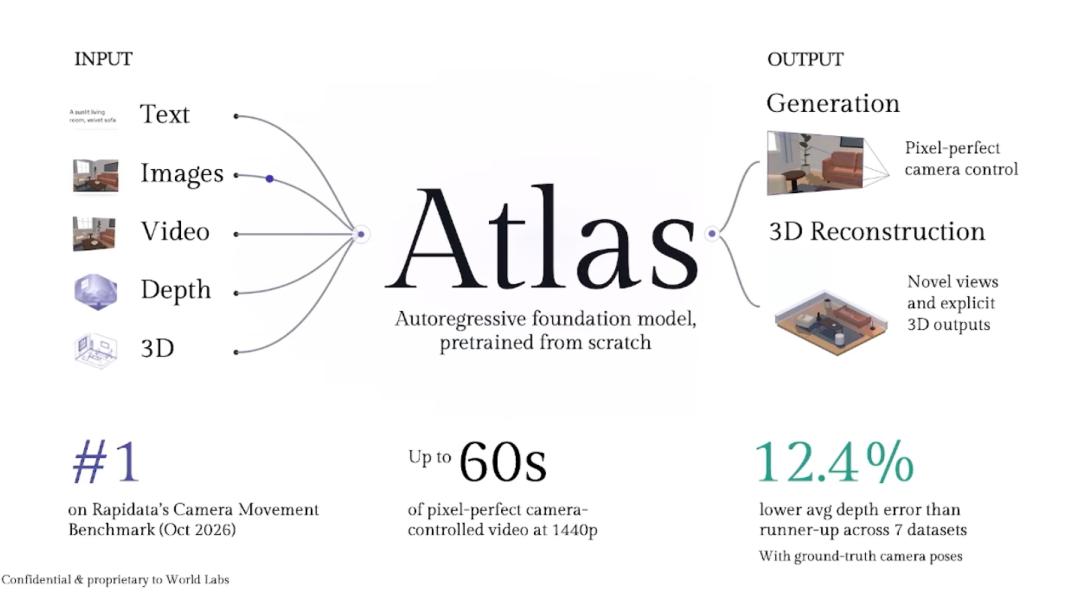
Its output is pixel frames. But Atlas can not only generate high-quality image frames in a spatio-temporally consistent manner, but also synthesize new viewpoints, so as to achieve precise and high-fidelity 3D reconstruction.
Next, I will show some experimental results and specific details. First, I will introduce the overall capabilities of Atlas.
Let's first review the development of related research.
There are two very important problems in the field of computer vision. Of course, these are not the only two problems in the field of computer vision, but they are indeed very important. Researchers have spent many years, even generations, studying these problems.
One of them is the 3D reconstruction problem. The research I show here includes both the classic paper Building Rome in a Day and the latest state-of-the-art research, such as NeRF-related papers.
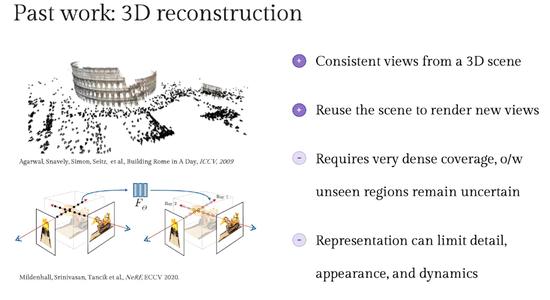
The fundamental problem we are trying to solve is: how to construct a 3D scene that conforms to the real world based on images taken from different camera positions and poses?
Most traditional methods require a large number of images with camera pose information.
If these camera viewpoints do not cover the entire surface area of the scene, reconstruction will become very difficult, and the model will find it hard to accurately estimate the uncovered areas. Therefore, the final 3D reconstruction results often have large uncertainties.
This is the classic 3D reconstruction problem.
But in recent years, generative artificial intelligence has made great progress. Now, we already have pure generative models that can directly generate high-quality pixel content.
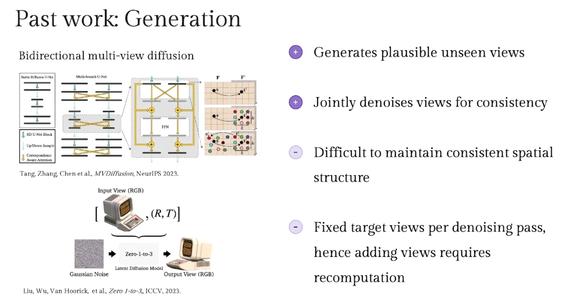
At the same time, the backbone architecture based on diffusion models also provides a new exploration direction for multi-view generation research, further shortening the distance between generation and reconstruction.
Along this research line, there have been some excellent works that try to generate previously unobserved viewpoints and maintain spatial consistency by jointly denoising multiple viewpoints.
However, in general, the effects of these methods are still limited. They still struggle to maintain spatial consistency, and each denoising process can usually only target a fixed target viewpoint. If you want to change the viewpoint or achieve real-time generation, the computational cost will be very high.
Atlas continues to explore along the direction of a series of studies in the past few years, trying to unify generation and reconstruction.
Our goal is to use the same model architecture and the same set of training schemes to solve both problems at the same time.
Specifically, Atlas can switch between the two directions of generation and reconstruction.
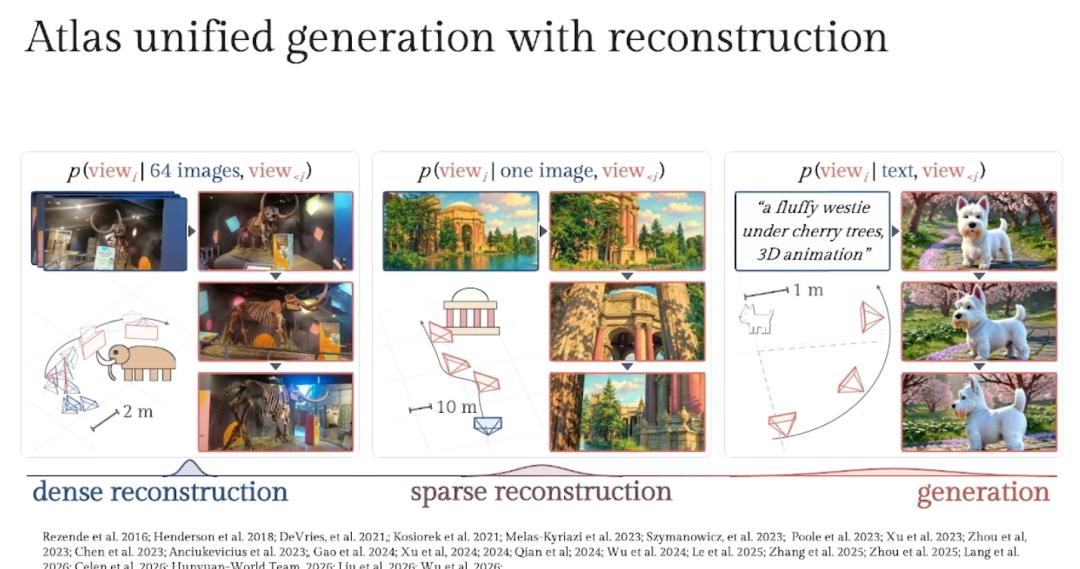
In one extreme case, if Atlas gets multiple input images and the number of images is large enough, it can perform reconstruction tasks. The model can perform dense reconstruction and output high-quality scenes and world structures.
In the other extreme case, if there is no pixel condition input at all and only a text prompt is provided, Atlas can perform pure generation tasks. It can also generate multiple consecutive frames with viewpoint consistency.
More interestingly, Atlas can also complete a task that connects generation and reconstruction, which we call Sparse Reconstruction.
In this case, Atlas gets a very limited number of viewpoints. In the extreme case, the input is even only one image.
Atlas can estimate the camera pose, then further generate multiple viewpoints within the model's capability, and finally reconstruct and generate a complete world.
Therefore, Atlas can realize the switch from dense reconstruction to sparse reconstruction and then to pure generation under the same model framework.
02. Even with a Small Number of Images, a Complete World Can Be Reconstructed
Before introducing the technical details, let me show you an example first. Some of you here should recognize that this is the campus of Stanford University.
Stanford has a very famous Main Quad.
If you only give the model two limited input images, it will generate, or complete, a main quad.
If you are familiar with Stanford University, you will find that this is not our real main quad. It feels like the main quad, but it is not the real main quad at all.
The model performs conditional generation based on features such as the corridors in the input image, so the generated scene retains some characteristics of the corridors, and arches also appear, but on the whole it is still a plaza generated based on the input.
If you give the model eight images, the effect will be much better.
Considering that the space itself is very large, the information provided by the eight images is still very sparse. But if you look closely, the model has basically reconstructed the entire plaza.
At first glance, it is almost perfect. However, people familiar with Stanford University will find that the famous Memorial Church is missing. This is because the input images do not contain the Memorial Church.
Finally, if 33 images are input, although these images are still very sparse in view of the scale of the entire space and many areas are not covered, one of the images does contain the Memorial Church.
Therefore, Atlas can basically reconstruct the beautiful main quad of Stanford University.
I also want to emphasize one point in particular: all these 33 images were taken at ground level, that is, they are ordinary images taken by a person holding a camera.
But the model can generate different observation viewpoints, including the aerial viewpoint I am showing now.
Then, what is the key technology behind Atlas that enables it to do this?
03. Viewpoint Prediction Is the Core Technology of Atlas
For large language models (LLMs), we are already very familiar with the objective function of Next Token Prediction.
For Atlas, our core idea is: Viewpoint Is All You Need.
We let the model predict the next viewpoint through precise camera pose condition control.
Specifically, Atlas adopts a multimodal autoregressive diffusion Transformer architecture.
As mentioned earlier, Atlas can accept text input and generate images according to camera poses.
It can also accept an image, estimate the corresponding camera pose, and then use this input image as a condition to generate more images and more new camera viewpoints.
What is shown here is a very cute little robot located in the garden. We can see that the model can generate frames from different viewpoints along the motion path surrounding the camera.
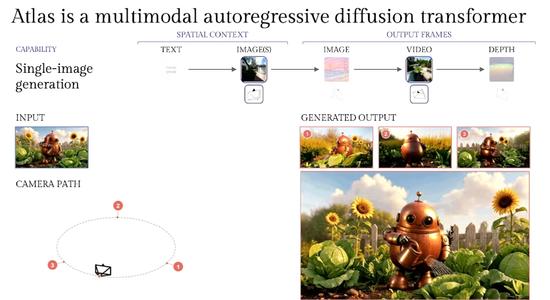
In addition, as the Stanford main quad example just demonstrated, Atlas can also accept images from multiple viewpoints, interpolate and extrapolate along different camera motion paths, so as to restore a 3D scene.
It can also accept depth images or Graybox inputs and output RGB pixel images. This capability is very useful in many robotics and game application scenarios.
Next, let's look at the performance of Atlas with some quantitative results. I want to show its results in generation and reconstruction respectively.
The first is camera-controlled generation.
The results here were actually obtained just a few days ago from an independent third-party organization called RapidData.
Without notifying us in advance, they conducted benchmark tests on multiple state-of-the-art video models to evaluate the camera-controlled generation capability, and the test included about 500,000 human judgments.
In the end, Atlas ranked first in this test, surpassing many current state-of-the-art video models.
As you can see from the figure, there is a fairly obvious gap between Atlas and the second-ranked model.
Atlas can generate coherent videos longer than 60 seconds. In fact, the duration it can generate now is far more than 60 seconds.
What is shown here is our latest results in 2026. I especially want to compare it with the early model we tried about a year and a half ago.
You can see that the range that the early model could generate was very limited, and the geometric consistency was relatively poor. At that time, we even