Why is Lenovo getting into the token business? | The Frontline
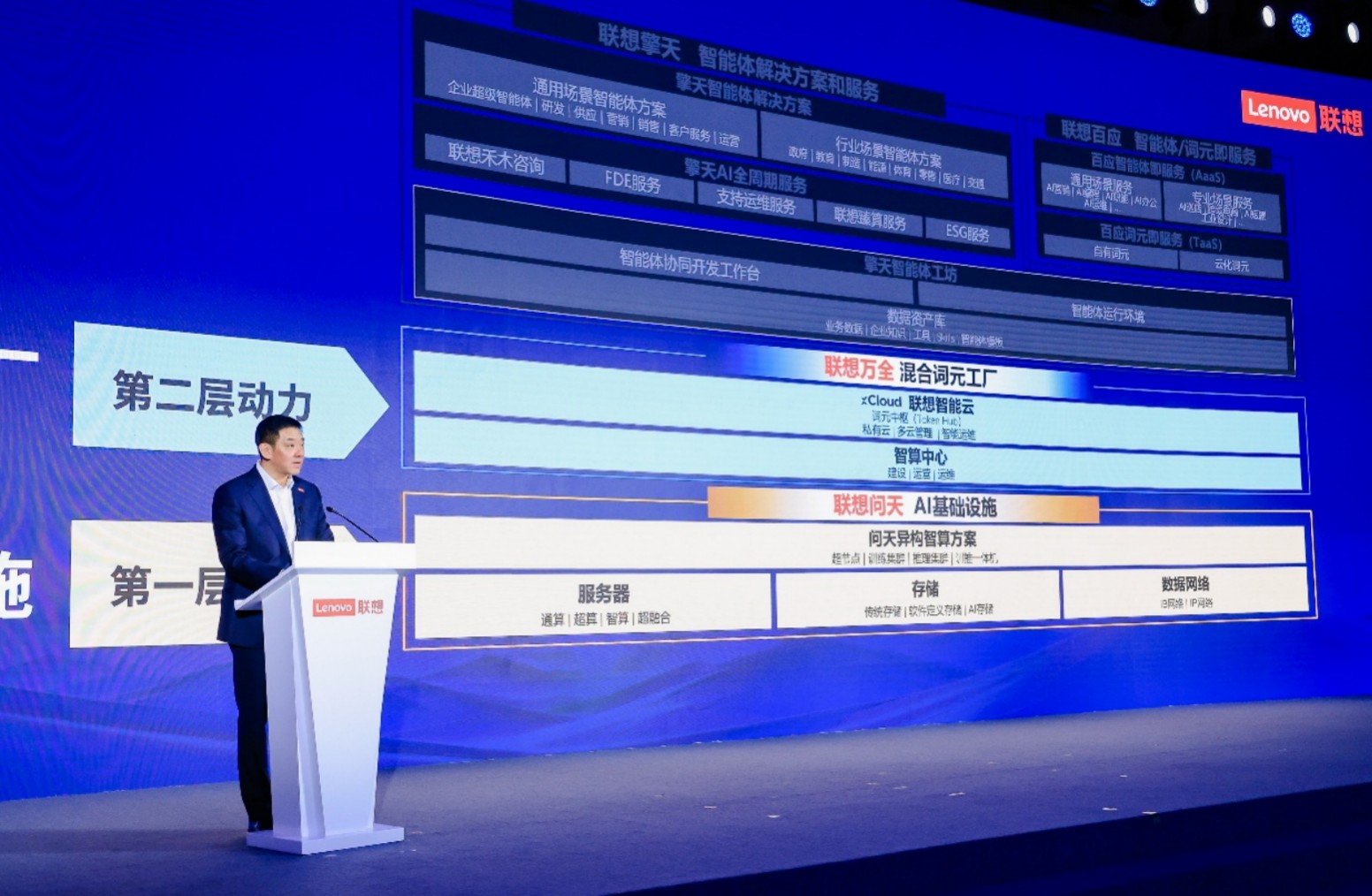
Image source from Lenovo official channels
By Xiao Man
Edited by Yuan Silai
On November 10, Lenovo launched the "Wanquan Hybrid Token Factory" brand, and announced a cooperation with the Zhangjiakou Municipal Government to build the first hybrid token master factory.
According to the plan released by Lenovo, the Zhangjiakou master factory will initially build a 15,000P heterogeneous computing power cluster and an intelligent computing center of approximately 100MW, with an annual token output of over 2000 trillion and a peak token output of 200 million per second. By 2030, relevant core indicators are expected to increase by more than 10 times on the current basis.
This means that Lenovo aims to transform its past business model dominated by "selling AI devices", and further convert computing power resources into "AI output".
In the past three years, the most certain business in the AI industry has been computing power.
From NVIDIA GPUs to servers, switches, and then to data centers and supporting power facilities, capital and industrial resources have continuously poured into AI infrastructure construction. The ability to obtain chips and build larger-scale computing power clusters has become the key to competition at this stage.
However, computing power construction does not equal the direct realization of commercial value. Purchasing servers and building intelligent computing centers is only the beginning of AI investment. Model training and reasoning require continuous consumption of computing power. How to improve equipment utilization, reduce unit reasoning cost, and enable models to stably complete practical tasks is the key to whether AI can truly enter business processes.
Especially as AI evolves from a simple chat tool to an intelligent agent, Token consumption is constantly increasing.
In the past, when a user asked a large model a question and the model returned an answer, the Token consumption was relatively limited. Now, intelligent agents are beginning to undertake continuous tasks such as search, analysis, decision-making and execution. A single business process may require multiple rounds of model calls, and Token consumption increases accordingly. Data from the National Data Administration shows that as of June 2026, the daily average token call volume in China has exceeded 500 trillion.
This means that new changes are emerging in the competition of the AI industry chain: in the past, the competition focused on who owns more computing power, and in the next stage, it will also focus on who can produce more, cheaper and more effective Tokens with the same amount of computing power.
Ying Ying, chief analyst of the computer industry at China Securities Construction Investment Securities, mentioned in the post-meeting exchange that from the perspective of financial statements and investment books, AI infrastructure still occupies a relatively high value, but from the perspective of actual profit growth in the next three years, the Token operation and application links are expected to undertake more growth.
This is similar to the development of the early cloud computing industry. Cloud computing initially solved the problem of enterprise IT resource supply, and then the competition gradually shifted to resource scheduling, platform services and application ecosystems. AI infrastructure may also go through a similar process: from selling computing power, to selling computing power services, and then to selling actual AI production capacity.
In this process, the token factory has become a new form of infrastructure, which Ying Ying regards as the "New Cloud", that is, a new generation of cloud platform.
A token factory is not simply a place that gathers a batch of GPUs and then sells Tokens externally. It also needs to solve the matching problem between different computing powers, models and businesses.
Lenovo has built a "three-layer hybrid power" for the Wanquan Hybrid Token Factory: the bottom layer is Lenovo Tianwen AI infrastructure, which is responsible for providing heterogeneous computing power; the middle layer is the Wanquan Hybrid Token Factory, which is responsible for computing power management, model scheduling and Token production; the upper layer is the Skyteller and Baiying intelligent agent solutions and services, which convert Tokens into productivity in specific business scenarios.
Lenovo is not the only enterprise that has spotted the opportunity of Token operation. In the past two years, many enterprises that originally focused on servers or computing power equipment have also begun to extend to Token operation and services. Cloud vendors that already have computing power resources, model ecosystems and customer entrances are also competing for the enterprise AI infrastructure market.
Ying Ying believes that for enterprises to enter the token factory market, referring to the cloud computing and IDC (Internet Data Center) industry, there are two thresholds: hard resources and soft operation. In terms of hard resources, as long as one of land, electricity price or server infrastructure procurement and deployment has a cost advantage, there is a certain foundation for market entry; in terms of soft operation, a technical team that can optimize operators and build a high-concurrency cloud platform is required. Even with the same hardware conditions, different operation teams may produce Tokens with significantly different costs.
This means that the token factory is not an industry where barriers can be established only by capital investment. The scale of computing power can be obtained through investment, but continuous scheduling optimization, customer understanding and operation efficiency need to be accumulated in real business operations.
Token production is only an intermediate link, and the ultimate reason why enterprises are willing to pay continuously depends on whether AI helps them shorten the R&D cycle, improve production efficiency, or create new revenue.
From servers to intelligent computing centers, and then to token factories, Lenovo is actually striving for a position in the AI infrastructure industry chain that is closer to customers and closer to the realization of commercial value.
However, this competition has only just begun. For Lenovo, building a token factory is only the first step. The real test of this transformation is whether it can combine computing power, models and operation capabilities into a business with stable customers, continuous revenue and reasonable profits.