Is BYD trying to seize smart's market share? The patent images of the new car have been exposed, and the two-seat all-electric mini car is coming.
BYD is also set to launch two new personalized compact cars. Is this a move to directly compete with smart?
According to the announcement from the China National Intellectual Property Administration, BYD filed an appearance design patent on December 18, 2025, with the authorization announcement date set as November 10, 2026. It can be seen from the patent page that the patent filed by BYD this time corresponds to a two-door, two-seat personalized microcar.
It is worth noting that in the list of patent designers for this model, the first place goes to Zhao Binggen, Dean of BYD Dynasty Institute, and the second place goes to Wolfgang Egger, who has led the R&D of many classic BYD models.
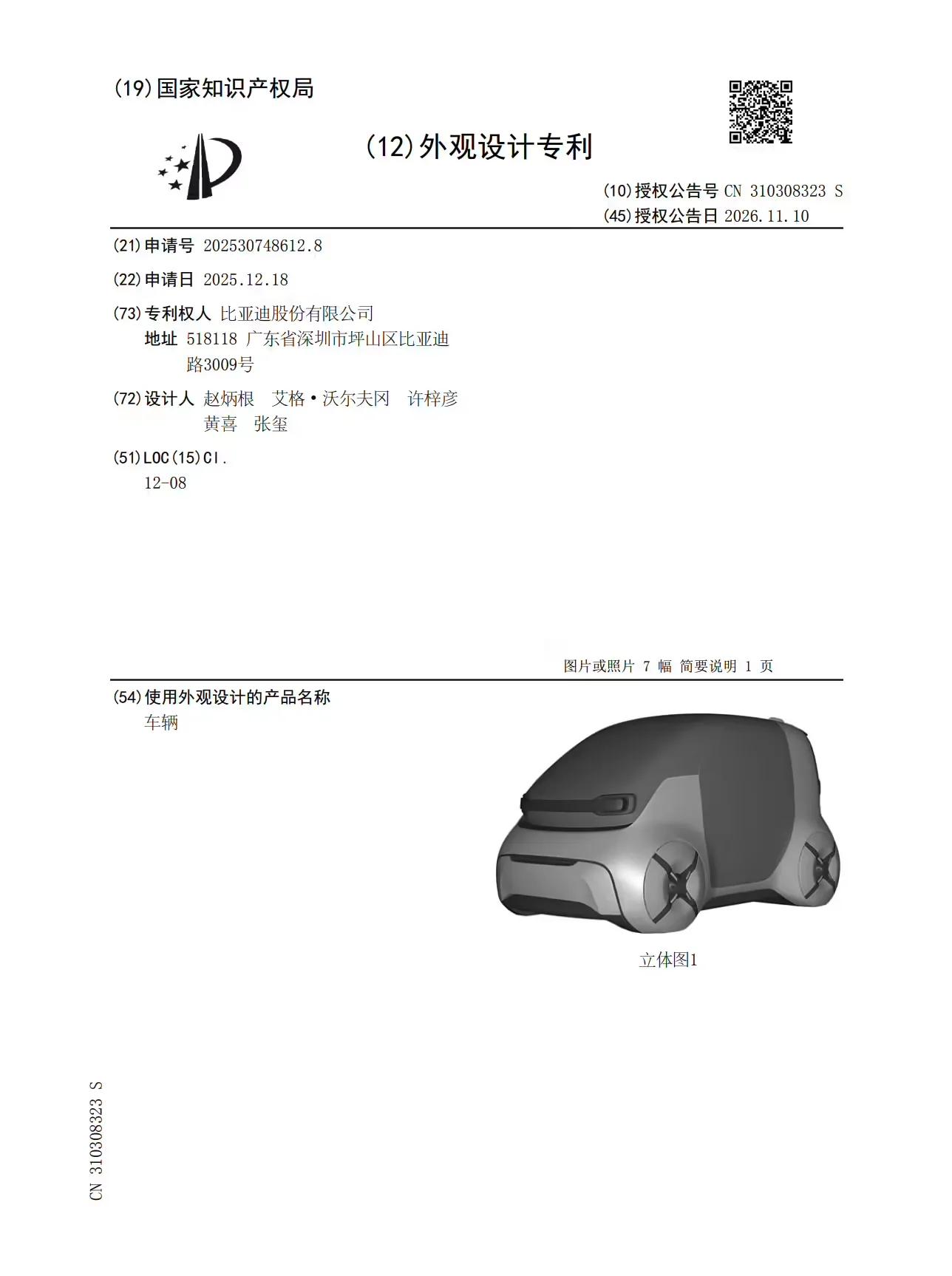
(Image source: China National Intellectual Property Administration)
That means, if this small car is successfully launched, it will most likely be included in the Dynasty Line in the future, becoming the first A00-class model of the Dynasty family, and will serve as the successor model after the BYD Seagull is upgraded to the A0-class model.
For BYD, does the launch of personalized A00-class small cars mean that the company's perception of microcars has changed? In such a niche track with relatively low demand, is BYD ready to fight against smart?
The first two-seat microcar of the Dynasty Line, how will BYD make its move?
Judging from the disclosed patent drawings, this BYD microcar barely shows any traces of existing models in the Dynasty Line. Its exterior design does not follow the "Dragon Face" style of the Dynasty Line, but adopts a more minimalist design. Its body lines are smooth, and it adopts the four-wheel-four-corner layout same as smart fortwo and Smart #2, to maximize the interior space. In addition, the headlamps and taillights of this car adopt the same shape, which is the first time to appear on BYD's passenger vehicles.
However, Dianchetong (ID: dianchetong233) also noticed that the wheels on the patent drawings adopt a design integrated with the car body, which is basically only used on concept cars. Therefore, Dianchetong speculates that the model shown in the patent drawings may be a concept car. But according to BYD's style in recent years, after launching a concept car, it will also launch a regular mass-produced version based on the concept car.
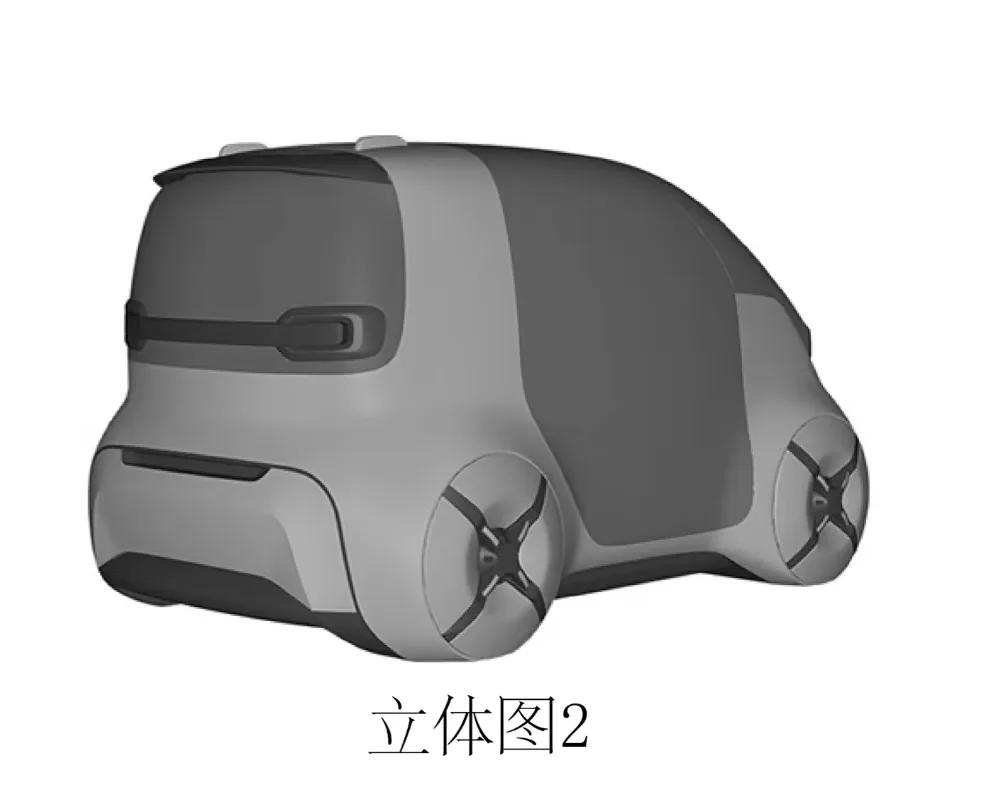
(Image source: China National Intellectual Property Administration)
So, what will the design language of the new car be named? The new generation of Dragon Face, or the mini version of Dragon Face? What will the name of this small car be? The new generation of Yuan / Yuan Pro, or will a new dynasty naming convention be adopted? All these will not be known until the official debut or the filing with the Ministry of Industry and Information Technology.
However, Dianchetong speculates that there is also a possibility that this car will eventually be launched under another BYD brand. For example, the Denza Z originally belonged to the Fangchengbao brand and was later adjusted to the Denza brand. In Dianchetong's view, whether it is the Dynasty Line or the Ocean Line, its entry-level models are more focused on cost-effectiveness, that is, the configuration of the vehicles focuses more on space, comfort and safety, and has nothing to do with exquisiteness and personality. If a small car that focuses on exquisiteness and personality is placed in the Dynasty Line, it will look a bit out of place, and there will be little room for premium.
For example, the smart #2, jointly developed by Geely and Mercedes-Benz, bears the smart badge and is sold in Mercedes-Benz dealerships. Its price of 99,900 yuan even seems to be quite cost-effective. If this car does not belong to smart but to Geely Galaxy, even if it is sold for 59,900 yuan, some consumers will think that at this price point, why not buy the Xingyuan?
Therefore, if this car really belongs to the Dynasty Line, how the Dynasty Line will operate this car well, so that it will not be labeled as a cheap small car and can achieve relatively excellent sales among small cars of the same class, is indeed a big test for the capability of the Dynasty Line.
What is the prospect of two-seat pure electric personalized small cars?
Two-seat micro pure electric vehicles have actually developed together with the new energy vehicle industry.
As early as the early stage of new energy vehicle subsidies, that is, from 2012 to 2017, brands such as Zotye and Zhidou targeted this market, and achieved apparent prosperity relying on the low selling price after subsidies.
For example, the Zotye E200, which was launched at the 2016 Beijing Auto Show, had an official guide price of 181,800 yuan, but the unified national selling price after subsidies was 59,800 yuan. This set of figures is enough to show how strong the subsidy intensity was in those days.
At this stage, consumers buying micro electric vehicles are more or less buying a license-plate-allowed "low-speed electric vehicle for the elderly". After all, with heavy subsidies, a micro electric vehicle is only slightly more expensive than a low-speed elderly vehicle, and they can get a car that can be registered and has a better experience. Why not do it?
With the subsidy phasing out and the new energy technology becoming more mature, such low-cost commuting demand has been gradually taken over by two-door four-seat small cars such as Hongguang MINIEV with lower production costs. Although brands such as Wuling have tried to move upmarket after the popularity of such two-door four-seat small cars, and launched more personalized and exquisite two-seat small cars such as the Air EV, the domestic market did not accept them, and they ended up being discontinued.
At the current stage, the positioning of two-seat pure electric small cars is changing. As low-cost A00-class small cars like Wuling Hongguang MINIEV are gradually replaced by A0-class models such as Geely Xingyuan, two-seat pure electric small cars are starting to focus on personalization. For example, the newly launched smart #2 has formed a significant configuration difference with other A00-class small cars by piling up materials in the chassis, body, interior and other aspects, which is more in line with its positioning as an exquisite small car.
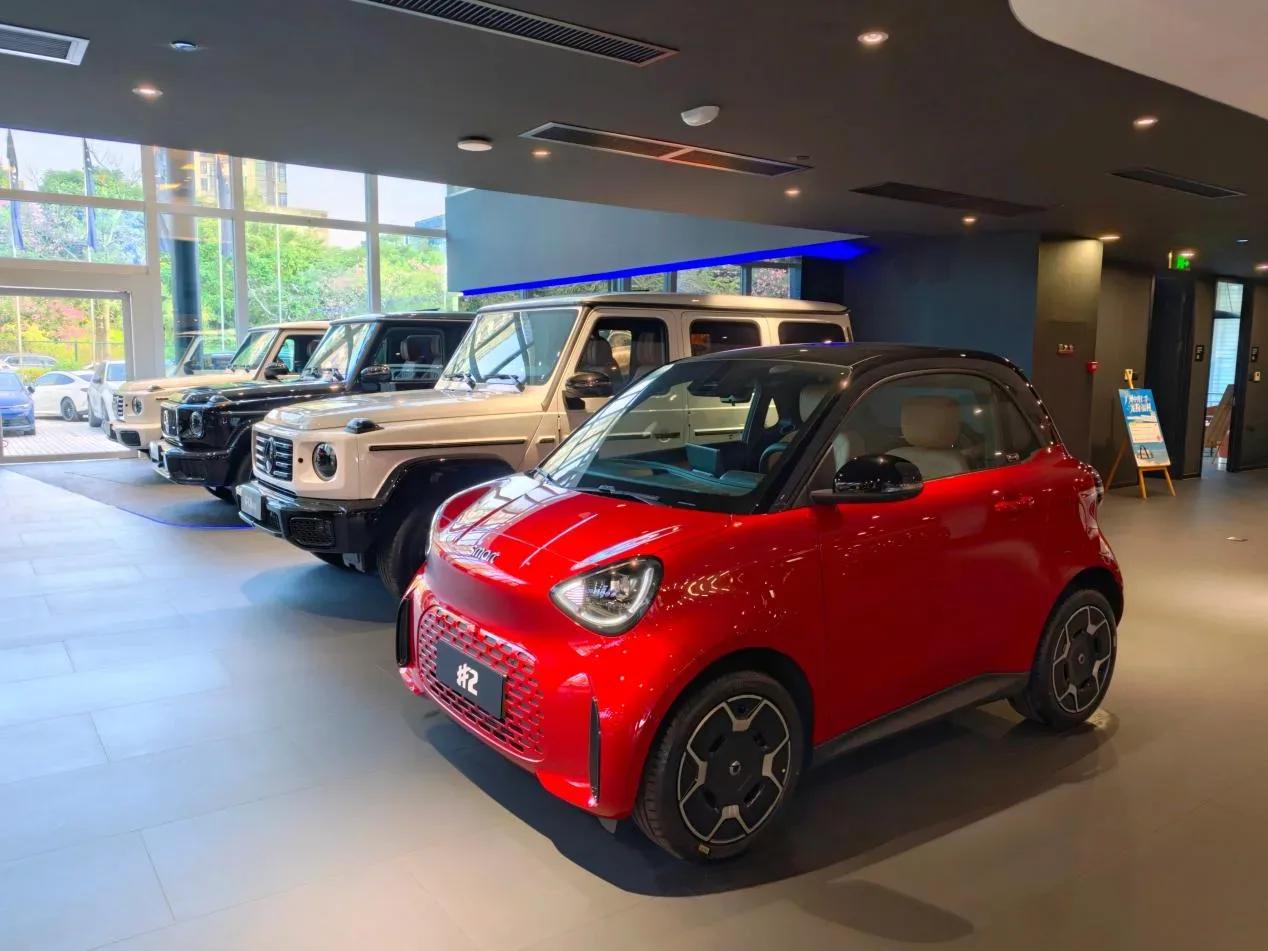
(Image source: Filmed by Dianchetong)
However, in Dianchetong's view, China's automotive market is still in the state of "bigger is better" at the current stage. Users will take the space performance of the vehicle as an important factor when purchasing a car. Therefore, such exquisite personalized small cars will most likely be a niche category in the domestic market in the future, and it is already the limit if one or two models sell well.
However, the previous analysis and discussion missed an important influencing factor, that is, the overseas market — small cars that are not popular in the Chinese market may not be unsuccessful in markets such as Europe.
For example, Leapmotor T03, although it has been discontinued in the domestic market and its positioning has been replaced by models such as A05 and A10, this car is still normally sold in many European countries. Brands such as Citroën and Opel, which are also owned by Stellantis that holds shares in Leapmotor, are expected to build pure electric small cars based on the T03 platform in the future.
Therefore, in Dianchetong's view, whether for BYD or other automakers, the overseas market, especially the European market, will be a new blue ocean for high-quality new energy small cars. In particular, BYD is already able to launch new models targeted at different markets. Will it build pure electric small cars suitable for local consumers according to the needs of European consumers?
Or in other words, the set of patent drawings just published, the corresponding mass-produced model, is not for the domestic market, but for overseas markets?
Of course, this is just speculation. The specific situation of the vehicle needs to wait for its official launch. But from the perspective of going global, this BYD small car is indeed more suitable for the European market. If it belongs to the Dynasty Line, it does not seem out of place.
Will exquisite pure electric small cars trigger industry follow-up again?
Compared with other segmented markets that have evolved from blue ocean to red ocean with fierce competition, the track of exquisite small cars does not seem to need to worry too much.
Because such models are really not easy to make, and the profit margin is relatively low. Once it enters the stage of cutthroat competition, the product must lower its positioning, which will return to the positioning of non-exquisite cheap small cars.
Instead of wading into the muddy water of microcars, automakers might as well focus on making C-class sedans, large six-seat SUVs and other models. After all, although these tracks are more competitive, if they lose in the competition, the result will not be too tragic at least, and they can always rely on the mobility service market as a fallback.
Therefore, those who can make exquisite pure electric small cars are either leading large manufacturers or enterprises that have been rooted in this track. Such cars are a niche category at the current stage, and will most likely remain a niche category in the future.