Beijing's first "Housing Development" plan has been unveiled. What signals does it convey?
On November 6, 2026, Beijing Municipal Commission of Housing and Urban-Rural Development released the *Housing Development Plan for the 15th Five-Year Plan Period of Beijing* (Jing Jian Fa [2026] No. 525). This is the first five-year special plan named after "housing development" in Beijing, and the corresponding previous document was the *Housing Security Plan for the 14th Five-Year Plan Period of Beijing*. This plan clarifies a new core development line — "reasonable total volume, stock priority, structure optimization, quality iteration, and governance improvement". These five key elements form a complete path for the capital's housing work to shift from "guaranteeing everyone a place to live" to "ensuring everyone a livable home", and also serve as the logical entry point for understanding the 24 key tasks and 13 major indicators throughout the full document.
Reasonable Total Volume: Total Urban Housing Stock Remains Stable in the Next Five Years, Expected Per Capita Floor Space of Residential Buildings to Increase by 0.3 Square Meters
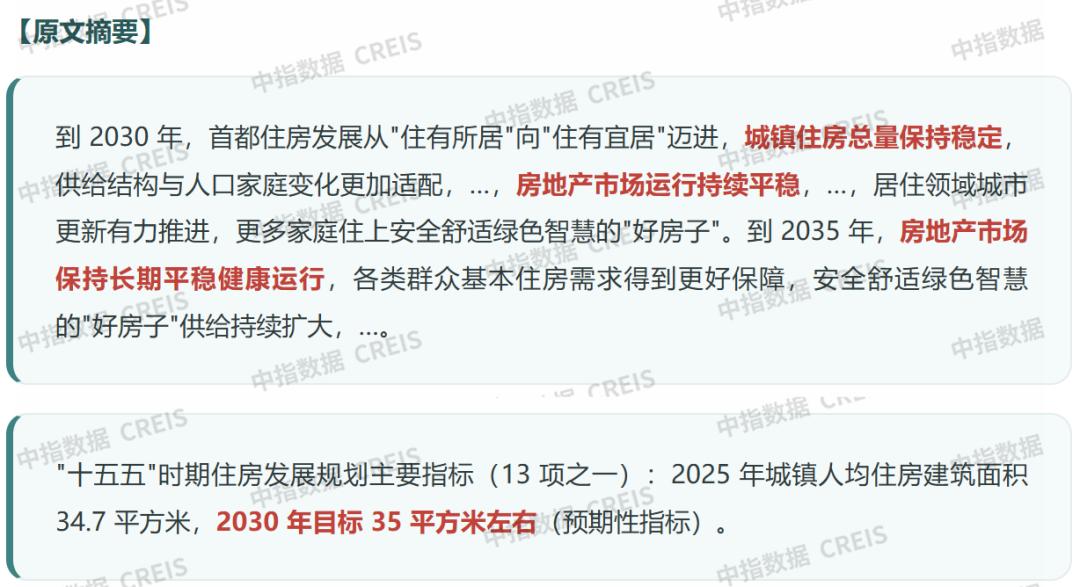
The 2030 target statement that "the total urban housing stock remains stable, and the supply structure is more adapted to changes in population and households" forms a contrast with the orientation of the 14th Five-Year Plan period, which took the scale of construction and fundraising of indemnificatory housing as the core goal, meaning that Beijing's policy goal has shifted from "whether housing is available" to "whether housing is high-quality and well-matched".
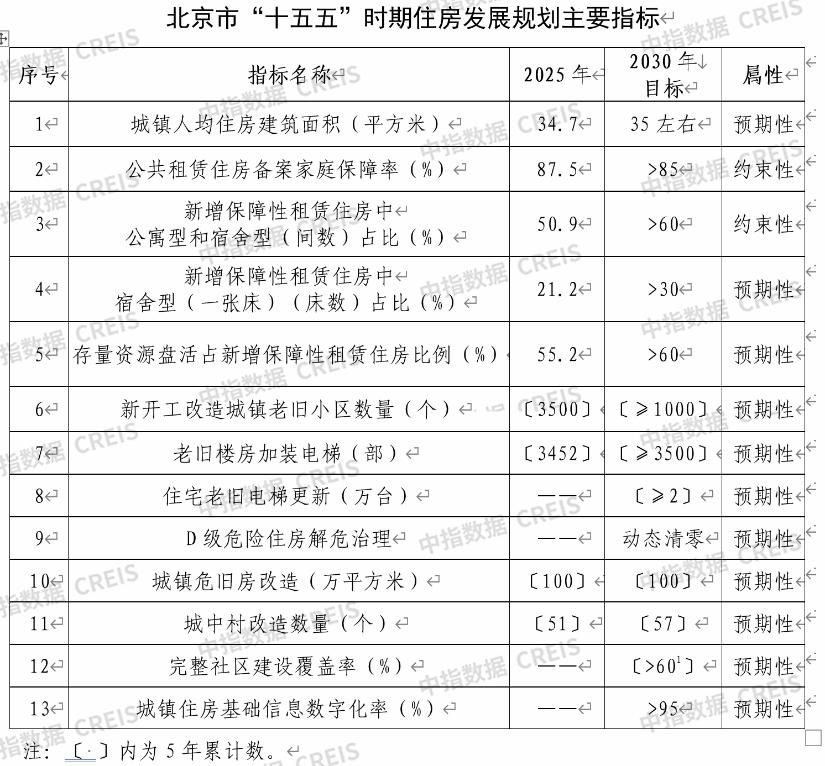
In the next five years, the per capita floor space of urban residential buildings in Beijing is expected to increase by 0.3 square meters, 0.7 square meters lower than the actual increase in the 14th Five-Year Plan period (the per capita floor space of urban residential buildings in Beijing rose from 33.7 square meters in 2020 to 34.7 square meters in 2025). This shows that the plan's expectation for the per capita living level at the end of the period is basically flat with slight improvement. Estimated based on the 19.249 million permanent urban residents in Beijing in 2025 (excluding population changes for the time being), the new housing demand brought by the increase in per capita floor space of residential buildings in the next five years is expected to be about 5.77 million square meters. Considering demolition and relocation, the new housing scale will be higher than this figure. However, taking into account factors such as the fact that the renovation target of dilapidated houses in the 15th Five-Year Plan period is consistent with that in the 14th Five-Year Plan period and the number of urban village renovations has increased slightly, the overall new housing supply in Beijing during the 15th Five-Year Plan period is expected to shrink compared with the 14th Five-Year Plan period.
On the premise of stable total housing volume, the structural adjustment space of housing supply mainly comes from the circulation of stock housing, the space released by urban renewal and the activation of idle assets. It is expected that the future new housing supply will present the characteristics of "small in quantity but high in quality, and core-oriented", and the supply will be further concentrated around rail transit stations, areas with complete supporting facilities and employment-intensive areas. Second-hand housing and stock renewal will become the main battlefield of the market, and the competition among real estate enterprises will shift to "product strength + operation strength + service strength".
It is worth noting that the plan clarifies the two phased targets by 2030 and 2035, and the stable operation of the real estate market is one of the core contents in both stages. It also clarifies six key tasks, including optimizing land supply, improving the basic system of real estate, encouraging and supporting rigid and improved housing consumption, standardizing market order, improving supporting services for stock residential communities, and strengthening the overall planning of resettlement housing. In the part of encouraging housing consumption, it emphasizes "targeted support" and "gradient consumption", and clarifies targeted support for groups such as new citizens, young people, and multi-child families. It is expected that there will be supporting arrangements in subsequent aspects such as the provident fund loan quota and housing purchase subsidies. The statement of "promoting gradient consumption and housing recycling, and invigorating the stock housing market" points to unblocking the second-hand housing replacement chain. If more targeted support is given subsequently, the replacement efficiency is expected to be improved.
In addition, this plan clearly states that "the new scale of resettlement housing shall be reasonably controlled" (the 14th Five-Year Plan period was "actively promoting the construction of resettlement housing"). The housing ticket resettlement policy has been officially written into the five-year plan. Its advantage lies in opening up the cycle between resettlement demand and market stock commercial housing, which can not only reduce new construction and shorten the resettlement cycle, but also help digest the inventory of commercial housing in the region. If the scale of housing ticket resettlement is large, it will promote the release of housing demand and bring positive benefits to the real estate market.
Stock Priority: Rich Content, Multi-line Progress Including Urban Renewal in the Residential Sector and Invigorating Market Vitality
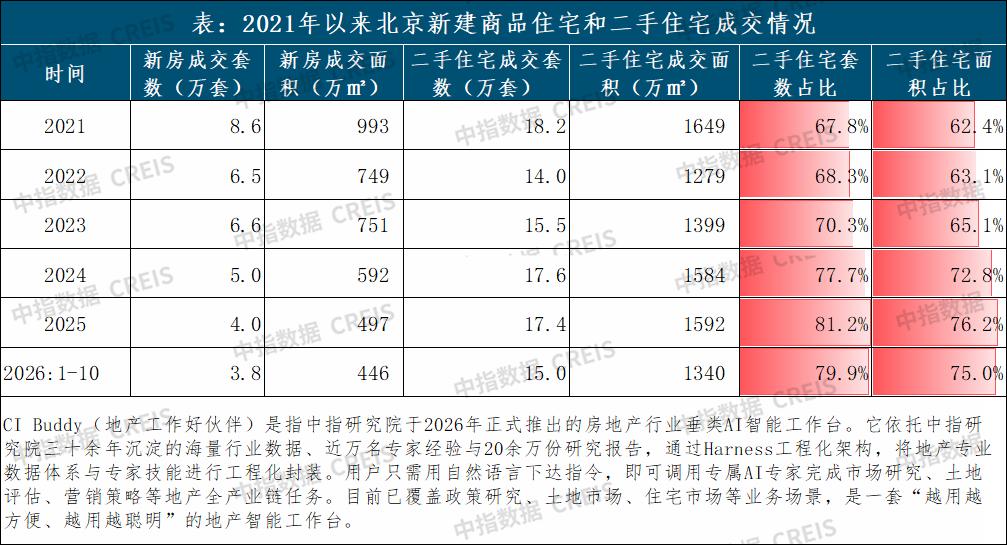
This plan involves a large amount of stock-related content. 8 of the 13 major indicators (items 5 to 12) are directly related to the stock, and three parallel stock chains are constructed as a whole. The first is the transaction end of stock housing: "unblock the transaction chain of second-hand housing", "promote gradient consumption and housing recycling, and invigorate the stock housing market", so as to make the stock housing circulate among residents, and the policy focus is expected to shift to unblocking the second-hand housing replacement chain. According to data from the China Index Academy, since 2023, the proportion of second-hand residential transaction volume in Beijing in the total transaction volume of commercial residential buildings (new housing + second-hand housing) has remained above 70%, and the proportion from January to October 2026 is about 80%, and the transaction in the stock market remains relatively active.
The second is the housing source end of indemnificatory housing: a variety of methods such as reconstruction of non-residential buildings, activation of commercial and office projects, and conversion of remaining resettlement housing and vacant public rental housing can turn stock houses into indemnificatory rental housing. This plan clarifies the indicator target that the proportion of activated stock resources in new indemnificatory rental housing will reach more than 60%, which means that more than 60% of the new indemnificatory rental housing will come from activation, and less than 40% will come from new construction. More supporting policies are expected to be further implemented, such as optimizing the standards and approval procedures for non-residential reconstruction.
The third is the renewal and reconstruction end: old residential communities, dilapidated houses, bungalow areas in the old city, urban villages, and complete communities, combined with the coordinated promotion of housing development and urban renewal, constitute six key tasks of the fourth part "urban renewal in the residential sector". At the same time, it is necessary to improve the supporting services of stock residential communities. Multiple indicators are equipped with quantitative tasks: in the 15th Five-Year Plan period, no less than 1000 old residential communities will be newly started for reconstruction, no less than 3500 elevators will be installed, more than 20000 old residential elevators will be updated, about 1 million square meters of dilapidated houses will be reconstructed, 57 urban villages will be basically completed for reconstruction, and the governance of D-level dangerous houses will achieve dynamic zero clearance. The reconstruction method emphasizes classified policy implementation: for dilapidated houses, we adhere to the combination of "retention, reconstruction and demolition", encourage residents to carry out independent renewal and explore financing support such as reconstruction loans. For urban villages, we adopt methods such as demolition and new construction, renovation and improvement, and the combination of demolition and renovation according to local conditions. The renovation standards for old residential communities are also raised simultaneously. In addition to basic renovation, it also includes function improvement and quality upgrading, and encourages enterprises to provide integrated packages for indoor decoration and renovation, and launch diversified schemes for overall improvement and partial renovation of stock housing.
From the perspective of impact, the priority of stock means that housing investment is shifting from incremental development to stock renovation and operation, and market entities participating in urban renewal, old residential community renovation, embedded community services and stock asset operation will obtain more policy space.
Structure Optimization: Adjust Structure in Space and Products, Make Supply Match Demand
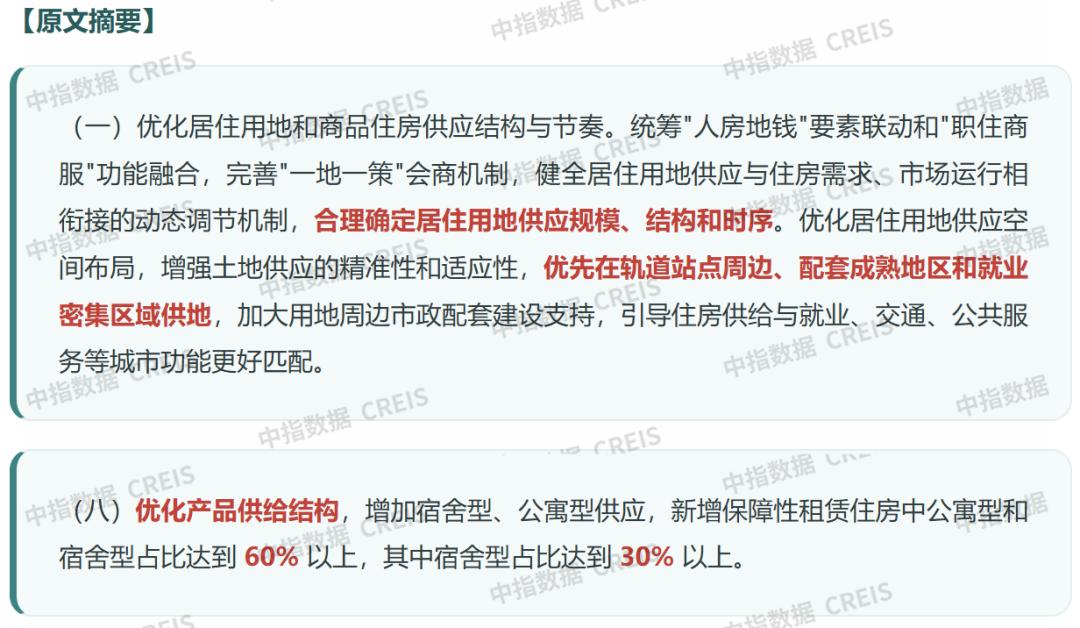
Structure optimization is promoted in three key directions. The first is to strengthen total volume matching: the plan incorporates the linkage of elements of "people, land, housing and capital" into the supply mechanism, which essentially embeds indicators such as market supply and demand into land supply decision-making, and makes the scale, structure and timing of land supply dynamically linked to housing demand.
The second is to optimize the spatial structure: in the supply of residential land, areas around rail transit stations, areas with complete supporting facilities and employment-intensive areas are listed as priority, while the supply of plots in peripheral areas lacking supporting support will be further reduced. In 2026, Beijing's land supply has already tilted to areas around rail transit stations, areas with relatively complete facilities and employment-intensive areas. At the end of October, the 13th round of land supply list continued to focus on rail transit stations, especially areas with mature supporting facilities around the rail micro-centers for supply. At the same time, the plan clarifies three paths of "station-city integration, industry-city integration, and water-green integration" and the Column 8 "Guidelines for Housing Space Linked with Employment and Living by Different Circles". It puts forward that the core area "adhere to reduction development and organic renewal", the central urban area "promote the residential land to appropriately tilt to employment-intensive areas", the sub-center of the city "support industrial cultivation and functional maturity through housing allocation", the plain new city "reasonably arrange the structure and timing of housing supply in combination with industrial introduction and rail transit construction", and the ecological conservation area "focus on meeting the improved and urbanized living needs of the permanent population". This is the first time that Beijing has systematically put forward differentiated supply guidelines for five types of circles in the housing plan.
The third is to optimize the product structure: the proportion of apartment-type and dormitory-type (by number of units) new indemnificatory rental housing has increased from 50.9% in 2025 to more than 60%, and the proportion of dormitory-type (single bed) has increased from 21.2% to more than 30%. The supply structure tilts to the actual rental demand of new citizens, young people and urban operation service support personnel, which echoes the statement of "supply determined by demand" in the plan.
Quality Iteration: Policy Design Covers the Whole Chain of Standards, Construction, Operation and Maintenance
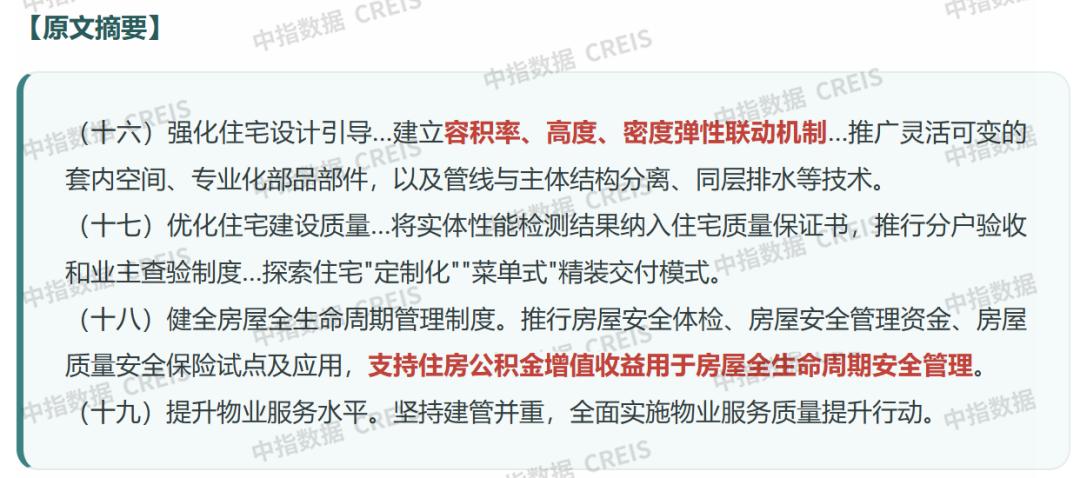
The quality iteration policy covers the complete chain of residential design, construction, operation and maintenance. In the design link, the proposal of the flexible linkage mechanism of floor area ratio, height and density is worthy of attention, which means that on the premise of meeting the basic requirements, the constraints on residential product design are relaxed, releasing space for product innovation.
In the construction and delivery link, the physical performance test results are included in the residential quality guarantee, household-by-household acceptance and owner inspection are implemented, so as to move the contact point of quality responsibility forward to the delivery link, and provide institutional support for the governance of high-frequency complaint problems such as sound insulation, anti-odor cross and waterproofing. The potential defect insurance of engineering quality shares the long-term quality risk through the insurance mechanism.
In the operation and maintenance link, in the whole life cycle management system of houses, the statement of "supporting the use of the added value of housing provident fund for the whole life cycle safety management of houses" provides a stable capital channel for house physical examination and maintenance, and solves the capital source problem that restricts the implementation of the system. In addition, "high-quality house" projects and existing house sales projects enjoy preferential treatment in development loans, which essentially guides enterprises to improve product quality through the difference in financing costs.
In terms of property services, the formation rate of property owners' committees (property management committees) and the coverage rate of property services in Beijing have both exceeded 97% during the 14th Five-Year Plan period. The goal of this plan further focuses on the improvement of service quality. The "market mechanism with matching quality and price" directly points to the long-term pain point of disconnection between property fees and service levels. The statements of "promoting full coverage of property services in old residential communities", "exploring the 'property + life' service mode" and "studying and improving the feedback mechanism of community supporting operation" further guide the property industry to shift to operation links with self-sustaining capacity.
Governance Improvement: Build a Long-term Operation Mechanism
Governance improvement answers the question of "how to achieve long-term operation" at the institutional level. In terms of basic systems, existing house sales are clearly defined as "implemented in an orderly manner", forming a combination with the strengthened supervision of pre-sale funds. On September 24, Beijing has implemented the detailed rules. For plots newly transferred after August 28, pre-sale can only be carried out after the main structure is capped, and the pre-sale funds are fully supervised. A certain transition period is given to projects under way, and the "orderly" in the plan corresponds exactly to this path choice of "separating new and old projects and gradual transition".
In terms of house governance, the trinity system of "physical examination - capital - insurance", combined with the "smart house safety system" and "digital archives of house safety", integrates the management responsibilities that were previously scattered in the housing and urban-rural development, fire protection and emergency management departments, and the house safety management has also shifted from passive disposal to active early warning.
In terms of planning governance, annual monitoring + mid-term evaluation + summary evaluation form a closed loop, and the supply and demand monitoring and early warning mechanism is improved, making "rent, housing price, market supply and demand" as the important basis for adjusting supply.
On the whole, Beijing's 15th Five-Year Plan for Housing Development takes "reasonable total volume, stock priority, structure optimization, quality iteration, and governance improvement" as the main line. For market entities, the signals released by the plan are clearer. It is expected that the new housing supply will be "small in quantity but high in quality, and core-oriented", the housing supply will be concentrated around rail transit stations, areas with complete supporting facilities and employment-intensive areas, and the competition among real estate enterprises will also shift to "product strength + operation strength + service strength". The stock market has become the "main battlefield". Multiple points of progress such as unblocking the second-hand housing replacement chain, the implementation of housing ticket resettlement, and urban renewal in the residential sector also open up policy space for entities