Sales of fuel-powered vehicles have nearly been cut in half, the Chinese automobile market is witnessing a drastic reshuffle, and the annual export volume is expected to exceed 10 million units for the first time.
The year-on-year decline in domestic automobile sales has exceeded 20% for seven consecutive months, and the proportion of new energy vehicle sales continues to rise.
CheDongXi News on November 11: As of today, the China Association of Automobile Manufacturers has released the production and sales data of the automotive industry in October 2026. Since the beginning of this year, the domestic market has continued to decline due to the superposition of multiple factors, the year-on-year decline in domestic automobile sales has exceeded 20% for seven consecutive months. In October, the overall production and sales of passenger cars increased slightly month-on-month, but still showed a downward trend year-on-year.
The production and sales of new energy vehicles maintained year-on-year growth, while the domestic sales of traditional fuel passenger cars continued to shrink significantly, plummeting 49.4% year-on-year, new energy passenger cars have accounted for 70.4% of domestic passenger car sales.
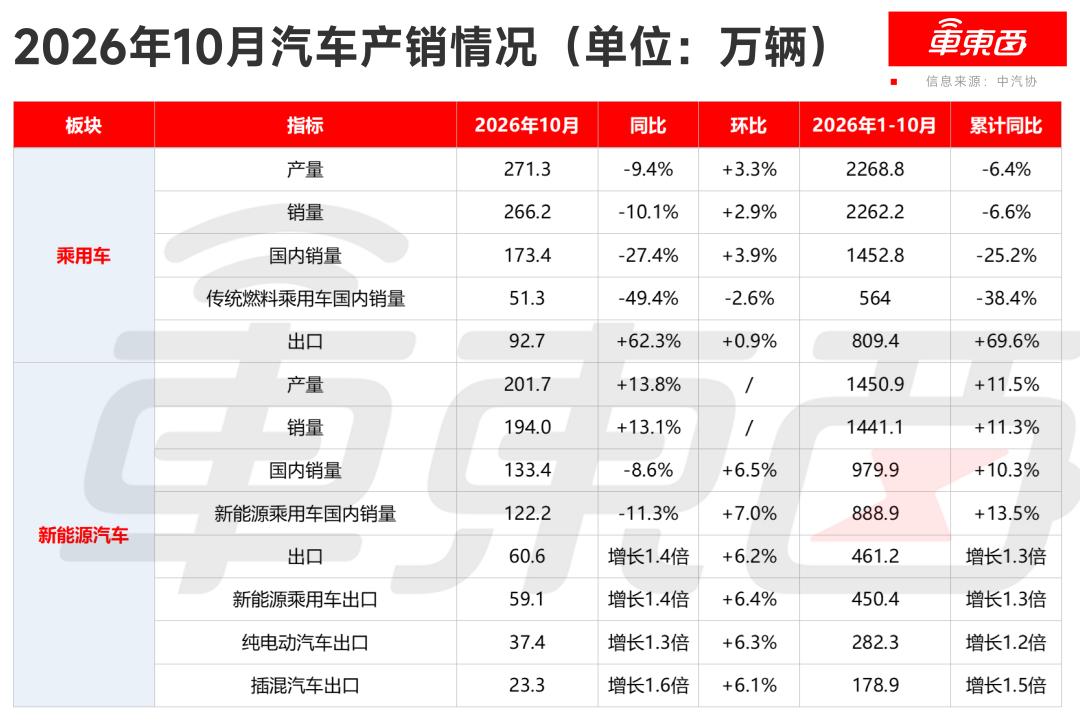
Automobile production and sales data in October 2026
Meanwhile, exports maintained a strong momentum, in October this year, passenger car exports reached 927,000 units, an increase of 356,000 units from 571,000 units in October 2025, representing a year-on-year increase of 62.3%; new energy vehicle exports reached 606,000 units, an increase of 350,000 units from 256,000 units in October 2025, surging 1.4 times year-on-year.
According to media reports, at the monthly information press conference held by the China Association of Automobile Manufacturers today, Chen Shihua, Deputy Secretary-General of CAAM, stated at the conference that the total annual automobile export volume this year is expected to exceed 11 million units.
Overall, the coexistence of pressure on the domestic passenger car market and export growth is a prominent feature.
01. Domestic Market Under Pressure, Sales of Traditional Fuel Passenger Cars Shrink Rapidly
In terms of the overall passenger car market, the production and sales of passenger cars in October reached 2.713 million units and 2.662 million units respectively, down 9.4% and 10.1% year-on-year, and up 3.3% and 2.9% month-on-month respectively.
By splitting the structure of domestic and overseas sales, the divergent performance is obvious at a glance. In October, domestic passenger car sales reached 1.734 million units, down 27.4% year-on-year and up 3.9% month-on-month; passenger car exports reached 927,000 units, up 62.3% year-on-year and 0.9% month-on-month. It can be seen that exports have become one of the pillars to hedge the downward trend of the domestic market.

Cars waiting for transportation after production
One major reason for the decline of the domestic market is the rapid shrinkage of traditional fuel passenger cars. In October, the domestic sales of traditional fuel passenger cars were only 513,000 units, 500,000 units less than the same period of last year, plummeting 49.4% year-on-year.
New energy vehicles are one of the few positive growth sectors in the current automotive market. In October, the production and sales of new energy vehicles reached 2.017 million units and 1.94 million units respectively, up 13.8% and 13.1% year-on-year. The proportion of new energy vehicle sales in total new automobile sales reached 64.3% in the month.
However, the domestic new energy market is also under pressure. In October, domestic sales of new energy vehicles reached 1.334 million units, down 8.6% year-on-year, of which domestic sales of new energy passenger cars reached 1.222 million units, down 11.3% year-on-year.
The penetration rate data intuitively shows the progress of new energy transformation in the domestic market. In October, the domestic sales proportion of new energy vehicles was 68.4%, and new energy passenger cars have accounted for 70.4% of domestic passenger car sales. From January to October, the penetration rate of domestic new energy passenger cars was 61.2%, and the domestic passenger car market has entered a stage dominated by new energy.
02. Overseas New Energy Vehicle Sales Grow Rapidly, Plug-in Hybrid Models Outpace Pure Electric Models in Growth Rate
The high growth of new energy vehicle sales is partly driven by the overseas market. In October, new energy vehicle exports reached 606,000 units, up 6.2% month-on-month and surging 1.4 times year-on-year, of which new energy passenger car exports reached 591,000 units, also up 1.4 times year-on-year. From January to October, the cumulative export of new energy vehicles reached 4.612 million units, up 1.3 times year-on-year, and the export of new energy passenger cars reached 4.504 million units, up 1.3 times year-on-year.

Cars waiting for export
Within new energy vehicle exports, the growth rate of plug-in hybrid models has exceeded that of pure electric models. In October, exports of pure electric vehicles reached 374,000 units, up 1.3 times year-on-year; exports of plug-in hybrid vehicles reached 233,000 units, up 1.6 times year-on-year. From January to October, exports of pure electric vehicles reached 2.823 million units, up 1.2 times year-on-year; exports of plug-in hybrid vehicles reached 1.789 million units, up 1.5 times year-on-year.
Exports maintained a stable high prosperity, but the scale of domestic imported automobiles continued to shrink. In September 2026, automobile imports were only 21,000 units, down 48.7% year-on-year; from January to September 2026, automobile imports reached 288,000 units, down 20.1% year-on-year.
03. Conclusion: The Growth Focus of Automobile Market Sales Shifts to Exports
Overall, the overall domestic automobile market warmed up month-on-month in October, but domestic demand is still weak, the fuel vehicle market has further shrunk, the penetration rate of new energy continues to rise, and the growth focus has shifted to overseas markets.
For domestic automakers, the overseas market is no longer just a supplementary market, but one of the key factors driving the growth of annual sales. The dual-track overseas expansion of pure electric and plug-in hybrid vehicles may become the main line of the industry in the coming period.
This article is from the WeChat official account "CheDongXi", Author: Zhang Rui, Editor: Zhihao, published with authorization from 36Kr.