Investigation on the Price Mystery of Embodied Data Collection: Quotation of 1000 Yuan, Hourly Wage of 8 Yuan, Where Has the Price Difference Gone?
Xiao Yun repeatedly folded and unfolded her coat at home. This is an embodied data collection task she received from a part-time job group, with an hourly wage of 15 yuan after receiving payment.
The first-person perspective action data she recorded, after being packaged and resold by middlemen, can be quoted up to 300-500 yuan per hour when sold to robotics companies. Between 15 yuan and 300 yuan, what separates them is not only the data quality, but also a multi-level subcontracting chain.
After days of interviews with front-line collectors, data suppliers, purchasers, and county-level data collection service providers, reporters from Sci-Tech Innovation Board Daily found that there are significant price differences in embodied data transactions. Calculated on the same 1-hour basis, the listing price of high-quality real-machine data can reach 1,000 yuan, while the lowest price of original monocular data at the end of the circulation is only 5 yuan. The price gap not only stems from the differences in data quality and processing depth, but also is related to the multi-level subcontracting of orders and repeated resale of data. In some projects, the hourly wage of front-line collectors is even suppressed to around 8 yuan.
On the one hand, backed by booming capital, many embodied intelligent data collection service providers have joined the 100-billion-yuan valuation club, and the industry is emphasizing the scarcity of high-quality data; on the other hand, low-cost copies are rampant, orders are subcontracted at multiple levels, data traceability fails, and disputes over the authenticity of orders emerge. How does the quotation of a 1,000-yuan embodied data collection order gradually turn into an hourly wage of as low as 8 yuan? Where does the data that costs only 5 yuan per hour come from?
In recent days, reporters from Sci-Tech Innovation Board Daily launched an investigation along the order circulation and data sources.

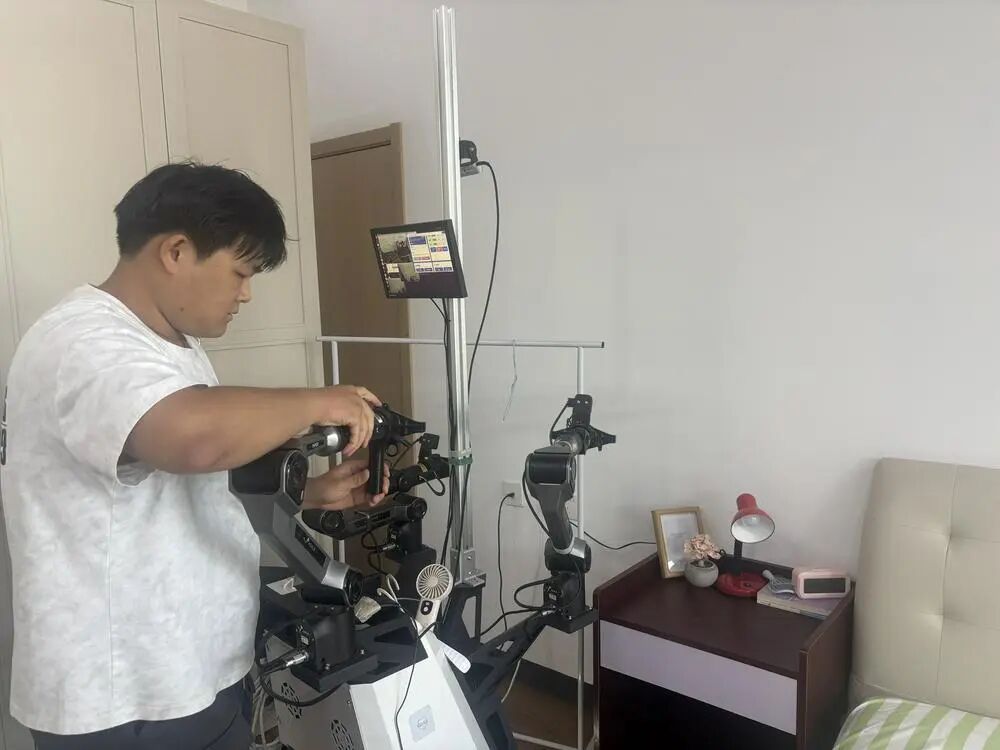
Real working scene of data collectors (Photo by Tian Ye)
Where did the price difference go: multi-level subcontracting and copy resale
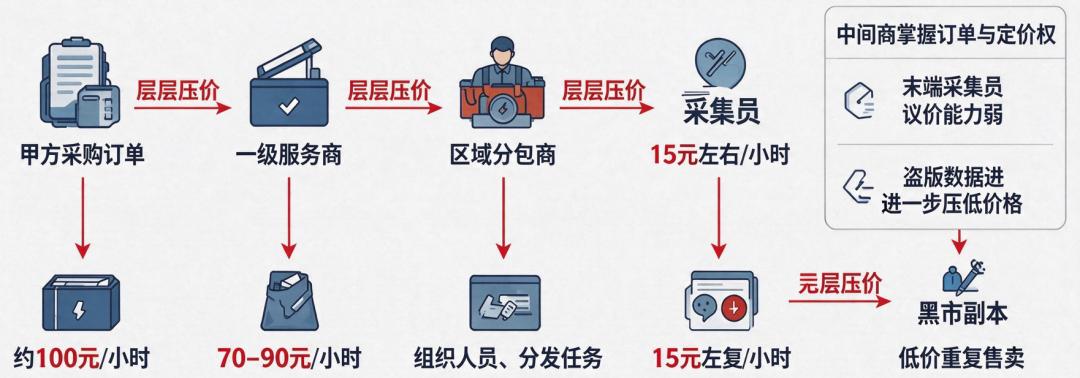
Xiao Yun's experience is not an isolated case. Multiple data collection practitioners confirmed to reporters from Sci-Tech Innovation Board Daily that multi-level subcontracting exists in the industry. An order that Party A offers for hundreds of yuan per hour, after being transferred by five or six levels of middlemen, will only leave a remuneration of about 15 yuan for the grassroots collectors, and the lowest is only 8 yuan.
A service provider who organizes collection projects at the county level told reporters from Sci-Tech Innovation Board Daily that the bottom line of remuneration he offers to collectors is 30 yuan per hour. "Below this standard, either the project itself is difficult to make a profit, or there are hidden dangers in the compliance and source of the data."
Reporters from Sci-Tech Innovation Board Daily learned during interviews that the low threshold for non-robot collection equipment has quickly turned data collection into labor subcontracting. Model manufacturers or large suppliers issue orders, middlemen split tasks, and regional collection points then organize personnel to complete action recording.
"This is essentially the 'contractor' model, and management capability directly determines production capacity." The above county-level data collection service provider said that data collectors "only need to be literate and can get started in three days", so the core profit of some projects has shifted from technology research and development to human resource organization capability.
Among the projects contacted by this data collection service provider, after the upstream party gets the hundred-yuan level order, the price subcontracted to the service company drops to 70-90 yuan per hour, and then split downwards, only 40-15 yuan per hour is settled to the front-line collectors. These figures come from different projects and cannot be simply regarded as the fixed share of the same order, but the phenomenon of successive price suppression has been repeatedly mentioned by many interviewees.
Wang Jian, a senior insider in the embodied intelligence industry, compares some middlemen to data "grain merchants". End buyers need data of 100,000 hours or even millions of hours, so suppliers collect goods from scattered collection points, deduplicate and process them, then package and deliver them uniformly. Since there are limited buyers who can consume massive amounts of data, whoever holds the orders largely controls the subcontracting and pricing power.
The above county-level data collection service provider revealed that the average gross profit of domestic data producers is about 20%-30%, and the gross profit in overseas markets can reach 30%-50%.
In addition to subcontracting, another way to lower the selling price of data is to make the same data sold multiple times.
Jin Ge, co-founder and CEO of Lingyu Intelligence, estimates that collecting non-robot data in China, even with a low-cost solution, the total cost of labor, equipment, storage and transmission still requires 20 to 40 yuan per hour. For data sold for only a few yuan per hour, purchasers need to verify whether there are problems such as repeated sales, privately retained copies or other abnormal sources.
"It is very common in the industry that non-robot data is resold three to five times." Jin Ge said, because this type of data is difficult to trace, some teams privately back up and resell it a second time when completing orders; even worse, some teams will set up additional recording equipment next to the customer's collection equipment, to realize revenue from one set of materials through multiple channels.
Some practitioners described a more hidden operation to reporters from Sci-Tech Innovation Board Daily where the collection team ties several mobile phones together with rubber bands to record the same action synchronously. One copy is used to complete the original order, and the remaining copies are privately retained and then flow into the black market.
Jin Ge admitted that his team has added traceable "data fingerprint" to real machine data, but there is "no very good solution for non-robot data at present". When the data source, authorization and number of sales cannot be confirmed, comparing prices by the hour loses its most basic meaning.
Illustrated by Tian Ye
The same "one hour", the quotation differs by a hundred times
It is reported that the embodied intelligence data currently circulating in the market is mainly divided into two categories: one is the real machine data generated by the operation of the robot body; the other is the human first-person perspective data recorded by people wearing cameras, glasses and other equipment, which is also called non-robot data or Ego data in the industry.
Produced by reporter Li Mingming
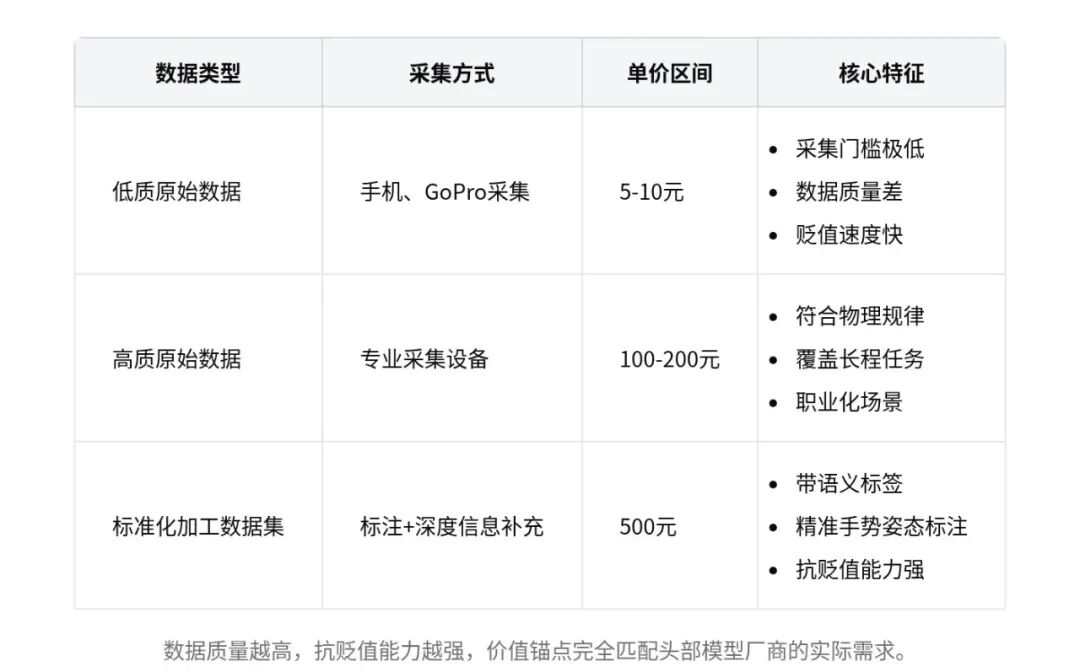
Jin Ge, co-founder and CEO of Lingyu Intelligence, gave the industry's approximate reference price to reporters from Sci-Tech Innovation Board Daily: non-robot data is about 100 to 300 yuan per hour, and real machine data is about 300 to 1000 yuan or even higher.
Wang Jian, a senior insider in the embodied intelligence industry, gave another set of sharply contrasting market conditions: for monocular raw data collected with simple equipment such as mobile phones and GoPro, some sources sell for only 5 to 10 yuan per hour; after semantic annotation and supplementing information such as gesture posture and depth, the quotation of standardized non-robot data sets can reach 500 yuan per hour.
Wang Jian said bluntly to reporters from Sci-Tech Innovation Board Daily that many non-head robot body products on the market have obvious design defects, and their efficiency in completing conventional tasks is far lower than that of humans. According to his judgment, the proportion of high-quality real machines that meet the training standards is less than 1% at present. Only a very small number of head manufacturers' bodies can meet the requirements, and the data generated by other real machines has limited reference value.
The relevant person in charge of embodied intelligence enterprise Forcelink Robotics also told reporters from Sci-Tech Innovation Board Daily: "For embodied intelligence, more data is not always better. The key is whether the data is real and effective, and whether it can support the model to learn the correct action strategy."
If low-quality data is directly used for post-training, the problems in the data itself will be brought into the training process, and finally reflected in the actual deployment performance. "Using low-quality data of 5 yuan per hour to feed the model will not only waste computing power, but also pollute the model." the person in charge said.
On-site photo by reporter Li Mingming
The ebb of data collection sites: orders need to pass the test of real demand
Apart from the price fog, the authenticity of orders has also begun to be tested.
According to the understanding of reporters from Sci-Tech Innovation Board Daily, as of June 2026, more than 70 embodied intelligence training sites have been completed and put into use across the country, and more than 40 are under construction or planned. In September this year, Shao Tianlan, founder of Mech-Mind, publicly questioned that some embodied intelligence companies obtained "false and unsustainable revenue" through data collection centers and related transactions.
Jin Ge, co-founder and CEO of Lingyu Intelligence, believes that the data collection center model is not naturally equivalent to order brushing. Local platforms undertake heavy asset investments such as equipment and sites, and enterprises provide equipment and repurchase data. The model is similar to contract farming. As long as the data is truly collected and can be used for their own model training or sold to customers with real demand, the commercial chain can be established.
But he also admitted that the data collection center is a transitional form in the early stage of the industry. At present, a large number of orders are still in the demonstration Demo stage, which is difficult to create real industrial value, but the capital market may give valuations according to the mature stage. Once the end demand does not form, or local financial support shrinks, enterprises relying on such orders will face the risk of revenue decline.
Wang Jian, a senior expert in the embodied intelligence industry, revealed to reporters from Sci-Tech Innovation Board Daily that according to his observation, the false transaction model of mutual circular procurement of hardware and data between robot companies in the past is gradually decreasing this year, and some manufacturers relying on pure real machine data collection have gradually withdrawn from the market.
"Local governments will no longer build new traditional data collection sites that place real machines in a centralized manner as in the past. The newly built data collection sites in the future will shift to a model centered on real scenarios and manually collect non-robot data." Wang Jian said.
An observable case is that the Ruizhimei data collection site in Shougang Park, Shijingshan, which adopts real machine teleoperation collection, was once known as Beijing's first humanoid robot data training center, and has now been shut down.
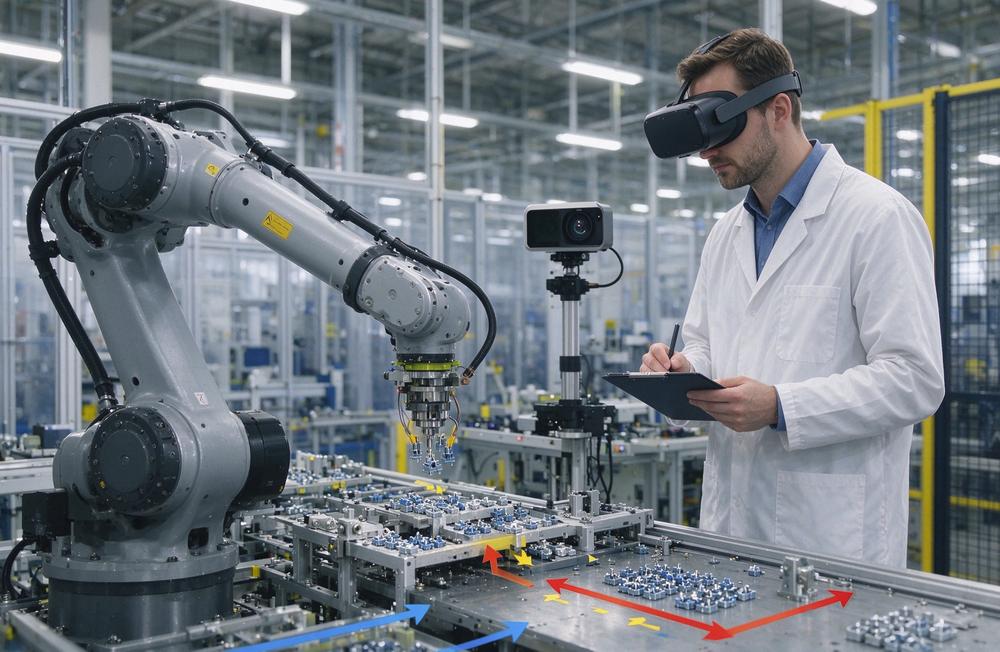
Behind this change is the migration of data demand. The pre-training stage of the model requires massive and diverse scenario data as the foundation, while real machine collection is slow, the scenario is relatively single, and the cost is high, which has been difficult to fully adapt to the current demand. Whether the data comes from a real machine is no longer the most important thing. Whether it can enter the real scenario and be effectively used by the model is becoming a new inspection standard.
How does data value shift from scale to quality?
In the past, embodied data has always been priced and purchased according to "how many hours have been collected", but now this logic is being broken.
The relevant person in charge of Forcelink Robotics told reporters from Sci-Tech Innovation Board Daily that the data itself cannot be directly priced by the hour. In their data collection practice, the post-training stage of the model is charged according to the actual GPU training duration, and the cloud inference after deployment is charged according to Token consumption.
He also said that 1 yuan per million Tokens is the calling price of the general model, which has no direct corresponding relationship with data value. "We cannot simply use the Token price to deduce how much the data is worth, nor can we judge how much the price difference from 5 yuan to 1000 yuan will be compressed in the post-training link. Whether the data is valuable ultimately depends on whether it can help the model solve more complex real tasks."
"Real data is not equal to real machine data." The person in charge believes that at the stage when the scale of robot deployment is not large enough, collecting human first-person perspective operations can be an important supplement to real machine data. But in the long run, embodied data must shift from manual collection to large-scale operation of robots in real scenarios and continuous data return. Only by letting robots enter actual scenarios and accumulating failure cases and feedback during continuous operation can we "form a truly effective data flywheel" — the more data is used, the better the model is trained.
It needs to be pointed out that data suppliers and the capital market are ultimately facing the same set of problems: whether the data has legal and clear authorization, whether customers are actually using it, and whether it can continuously bring repurchases and payment collection. When the acceptance standard shifts from "how many hours have been delivered" to "what more the robot has learned", the business that only relies on copying data, suppressing labor prices and inflating book orders will have less and less space.
Reporters from Sci-Tech Innovation Board Daily noticed that the current pain points of the embodied data industry have entered the policy vision. The National Data Administration recently put forward the principle of "supply determined by demand, construction promoted by application, and quality improved by evaluation" at the symposium for leading enterprises in the construction chain of high-quality industry datasets, pointing out the direction for the industry to shift from scale to quality.
(At the request of the interviewees, Xiao Yun and Wang Jian in the text are pseudonyms.)
This article is from the WeChat official account "Sci-Tech Innovation Board Daily", authors: Li Mingming & Tian Ye, authorized for release by 36Kr.