Just now, Google released its first decision-making model Gemini Decision 1, which took the first place in 7 out of 9 tests, with a maximum accuracy rate of 92.2%.
While the entire AI industry is still competing to generate more tokens and achieve stronger reasoning capabilities, Google has launched a new model that does not generate answers word by word.
Google has just officially released Gemini Decision 1, alongside the Gemini Decisions API powered by this model. Different from traditional generative large language models, this model is specifically designed for fast decision-making. Instead of generating text token by token, it scores pre-set candidate answers through a single forward propagation pass.
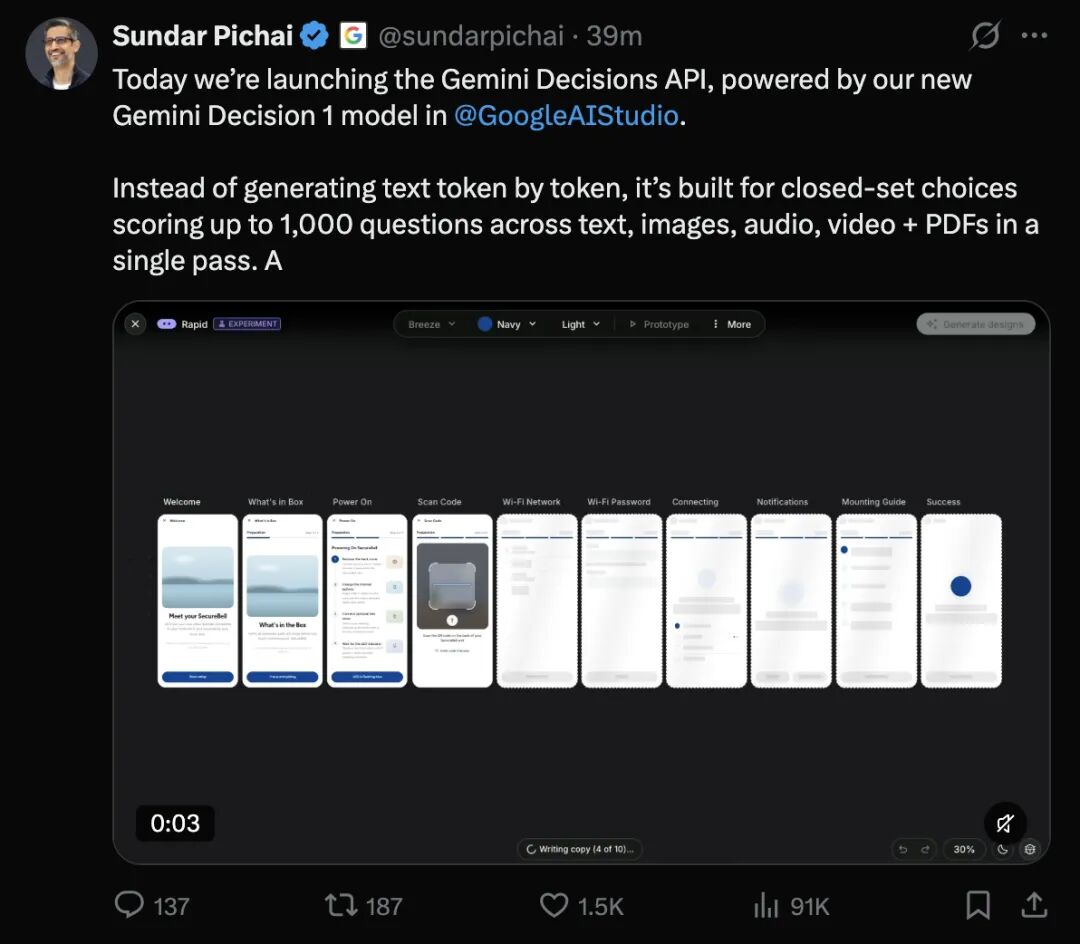
Google CEO Sundar Pichai also posted on X to introduce the core capabilities of Gemini Decision 1. He wrote:
Today, we are officially launching the Gemini Decisions API in Google AI Studio, powered by the brand-new Gemini Decision 1 model.
Unlike traditional models that generate text token by token, this model is specifically designed for decision-making tasks within a closed set of options. It can score up to 1000 questions in text, image, audio, video, and PDF formats in a single processing pass.
Here are several notable details:
· Supports three types of decision-making: yes/no judgment, multiple choice (up to 255 options), and scoring based on grading rubrics;
· The price is only $0.10 per million input tokens, with zero cost for output tokens, which is about one-fifth of the cost of Flash-Lite;
· It leads in multiple benchmark evaluations while boasting the lowest calibration error.
Google's internal teams have already started using this technology.
In the past, when developers wanted AI to determine whether an email was spam, or decide which agent a certain task should be assigned to, they often needed to call a generative large model and then extract results from the text generated by the model. Gemini Decision 1 eliminates the step of decoding word by word.
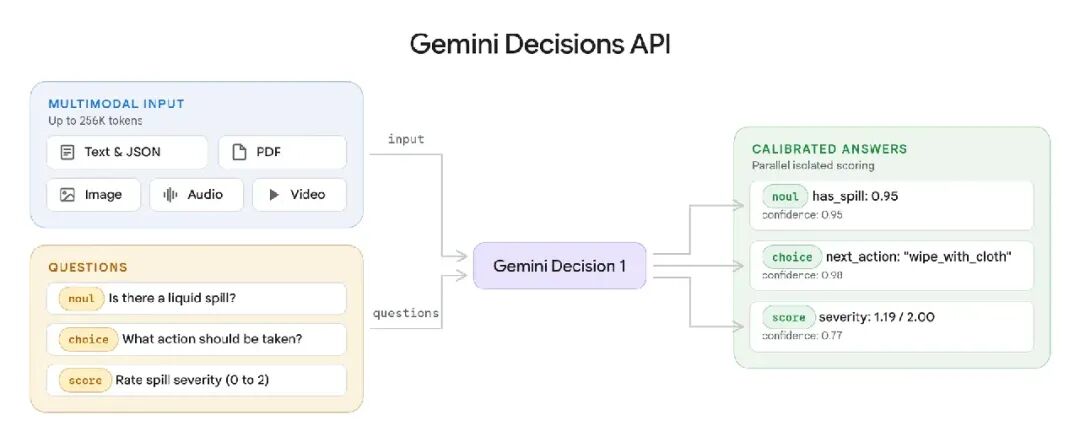
Developers only need to provide the input content, the questions to be judged, and the candidate options, and the model will directly return the corresponding judgment result, probability and confidence level.
This means that for tasks that only require a classification, scoring or selection result, AI no longer needs to go through the entire text generation process.
According to the data released by Google, Gemini Decision 1 can process up to 1000 independent questions in a single request, supports multi-modal inputs including text, images, audio, video and PDF, with an end-to-end latency of only 150 to 250 milliseconds.
The pricing is also very aggressive: it only costs $0.10 per million input tokens, with no charge for output tokens. In the same set of benchmarks released by Google, its invocation cost is nearly 5 times lower than that of Gemini 3.5 Flash-Lite.
More notably, this is not just a model for answering multiple-choice questions. Google has already applied it to scenarios such as AI model routing, agent tool selection, product design and safety detection, trying to make it an underlying component dedicated to judgment and decision-making in AI systems.
Process 1000 Questions in One Pass, Up to 255 Options
According to the technical introduction released by Google, Gemini Decision 1 provides three core decision-making capabilities.
The first type is Yes/No (binary judgment). For example, determining whether there are potential safety hazards in an image, or whether a piece of text violates established rules. The model will give the probability that the corresponding condition is true.
The second type is Multiple Choice. Developers can pre-set 2 to 255 candidate options, and the model will not only select the answer that best meets the conditions, but also return the normalized probability of each candidate option.
The third type is Ordered Rubric scoring. Developers can customize grading standards for different levels, let the model evaluate the input content, and return continuous weighted scores as well as the probability of each level.
The three types of tasks can also be executed in a mixed manner in a single request.
Google provides a simple example: upload a photo of the countertop in the office pantry to the model, attach a text description, and ask it to simultaneously determine whether there is liquid spill on the desktop, what cleaning measures should be taken, and the severity level of the scene.

Traditional methods may require designing multiple classifiers, or executing different prompt tasks through generative large models. Gemini Decision 1 can complete all these judgments in a single request.
In addition, the model supports a maximum multi-modal input context of 256K tokens. For enterprise scenarios, this means developers can analyze call recordings together with customer profiles, or make judgments by combining insurance claim documents with on-site photos.
Each decision will provide a confidence level ranging from 0 to 1, making it convenient for the system to hand over uncertain results to other models or manual review.
Another competitive advantage of Gemini Decision 1 lies in its speed and cost.
According to Google's official introduction, in benchmarks covering agent routing, reasoning, ranking and multi-modal understanding, Gemini Decision 1 delivers leading performance and achieves the lowest calibration error.
In test contexts no larger than 16K tokens, the median latency during the model calculation phase remains between 50 and 100 milliseconds, with an end-to-end latency of approximately 150 to 250 milliseconds. Even if the number of questions contained in a single request increases from 1 to 100, the latency remains basically stable.
On the common benchmark test set used by the official, the cost of the Gemini Decisions API is nearly 5 times lower than calling Gemini 3.5 Flash-Lite via the Interactions API.
Wins 7 out of 9 Tests with Maximum Accuracy of 92.2%
When releasing Gemini Decision 1 this time, Google also published a highly informative model comparison scorecard.
Different from the usual practice of comparing general large models together, Google selected three competing products this time: OpenAI's GPT-6 Luna, TypeSafe Jev 1.14 which is dedicated to classification and decision-making, and its own Gemini 3.5 Flash-Lite.
The results show that Gemini Decision 1 takes the first place in 7 out of 9 benchmark tests, and also leads in probability calibration. However, there are still scenarios where competitors perform better in the other two tests and in total invocation cost.
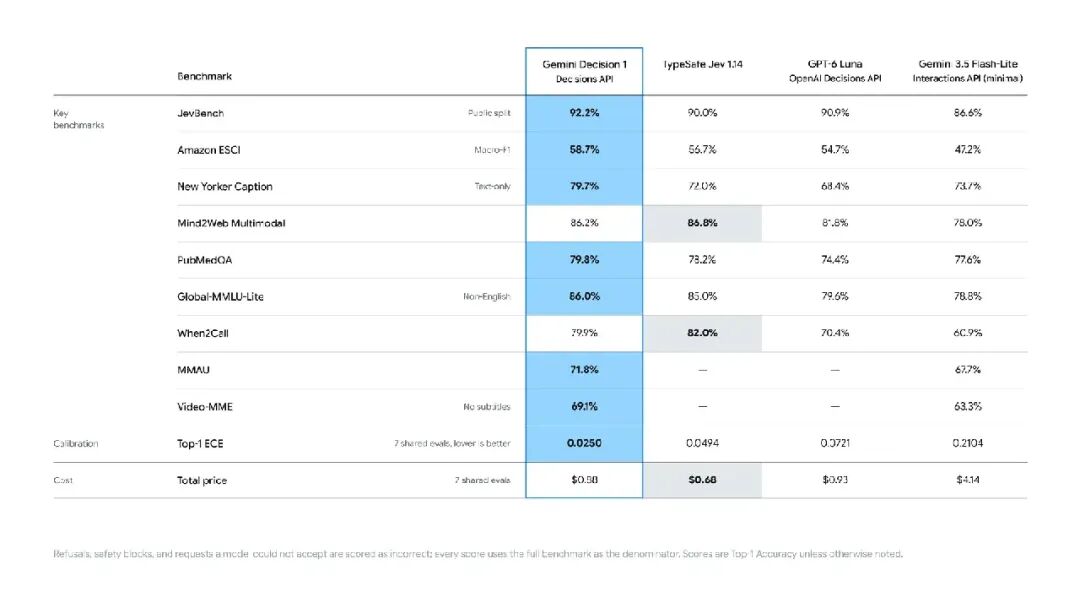
In the JevBench test, Gemini Decision 1 achieves an accuracy rate of 92.2%, surpassing 90.9% of GPT-6 Luna, 90.0% of TypeSafe Jev 1.14, and 86.6% of Gemini 3.5 Flash-Lite.
In the Amazon ESCI product search relevance test, Gemini Decision 1 gets a Macro-F1 score of 58.7%, which is 4 percentage points higher than GPT-6 Luna and 11.5 percentage points higher than Flash-Lite.
In the New Yorker Caption test, the gap is further widened. Gemini Decision 1 scores 79.7%, while GPT-6 Luna scores 68.4%, a difference of 11.3 percentage points. This test involves understanding and selecting captions for comics, testing the model's contextual understanding and candidate content judgment capabilities.
In the medical Q&A test PubMedQA, Gemini Decision 1 also ranks first with a score of 79.8%, higher than GPT-6 Luna's 74.4%.
The results of the multilingual test Global-MMLU-Lite are similar. Gemini Decision 1 scores 86.0%, while GPT-6 Luna scores 79.6%, a difference of 6.4 percentage points.
However, Google has not achieved full leadership.
In the Mind2Web Multimodal test, TypeSafe Jev 1.14 ranks first with a score of 86.8%, while Gemini Decision 1 scores 86.2%, 0.6 percentage points behind.
In the When2Call test that tests tool invocation judgment capabilities, TypeSafe Jev 1.14 has a more obvious advantage, scoring 82.0%, while Gemini Decision 1 scores 79.9%.
This result is particularly noteworthy. Tool selection and invocation timing judgment are one of the key agent application scenarios that Gemini Decision 1 targets, but in this test, the dedicated decision-making model TypeSafe Jev still maintains a leading position.
In addition, in the audio understanding test MMAU and video understanding test Video-MME, Gemini Decision 1 scores 71.8% and 69.1% respectively, both higher than Flash-Lite.
More noteworthy than accuracy is the probability calibration capability that Google has specially emphasized this time.
In the Top-1 ECE (Expected Calibration Error) test, the calibration error of Gemini Decision 1 is only 0.0250, compared with 0.0721 for GPT-6 Luna, 0.0494 for TypeSafe Jev 1.14, and 0.2104 for Flash-Lite.
In other words, in this set of evaluations, the calibration error of Gemini Decision 1 is about 65% lower than that of GPT-6 Luna, and about 88% lower than that of Flash-Lite.
This indicator is particularly important for agent systems.
For example, when an agent needs to determine whether there is a security vulnerability in a piece of code, the model not only outputs a "exists" or "does not exist" result, but also may include a probability value. The system can decide whether to take automatic action or submit it for further manual verification based on the relationship between the probability and the actual accuracy rate.
Google Has Already Adopted It: Agent Routing Latency Reduced by Up to 40%
Different from some new models that only demonstrate benchmark results, Google also disclosed the application cases of the Gemini Decisions API in internal products this time.
The most notable one is Gemini Notebook.
Google is using the Decisions API as a real-time model router to select the appropriate model tier and reasoning intensity according to the complexity of user requests. For simple daily questions, the system can preferentially call models with lower cost and faster response; when encountering complex reasoning tasks, the requests are forwarded to more capable models.
Google states that with this dynamic routing method, the latency of daily queries can be reduced by up to 40%.
This design is closely related to the current development trend of agent systems. When an agent completes a task, it often needs to constantly judge the next action, such as which tool to select, which model to call, or whether manual intervention is required.
If every simple decision has to be processed by a large generative model, the system will incur additional latency and cost. The dedicated decision-making model provides another option: assign relatively simple judgments with clear options to low-latency models, and leave complex tasks to general large models.
In addition to Gemini Notebook, Google also disclosed three other application directions.
In Google Stitch, the newly launched Rapid Canvas experimental feature uses the Decisions API to generate interactive product flow wireframes in seconds, and quickly respond to user modification instructions sent via voice or clicks. After users confirm the design direction, the page can be transferred to the full Stitch workflow for further improvement.
In the CC product of Google Labs, the Decisions API is used to quickly select appropriate emoji reactions from more than 200 emoji options. Inside Google Search, Google also uses this API to build a safety detection layer for MCP tools to identify potential adversarial behaviors and content.
Reference Links:
https://blog.google/innovation-and-ai/technology/developers-tools/gemini-decisions-api/
This article is from the WeChat official account "AI Front" (ID: ai-front), written by Dongmei, and authorized for release by 36Kr.