Amid the anti-data-center wave, how far can AI trading go? The key depends on the GPU rental price.
After the midterm elections, data center construction faces the risk of tightened regulation and approval, but the rise in GPU rental prices is expected to offset the losses from reduced capital expenditure. This mechanism will drive a structural rotation in the AI investment logic: hyperscale cloud vendors with abundant existing computing power will regain pricing power and premium; while AI labs, emerging cloud service providers and the data center industrial chain that rely on computing power expansion will face pressure.
The political headwinds for data centers are reshaping the AI investment logic, but the life and death of this transaction ultimately depends on a rarely noticed price signal — GPU rental prices.
According to an article by Simon White, a macro strategist at Bloomberg, after the US midterm elections, the supply of computing power faces tightening risks, and the market has already reacted first. Although the market has stabilized after a sharp fall last week, the volatility has not subsided. The core question is: If data center construction is blocked, can the rise in GPU rental prices be high enough to offset the losses caused by shrinking capital expenditure?
Judging from the existing price signals in the market, the answer is somewhat feasible. The establishment of this logic will drive a structural rotation within AI transactions — shifting from AI labs, emerging cloud service providers and data center construction chains that rely on continuous expansion, to hyperscalers with a large amount of existing computing power.
Election Shock: The Political Root of Tightened Computing Power Supply
The Democratic Party won an overwhelming victory in the midterm elections, and computing resources are likely to face tightening. The elections in multiple constituencies essentially evolved into referendums on AI, and the states where the Democratic Party's vote share increased the most are precisely the regions with the most dense data center layouts.
However, there has always been a gap between campaign slogans and governing realities. Data centers are of vital importance to the economy, and it remains to be seen to what extent the Democratic Party will tighten the approval of related projects.
The market did not wait for the answer. After the sharp fall last week, it has stabilized somewhat, but given that the world's second largest market capitalization company is mired in a spy scandal, and volatility control funds still need to reduce risk exposure to cope with higher volatility, it is still uncertain whether the stabilization can continue.
GPU Rental Price: The Core Indicator to Judge the Quality of AI Transactions
Bloomberg macro strategist Simon White pointed out, After the market sentiment settles, investors need to closely track the trend of GPU rental prices — this is the key indicator to judge whether the supply of computing power is shrinking relative to demand, and then measure the evolution direction of AI transactions.
At present, there is no obvious change in the upward trend of GPU rental prices after the election. However, if new data center projects are suspended or their approvals are delayed, the rental prices may accelerate to rise.
This will fundamentally change the economic logic of AI transactions: It is beneficial to hyperscale cloud vendors that already have large-scale existing computing power, but unfavorable to AI labs and emerging cloud service providers that are essentially in a "short" position of computing power, and also unfavorable to data center builders, equipment suppliers and power providers — including NVIDIA, Eaton and Vertiv. Since the election, the stock prices of hyperscale cloud vendors have rebounded, while the stocks of emerging cloud service providers, power suppliers and semiconductors have generally fallen, and this differentiation confirms the above logic.
How Big Is the Supply Shock? Risk Estimation of Data Center Interruption
The potential scale of blocked data center construction cannot be underestimated. In the assessment report after the midterm elections, energy research institution Modo Energy estimates that about 40% of the announced data center projects may be impacted by the suspension order, involving a computing power capacity of up to 256 GW.
However, the institution also believes that by 2035, the growth of computing power load will only decline moderately — some projects will still be promoted after being delayed, and others will move to regions with more friendly policies, whether in other US states or overseas markets. Modo Energy's calculation shows that by 2035, the net reduced computing power capacity is about 4 GW, while its estimated total planned capacity exceeds 600 GW; the gap in Texas (ERCOT grid) is expected to be basically filled in other regions.
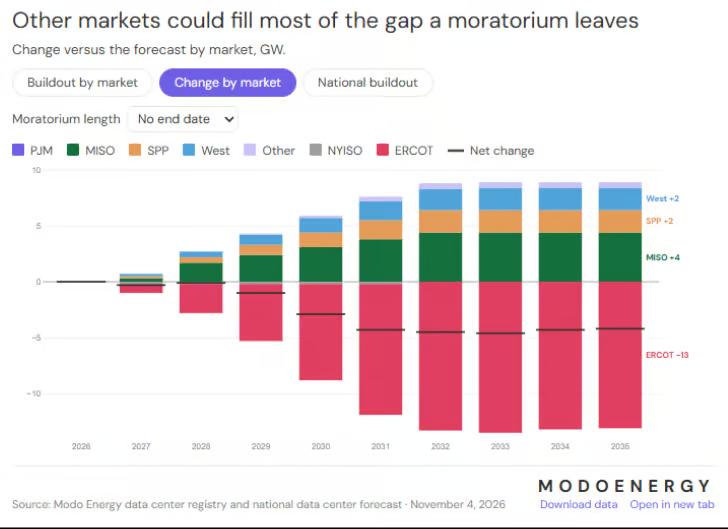
Of course, there are errors in the forecast itself. Even if the overall impact is limited, it does not rule out the emergence of local computing power bottlenecks in the short term, which will push up GPU rental prices.
Capital Expenditure and Rental Price: Can They Form a Hedge?
The core problem facing investors is: If the regulation and control of data centers leads to shrinking capital expenditure, can the rise in computing power prices fully offset the losses?
Rough calculations show that this logic is mathematically feasible. Data from Epoch AI shows that the total capital expenditure of a 1GW data center is about 37 billion US dollars, which is converted into an annual investment of about 18.5 billion US dollars according to a two-year construction cycle. The current annualized revenue of computing power rental of CoreWeave is about 40 billion US dollars per GW. If the GPU rental price rises by 30% (the rental price of NVIDIA H100 chips has risen by more than 50% in the past year), it can bring an additional income of about 12 billion US dollars per year.
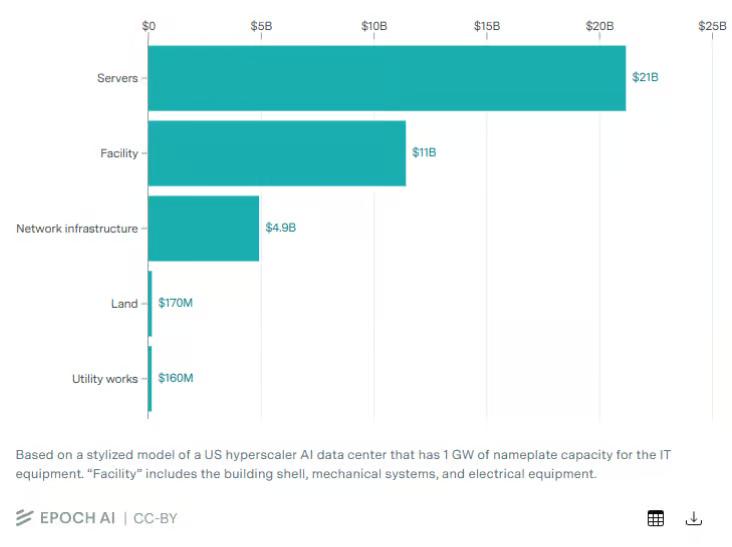
Accordingly, a 30% price increase for 1.5 GW of existing computing power can cover the capital expenditure loss of 1 GW of new computing power. Considering that the existing computing power installed capacity in the United States is about 30 GW, if 10% to 20% of it can be repriced quickly, the economic logic will shift from "building new computing power" to "monetizing existing computing power".
The reverse signal to verify whether this logic is valid is clear: If capital expenditure and GPU rental prices decline simultaneously, the assertion is wrong. Otherwise, the worst outcome of AI transactions may only be an internal structural rotation. Even if Anthropic and OpenAI postpone their IPOs due to insufficient computing power, the market may not be unable to digest it, because part of the economic benefits have been concentrated to hyperscale cloud vendors.
Recent Market Stabilization: Hedge Fund Deleveraging Provides a Buffer
From a short-term perspective, there are two reasons to support the market to stabilize after recent fluctuations.
According to data from Goldman Sachs, hedge funds, the main force of last week's sell-off, have completed a considerable degree of deleveraging: in the past week, the overall position size has decreased by nearly 9 percentage points, and the beta-adjusted risk exposure has decreased by nearly 16 percentage points. Morgan Stanley pointed out that the net risk exposure of hedge funds has dropped to a one-year low. The highly leveraged and highly homogeneous position structure makes hedge funds prone to local stampedes, but retail and institutional investors with fewer constraints and slower decision-making rhythms have not followed up the sell-off on a large scale — the leverage ETF capital flow shows that retail selling pressure is not obvious; on the institutional side, before being reviewed by the investment committee, the possibility of a full exit is low, and the proportion of institutional holdings in technology stocks is still high.
Secondly, the current recession signal is not obvious. Macroeconomic data shows that a deep stock market fall (a drop of more than 20%) usually occurs during a recession, and there are no such signs at present.
Rotation Rather Than Termination: The Evolution Path of AI Transactions
Large-scale cancellation of data center projects will deal a heavy blow to the economy, but this is not the baseline scenario. As analyzed above, a large number of projects can be moved to regions with a more friendly policy environment.
A more likely outcome is a structural rotation within AI transactions: hyperscale cloud vendors benefit from the scarcity premium of existing computing power, while AI labs, emerging cloud service providers and the data center construction chain are under pressure. This rotation will weaken the breadth and vitality of AI transactions, but it may also continue the transaction in a narrower and more fragile form.
This article is from "Wall Street CN", author: Zhang Yaqi, published with authorization from 36Kr.