With a daily salary of 180, working as a teacher for robots on the assembly line.

I became a person who could be replaced at any time on the assembly line.

Text | WANG Zhipeng
Edited by | LIU Sijie
Visual Design | QU Mei
My mind was full of the glove described in Klein Bottle, a thin layer of liquid interlayer. Once connected to electricity, the palm could touch the virtual world. At first, I thought data collection was just like that.
In July this year, the Ministry of Human Resources and Social Security publicly announced the plan to add 12 new occupations, among which "Embodied Intelligence Robot Application Technician" was included, and "Data Collector" is the specific type of work under this occupation. Behind the data collectors lies huge industry demand. It is estimated that to achieve the initial human-like capabilities, robots require approximately 100 million hours of data, while the total valid global data is only hundreds of thousands of hours. Therefore, 2026 is regarded by the industry as the first year of large-scale embodied intelligence data.
In August, I decided to experience this new occupation as a "data collector".
When I searched for "part-time data collection" on recruitment apps, a full screen of recruitment information popped up. "Glove data collection, 180 yuan per day, start work at 8:30 in the morning, get off work at 7 p.m., you can leave once you finish the tasks, extra overtime pay for overtime work, the job content is to collect data for robots." This is the full introduction of this position.
In my imagination, this job was easy, well-paid, and full of sci-fi sense. But when I actually started working, I became a new-era assembly line worker, repeating simple movements like "squeezing toothpaste", and even figured out small tricks to cut corners, while the data still met the standards. My body and movements were converted into data commodities, and I never figured out how these data would be used.
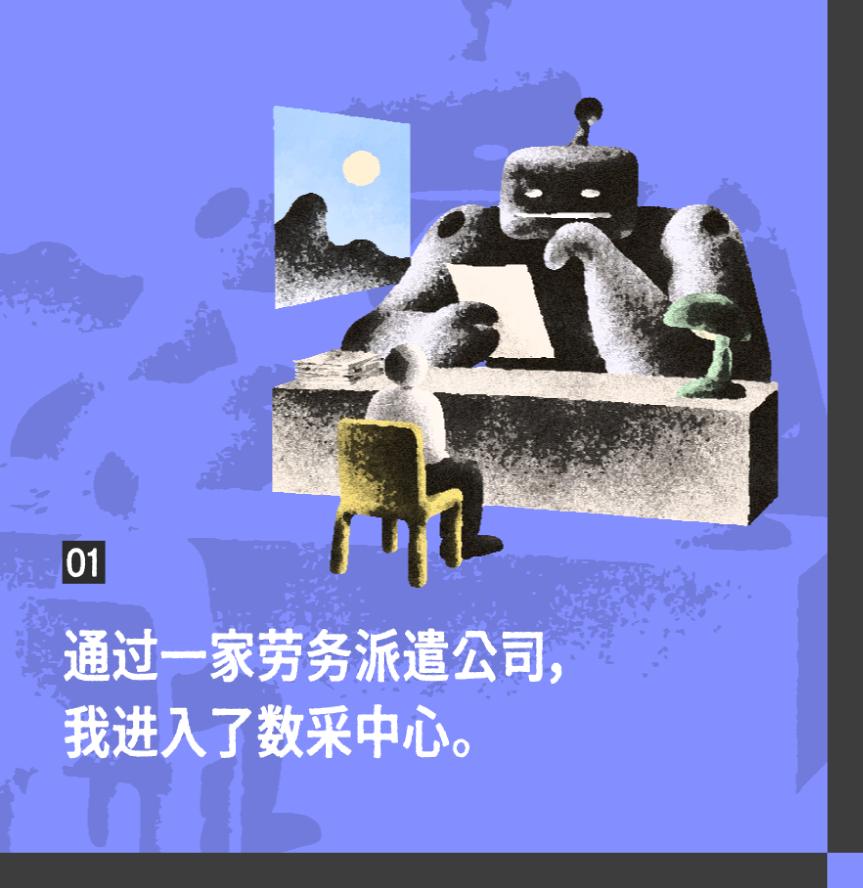
Behind the account that posted the recruitment was an e-commerce company, whose main business was catering ingredient supply chain. On its homepage, besides data collection, there were positions such as warehouse stock sorting and packaging.
The communication with HR went surprisingly smoothly. He didn't ask about my education background or work experience, nor did he mention the contract. He only asked about my schedule, and we added WeChat. The next day, he referred me to a "Mr. Wang". "Mr. Wang" created a group and set three ground rules: Do not leave your post at will, do not take photos or videos, start work at 8:30, arrive early, or there will be no available seats if you are late.
At 8 a.m., I arrived at the building where the collection site was located. The interior of the building was like a vertical maze. The whole building was U-shaped, and it was packed tightly. The shops on the first floor stood side by side, 7-11, ramen restaurants, print shops, and pharmacies occupied the space on the ground floor; the 20 floors of office areas above were stacked layer upon layer, and companies and studios in technology, education, design, and finance fields occupied every available space.
Opposite a design company with a sign printed on A4 paper was the collection site where I was going to work. There was no sign or storefront, only a small wooden table placed under the glass door. A check-in QR code was pasted on the door. Scanning it showed four options, corresponding to four companies. As "Mr. Wang" instructed, I selected "XX" — the name of a labor dispatch company.
According to a report by China Securities Journal in October, there are only dozens of companies across the country that can directly obtain data collection orders at present, but there are already hundreds of large and small labor dispatch companies that subcontract the business downwards.
The business model of the labor dispatch company that organized me to go to the collection site was very simple: robot companies or embodied intelligence model companies put forward data requirements, and data service providers take the orders. Outsourcers and labor dispatch companies organize labor, and earn the price difference from it.
The collection site where I actually worked was at the very end of this data industry chain.
The collection site had two floors, each of which was smaller than two high school classrooms, and was divided into several areas by partition walls: thin-film collection area, head-mounted collection area, with dozens of workstations packed full. I thought someone would tell me what to do as soon as I arrived, but no one noticed me. Remembering that "Mr. Wang" said "grab a seat first", I quickly sat down at an empty seat.
Two young people next to me eating Chinese pancakes looked like staff members. I asked: "Do you know where these data will be used in the end?"
"They will probably be used on robots, we don't know anything else."
A staff member went upstairs to find someone to do glove collection. I quickly stood up, but he waved his hand: "Newcomers do the thin-film collection first, and only those who have worked for a few days can do the glove collection."
A colleague told me that the glove collection area was on the first floor, which was easier. The thin-film collection area was on the second floor, and there was a small area for head-mounted collection. Even among part-time workers, there was a hierarchy.
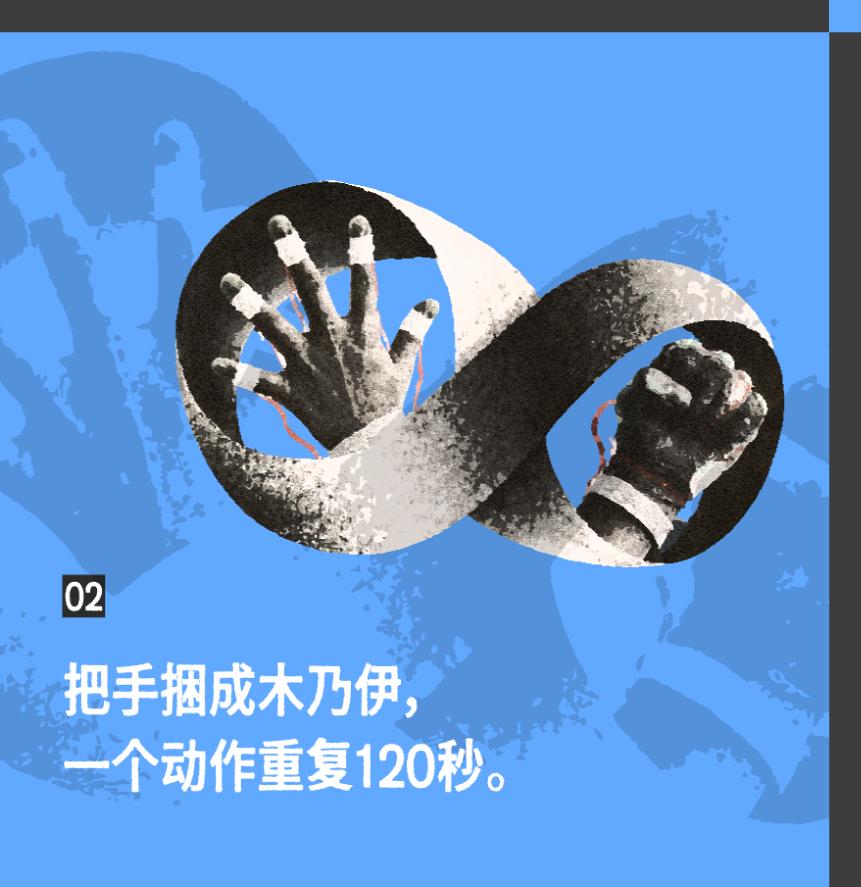
My hand was tied like a partial mummy.
A long-term collector helped me install the thin-film collection equipment. She pressed the metal gasket with one finger, and wrapped the tape around it with the other hand. Several thin wires extended from the fingertips and connected to the computer. The whole installation took about 20 minutes. The circuit was fragile. After installation, I could hardly do anything except grasping movements, even picking my nose was difficult.
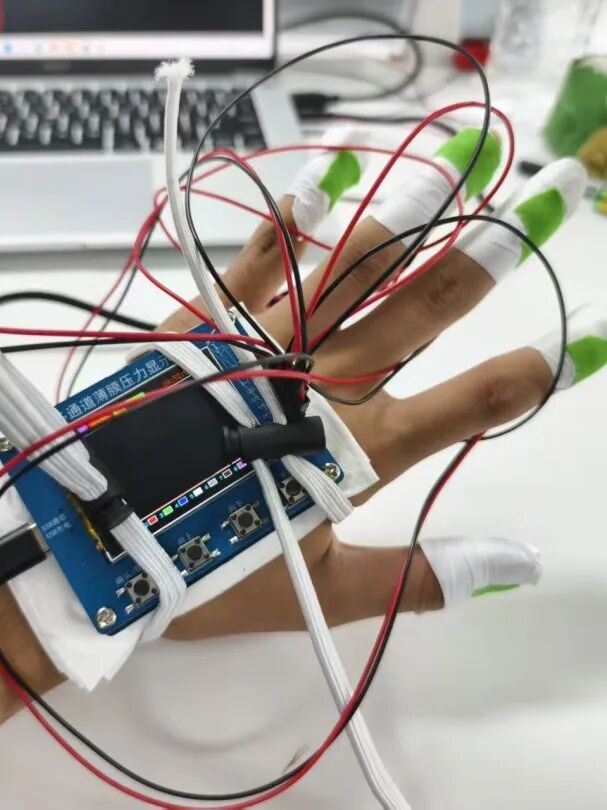
On-site thin-film data collection equipment
I quickly figured out the rules: Imitate the demo video on the computer, and repeat simple movements with the props on the table, 120 seconds for each group. There were fake eggs, plastic water cups, plates, beauty blenders, toothpaste, and empty bottles on the table. There were 12 sets of movements in total to cycle through: first pinch the beauty blender with two fingers for 30 seconds, then pinch the small ball with three fingers, then switch to sponges and empty bottles; or pick up the plate from the left, suspend it in the air for a few seconds, and gently put it on the other side.
The standard daily volume was 155 groups. For the single movement of "pinching" alone, I had to do it over and over again with different tools, pinching at least two thousand times a day.
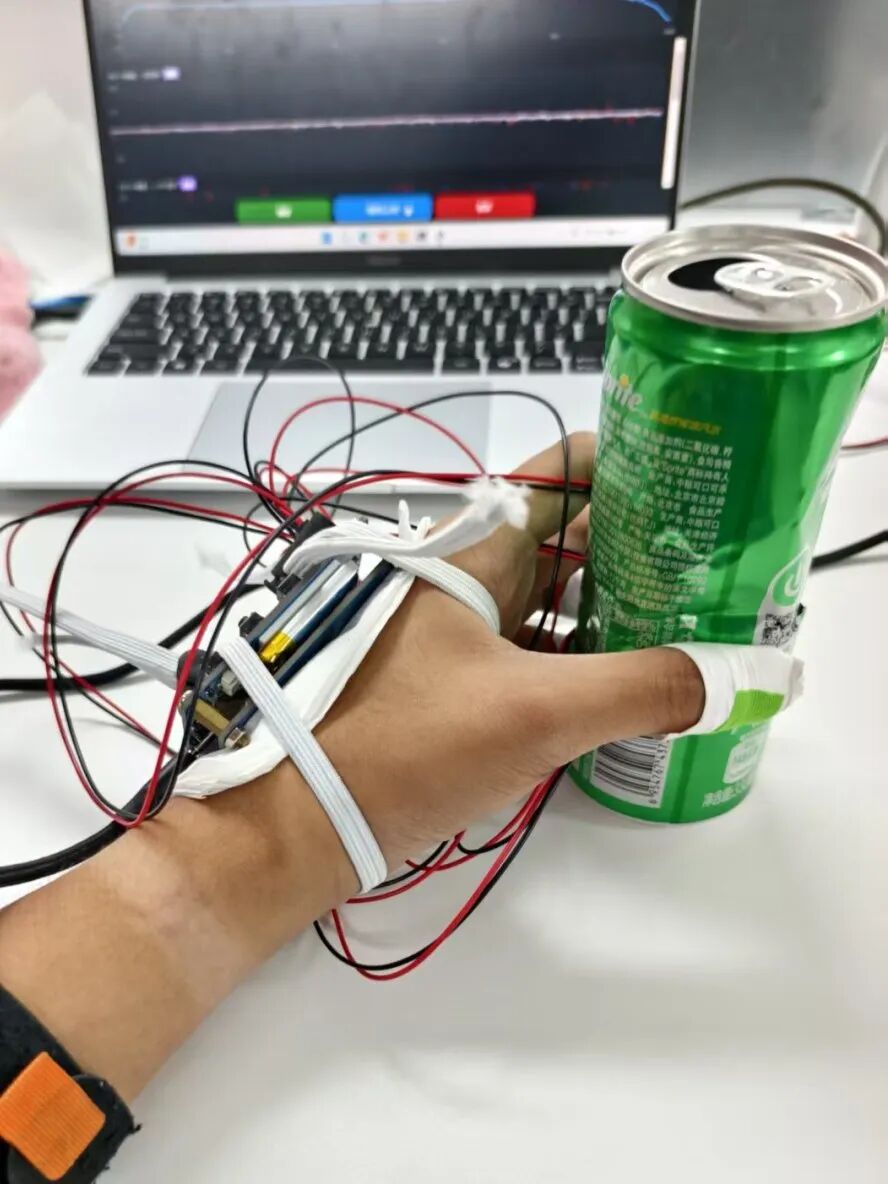
Repeating simple movements while wearing data collection equipment
An aunt next to me was prepared long ago, she shook the toothpaste in her hand: "This is an empty toothpaste I specially brought from home, it's much lighter than the solid one here." I looked down at the one on my desk, and I didn't understand why she brought her own until I actually started pinching it.
Sweat softened the tape, and the tape in turn tied my five fingers until they turned white. When I lifted the plate for the seventh time, my arm was numb and stiff, but I couldn't stop moving.
I became a clockwork mechanical device, gear meshing with gear, clicking back and forth along the same arc, which was extremely boring and tedious.
I couldn't help but smile bitterly: People wearing gloves in Klein Bottle were to feel a non-existent world, but I wore these devices to let robots feel the existing world.

To dispel boredom, I started chatting with my colleagues.
The short-haired girl who tied the equipment for me was a long-term data collector. She didn't look for a job after graduating from college, and has been working here. I asked her if she had ever thought about finding a more stable job. She didn't stop her movements, slowing down a little: "It's hard to find a job now, the salary here is quite good. I haven't figured out my next step, so I'll just keep working here for now."
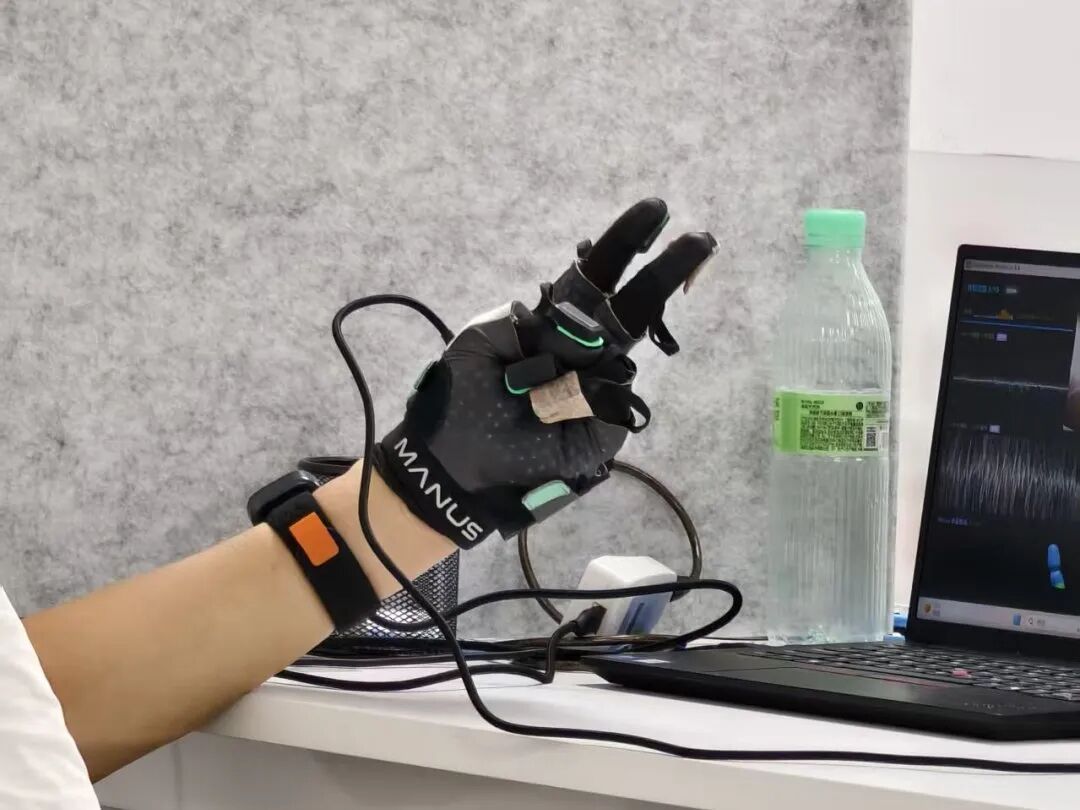
Glove data collection
The man sitting next to me used to work in the internet industry and is now unemployed. "I saw this job in the newspaper and wanted to give it a try." 180 yuan per day plus a few hours of overtime pay can barely cover his family expenses for the time being. Although he has to squeeze the subway for more than two hours every day commuting from Changping, compared with being unemployed, sitting in an office building doing things related to robots is not a "decent" job.
In a report by Xinhua News Agency in September, an industry insider Gao Shaolong was quoted as saying that the scale of part-time data collectors that enterprises can mobilize has "approached the million level", and the part-time group will be the main force of the industry for a very long period of time.
For these people I met, this does not seem to be an entry to the artificial intelligence industry, but more like a buffer zone between unemployment and the next job.
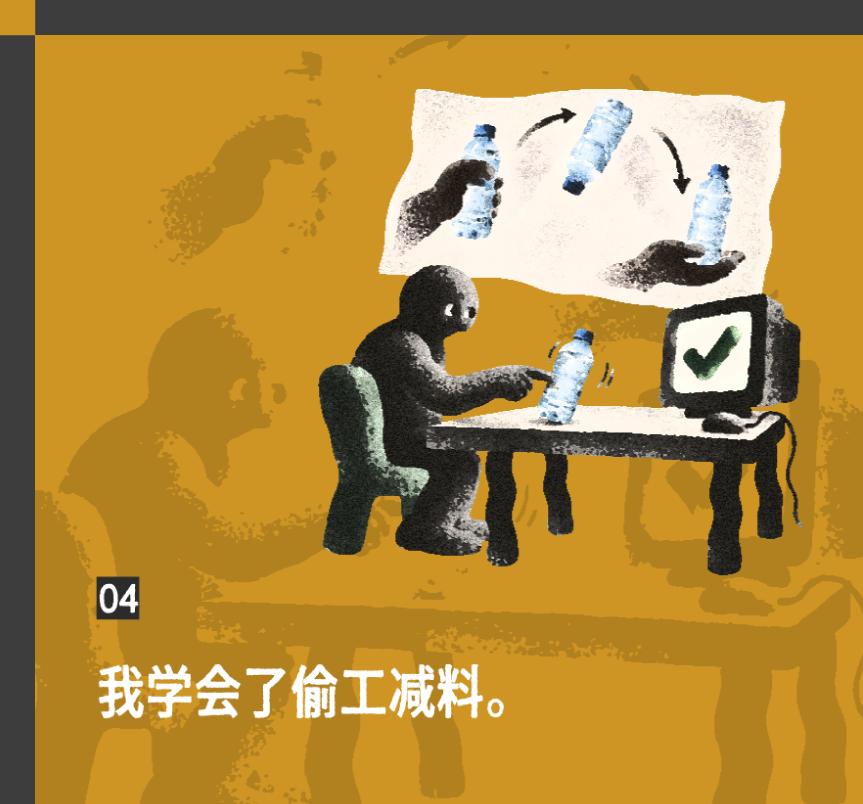
Near the end of the morning, a staff member holding a computer called my name. My heart tightened: the intermediary had said that if I failed to meet the standard in the morning, I would be fired in the afternoon.
"Your pass rate is only 82%, almost below 80%, use more force in your movements."
The system monitored two indicators: the number of completed movements, and the movement pass rate. The pass rate was related to the standardization and strength of the movements, which was required to be above 80%, and you could not get off work if you failed to meet the standard.
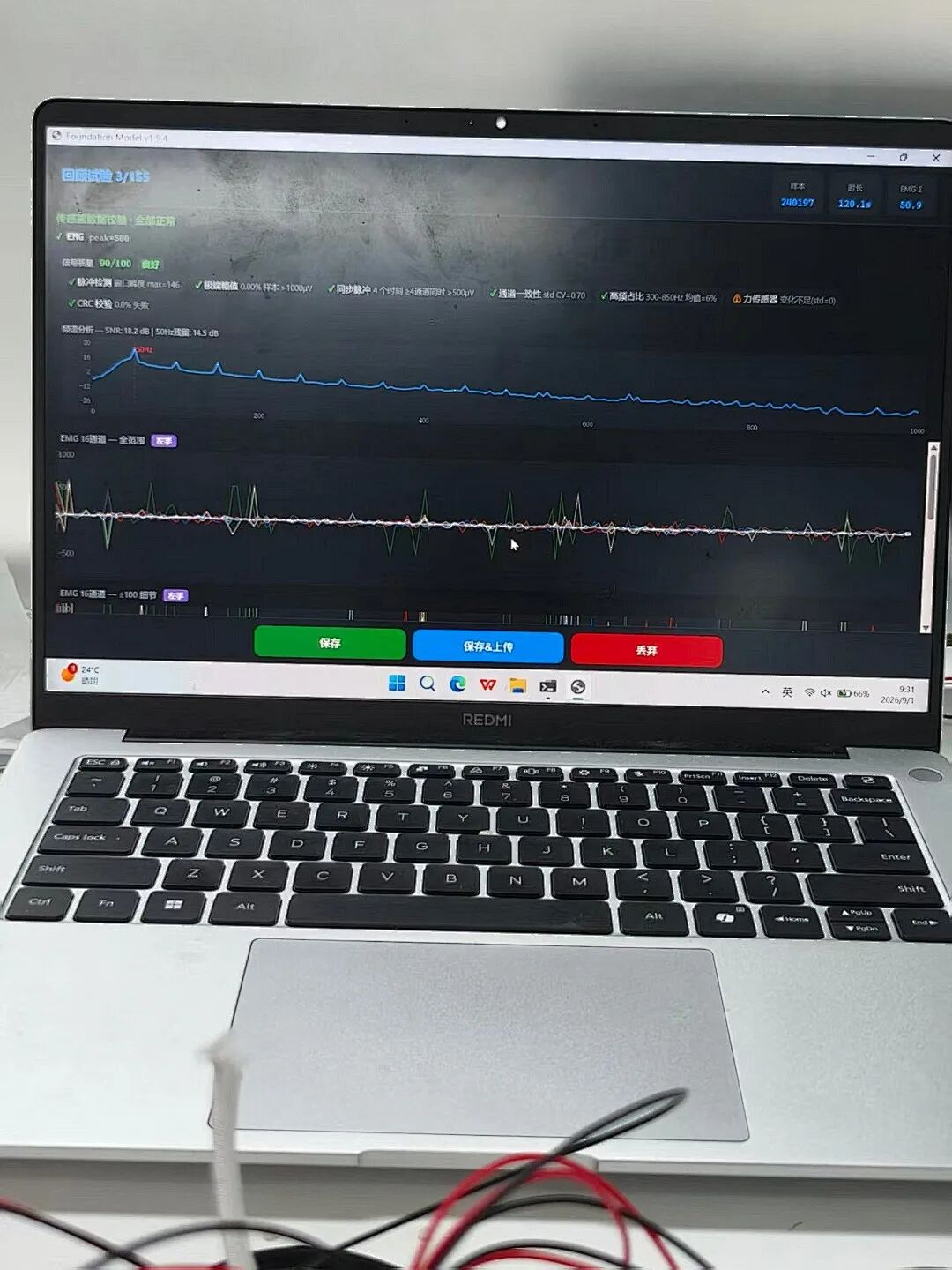
Pass rate displayed on the computer at the data collection site
After working busily for half a day, I was already a skilled worker, and I even figured out the trick to cut corners by myself. The equipment was not sensitive: the whole set of movements of placing the mineral water bottle upside down, grasping, flipping, keeping it inverted for 5 seconds, then turning it upside down and putting it down, I tried not to flip it, just shake it vigorously in my hand, and the data on the screen remained stable.
The aunt next to me soon found out that I was cutting corners. She shouted to the people around: "Young people are so smart, they have their own methods. I've been working for several days and didn't find out I could do this, but he found the trick on his first day." Some people smiled and continued to do their own work, some understood and nodded.
A woman in the back row whose circuit always had problems called the staff over, complaining while glancing at me: someone didn't do the work properly but still met the standard, why couldn't hers. I was so scared that I immediately resumed my normal movements.
I asked the on-site staff if there were mandatory standards for the data. They didn't