The night before Double 11, Alibaba quietly arranged for T-Head to go public.
On the evening of November 10, an announcement from Alibaba drew the attention of the tech community and the capital market to the Hong Kong Stock Exchange.
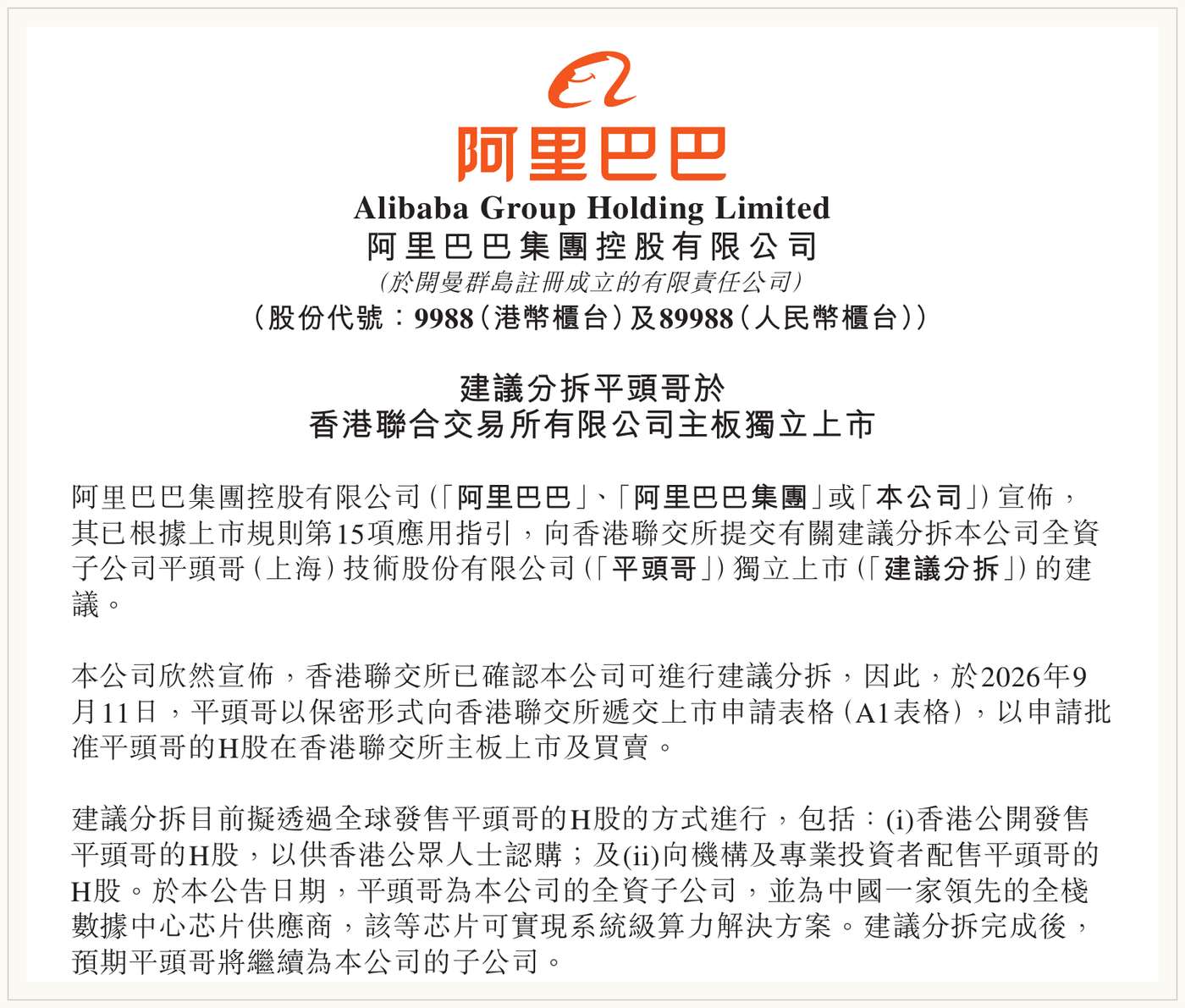
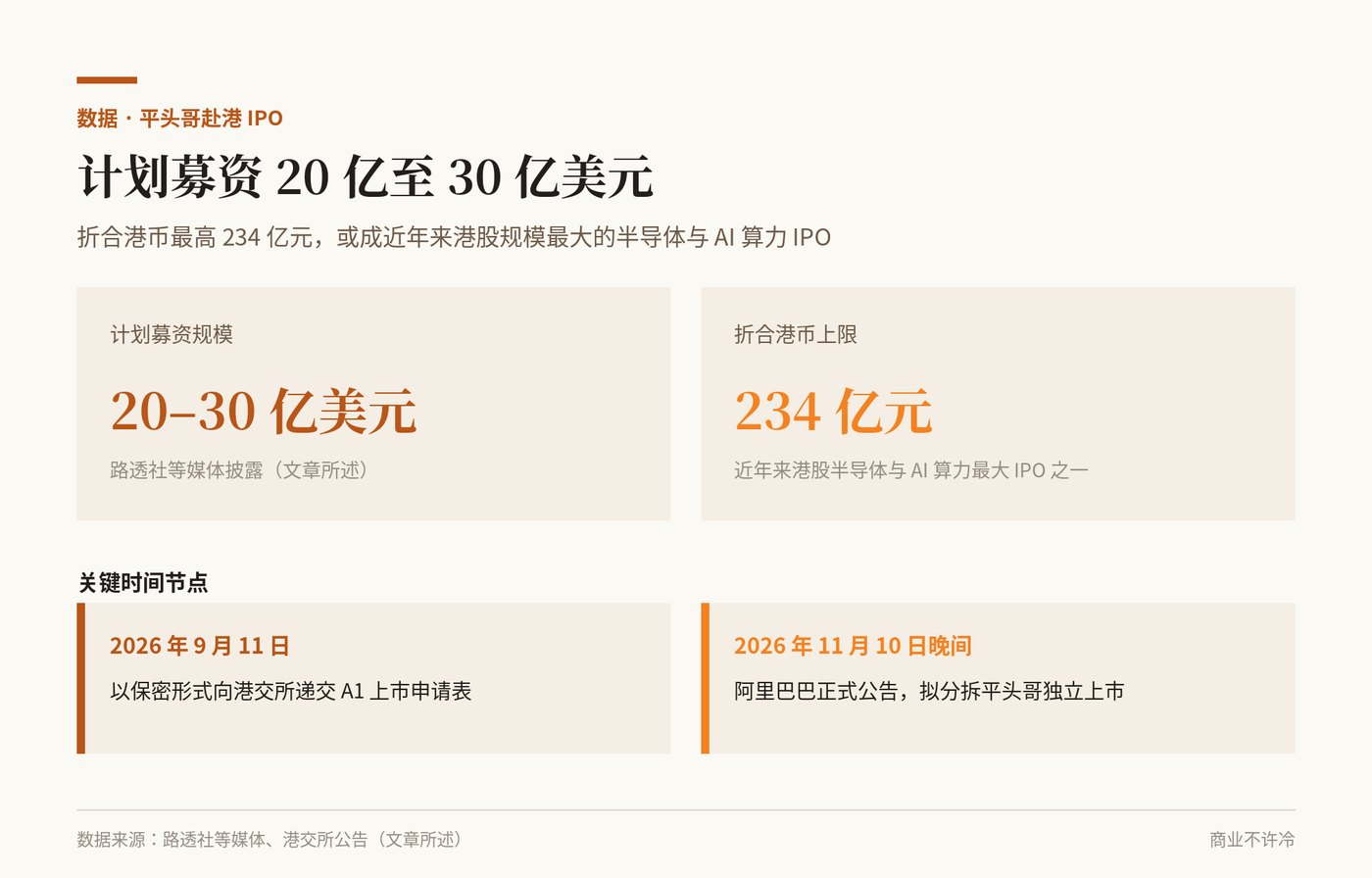
In the announcement disclosed on the Hong Kong Stock Exchange, Alibaba officially announced that it plans to spin off its wholly-owned chip subsidiary T-Head for an independent listing on the Main Board of the Hong Kong Stock Exchange. In fact, T-Head submitted its A1 listing application form to the Hong Kong Stock Exchange in confidential form as early as September 11 two months ago. Information disclosed by media including Reuters shows that T-Head plans to raise USD 2 billion to 3 billion, equivalent to a maximum of HK$234 billion, which will become the largest semiconductor and AI computing power IPO in the Hong Kong stock market in recent years.
The timing of this announcement is very subtle, and very Alibaba-style.
The night of November 10 is just the eve of the full launch of the Double 11 grand finale. Over the past decade, this night originally belonged to the e-commerce GMV big screen of Tmall and Taobao, and the promotion numbers of the whole network carnival. But today, when the e-commerce dividend is gradually peaking, Alibaba suddenly pushed this chip hole card that has been hidden for eight years to the front of the stage on the eve of Double 11.
Many people's first reaction is: Is this specially selected to boost morale during its own festival to cater to Alibaba's usual publicity style?
If this official announcement is only explained by public relations hype, it obviously underestimates the strategic shift of this Internet giant. Pressing the confidential submission for two months and finally detonating it on the eve of Double 11 is not a simple coincidence, but Alibaba is shifting the focus of market attention from consumer e-commerce to underlying computing power.
After supporting Alibaba Cloud as an auxiliary for eight years, the backup plan finally came to the front stage
Looking back at the development history of T-Head, the name itself is full of strong legendary colors.
At the 2018 Yunqi Conference, Jack Ma officially announced the establishment of T-Head Semiconductor Co., Ltd., which was integrated from Alibaba's previously acquired C-Sky Microsystems and the Damo Academy's chip R&D team. The name T-Head is taken from the honey badger, implying the spirit of taking life lightly and fighting back when provoked.
For a long time, the outside world and even the entire semiconductor industry have been full of doubts about this Internet chip-making company. Chip making is a hard tech industry with heavy capital investment, long cycle and high failure rate. Some Internet giants' attempts to make chips only stayed in the press releases of the press conference. At the beginning of its establishment, T-Head was also regarded by many people as a self-developed backup prepared by Alibaba Cloud to prevent supply chain interruption.
But T-Head's layout in the past eight years is much more complete than what the outside world sees.
From the earliest Xuan Tie RISC-V open-source processors focusing on IoT terminals, to the server CPU Yitian 710, and then to the cloud AI acceleration chip Zhenwu series, T-Head has unknowingly completed the system-level puzzle of the three core data center chips of computing power, storage and network.
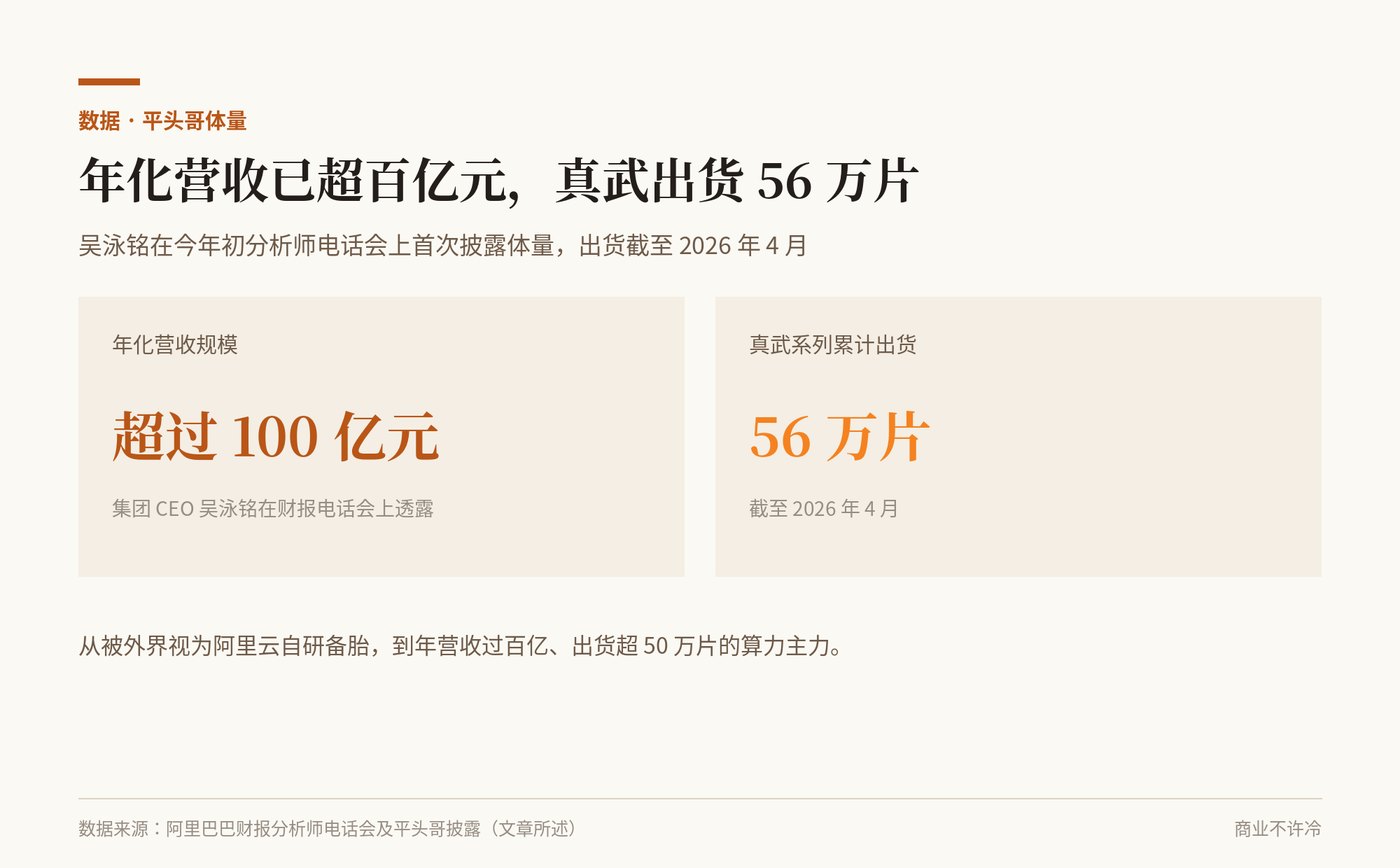
At the Alibaba earnings analyst conference call earlier this year, group CEO Wu Yongming first revealed the true scale of T-Head. Wu Yongming disclosed that T-Head's annualized revenue scale has exceeded 10 billion yuan, and the cumulative chip delivery volume has exceeded hundreds of thousands of pieces.
By April this year, the cumulative shipment of T-Head's Zhenwu series AI chips had reached 560,000 pieces.
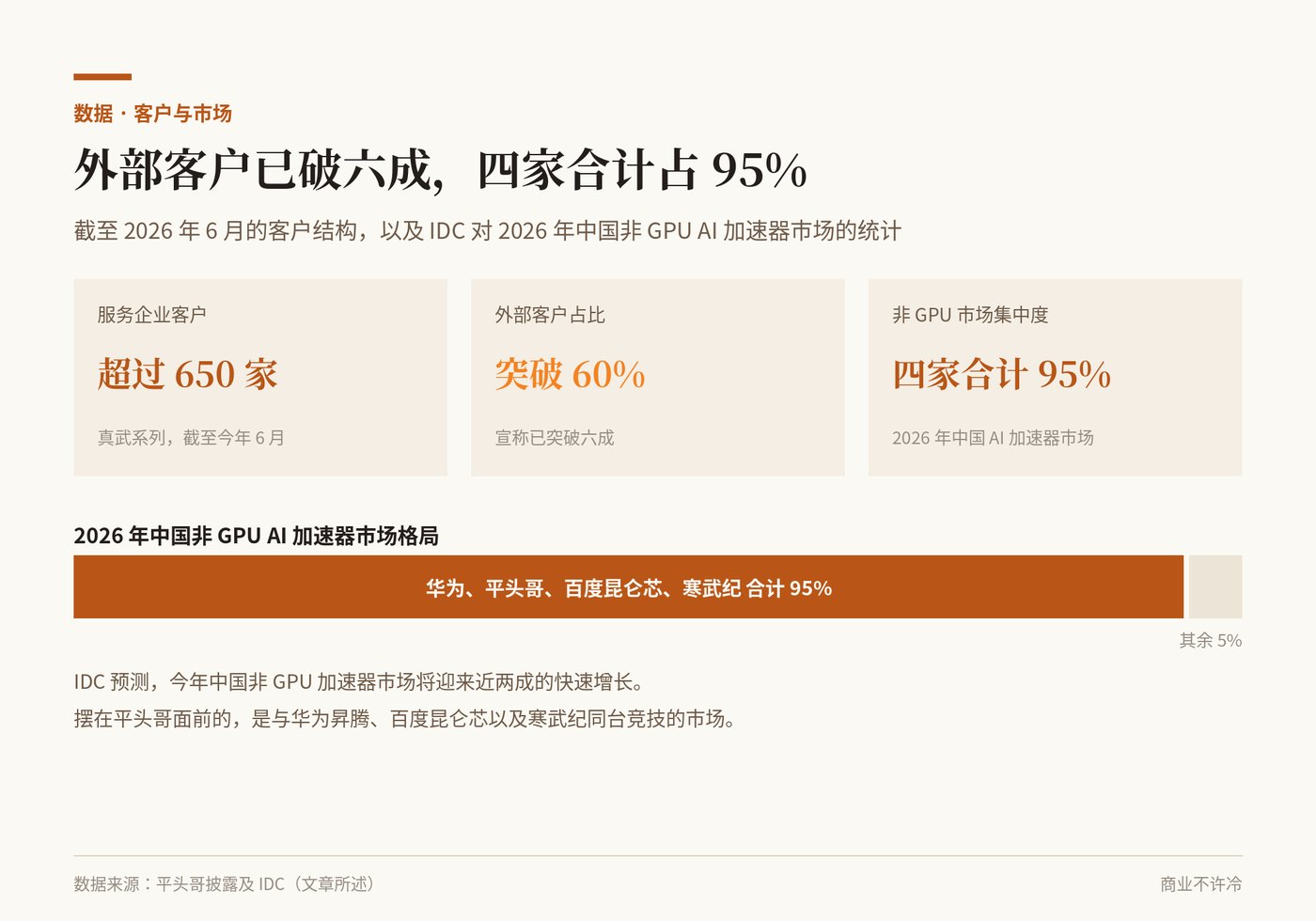
IDC's survey data shows that in China's AI accelerator market in 2026, demand for non-GPU chips has exploded rapidly, and four companies including Huawei, Alibaba's T-Head, Baidu's Kunlunxin and Cambricon together account for 95% of the share of this market segment.
From a small internal team that was once suspected of being a concept packaging, to a main force of computing power with annual revenue exceeding 10 billion yuan and shipments exceeding 500,000 pieces, T-Head has quietly grown into a giant in the hinterland of Alibaba Cloud.
Submitted the application secretly for two months, why choose to lift the lid on the eve of Double 11
The official submission time of T-Head is September 11, 2026, in a very low-key confidential submission form.
Since the listing application was submitted two months ago, why did Alibaba deliberately hold back the news and not officially announce it to the public until the eve of the opening of Double 11 on November 10?
This reflects Alibaba's active reshaping of the group's narrative.
In the past few years, Alibaba has suffered huge valuation discounts in the capital market. In the cognitive framework of traditional investors, Alibaba is still defined as a retail platform that earns advertising fees and commissions from its e-commerce Taobao and Tmall business. With the adjustment of macro consumption expectations, the intensification of price competition among major e-commerce platforms and the ebb of full-reduction promotion routines, the valuation multiple of the e-commerce business has been compressed to the range of the traditional retail industry.
Even if Alibaba Cloud's AI product revenue maintains triple-digit growth for consecutive quarters, as long as T-Head is still huddled in the group's large financial statements, the capital market will only regard T-Head as an expensive R&D expense, and it is difficult to give it the high valuation premium that an independent hard technology enterprise deserves.
Announcing this news on the eve of Double 11 is a carefully chosen cognitive switch. At a time when the growth rate of e-commerce GMV is gradually losing its mystery and consumers are tired of promotion war reports, Alibaba needs to use T-Head to tell a new growth story to the capital market. What was delivered this night is no longer a discount list, but an AI chip listing plan with a valuation of up to tens of billions of US dollars.
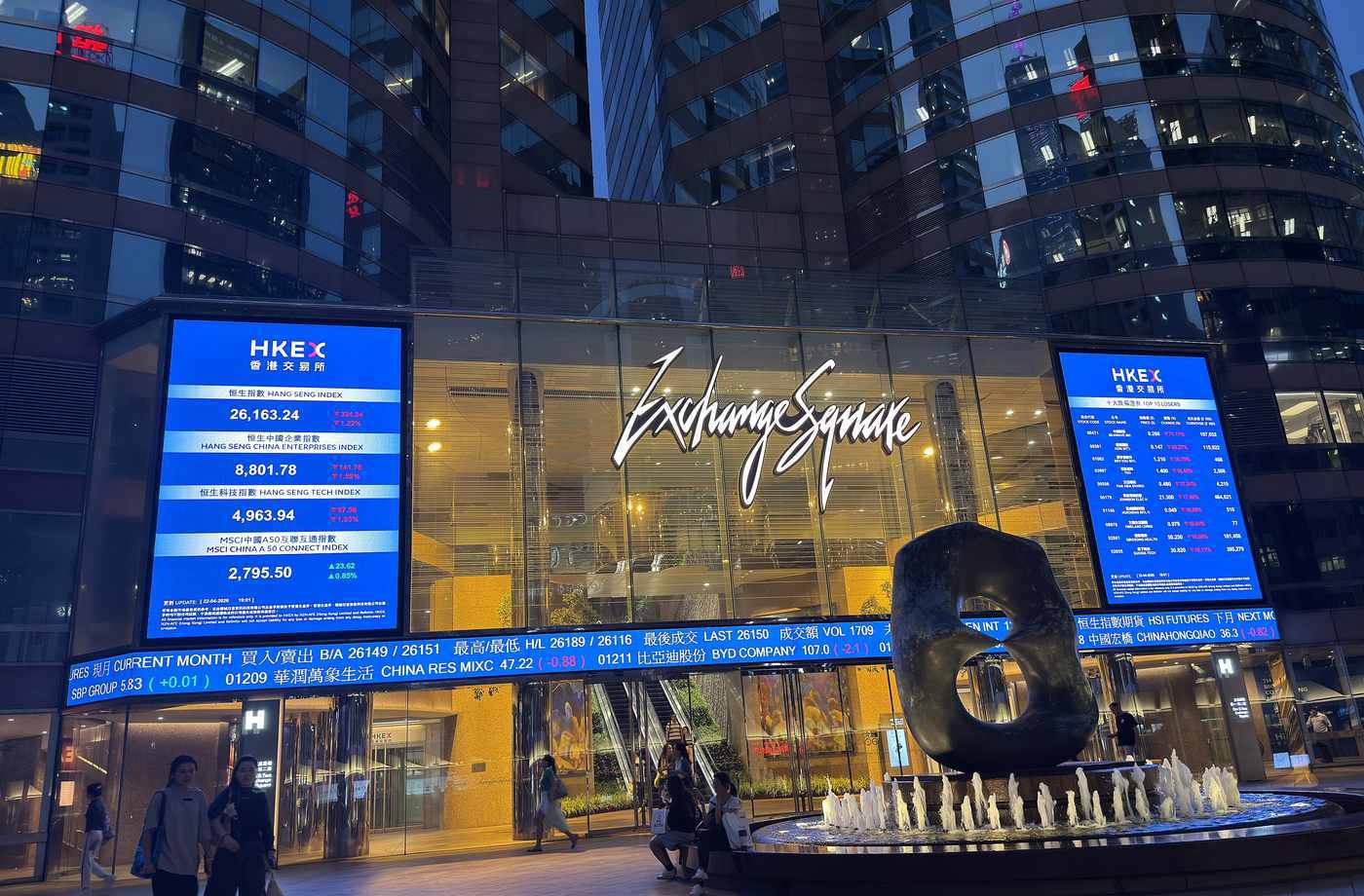
Alibaba borrowed the attention of Double 11, and also pushed market cognition from e-commerce parcels to underlying computing power. The group is sending a signal to the outside world that Alibaba's future is no longer only tied to Taobao and Tmall, but deeply rooted in the infrastructure of the large model era.
Say goodbye to single blood transfusion, going independent to the market can really grow up
In addition to the handover of capital narrative, the more realistic driving force for spin-off and listing comes from T-Head's own survival and expansion needs.
Chip design is an extremely cruel capital marathon. A large computing power AI chip with advanced process technology often costs hundreds of millions of yuan from tape-out, packaging to cluster joint debugging. If every architecture upgrade has to rely entirely on the parent company's internal profits to support, it will not only bring a heavy burden to Alibaba's cash flow, but also make T-Head face balance and compromise between various business segments of the group in resource allocation.
The more critical bottleneck lies in the independence of the customer group.
As of June this year, T-Head's Zhenwu series chips have served more than 650 enterprise customers, and the proportion of external customers is claimed to exceed 60%.
But in actual commercial competition, since T-Head is fully owned by Alibaba, few tech giants are willing to hand over the computing power lifeline of their core AI business to a wholly-owned subsidiary of a direct competitor. This identity bundling has largely blocked the space for T-Head to develop external large enterprise customers.
Going for independent listing in Hong Kong is a realistic way to unlock this trust shackle.
After the spin-off is completed, T-Head will still be a holding subsidiary of Alibaba, but it will have an independent corporate governance structure, transparent financial statements and a public equity incentive pool. T-Head can introduce semiconductor funds and industrial investors, use money from the public market to share R&D risks, and can also go to the entire China and even the global AI computing power market as a relatively independent chip design company.
The process of walking out of the parent company's greenhouse is inevitably accompanied by pains. Without Alibaba's full guarantee, T-Head must directly face the strict test of R&D input-output, customer expansion and independent profitability. But this is exactly the only way for a chip to really run through the commercial cycle.
Chip making by large manufacturers has reached a watershed, from showing off strength to real head-to-head competition
T-Head's listing in Hong Kong is also a milestone event in the history of chip making by China's entire Internet giants.
Looking back at the past ten years, almost all of China's Internet giants have launched chip fantasies. Baidu incubated Kunlunxin and completed the split and financing early, Tencent invested in Enflame Technology and internally developed chips such as Canghai and Xuanling, and ByteDance is also continuously expanding its self-developed chip team. But for a long time, chip making by large manufacturers was mostly regarded as a defensive technical show of strength, lacking the courage to really go to the public market to fight head-on with professional chip giants.
Now that T-Head has taken the first step of independent IPO, it means that chip making by large manufacturers has begun to move out of the internal use stage and accept the test of the public market.
In the stage of accelerated implementation of large models, the competition for computing power infrastructure is expanding from code capabilities to full-stack capabilities of chips, compilers, super-node networks and cluster interconnection. Whoever can provide cost-effective, stable, reliable computing power that is not affected by external supply cuts is eligible to enter the next round of competition.
In IDC's forecast, China's non-GPU accelerator market will usher in a rapid growth of nearly 20% this year. What is in front of T-Head is a cruel battlefield competing with Huawei Ascend, Baidu Kunlunxin and Cambricon. The spotlight of the public market will clearly illuminate the real yield rate, single-chip cost, software and hardware adaptation ecology and customer stickiness of the chips.
Final Notes
T-Head's choice to come to the front stage on the eve of Double 11 is itself a clear signal of shift.
The Internet era that relied on traffic, platform commissions and consumption prosperity to support high valuations is fading out, and underlying computing power and hard technology are beginning to become the new center of the story.
The capital market no longer pays for pure platform scale, but pays more attention to the autonomy and hematopoietic capacity of core underlying technologies.
From an e-commerce empire connected by a network cable to self-developed chips running at high speed in computer room servers, Alibaba has spent a full 26 years.
Spin off T-Head for listing in Hong Kong is not only a key move for this giant to unlock its own valuation, but also a public bet on computing power autonomy. When the parcel carnival of Double 11 gradually calms down, what awaits T-Head at the Hong Kong Stock Exchange will be a coming-of-age ceremony that no longer relies on the shelter of the parent company's internal orders and is fully tested by the real demand of the market. Whether it can gain a firm foothold in the public market will directly determine whether chip making by large manufacturers is just an expensive defensive drill, or a truly significant business breakthrough.