Apple, which has best withstood market slumps, is now ramping up its AI push.
In 2026, the Magnificent Seven tech stocks on the US stock market have diverged in performance.
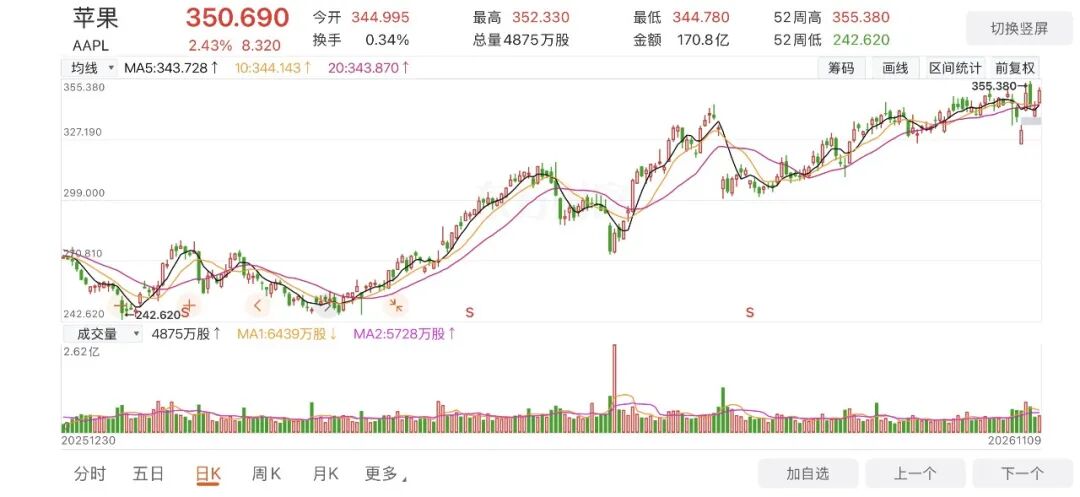
As of the close on November 10 Eastern Time, Apple's year-to-date gain is about 29%, making it the only member that significantly outperformed the S&P 500. In contrast, stock prices of giants with heavy positions in AI infrastructure such as Google, Meta, and NVIDIA have declined to varying degrees, with Tesla's share price falling by more than 20%.
Looking beyond the surface of stock prices, Apple's resilience to decline does not stem from leading AI technology, but from its "asset-light" financial foundation. While other giants are dragged into cash flow quagmires by hundreds of billions of dollars in capital expenditure, Apple, with extremely low capital expenditure and abundant free cash flow, has firmly secured its position as a safe-haven asset.
However, facing intensifying AI competition, Apple, which is half a step behind, is being forced to speed up its counterattack. Without spending heavily to build computing power, can Apple still hold onto its "asset-light" defense?
Why is Apple the most resilient to decline?
According to sorting out by reporters from Sci-Tech Innovation Board Daily, as of the close on November 9 Eastern Time, Apple's year-to-date gain is about 29%, making it the only member among the seven giants that significantly outperformed the S&P 500. During the same period, Microsoft's share price rose by about 12%, Amazon's by about 15%, NVIDIA's fell by about 6%; Meta and Google's share prices fell by about 3% and 8% respectively, and Tesla's decline was about 20%.
It can be said that Apple is the most prominent anti-decline player among the seven major US tech giants at present. To understand Apple's resilience to decline, we first need to see clearly what the other tech giants have experienced in 2026.
In the third quarter of 2026, the total capital expenditure of Amazon, Alphabet (Google's parent company), Microsoft and Meta reached 201.9 billion US dollars, and the annual capital expenditure plans of all four companies exceeded 100 billion US dollars. Over the past three and a half years, the cumulative investment of these four companies in AI infrastructure has exceeded 1 trillion US dollars, almost all directed to data centers, GPU clusters and computing power networks.
The cost of asset-heavy transformation has emerged. In Q3 2026, the free cash flow of Alphabet and Meta turned negative. Although Microsoft's free cash flow is still positive, it decreased by 27% year on year; Amazon's free cash flow in the past 12 months was negative 42.4 billion US dollars.
The asset-heavy transformation of capital expenditure has changed not only the cash flow figures, but also the market's pricing framework for such companies. When depreciation begins to continuously erode profits and free cash flow turns from positive to negative, investors need to constantly answer the same question: When can this capital expenditure be converted into returns? The market's pricing framework for such companies is also shifting from "high-margin software companies" to "infrastructure companies that require continuous investment to maintain operation".
On the other hand, NVIDIA, which is at the other end of the AI chain, although its own capital expenditure is extremely low, only 6 billion US dollars in FY2026, its share price has fallen by about 6% year to date. The reason is that as a "shovel seller", NVIDIA's performance is highly dependent on the procurement of those four giants. When buyers face doubts about peaking capital expenditure due to the deterioration of free cash flow, the sustainability of NVIDIA's orders is naturally questioned.
Tesla faces another kind of dilemma. It has not been involved in the arms race of large model data centers, but its R&D expenses in Q3 surged by 69% to 2.76 billion US dollars, while its operating profit fell by 56% year on year to 718 million US dollars, and its operating profit margin dropped to 2.6%. Coupled with the decline in delivery of its core automotive business and the pressure on revenue from its energy business, Tesla's AI narrative is still grand, but it is difficult to fill the gap of declining core business profits in the short term.
In contrast, Apple has neither made heavy asset investment as a buyer nor participated in the cyclical game as a seller. Its total capital expenditure in fiscal year 2026 was only 9.04 billion US dollars, down 29% from 12.7 billion US dollars in the previous fiscal year. Financial reports show that Apple's annual revenue reached 478.8 billion US dollars, up 15% year on year; its net profit was 132.2 billion US dollars, up 18% year on year; its cash flow from operating activities was 145.097 billion US dollars, up about 30% year on year; its free cash flow was 136 billion US dollars, up about 38% year on year.
Zhang Yirui, Managing Director of CIC Insights, attributed this difference to different pricing anchors in an interview with a reporter from Sci-Tech Innovation Board Daily.
Zhang Yirui pointed out that the market is currently strictly reviewing ROI and free cash flow for AI giants. "The pricing anchor of other giants lies in the cloud elasticity converted from high AI CapEx, while Apple's pricing anchor lies in the stock base of more than 2 billion active installed devices, high-margin service cash flow, and highly deterministic stock repurchases."
In his view, the restrained pace of AI development is the key to Apple's risk aversion. "Apple did not carry out aggressive heavy asset arms races on general large models and large-scale GPU clusters in the early stage, which instead avoids the current market concerns about excess capital expenditure and profit erosion by depreciation," Zhang Yirui told the reporter of Sci-Tech Innovation Board Daily.
Will Apple still be able to maintain its "asset-light" foundation when it aggressively expands investment in AI?
Apple's "asset-light" defense strategy is facing the challenge of the paradigm shift of AI competition. Not being involved in the computing power arms race certainly makes Apple appear resilient to decline at the moment, but it cannot hide Apple's anxiety about AI capabilities.
According to media reports, Apple's new CEO Turenas recently held a closed-door meeting with Craig Federighi, head of the software business. Turenas expressed dissatisfaction with the company's current progress in the AI field, demanding that he should not be satisfied with patching the existing Siri, but formulate a long-term plan.
It is reported that Turenas asked the software team at the closed-door meeting to "quickly move beyond the stage of only making necessary improvements to Siri". Apple is considering endowing the voice assistant Siri with stronger autonomous action capabilities, and it is expected to launch a new version of Siri with agent capabilities as early as 2027.
It is worth mentioning that Turenas has always maintained a cautious stance on artificial intelligence before. In an interview with Wired on October 30, he said, "We don't want to ship AI for AI's sake". Apple will embrace AI, but it does not think that AI should be installed in products just because the technology is popular.
The contrast between Turenas's internal pressure and external restraint points to the narrowing of the competitive window. Apple's expansion in AI is first of all an entrance defense war, and secondly a capability catch-up.
Why can't Apple "sit still"? Because the competition paradigm is shifting. OpenAI, Meta, and xAI have shifted the focus of competition from "better chat assistants" to "goal-driven agents", where the system continuously tracks goals in the background and independently judges the next operation, instead of waiting for users to issue instructions one by one.
Apple has not made no progress. The Siri AI launched by Apple in the US market already has the capabilities of cross-application operation, screen perception and multi-step task execution, and is no longer a simple single-step instruction tool. But it still stays in the "request-response" mode: the user issues an instruction, Siri executes it, and then waits.
In terms of mobile phone manufacturers, Huawei, Xiaomi, Honor and other brands in the Chinese market have carried out multiple rounds of iterations around on-device large models and system-level agents. However, Apple's domestic version of Apple Intelligence was not officially announced to be connected to Alibaba's Tongyi Qianwen until October 31, and the first batch of about 18 functions will be pushed with iOS 27.3 in December, covering basic capabilities such as writing tools, real-time translation, photo elimination, and notification summary. But this update does not include Siri AI and other next-generation Apple smart functions announced at WWDC 2026.
The internal pace is also under pressure. According to media reports, Federighi's software department is used to planning for 12 to 18 months, and the hardware department lays out plans several years in advance, and the mismatch easily makes the first version too conservative. Apple has adjusted the initial rhythm of iOS / iPadOS 28 and macOS 28 from "four weeks of coding, four weeks of integration" to "six weeks of coding, two weeks of integration".
Then, will expanding investment in AI overturn the low capital expenditure narrative that supports Apple's relative returns?
At present, the AI investment of tech giants is mainly capital expenditure - buying GPUs and building data centers. Financially, this sum of money is not included in the current cost, but becomes "fixed assets", which is amortized slowly in the next 5-10 years through annual depreciation. As a result, the free cash flow of the giants has plummeted to negative, and they face the risk of huge depreciation suppressing profits in the future.
However, Apple's expansion mainly increases R&D expenses, chip BOM costs and so on. R&D expenses belong to the current operating expenses, which directly deduct the current profits and do not generate subsequent depreciation burdens. Moreover, this marginal cost can be transferred to end consumers through supply chain management and product tiered pricing.
Zhang Yirui, Managing Director of CIC Insights, also analyzed to the reporter of Sci-Tech Innovation Board Daily that on-device AI mainly increases chip R&D and BOM costs, which is different from the huge fixed asset depreciation of self-built AI data centers. "This marginal cost can be passed on to end consumers through supply chain control and product tiered pricing, which is different from the expenditure attributes of other giants. The layered architecture adopted by Apple, that is, light tasks are processed by local chips, and deep tasks are connected to third-party large models, effectively externalizing the high cloud computing power and reasoning costs."
Zhang Yirui further pointed out: "As the gatekeeper of hardware and system, on-device AI directly raises the threshold of device replacement and hardware ASP, and at the same time firmly locks the super entrance of billions of high-net-worth users. No matter which external large model wins, accessing the Apple ecosystem requires accepting its platform sharing and rules, and the commercial closed loop is relatively stable."
Apple's financial report shows that in fiscal year 2026, Apple's R&D expenses were 45.765 billion US dollars, up about 32% year on year; capital expenditure was only 9.041 billion US dollars, down about 29% year on year. Chief Financial Officer Parekh said at the performance meeting that it will "significantly increase the overall investment in AI", and the investment is mainly concentrated in the R&D field. The magnitude difference of more than five times between R&D expenses and capital expenditure also means that Apple's AI catch-up is far "lighter" on the balance sheet than other giants.
But "light" does not mean "no cost". R&D expenses are real expenditures in the current period. Every dollar Apple spends to catch up with AI capabilities will directly fall on the operating profit margin, instead of being amortized over many years in the future like depreciation. At the same time, the rise in memory prices is squeezing gross profit margins from the other side. Turenas said that memory prices are "unprecedented", and Apple has successively raised the prices of Mac, iPad and iPhone to hedge against the impact.
Apple's relative returns are built on the balance between restrained capital expenditure and monetization of the stock ecosystem, but this does not mean absolute safety. As soaring R&D expenses directly erode current profits and rising memory prices compress hardware gross margins, the cost for Apple to maintain a high valuation is getting higher. Sci-Tech Innovation Board Daily will continue to pay attention to whether Apple can maintain its profitability while increasing AI investment.
This article is from the WeChat official account "CLS AI Daily", author: Li Jiayi, authorized for release by 36Kr.