Following the after-hours reversal last night, the optical communication sector continued its rally.
On the morning trading of November 11, the optical communication sector of A-share market ushered in its long-awaited third consecutive trading day of rise, led by bullish capital.
Segmented core tracks also delivered outstanding performance, with the co-packaged optical module index climbing 2.19% simultaneously, and the single-day trading volume reached as high as 685.17 billion yuan. Against the tepid market backdrop where the Shanghai Composite Index only edged up 0.06% in the same period, the optical communication sector once again demonstrated extremely strong offensive resilience and independent excess returns.
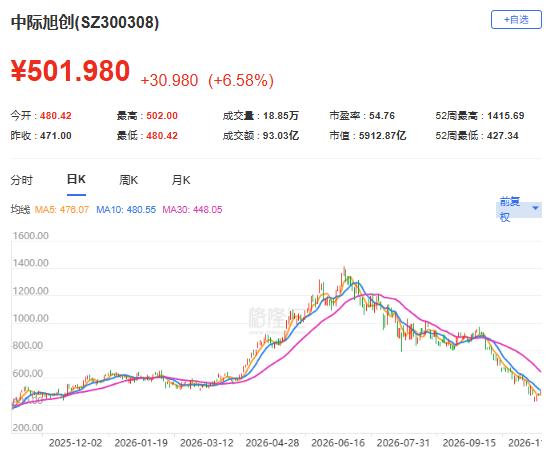
(Trend of Innolight; Gelonghui)
Leading stocks took the lead to rally on the market, with Innolight surging 6.09% during intraday trading, Eoptolink's increase reaching 7.14%, and Source Photonics and T&S Communications both soaring by more than 9%. Meanwhile, Cambridge Tech was strongly sealed at the daily limit supported by buying orders, while Link Instruments and TFC Communications also recorded notable increases of 7.22% and 5.36% respectively.
If we extend the observation window to three trading days, Innolight has posted a cumulative increase of 11.58% since it started rallying after market close on November 6. This solid phased rebound has directly created a clear weekly profit space for the whole sector.
However, if we further expand the timeline to the past 20 trading days, the underlying nature of this round of market rally becomes clear. Innolight still saw a deep pullback of 27.89% in the past 20 trading days, and its decline since the beginning of the year remains at the level of 17.79%.
The sharp turn of market sentiment stems from a sudden inflation chill that hit overseas macro markets the night before. The US Bureau of Labor Statistics announced that the CPI rose 0.4% month-on-month in October, which was not only higher than the general market expectation of 0.3%, but the core CPI also recorded an unexpected 0.3% month-on-month increase.
More severely, the core inflation indicator has remained stubbornly at 0.3% for the third consecutive month. Due to the lack of some official base data caused by the previous federal government shutdown, the official made an exception and did not release the year-on-year data this time, but this did not ease the market's austerity anxiety.
The stubborn inflation stickiness instantly ignited the Fed's interest rate hike expectations, and the previously moderate dovish trend was strongly corrected. Fed Governor Waller publicly stated in London that even if inflation cools down temporarily in October, the Fed should not hesitate to support another interest rate hike in December.
Waller further warned that if the month-on-month core inflation continues to stay at 0.3% or even higher, the FOMC should even seriously consider a one-off aggressive 50 basis point interest rate hike.
The core reason he gave points directly to central bank credibility, arguing that an excessively slow pace of interest rate hikes would put macro credit at an unbearable risk exposure.
With the hawkish officials' remarks setting the tone, the data of the CME FedWatch Tool fluctuated sharply. The market's pricing probability of a 25 basis point interest rate hike in December instantly soared to a high range of 84.2% to 88.2%, and the probability of a direct 50 basis point interest rate hike also rose from zero to 11.8% instantly.
The steep rise in interest rate expectations directly triggered an indiscriminate selling wave in the US Treasury market. Among them, the 2-year US Treasury yield, which is the vane of short-term policy interest rates, skyrocketed 18.46 basis points in a single day, climbing directly to the dangerous edge of 4.742%.
The 10-year US Treasury yield, the anchor of global broad asset pricing, was not spared either, rising significantly by 11.17 basis points in a single day and finally closing at 4.996%. During the intraday trading session, the yield even once violently touched the psychological threshold of 5.025%.
The long-dated 30-year US Treasury yield also rose by 7.74 basis points simultaneously, standing firmly at a high level of 5.357%. The extreme panic of liquidity tightening quickly spread to the equity market, and the three major US stock indices closed lower under collective pressure, with the Dow Jones Index, S&P 500 and Nasdaq Index falling by 0.30%, 0.38% and 0.74% respectively.
Just as the haze of macro liquidity was suffocating the entire tech stock camp, the after-hours financial report from the other side of the ocean completed a thrilling expectation reversal.
CoreWeave, the leading computing power infrastructure giant, officially delivered a Q3 financial report that far exceeded market expectations.
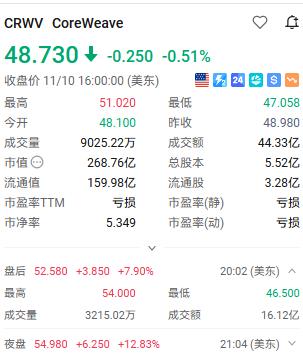
The financial data shows that CoreWeave achieved operating revenue of 3.661 billion US dollars in a single quarter, a sharp year-on-year surge of 168%, significantly higher than the market consensus expectation of 3.56 billion US dollars. In terms of profitability indicators, the loss per share narrowed to 1.27 US dollars, which also performed better than the market expected loss of 146 million US dollars.
What is even more exciting for bullish capital is the substantial improvement in profitability, with adjusted operating profit reaching 379 million US dollars, and the corresponding operating profit margin exactly hitting the 10% threshold. This profit realization node is a full quarter ahead of the official guidance previously set by the company.
Although the operating performance on paper is bright, the capital market's previous short logic for this unicorn has always been locked on its high debt cost. In the third quarter, the company's net interest expense in a single quarter reached as high as 846 million US dollars, nearly doubling year-on-year, even exceeding the adjusted operating profit of the current period.
The huge interest burden, coupled with the astonishing bond yield that once soared to 15.2%, is the fundamental root cause of CoreWeave's stock price being cut in half and the cumulative decline exceeding 40% in the past month. Facing the intensive siege of short sellers, the company's CEO Michael Intrator launched a powerful set of response combination punches at the subsequent earnings call.
The first card he threw out was the certain recovery of cash flow, clearly announcing that the company will centrally receive about 9 billion US dollars of customer advance payments and deposits in the next three months. At present, as high as 70% of its annual transactions have completed the transfer of advance payments, and the weighted average debt cost has also dropped significantly by 250 basis points year-on-year to 7.9%.
The second card is to resolutely cut off the usury-style financing chain. The management publicly promised that it will never step into the unsecured debt market at the current abnormally high yield level. Through the capital operation of flexibly delaying the drawdown of term loans, the company successfully completed the replacement and repayment of more than 4 billion US dollars of high-cost debt.
The third card points directly to the strongest endorsement of underlying demand. By the end of September, the scale of the company's contracted but unconfirmed backlog of orders has expanded unprecedentedly to 1325 billion US dollars. At the end of June this year, this figure was still at the volume of 1040 billion US dollars.
This explosive order backlog reflects the terrifying terminal absorption capacity, and the computing power rigid demand released by customers has exceeded more than ten times of all available production capacity in 2027. This means that the company's 2027 computing power architecture is basically sold out, and even the new generation of infrastructure planned to be launched in 2028 has been pre-booked by downstream giants.
The fourth card is the prudent consideration of capital expenditure. As high as 75% of the committed capital expenditure has been tied to real money from investment-grade large customers and enterprise-level long-term contracts. Based on this, the management further raised the full-year revenue guidance to 130 billion to 133 billion US dollars, and at the same time revised the lower limit of capital expenditure upward by 20 billion to the range of 370 billion to 390 billion US dollars.
This confident financial report and earnings call communication directly shattered the market's bearish psychological defense line, CoreWeave's stock price once surged by about 8% strongly in the subsequent after-hours trading. This strong spillover of sentiment constitutes a direct and strong fundamental support for the upstream optical module sector.
For a long time, the deepest hidden worry in the global capital market is that the huge capital expenditure of the AI industry may be cut off instantly by the high debt cost. Now CoreWeave has proved with real advance payments, huge long-term contracts and fully sold out forward production capacity that the cash flow closed loop of computing power infrastructure is still operating at high speed.
Since the capital expenditure chain downstream of AI has not broken, the massive orders and shipment rhythm in the hands of upstream optical module manufacturers will naturally not encounter a sudden emergency brake. The underlying logic of the sector's fundamentals has obtained the most solid practical closed-loop verification at this moment.
Positive signals of marginal easing have also come from external regulatory disturbances. According to an exclusive report by Reuters citing three people familiar with the matter, Microsoft is launching high-intensity intensive pressure on the Trump administration. Microsoft's core demand is to ask the White House to completely abandon the previously proposed extreme plan to ban the import of optical transceivers from China.
The core reason Microsoft gave for its opposition is straightforward: such rigid trade protection bans will further slow down the overall construction cycle of data centers across the United States. At present, Microsoft has 35 data centers under accelerated construction in the United States, and as many as 134 new projects are in the planning and implementation stage.
This real interest game from North American super large factories has greatly hedged the potential tail risk of the optical module supply chain at the geopolitical level. The policy side's scruples about harming innocent bystanders have won a precious strategic buffer period for China's leading export-oriented enterprises.
The pace of domestic technological evolution has not slowed down either. China's scientific research and industrial circles recently successfully completed the world's first thousand-kilometer-level two-way real-time transmission verification of hollow-core optical fibers. The project realized synchronous transmission of ultra-large bandwidth signals of 64Tb per second in both directions on a complex line as long as 1007.48 km, and the one-way delay was firmly suppressed at 3.43 milliseconds.
This subversive breakthrough in cutting-edge communication technology directly sparked a bullish ripple on the A-share market, and related concept targets such as Huamai Technology were immediately sealed at the daily limit. The continuous expansion of technical boundaries has continuously broadened the imagination space of mainstream capital for the optical communication track.
The capacity expansion on the supply side is also advancing at full speed. Cambridge Tech, the core domestic high-speed optical module target, publicly stated that it plans to expand the annual production capacity of high-speed optical modules by at least 10 million units again by the end of 2027. This large-scale capital expenditure and capacity expansion action directly reflects that the industry prosperity is by no means a short-lived flash in the pan.
The valuation coordinate system provides a rare safety cushion for the current market game. After the irrational deep sell-off that lasted for several weeks in the early stage, the valuation moisture of industry leaders has been greatly squeezed out. The current rolling price-earnings ratio of Innolight has fallen back to 22.72 times, and Eoptolink has even dropped to an absolute low of 18.84 times.
If we expand our vision to the entire optical communication sector, the overall rolling price-earnings ratio remains at 38.08 times, while the average rolling price-earnings ratio of the CPO co-packaged optical module sector is 29.34 times. Considering that these targets have double-digit deep declines in the past 20 trading days, the market price has obviously completed risk clearance prior to fundamentals.
The realistic pressure that must be faced still exists. The objective fact that US Treasury yields are approaching 5% during intraday trading does constitute a hard constraint on the upper valuation limit of high-elasticity growth stocks. The tightening of macro liquidity is a Damocles sword hanging over all high-valuation assets, and any blind optimism that tries to ignore the cost of interest rates is extremely dangerous.
However, the macro interest rate that suppresses the valuation multiple and the industrial trend that determines the central level of enterprise stock prices can never be confused in essence. The previous tragic plunge of the optical communication sector is essentially an extreme pricing of the pessimistic expectation that AI capital expenditure may be interrupted by debt and supervision.
With CoreWeave putting real advance payments, fully sold out forward production capacity and the fact of falling debt costs on the table, the panic pessimistic expectation on the market instantly receded a large step backward. Macro interest rates cannot erase the real profits pouring in on the corporate books.
The core confidence of current optical communication assets comes from the valuation cost performance of just over 20 times, which corresponds to the deterministic performance growth next year. At the moment when the delivery rhythm of computing power hardware has not slackened at all, the continuous landing of core orders is the only anchor that anchors the real direction of stock prices.
As institutional capital begins to flow back to build positions after the deep plunge, the current position of tech stocks has ushered in an excellent risk-return ratio window. Macro interest rates may disturb the upper elasticity limit of valuation in stages, but as long as the global large-scale computing power infrastructure machine does not shut down one day, orders and performance will use the most solid cash flow to reward real long-term patience.
This article is from WeChat Official Account "Gelonghui APP" (ID: hkguruclub), author: Gejira, 36Kr is authorized to publish this article.