Yao Shunyu pointed out the "grand strategy" of Tencent AI4S
As AI enters scientific research, it is evolving from task-specific models to general intelligences that can solve problems and create tools.
On November 7, 2026, Shunyu Yao, Chief AI Scientist of Tencent, shared his judgment on three paradigm shifts of AI for Science and the latest practices of the Hunyuan team at the Science Summit of the 2026 Future Science Prize Week.
Shunyu Yao graduated from the "Yao Class" of Tsinghua University and Princeton University. He has proposed methods such as ReAct and Tree of Thoughts, and also participated in the R&D of OpenAI agent products.
Before sorting out the content, two simple notes are explained first.
1. This article is organized by TideSurge AI based on Shunyu Yao's on-site speech, retains the first-person perspective, and has undergone necessary sentence smoothing and streamlining.
2. Proper nouns and numbers are corrected according to the on-site slides and public materials, and supplementary information is marked with "Background Supplement".
The following is the main text of the transcript of Shunyu Yao's speech ——
AI for Science is Undergoing Three Paradigm Shifts
It's a great pleasure to be here to talk with you about AI for Science.
We have just released the Hy4 model and the Hyra 2.0 tool framework. For most of the content mentioned today, if you want to learn more details, you can check the research page of Hunyuan.
In general, we are experiencing three very rapid paradigm shifts. They are not a simple substitution relationship, but progressive and develop in parallel.
The first stage, is that we build dedicated models for specific scientific problems.
The second stage, thanks to the development of large language models, we have general agents that can solve problems.
Up to this year, with the continuous development of large language models, we have entered the third stage: agents can not only solve problems, but also create tools. It not only solves current problems, but also prepares for future problems.
From the perspective of the first stage, when it comes to AI for Science, the most classic example is AlphaFold. It represents the first paradigm: human researchers face a specific problem, design a neural network for this problem, and then put a large amount of human-induced prior knowledge into the model architecture, such as distance deviation or sequence evolution deviation.
The first to third generations of AlphaFold roughly appeared from 2018 to 2024. This is a very important route for AI for Science: researchers train a neural network and use it to complete specific scientific tasks.
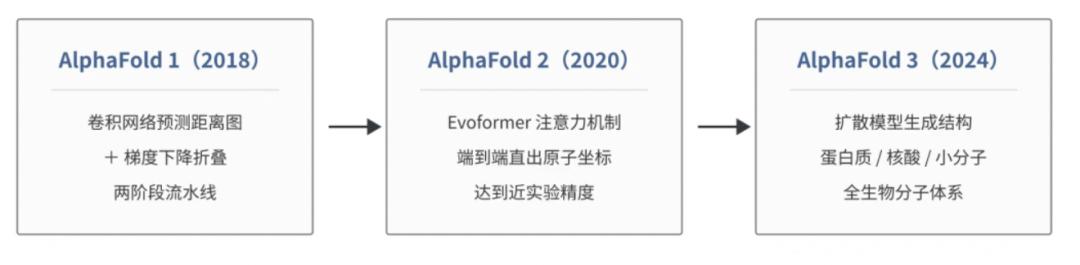
The technical main line of the three generations of AlphaFold (sorted out by blogger @Hooch Hu)
But at the same time, another revolution is taking place, that is large language models.
Large Models Achieve Unification First, Then Release Capabilities Through Scaling
From about 2017 to 2022, large language models completed a series of unification and simplification.
The first step is to unify data.
With the help of Transformer and self-attention mechanism, we can represent any type of data as a string of tokens. Whether it is sentences, images, videos or audios, they can all be turned into a list of tokens.
The second step is to unify the architecture.
Since different data can be represented as token lists, we can use the same architecture to process them, the key is to enable self-attention calculation between different tokens.
With the highly unified model architecture of Transformer, the next step is to unify tasks.
The input and output of tasks originally have many forms, but we can define it in a more general way: predict the next token.
Thus, when any input comes in, many tasks can be converted into the same problem — which token should appear next.
Later, ReAct added tool calls to this process. The model generates tokens not only for thinking, but also for taking actions. Faced with a problem, it can reason by generating tokens, and it can also call search, code, terminal or other external tools, and continue to act according to the results returned by the tools.
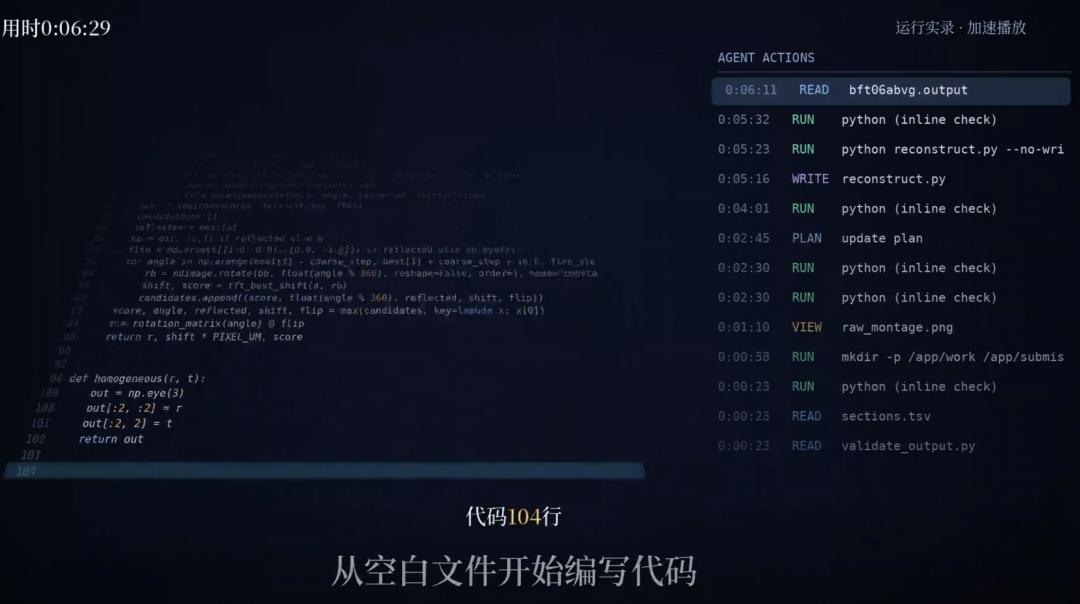
If you have a Transformer that can process multiple types of data, and it can also generate tokens to think and act, then it is not just a language system, but begins to resemble a general agent that can receive information, reason and take actions.
Another very important feature of large language models is scaling.
For AI practitioners, this may be intuitive, but I still think it is one of the most important concepts in AI.
With more computing power, more data and more parameters invested, the loss of the model predicting the next token will continue to decline.
However, the smooth improvement of model capabilities does not mean that the practicality of tasks will also improve smoothly. Task performance often changes suddenly at a certain point: it has been close to zero before, and after crossing a certain threshold, it suddenly becomes very good.
This situation appears repeatedly in many fields, such as mathematics, programming, multimodal understanding, including AI for Science.
General Agents Have Begun to Solve Real Scientific Problems
Once we have a large language model that can think and act like a human, we call it an agent. It can call tools and solve problems independently.
One example is that we use Hy4 to do inverse protein folding.
Protein folding takes a sequence of amino acids as input and outputs the corresponding three-dimensional spatial structure; inverse folding reverses the problem: given the geometric structure of the target skeleton, design an amino acid sequence that matches as much as possible.
The approach of the language model is very similar to the way humans think.
It first uses existing biological knowledge and priors to propose candidate sequences; then calls tools such as structure prediction to check the matching degree between the structure and the target; finally, continuously optimizes the solution according to the results.
At the beginning, the performance of the model was not good, but after multiple rounds of iteration, by the 17th submission, the results had been significantly improved. What is important here is not what is generated at one time, but that it can continuously propose solutions, call tools, read feedback, and then continue to make corrections.
Another example is that we use the model to analyze about 7 million cells and reconstruct the three-dimensional structure of a mouse embryo.
In short, the input is 84 unordered two-dimensional slices, and the goal is to reconstruct the corresponding three-dimensional embryo.
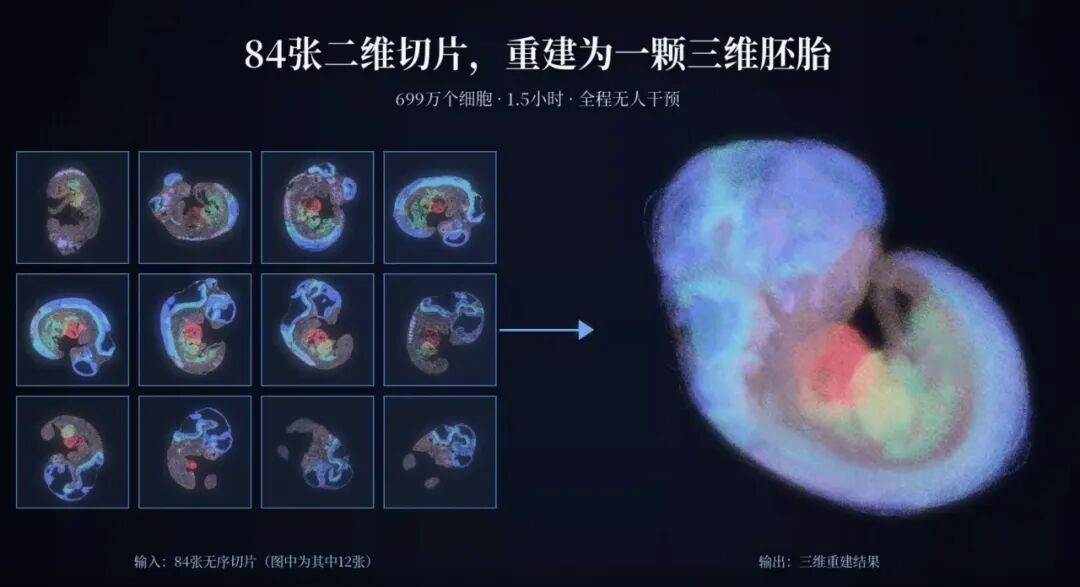
The difficulty is not only the large amount of data, some of which may also have errors or be damaged. The model needs to use tools such as programming and terminals, also find out where the error is, and then fix it.
In the end, it used one machine to complete the entire reconstruction process in about 90 minutes. For biologists, this can save a lot of time.
Similar progress has also emerged in the field of mathematics.
Agents have begun to deal with open problems in geometry, group theory, theoretical computer science and additive combinatorics. One of our own examples is the sum set and difference set problem: the agent repeatedly proposes, checks and revises ideas, finally obtains the optimal exponent, and participates in organizing the paper.
The standards and importance of these achievements may vary, but the working forms are similar: general agents no longer only answer a local problem, but push the research process forward with the help of tools.
In fact, it can now provide assistance in many links of scientific research. It can explore problems, design research schemes, write code, conduct experiments, analyze results, as well as review results, iterate and optimize, write papers and assist in submission.
In order to have a more comprehensive understanding of the performance of language model agents on scientific problems, we designed a benchmark called TenureTrail, covering 7 research fields and 123 executable research tasks, involving links such as problem exploration, research design, experiment and data analysis, review and iteration. The inverse protein folding mentioned earlier is one of the tasks.
From the evaluation results, Hy4 is the best-performing open-source model among them, but there is still a gap between the open-source model and the leading closed-source model.
Scientific Research Capabilities Are Rising Like Water Levels, and the Real Change Is That the Complete Workflow Is Unlocked
I think this is a somewhat counter-intuitive way of progress.
In the past, doing a vertical field was very much like building a house. You must focus on this problem, starting from the foundation, building up layer by layer.
The change brought by general agents is more like the sea level rising. The water level has been rising steadily, but it is not until it floods over your nose that you will truly feel that the change has taken place.
Programming is an example.
In the past five to ten years, the capabilities of the model have actually been steadily improving. It was not until it approached the level of human engineers that people suddenly felt that drastic changes had taken place. But the underlying capabilities did not start to improve that day, they have been improving all the time.
Another feature is that capabilities in different fields can be superimposed.
Maybe today it unlocks data analysis, and another day it unlocks coding. With capabilities such as literature retrieval, writing, data analysis, and programming being unlocked one by one, agents can connect these parts to form a larger task scope and a more autonomous workflow.
Many gradual improvements in capabilities eventually unlock not an isolated function, but a complete set of complete workflows.
The Next Step Is Not Just to Hand Over the Answers, But to Leave Reusable Tools
The third paradigm can be regarded as a continuation of the second paradigm.
We have seen that general agents can solve problems like humans. Taking one step further, it is to let it build software, tools and models to prepare for solving more problems in the future.
Here are several key changes.
Previously, we faced specific problems, such as the structure of a certain protein. Now, with general agents and dedicated task frameworks, problems can be more open, and methods can be adapted to different fields.
Especially for computer-related tasks, models are often easier to do well, because the results are easier to verify and more objective. Whether the code you write can run and whether the model can meet the indicators can all be checked.
This framework is called Hyra 2.0. It is a set of Harness that supports research tasks lasting from several days to several weeks, that is, the agent operation framework.
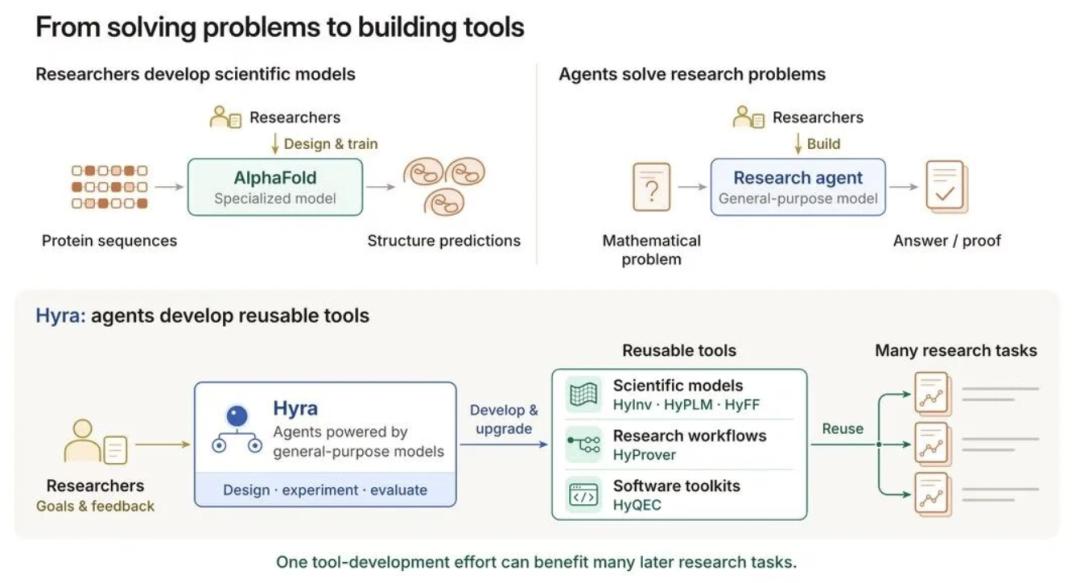
You can imagine it as a scientific laboratory.
The Overall layer is responsible for overall planning, the Mission layer decomposes and advances tasks, and the Worker layer executes specific research. Multiple agents collaborate with each other, share work progress, discuss progress, develop tools, organize original evidence, and even review each other's results.
Researchers not only get a final answer, but also can see the task process, evidence and outputs.
In this way, it is more and more like an autonomous research system that can work continuously.
The Next Step Is Not Just to Hand Over the Answers, But to Leave Reusable Tools
A very interesting result is that Hyra 2.0 can build models by itself.
It trained a new model called HyInv from scratch. This is a graph neural network with 1.96 million parameters, used for inverse protein folding.
This example is different from the previous one where Hy4 was used to solve an inverse folding problem. The previous one is more like the agent calling tools to solve a specific task; here it is more like the creation process of AlphaFold, except that the model is no longer completely built by humans, but the model participates in building the model.
HyInv has reached a competitive level in quality indicators, and its inference speed is also faster.
Under the test conditions demonstrated on site, it takes about 50.6 milliseconds to generate 128 sequences, which is about 57 times the speed of the public ProteinMPNN implementation. (Background Supplement: This number compares specific inference implementations and test conditions, and does not mean that the entire protein design process is 57 times faster.)
The model is also very good at doing acceleration, because the speed is easy to verify.
Progress is not only taking place in protein design. We also used Hyra and Hy4 to build the protein language model HyPLM-Flash, and there are also related models in directions such as molecular simulation.
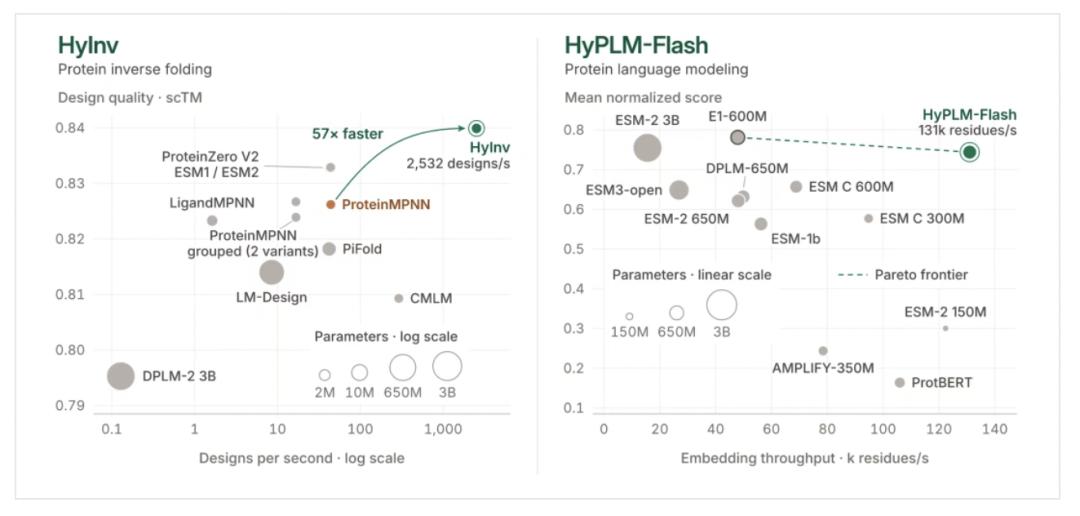
It even extends to the field of mathematics.
With the help of HyProver and working with collaborators from Peking University, we have recently achieved results on two mathematical problems: one is the five-dimensional case of Petty's equidistant point conjecture, which proves that every five-dimensional real normed space contains six pairwise equidistant points; the other is a seven-dimensional counterexample to Yau's circle action conjecture.
The boundaries need to be made clear here.
The Petty conjecture is advanced in the five-dimensional case; the Yau circle action conjecture obtains a specific counterexample, and the simply connected version is still open.
Beyond biology, chemistry and mathematics, we also use Hyra and Hy4 to deal with circuit design, quantum error correction and engineering problems. This method is very general and can be used in many different scientific and engineering fields.
In order to evaluate how good large models are at building foundational models, we also launched FMBench to examine the ability of models to design foundational models from aspects such as training data, model architecture and training strategies, with tasks covering machine learning and life sciences.
Here are three observations.
First, building models is an area where AI has comparative advantages over humans, because it involves a lot of tedious engineering work. You need to write code, run experiments, and compare results, all of which are very suitable for AI to do.
Second, there is still a large gap between open-source models and closed-source models.
Third, the improvement speed in this direction is very fast. The Hy4 Preview released two months ago was still at the bottom of the list, and the score of our new model in the same evaluation has roughly doubled.