In 2026, where did all the funds for AI applications flow to?
In 2026, the largest sums of capital in the AI financing market still flow to underlying capabilities including large models and computing power. However, an increasing number of frequent financing stories are taking place at the application layer.
According to statistics from Zhidx, in the first half of 2026, among AI industry chain financing deals worth over 100 million yuan in China, the AI application segment saw the largest number of financing events, totaling 33. Of these, video, image and 3D generation accounted for nearly 40%, AI Agent for around 20%, and 100-million-yuan-level financing also emerged in sectors including enterprise applications, AI healthcare/pharmaceuticals, AI finance and AI marketing.
Megan is the initiator of the Origin Community GTM Public Welfare Community and also an experienced operator for domestic C-end applications going global. She told *Focus One* that from the practical experience of communicating with investment institutions, capital's attitude towards AI applications has undergone a round of changes this year. The overall sentiment was positive in the first half of the year, but by the turn of late summer and early autumn, some institutions turned cautious, for two reasons: first, tracks such as embodied intelligence diverted their attention; second, some AI applications failed to achieve satisfactory daily active users, public influence and commercialization after massive capital injection, and exit paths also began to draw more discussions. After entering October, market attention picked up to some extent, but investors now value projects that can create differentiation, such as independent R&D model capabilities, technical barriers or software-hardware integration.
As investors become more cautious, capital flow is unevenly distributed across different sectors. AI creation company Yanyu Technology completed a nearly 300 million USD Series B+ financing in June, with a post-money valuation of over 2 billion USD; while in industries including healthcare, education, marketing and security, most companies only obtained financing ranging from tens of millions of yuan to several hundred million yuan. At the same time, large tech giants including ByteDance, Alibaba, Tencent and Kuaishou are present in almost every popular application track.
Why is capital concentrated in only a few tracks? Are opportunities inherently fewer in industries with limited financing? With the squeeze from large tech giants, what can startups rely on to survive?
01. Video, Image and 3D Are the First Segments to Secure "Huge Capital"
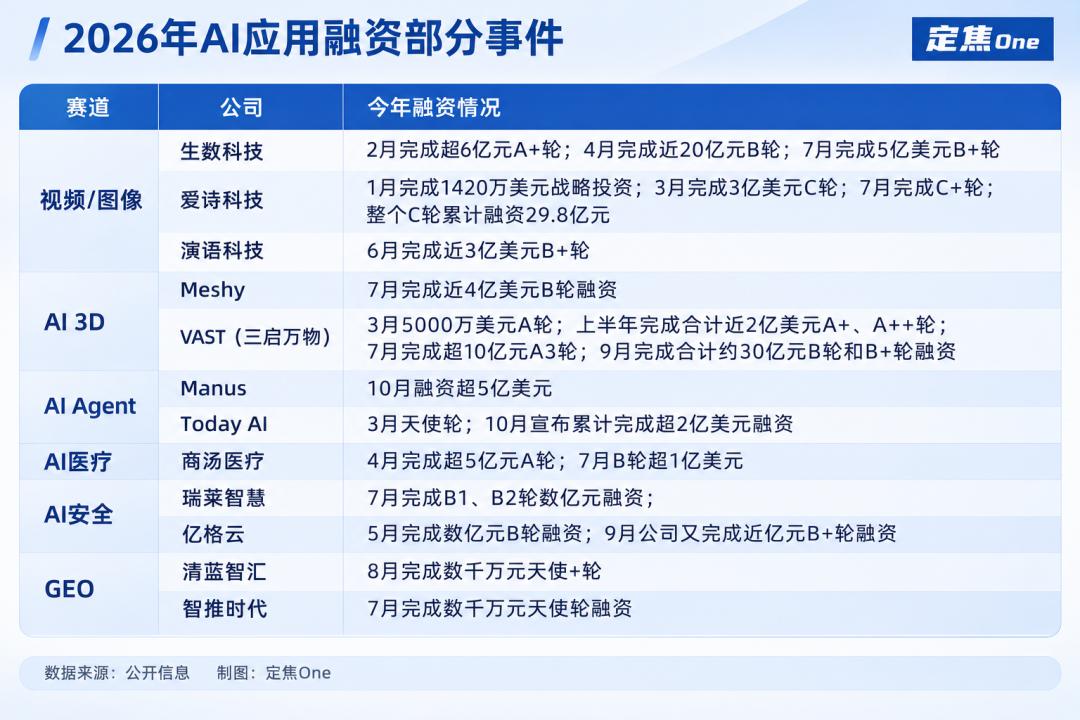
When putting all the large financing deals of AI application companies this year together, the capital flow pattern will become more intuitive.
Statistics from IT Juzi show that in the first half of this year, the AIGC application track represented by image and video generation saw 84 financing events in total, with a total amount of 59.605 billion yuan and an average single deal of 710 million yuan, the highest among all AI sub-sectors. Among them, four AIGC application companies including Shengshu Technology, Sand.ai, LiblibAI/Yanyu Technology and Aishi Technology raised a combined total of 9.378 billion yuan.
Since the start of this year, large-scale financing has continuously concentrated on companies related to visual creation.
After AI video company Aishi Technology completed a 300 million USD Series C financing in March, the total size of its Series C round reached 2.98 billion yuan in July; in June, Yanyu Technology, the parent company of LiblibAI, completed a nearly 300 million USD Series B+ financing with a post-money valuation of over 2 billion USD; in July, Shengshu Technology completed a 500 million USD Series B+ financing; AI 3D company VAST announced in September that it completed Series B and Series B+ financing with a combined amount of about 3 billion yuan, and its total accumulated financing in less than half a year reached about 5 billion yuan; Meshy completed a nearly 400 million USD Series B financing in July.
Why are video and 3D the first segments to secure huge capital?
Ding Bairan, an investor from Dewu Capital, told *Focus One* that capital first prioritizes the overall market ceiling. Among ToC applications, video remains one of the media forms with the richest content carrying capacity and the widest demand at present, while 3D is likely to become the new content carrier in the next stage. For capital that needs to bet on "big opportunities", such tracks are more capable of accommodating large companies and are more worthy of continuous investment.
A sufficiently large market is only a prerequisite. Bryan Liu, Investment Director of Alumni Ventures, told *Focus One* that visual generation has another feature that is easily favored by capital: its product feedback cycle is shorter.
"After generating a video, an image or a 3D asset, whether the content is usable and whether users are willing to use and pay for it can often be verified in a relatively short period of time." This feature makes visual generation easier to demonstrate the advantages of this generation of products over the previous generation, compared with some industry applications that require long-term effect verification.
A number of visual generation companies have already delivered quantifiable commercialization indicators in advance.
PixVerse, under Aishi Technology, launched commercialization in November 2024. Its disclosed ARR exceeded 40 million USD by October 2025, with more than 100 million users. Its revenue mainly comes from subscription services, dominated by overseas markets; Yanyu Technology disclosed that as of May 2026, the company's overall ARR reached 300 million USD. Capital has begun to use indicators that are closer to those of traditional internet companies, such as user scale, subscription revenue and API calls, to measure the performance of an AI application enterprise.
However, fast commercialization is not the full reason. Visual generation is also one of the AI application segments with heavy capital investment. The financing use of Aishi Technology includes video generation foundational models, real-time world models and global product growth; VAST not only operates Tripo, but also continuously invests in R&D of 3D foundational models, data and world models, all of which require continuous capital consumption.
Aishi Technology previously disclosed that if the investment in self-developed large models is not counted, its product business has basically achieved self-sufficiency. That is to say, there is still a layer of continuous model investment between the revenue generated by products and the overall capital demand of the company.
Another type of company proves that high valuation can also be obtained without self-developed underlying models. For example, Yanyu Technology does not build products relying on self-developed general foundational models, but aggregates different models, and devotes more capabilities to creation tools, workflows and user ecosystems. The company expanded from the LiblibAI community to StarFlow, a design Agent, and LibTV, a video creation platform, and its ARR has reached 300 million USD as of May this year.
Therefore, behind the phenomenon that "video and 3D attract the most capital", two different logics are superimposed: one type of company needs heavy capital to continuously improve model capabilities; the other type can form users, revenue and ecosystem relying on the application itself.
Apart from visual generation, Agent is another segment where large-scale financing has begun to emerge. In October, personal Agent startup Today AI, whose product was launched not long ago, announced that its accumulated financing exceeded 200 million USD; another star Agent company Manus completed a new round of financing of over 500 million USD in the same month, with a target valuation of about 4 billion USD, making it one of the most high-profile large financing deals in the Agent track this year.
Different from visual generation, the capital invested in personal Agent mainly bets on the team and the entry point. The product of Today AI was only launched in September, and what capital values is the founding team's product experience from large tech companies, and the possibility of personal Agent becoming the next generation AI entry point.
02. Are Opportunities Fewer in Segments with Smaller Financing Scale?
In terms of financing scale, video, image and 3D are almost the most prominent tracks for AI applications this year. But if we look at financing frequency, more vertical industry applications are even more active.
Data from iiMedia Research shows that in the first half of 2026, although the total financing amount of AI industry applications (excluding AIGC and general AI applications) was only 25.792 billion yuan, 133 financing events took place, making it the category with the largest number of financing events among the major segments counted, with an average single deal of about 194 million yuan.
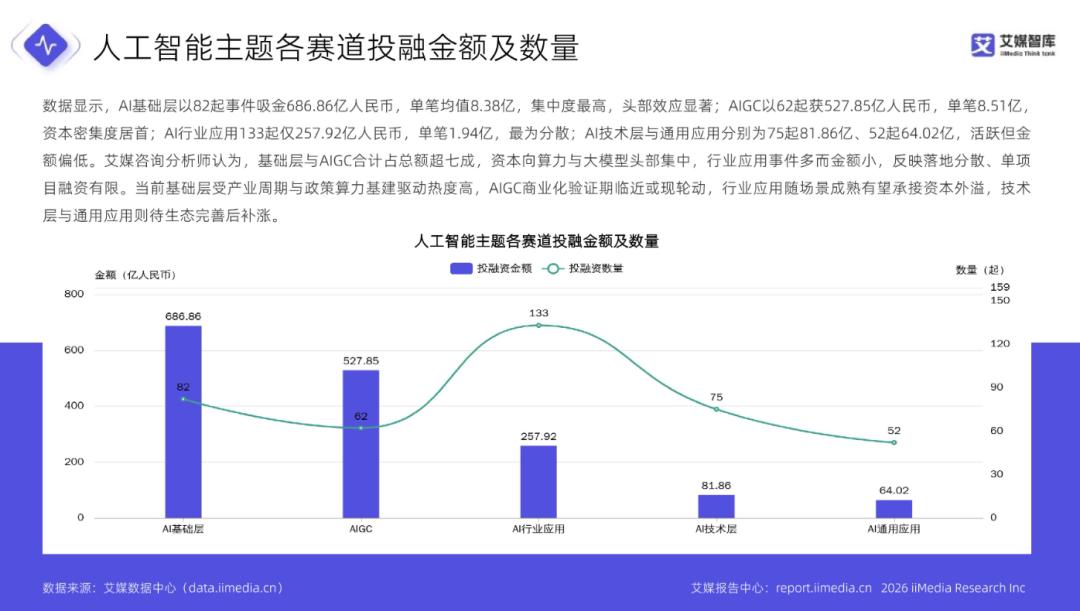
It can be seen that industry applications do not get capital less frequently, the capital is only more dispersed.
In Bryan Liu's view, these two types of tracks cannot be simply compared horizontally. Video, image and 3D are a form of technology and product, while healthcare, education, marketing and security are industries. What really widens the gap is that different businesses have different ways of verifying value.
The first type is businesses that require a longer period to prove "results". Healthcare and education are typical "long feedback" businesses.
Ding Bairan believes that healthcare and education are both constrained by data security, privacy, compliance or capitalization paths. For healthcare startups, the cycle to obtain industry data, complete product verification and enter real business processes is longer, while education companies face difficulties in realizing capitalization.
Bryan further explained that healthcare needs to prove clinical effects, education needs to verify learning outcomes, and some ToB scenarios need to further connect procurement, payment and responsible entities. "It's not that these industries have fewer opportunities, but that their verification paths are different, and some industries require more time."
SenseTime Healthcare is an example. This company spun off from SenseTime completed a Series A financing of over 500 million yuan in April this year, with a valuation exceeding 1 billion USD; it completed a Series B financing of over 100 million USD in July, with a post-money valuation of over 10 billion yuan. Its SenseCare platform has been disclosed to cooperate with more than 500 hospitals and obtained more than 30 medical device registration certificates. Compared with a C-end application that can be verified through user growth right after launch, medical AI obviously needs to accumulate far more than just model capabilities, but also hospital resources, clinical data and compliance systems.
The education sector is similar. Zhibei Technology, founded in 2023, completed a Pre-A round financing of several million US dollars in January this year; Aiweiwu, also founded in the same year, saw its AI teacher product "Aixue" achieve monthly revenue of tens of millions of yuan. As of November 2025, it has completed 4 rounds of financing with a total amount of about 150 million USD. Its product spent several months testing indicators such as class completion rate and refund rate before launch, and whether an AI education product can truly improve learning outcomes often requires a longer period of observation.
For such companies, capital needs to wait for the products to prove their effects.
The second type is businesses that can directly prove value through operating performance. Their financing scale may not be large, but they may deliver clear revenue and customer data earlier. GEO, which has heated up rapidly this year, is such an example.
Zhitui Times, which was only established in 2025, completed an angel round financing of tens of millions of yuan this year. As of the first half of this year, the company disclosed that its ARR has exceeded 100 million yuan; it currently serves more than 400 customers, and its full-year ARR in 2026 is expected to approach 200 million yuan. Similarly, Deep Yunhai, established in 2025, completed a 10-million-level angel round financing in October 2026, with an annual revenue of tens of millions of yuan.
Compared with training foundational video models, the capital demand of such companies is obviously not in the same order of magnitude. But smaller financing amounts do not prevent them from verifying demand with customers and revenue first.
The third type is businesses that need to wait for demand to mature, whose financing rhythm depends on market maturity. AI security is such a track.
An AI security practitioner told *Focus One* that it is not that there is no demand for security, but that many enterprises have not fully kept up their attention to AI risks with the speed of application deployment. Before sufficiently severe risk events occur, enterprises are unwilling to allocate special budgets for AI security.
However, as Agents start to access internal enterprise data, call tools and even perform tasks autonomously, this demand has begun to become explicit. After Yige Yun completed a Series B financing of several hundred million yuan in May this year, it extended its products from office security to the unified security governance of "human + AI"; it completed a nearly 100 million yuan Series B+ financing in September, and the capital will continue to be invested in the enterprise governance platform for humans and AI Agents.
Opportunities in some industries will only turn potential demand into explicit procurement after AI truly enters core business processes.
Therefore, the amount of financing does not equal the size of opportunities. Some tracks need to wait for their effects to be proven, some prove their value with revenue first, and some need to wait for demand to mature. To judge whether a track has opportunities, it is more meaningful to look at how and how long it takes to prove its value, rather than how much capital it has raised.
03. With Tech Giants Joining the Competition, Startups Still Need to Pass Three Barriers
The competition in AI applications is far more complex than it was a few years ago.
On the one hand, large model capabilities are still upgrading rapidly, and products that seem viable today may be covered by a single update of the foundational model tomorrow. On the other hand, Doubao and Yuanbao are competing for the general AI entry point, Alibaba, Tencent and ByteDance are all developing office products and Agents, and sectors including video generation, AI programming, education, marketing and even healthcare are also crowded with large tech companies.
In Megan's view, the advantages of large tech giants are not just more capital. Compared with startup teams, they have faster product development speed, more mature traffic placement channels and user growth mechanisms, and also hold a large number of existing users and data. Without such experience, new applications will lag far behind the giants even when they only learn user growth methods.
For startups, they need to prove what value they can retain even after large tech giants enter the market.
First, when large tech giants are both allies and rivals, whether startups can build their own independent value.
Now, the relationship between large tech giants and startups is becoming increasingly complex. In October, personal Agent startup Today AI announced that it has completed a total of over 200 million USD in financing, with both Tencent and Ant Group appearing in its list of investors, and large model company Stepfun also participated in its angel round. Its founder Qi Junyuan was previously the product vice president of ByteDance Feishu and the head of the Doubao PC side.

Source / pexels
But on the other side, Tencent is advancing its own Agent products, and Lingguang, under Ant Group, is also stepping up its personal task execution capabilities. For Today AI, industrial capital brings capital and resources, but it does not eliminate competition, and it still has to compete with products under its shareholders for the next generation personal AI entry point.
Such relationships are becoming increasingly common. Large tech giants invest in external companies while developing similar businesses on their own. Startups need to prove that even without the resources of their shareholders, they still have irreplaceable value that cannot be easily replicated.
Second, with the rapid iteration of model capabilities, the technical barriers of application companies are also being continuously impacted.
Bryan Liu believes that if a company's only advantage is calling a better general model, this capability is not exclusive. Model upgrades may even produce two opposite effects at the same time: on the one hand, it can help application companies reduce development and delivery costs; on the other hand, it may turn a previously paid function of a company directly into a basic capability accessible to all users.
Today AI also acknowledged