How come HUSTers who are not good at making empty promises have become such highly sought-after talents amid the AI boom?
In Silicon Valley's venture capital circle, there is a widely shared "mindset" for startups: "Fake it till you make it". Entrepreneurs first tell grand stories that easily reach tens of billions of dollars, attract capital to enter the market with expectations, and then use the raised funds to develop their products.
But in the landscape of China's tech entrepreneurship, facing fiercer commercial implementation and technological competition, entrepreneurs with different educational and cultural backgrounds have taken completely different paths. Among them, a group of entrepreneurs who graduated from Huazhong University of Science and Technology (hereinafter referred to as "HUST") are a very representative sample: they are used to "Make it, then talk", that is, develop the product first, then talk about it publicly.
This habit is closely related to the pragmatic and rigorous way of thinking formed in engineering training.
However, the rules of the business world are not one-sided. From the app boom in the mobile Internet era to the rapid AI iteration period led by large models, embodied intelligence and Agents, the "more action, less talk" style has two sides: on the one hand, it allows HUST entrepreneurs to more easily settle down and tap into real market demands and pain points; on the other hand, in early-stage financing where stories and narratives are more valued, it may also become an imperceptible shortcoming.
Standing at the intersection of the AI wave and global competition, we approach the "HUST faction" among AI entrepreneurs, trying to figure out what dilemmas this group of technology founders have encountered in the process of commercial trial and error and the choice of survival strategies, and what evolution they have achieved.
From Mobile Internet to AI: Why are the "HUST Faction" Always at the Forefront of the Wave?
China's tech startup market has experienced two major technological and market paradigm restructurings in the past 15 years.
The first restructuring took place during the mobile Internet boom from 2010 to 2017.
In that wave, a number of well-known projects founded by HUST alumni emerged, including WeChat, Love Memory, Meeu, and Snake Battle.
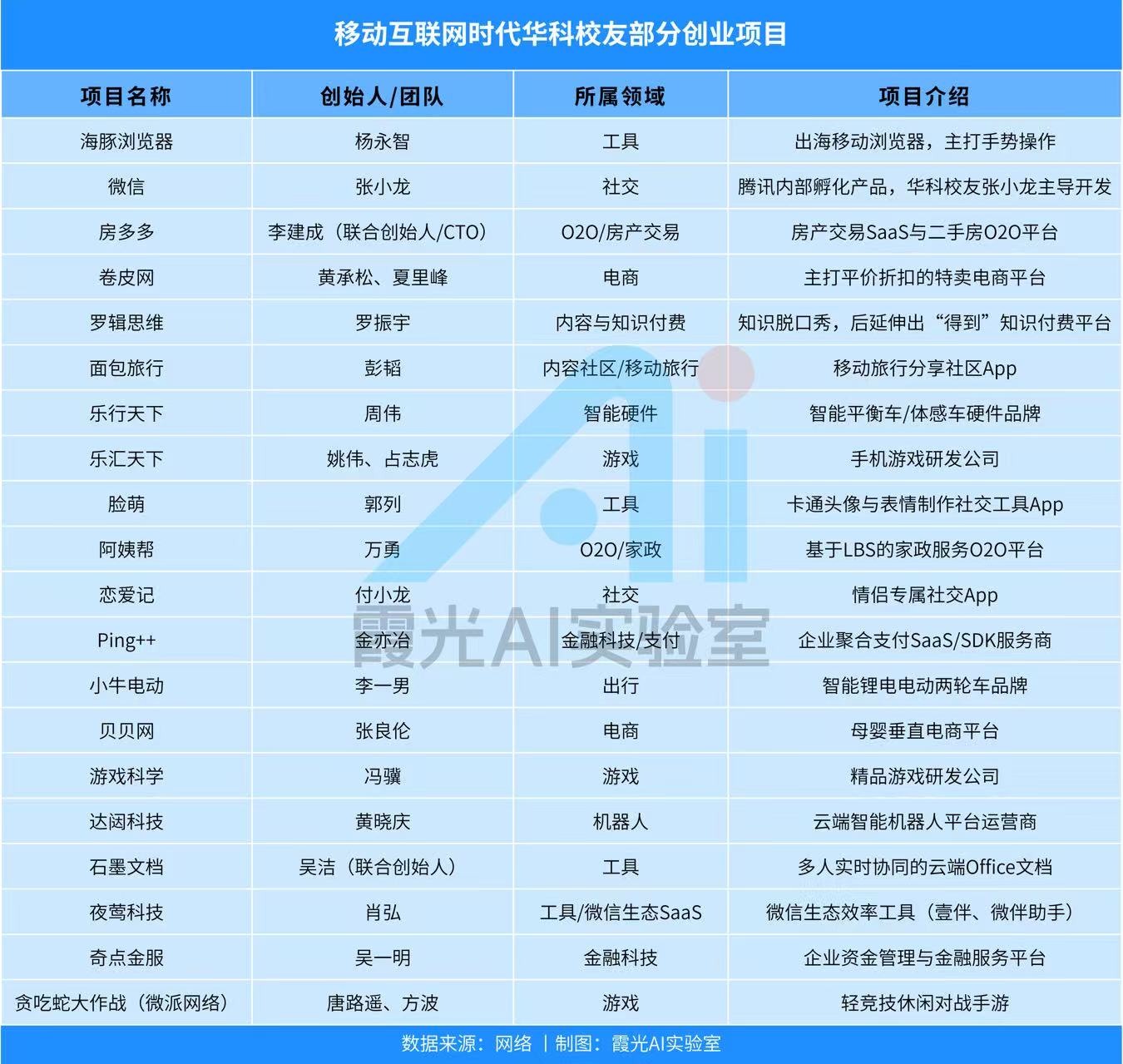
At that time, the core of market driving was the delivery efficiency of rapid technology implementation.
As the industry was in a severe supply gap, the public had hardly seen any user-friendly apps. Fu Xiaolong, founder of Love Memory, recalled that it was a golden era where grassroots apps achieved rapid growth relying on the hands-on ability of entrepreneurs, and the most important skill threshold was — being able to write code.
This exactly fits the traditional engineering skill set of HUST.
"From the principal, teachers to students at HUST, the underlying logic is technology-oriented, and everyone is used to using technology to solve pain points in specific scenarios," said Liu Pan, founder of SuperCat.
At the stage when business models and product designs were relatively rough, this solid technical capability greatly reduced the product implementation cost. It also allowed this group of HUST entrepreneurs who were used to solving problems with code to logically become one of the first groups to reap the dividends of mobile traffic.
In the current AI era, both technology and the market have ushered in deeper restructuring.
A large amount of basic coding work can now be completed by AI, and pure programming ability no longer constitutes a unique competitive barrier. The era when pure grassroots or campus teams made hit products only with an idea has come to an end.
However, after the advantage of coding is diluted, HUST entrepreneurs have not been absent from the new AI wave.
"Innovation and entrepreneurship is a signature feature of HUST," Liu Pan pointed out. HUST has always encouraged innovation, and everyone naturally maintains extremely high sensitivity and drive towards new technologies.
Another catalyst comes from the collisions in the alumni circle. Liu Pan recalled that at a previous alumni gathering, when everyone talked about AI, almost all of them felt that at this new node of the era, they could achieve great things.
This idea prompted them to quickly shift to new tracks:
For example, Narwal, CreateFuture Tech, Qianxun Intelligence, Neabot, and Lingxin Qiaoshou in the fields of embodied intelligence and physical industry, and Manus, Infinite Lightyear, SuperCat, Lessie AI and so on in the fields of AI applications and infrastructure.
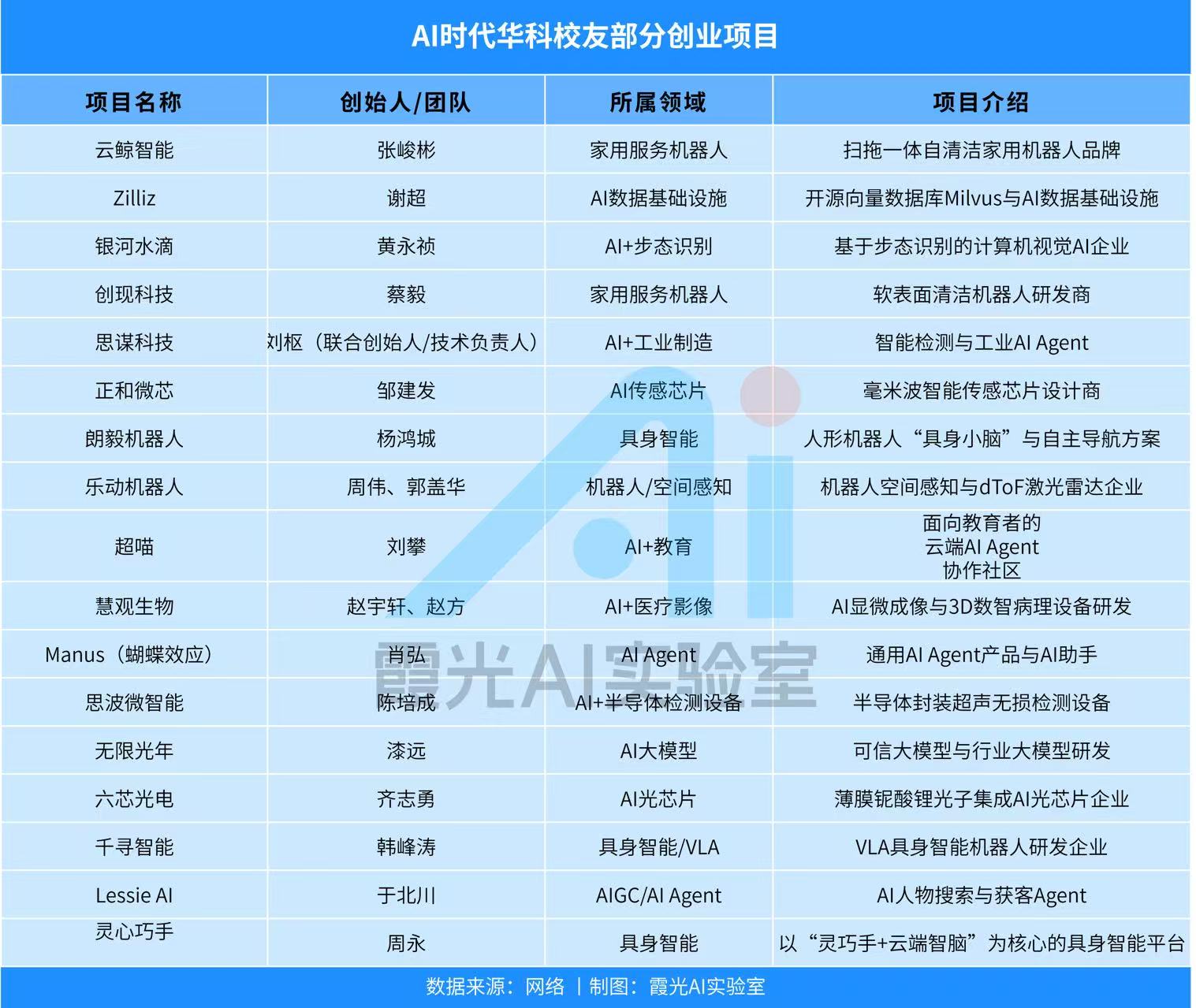
After entering the new track, reality pushed them to make another key decision — going global.
The domestic C-end market has low willingness to pay, and the cost of computing power is high, which easily leads to a consumption war. Directly targeting overseas high-paying markets has become an inevitable choice to close the business loop.
"The bigger the waves, the fatter the fish," Fu Xiaolong said frankly, you have to go to the places with more fish to catch fish.
Therefore, after his project Love Memory was acquired and exited, his second venture directly set the direction on exploring AI applications for the European and American markets;

Love Memory App
Cai Yi, founder of CreateFuture Tech, led his team to combine algorithms with automation, entered the track of automatic cleaning robots for soft surfaces such as bedding and sofas, and targeted high-paying regions including North America, Europe, Japan and South Korea;

CreateFuture Tech Intelligent Bedding Surface Cleaning Robot
Liu Pan targeted the underlying pain points of teachers' workflow in education scenarios, developing interactive visual Agents, and is currently preparing for going global. The reason is that subject knowledge is universally applicable around the world, and teachers in some overseas regions have mature subscription payment habits, which provides an excellent commercialization foundation for vertical Agents.
With the practical implementation of technology matching the mature overseas payment mechanism, these entrepreneurs are no longer limited to the local stock competition, but conform to the trend of technology and globalization, and once again stand at the forefront of the wave.
HUST Faction Entrepreneurs, Are Not Good at "Painting Grand Pies"
If you ask what common characteristics the HUST entrepreneurial group has, "pragmatism" is undoubtedly the word that appears most frequently.
Within their alumni circle, there is a natural resistance to flashy publicity.
"If you are from HUST, but you haven't made anything yet and publicize it very aggressively, we will despise you in our hearts," Liu Pan said straightforwardly, everyone appreciates real hard power.
When comparing the entrepreneurial genes of different universities, he observed that entrepreneurs from Tsinghua University are also very pragmatic, but their ambition and aspiration are obviously higher, and they tend to challenge top-level grand narratives such as chips, large models, and humanoid robots.
The pragmatism of HUST entrepreneurs, on the other hand, focuses on specific scenarios and specific pain points, and implements landing products at the application layer.
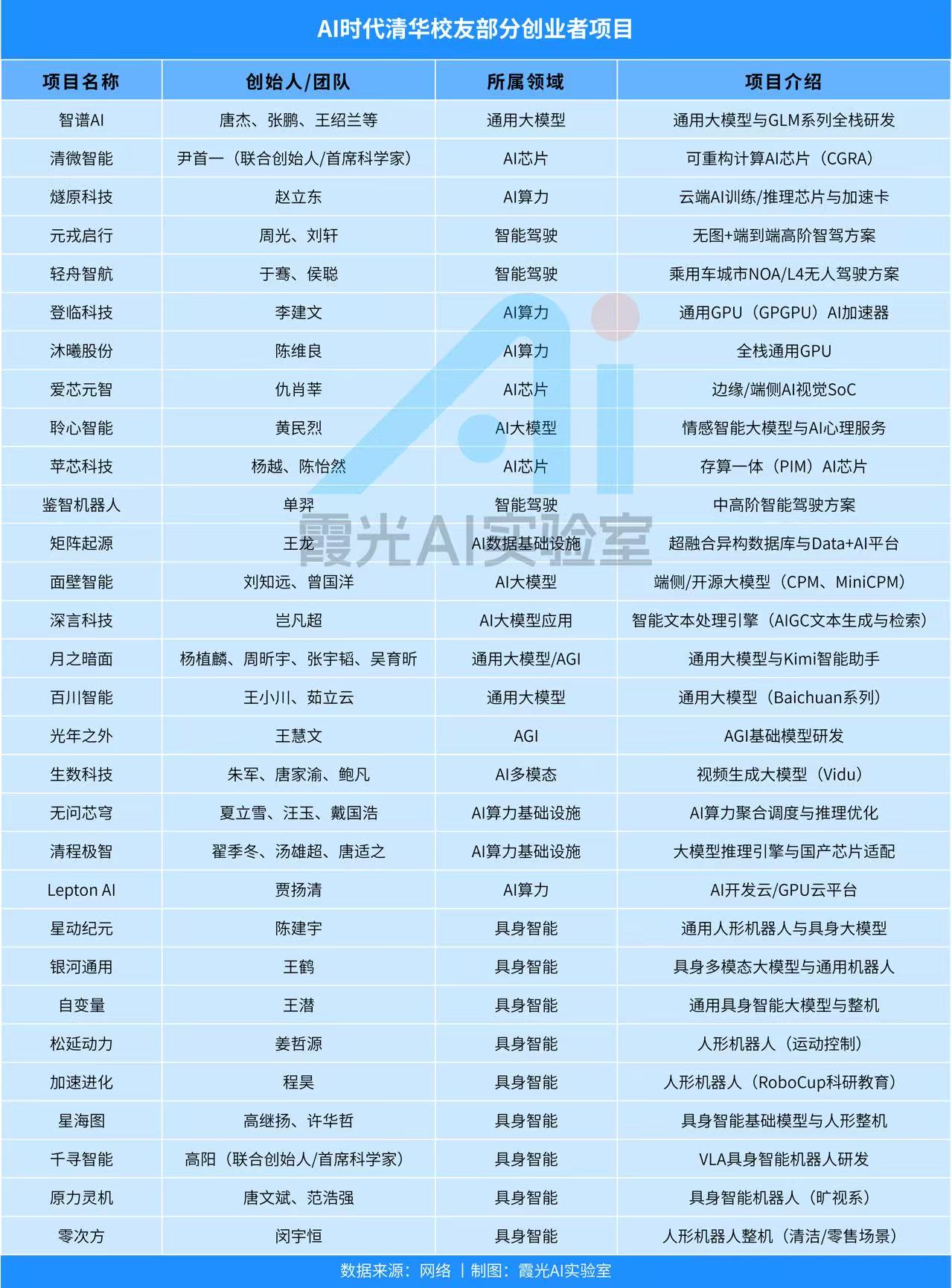
However, in the harsh business rules, this kind of "pragmatism" of HUST entrepreneurs is also a double-edged sword.
It guarantees the implementation capability of products in real scenarios, but it also forms a business constraint in the early investment stage which relies heavily on "expectations and stories".
Investors of early-stage projects attach great importance to high premium returns in the future. Some entrepreneurs haven't finished developing products, but they can tell grand business stories, and investors are often willing to pay for them.
But HUST entrepreneurs are more down-to-earth. In Cai Yi's words, "one is one, two is two". They choose very specific entry points, and dare not "paint grand pies" in advance.
But investors are pursuing high returns, Fu Xiaolong analyzed, "If you describe to him that this is a 100 billion US dollar business, he will be very interested; but if you describe to him that this is a 10 billion US dollar business, he may not be interested, and will think that this business is too small".
In addition to being relatively passive in financing, the technology-oriented thinking has also caused many entrepreneurs to pay a painful price in the real business world.
Many of them started their startups directly after graduating from school, without the transition of being employees, lacking social experience and business training, which led to countless pitfalls in supply chain, management, capital and risk control in the early stage.
Cai Yi recalled that when he was pursuing his postgraduate degree at HUST and starting his business in 2017, he was working on hotel unmanned delivery robots.
At that time, the team was completely immersed in technical implementation, and invested without cost control to ensure the realization of functions. The product had excellent performance after development, but when it was launched to the market, they found that the manufacturing cost was extremely high, and there was no commercial purchasing power at all.
Moreover, due to the lack of business awareness of prevention at that time, the team also suffered from commercial "beatings" such as external investors defrauding their technical achievements, and partner companies breaking contracts.
When Liu Pan was exploring the 1.0 version of SuperCat, he also experienced route misjudgment.
The team built hundreds of complex Agent workflows, thinking that the more functions the better, but when they really faced front-line teachers, the complex operation discouraged many users.
In order to correct the deviated route, they had to abandon the 1.0 architecture, invest a lot of R&D costs and nearly a year to completely reconstruct the 2.0 version.

SuperCat Redesigned 2.0 Version
In addition, in terms of capital chain management, young teams are also extremely prone to lose control.
Fu Xiaolong said that he received 10 million yuan in investment before he graduated from college. But due to lack of experience in capital consumption rhythm and team management, the money was burned out in just one year, and the team fell into a very difficult period for a long time.
The bloody experience of stepping into pitfalls forced these tech entrepreneurs to keep aligning themselves with business rules:
Cai Yi shifted from technical obsession to refined operation, and realized that "the existence of competitors means that the market demand is fully verified, and the rest is a long-distance business race";
Liu Pan gave up the idea of pursuing large projects, locked the new generation of products in bottom-up, high-frequency subscription vertical tools, and entered the huge group of teacher users with low prices;
Fu Xiaolong reshaped his strategic vision in his second venture, and realized that "choosing a sufficiently large track at the very beginning" is extremely critical. "The difficulty of building a company with an annual revenue of 100 million yuan and a company with an annual revenue of 10 billion yuan is almost the same," he said.
The pragmatism in thoughts and actions determines the product implementation, and the experience accumulated from these pitfalls completes the last link from technology to business.
"When the Company Was at Its Hardest Time, It Was the Senior Schoolmate Who Lent Us Money"
After continuous trial and error and paying tuition fees, this group of entrepreneurs from HUST began to arm themselves with more realistic business logic.
But when they really go to the market to compete with entrepreneurs of all backgrounds, what determines their underlying actions and risk resistance ability is still the consistent background they precipitated in the campus and alumni ecosystem.
This background is not reflected in the abstract campus spirit, but directly reflected in specific communication habits, problem-solving models and rescue resources.
First of all, it is equal communication that eliminates class divisions.
In the memory of many alumni, the campus life at HUST is very competitive, but at the same time it is diverse, open and active.
"There is no strong sense of class or identity in the school, and even now when alumni get together, there is no so-called social sophistication at all." Both Liu Pan and Fu Xiaolong have this feeling.
Respecting facts and science is far more important than respecting status and identity.
Teachers and students can discuss technical issues in a very equal attitude, even the principal is often active on the campus forum and interacts with students frequently. There are also teachers in innovation incubation organizations such as Qiming College, Dianshi Chuangxiao and Bingyan Workshop, who wholeheartedly support students' entrepreneurship without any selfish or utilitarian motives.
In this atmosphere, relevant associations and clubs have also developed rapidly, providing the earliest test field for the germination of entrepreneurship.
Secondly, it is the problem-solving thinking of controlling variables and finding core issues.
Entrepreneurship is a complex system full of variables such as marketing, financing, management and technical routes.
"The projects we did in school are very complex, and an important ability cultivated during that period is to control variables and find the most core problem in complex situations." Liu Pan said, this logic also applies to the subsequent entrepreneurial journey.
In addition, it is the practical support from the high-stickiness alumni network.
There is a natural trust bond between HUST alumni, which also constitutes practical resources for project cold start and risk resistance.
The investment that Cai Yi received in his first year of entrepreneurship came from a senior schoolmate from HUST; Liu Pan's current entrepreneurial partner and technical co-founder are both HUST alumni; when Fu Xiaolong's company was in difficult times, the key loans that helped him get through two crises also came from alumni.
"Everyone helps each other out," Liu Pan said, there is strong resonance and extremely high stickiness between alumni, and they are used to passing on experience and supporting each other, which has formed a unique circle culture.
The low communication cost and consensus culture brought by this alumni resource constitute extremely practical business support in the early entrepreneurial stage when there is a lack of certain social background.
Closing Remarks
Entrepreneurship is a cruel long-distance race that competes for survival ability.
For the entrepreneurs who graduated from HUST, they may still not be good at telling eye-catching grand concepts, and are not used to doing extensive public relations before product implementation.
But the execution of "make it first then talk", the rapid iteration after stepping into pitfalls, and the implementation capability in specific scenarios constitute their real survival cards.
Standing at the starting point of the new AI wave, these entrepreneurs have also put forward their own thoughts:
Fu Xiaolong believes that "all roads lead to Rome", the most important thing is to do what you really want to do, and it is better to start a business as early as possible;