At the age of 22, he was funded by his senior alumnus from Tsinghua University.
The area within a 1-kilometer radius centered on Haidian Origin Mansion is recognized as the region with the highest AI innovation density in Beijing, known as the "Center of the AI Universe".
It is only a hundred meters away from Tsinghua University. After stepping out of the laboratory, a large number of Tsinghua students often choose this place as their first stop for entrepreneurship — Tsinghua-affiliated AI unicorns including Zhipu AI, Infinicore, Jiliu Technology, and Shengshu Technology all started their journey here.
A group of post-2000s generation also embarked on their journey from here. Two months ago, 22-year-old Hu Tianshuo, a Tsinghua PhD candidate, led a group of classmates to establish Zhiyi Technology, focusing on enterprise AI gateways and long-term empirical memory systems. Investment Circle learned that Zhiyi Technology has recently completed tens of millions of yuan in seed round financing, led by Zhuoyuan Asia, which is managed by Lin Haizhuo, a senior Tsinghua alumnus.
After leaving Tsinghua University, Hu Tianshuo and his team hope to rebuild a set of enterprise collaboration systems for the AI era — handing over tedious work such as communication, alignment and comprehension in collaboration to Agents, so that people can refocus their attention on truly important matters.
"In the past two or three years, the world has become increasingly interesting." The youthful spirit in Hu Tianshuo's words is palpable. These young people are pulling back the curtain on the era of universal AI.
Post-2000s Generation, Tsinghua PhD Candidate, Leads Team to Build Team Agent
Born in 2004, Hu Tianshuo entered the Institute of Network Technology, Department of Computer Science and Technology, Tsinghua University during his undergraduate years, studying under Professor Cui Yong. Cui Yong is a tenured professor in the Department of Computer Science and Technology at Tsinghua University, director of the Institute of Network Technology, distinguished professor of the Changjiang Scholars Program of the Ministry of Education, and currently serves as the director of the Agent Communication Committee of the China Institute of Communications. In his sophomore year, Hu Tianshuo joined Professor Cui Yong's research group and began to engage in research on network systems and large model infrastructure. Now, he is a PhD candidate in the Department of Computer Science and Technology at Tsinghua University.
Although only 22 years old, Hu Tianshuo already has an impressive resume: he has not only published relevant research in multiple top conferences and journals, but also deeply participated in the development of enterprise-level Agent platforms and the industrial implementation of large models at a number of leading listed AI companies.
During his internship, a frequent phenomenon caught his attention: at that time, the team used the latest model for engineering development, and the AI only spent three hours on a code optimization that would originally take two days to write manually. However, it took humans four hours to understand the code, and another four hours for team reporting and rework.
"AI has greatly improved everyone's output efficiency, but the return on investment (ROI) has not improved accordingly." This situation often occurs in work scenarios — Agents can write plans and generate code within minutes, but humans still spend a very long time on approval, handover and waiting.
The time saved by AI is wasted in inefficient collaboration links. Later, when chatting with his Tsinghua classmates, the other party also mentioned this dilemma. This reinforced Hu Tianshuo's judgment: the original high-latency, low-bandwidth collaboration method of human beings is no longer applicable in the AI era.
"At that moment, we realized that the infrastructure of all collaboration mechanisms in human society has fallen behind." That's how the idea of starting a business sprouted.
The young people are full of drive, and he quickly put the idea into action, devoting himself to external research and verification. In early August this year, Hu Tianshuo and his team completed the first interactive prototype. During this period, seeing the continuous capability evolution of top models such as Mythos/Fable 5, Hu Tianshuo became more confident.
The timing gradually became ripe. When he told Professor Cui Yong about his idea, he received recognition and support as expected. At the end of August, he and several like-minded Tsinghua classmates officially established Zhiyi Technology — as AI becomes increasingly powerful, they hope to pave the way for AI and build the essential infrastructure for AI-native enterprises.
In Zhiyi Technology's product design, human members communicate intentions, build trust, make decisions, assign tasks to their own Agents, conduct supervision and provide feedback. Within the authorized scope, Agents share relevant background and experience with each other, and members can also directly and safely inquire about colleagues' Agents. This not only reduces communication costs, but also avoids information omission in narration, greatly improving collaboration efficiency.
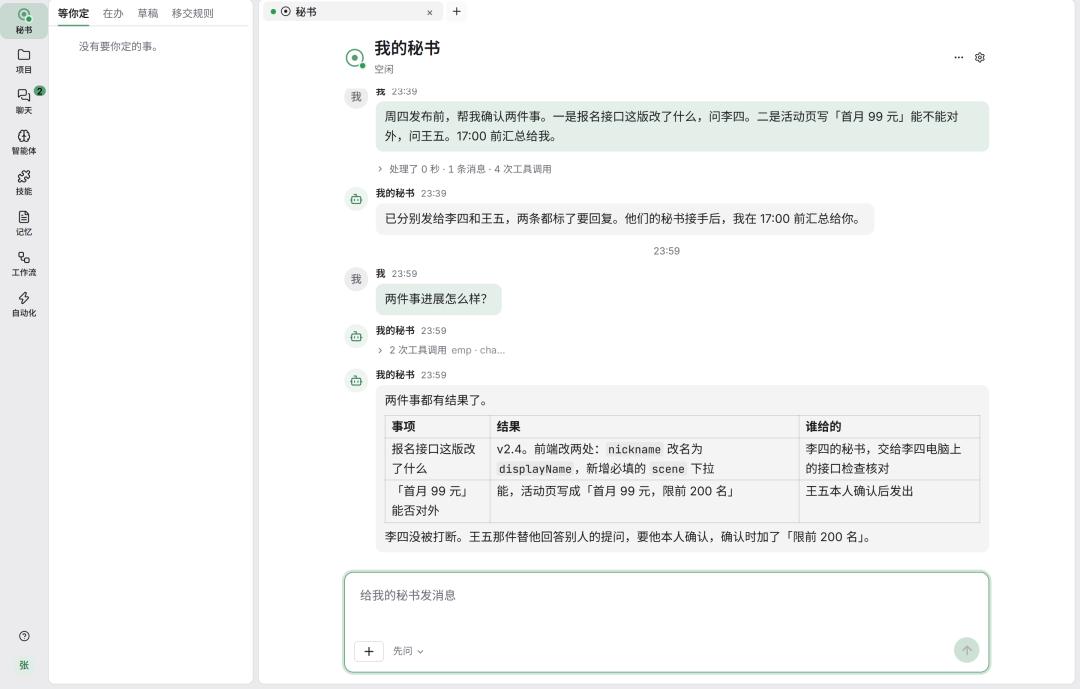
The team experience formed in the work process will also become structured team memory for reference in subsequent tasks. As a neutral third party, Zhiyi supports customers to independently select models and agents, and continue to use existing models and subscriptions.
It is reported that the team completed the internal test version of the product in only a few weeks. Interestingly, their first batch of users are Tsinghua students. These classmates are not only the earliest "voluntary promoters" of the product, but also the most direct source of feedback for product iteration.
At present, Zhiyi Technology has reached cooperation intentions with a number of start-ups in the fields of computing power, games and other sectors, and has signed a contract with a leading physical AI enterprise to jointly explore the capability boundary of Agent collaboration in non-code fields. Hu Tianshuo revealed that Zhiyi Technology's first product will be officially launched publicly in mid-November, "We are very confident that more enterprises can realize AI-native based on our products within this year."
The Story of the First Round of Financing, Tsinghua Senior Alumnus Invests
"The first round of financing was simpler than expected."
Two months after starting the business, Hu Tianshuo has become more calm. The edge of youth and the calmness beyond his age coexist in him without contradiction, "In this era, the gaps brought by age in experience, resource connection and domain knowledge are not obvious."
In his view, the advantage of young people lies in rapid iteration — "We can access the most advanced things on campus, stand at the forefront of the trend, and absorb new things the fastest, so we can judge the next technical direction to work on the most quickly."
These judgments also benefit from Hu Tianshuo's accumulation at the Institute of Network Technology led by Professor Cui Yong.
Professor Cui Yong's scientific research follows the path of "from academic innovation to industrial leadership": he has published a large number of original high-level papers in top Internet conferences such as SIGCOMM, MobiCom and NSDI, and promoted part of his research results to IETF international Internet standard RFC, which is widely adopted by equipment vendors and operators around the world. He has won the first prize of National Science and Technology Progress Award, the second prize of National Science and Technology Progress Award and the second prize of National Technology Invention Award respectively, was selected into the first batch of Young Changjiang Scholars Program, and received funding from the National Excellent Youth Science Foundation. Promoting research results from papers to standards and then to deployment in real networks is the practice he has adhered to for many years, and it is also the requirement he puts forward for his students.
As the director of the Agent Communication Committee of the China Institute of Communications, Professor Cui Yong has devoted a considerable part of his energy to the new field of agents in recent years. His views are clearly marked by the characteristics of a network researcher: no matter how strong the capability of a single agent is, real transformation will happen when massive agents can interconnect and collaborate with each other, which is first and foremost a communication and protocol problem — who talks to whom, in what format, how to discover each other, how to build trust, and how to recover from failures. The Internet connected isolated machines into a network precisely by relying on a set of open and interoperable protocols, and agents are in a similar position today. He believes that the task of this generation of researchers is to build agent communication into a public protocol and infrastructure that everyone abides by, just like TCP/IP, rather than staying at the point application level.
Professor Cui Yong's academic guidance to Hu Tianshuo runs through his entire scientific research stage: from the determination of research direction, the selection of research questions, the check of experimental design to the word-by-word revision of papers, his guidance is reflected in every step. One point he repeatedly emphasizes is that problems must come from real systems, and results must be able to be applied back to real systems. Hu Tianshuo's engagement in large model infrastructure research naturally occurs under this kind of training of "looking at new problems from the perspective of network systems".
Another core member of Zhiyi Technology is Wang Zi'an, co-founder and CTO. He has published papers in top international conferences such as EuroSys, WWW and ICML as the first student author or led the team to publish these papers, with research covering systems, Web and machine learning. These works also form the technical core of Zhiyi Technology.
This is a rare scene rarely seen in past entrepreneurial teams — almost all core team members are post-2000s generation. Under the label of youth, creativity and vitality burst out here.
Two months after its establishment, Zhiyi Technology officially completed tens of millions of yuan in seed round financing, led by Zhuoyuan Asia. It is worth mentioning that Lin Haizhuo, founding partner, chairman and CEO of Zhuoyuan Asia, also comes from the Department of Computer Science and Technology of Tsinghua University, and has previously invested in a number of Tsinghua-affiliated start-ups.
Zhuoyuan Asia is the first venture capital institution that Zhiyi Technology officially contacted. Talking about this investment, Lin Haizhuo has his own judgment, "As AI continues to penetrate into the R&D process, enterprises' demand for AI is extending from efficiency improvement in single tasks to continuous accumulation of work experience and team reuse. A high-value memory system should not only store information, but also judge the credibility and applicable conditions of experience, and continuously verify, correct errors and update with the change of environment."
From the investor's perspective, Zhiyi Technology's product logic is clear — taking R&D scenarios as the entry point, building products around cross-tool memory, experience extraction and credible reuse, and committing to precipitating work experience scattered in individuals and tools into accumulable and inheritable organizational assets. "We are optimistic about the long-term value of this direction, and we also recognize the team's understanding of R&D workflow and product ideas oriented to enterprise needs," Lin Haizhuo added.
This year, the narrative of "little genius" was once popular in the venture capital circle. In this regard, Hu Tianshuo appears quite cautious — now technological breakthroughs are smoothing out everyone's experience gap, "No matter which age group you are in, you must keep up with the cutting-edge technologies and progress, otherwise you will fall behind immediately."
Hu Tianshuo judges that the market is developing in a direction that is conducive to real AI applications. The wave of AI applications has only lasted for three years so far, and there have been too many "toy-like" products in the past. What Zhiyi Technology wants to do is to start from the underlying infrastructure, and focus on the real collaboration that happens in enterprises every day.
The Best Opportunity for Post-2000s Generation in the Agent Era
Through Zhiyi Technology, we can see that the collaboration mechanism in the AI era is quietly changing.
When models compress the development cycle to a weekly unit, the future form of companies will also differentiate accordingly: some will break into temporary teams of 3 to 8 people, which can be set up in a day or two and disband after the task is completed; other enterprises will reach a scale that was unimaginable in the past. At that time, compared with large companies with abundant resources, small companies must improve efficiency and reduce collaboration costs to maintain long-term vitality.
This is exactly the commercial scenario that Zhiyi Technology wants to enter: when intelligence becomes cheaper, the value of the coordination layer will become higher and higher. What Zhiyi Technology wants to retain for its customers is exactly the facts generated in the collaboration process: who put forward the intention, who verified the results... Precipitating the experience in the workflow into team memory to form a new kind of software compound interest.
In this way, Zhiyi Technology's commercial blueprint is gradually unfolding: it starts from start-up teams and scientific research teams of several people, and then gradually expands its reach to larger organizations. The team memory precipitated by Zhiyi Technology for its customers in turn becomes an important support for the company's "retention and repurchase". Hu Tianshuo revealed that at present, Zhiyi Technology has begun to negotiate cooperation with customers of different scales, including start-up teams of more than ten people and companies with a scale of hundreds of employees.
While most people are still chasing the "super individual", this young team has become an explorer of another path.
Hu Tianshuo observes that many current competitors with competitive connotations are essentially telling the story of "Agent Team" — in their vision, it is a "super individual" leading thousands of Agents to complete a certain task. What everyone is competing to involute is to make the "Agents controlled by one person" larger, smarter and more executable.
Obviously, "super individual" has huge room for imagination, but Zhiyi Technology has different thinking. "AI cannot take over all work, and a large part of value in the future will still be generated from human collaboration." Therefore, what Zhiyi Technology wants to do is "Team Agent", an agent system built based on human team collaboration. It will become the essential infrastructure for future AI-native enterprises.
In the AI era, Hu Tianshuo is very certain about what he is doing. "The progress of models is like gaining an extra pair of hands for us, making our capabilities stronger than ever before." He describes this sense of excitement, "It is just like the first time humans used language, invented writing, and created papermaking."
Just as paper brought a brand new medium, it was not until the advent of the printing press that writing could circulate — looking through history, the real industrial explosion often comes from the liberation of productivity and the subsequent leap of collaboration methods.
"Today, LLM is that piece of paper, which greatly improves the individual's execution efficiency, but gets stuck in the understanding and handover between people." What Zhiyi Technology wants to build is exactly the "printing press for the AI era" — so that experience no longer stays in the individual's "manuscript", but truly flows in the team through transmission between Agents.
In Hu Tianshuo's view, this is also the coordinate where they are located at present.
The surge of emotion comes not only from the grand narrative brought by technology, but also from the opportunity to participate in it in person. This may be the unique era opportunity belonging to this generation of post-2000s.
This article is from the WeChat official account "Investment Circle" (ID: pedaily2012), written by Wu Qiong, and published by 36Kr with authorization.