With its credit quota raised for three consecutive years, Financial Street plans to issue 8.7 billion yuan of corporate bonds to refinance maturing debts by raising new funds.
On November 9, Financial Street Holding Co., Ltd. convened the 2nd meeting of the 11th session of the board of directors, reviewed and approved the proposal for applying for the issuance of private placement corporate bonds, planning to privately issue corporate bonds with a total face value not exceeding 8.7 billion yuan, and the raised funds will be used for rolling over maturing existing corporate bonds via new issuances.
This marks the third consecutive year that Financial Street supplements its bond repayment sources through the same method.
In September 2024, the company's board of directors passed the pre-plan for private placement corporate bonds with a size of no more than 2.1 billion yuan; in August 2025, the quota was raised to no more than 5.17 billion yuan; this time it is further increased to 8.7 billion yuan. In three years, the declared scale has increased by more than 3 times, while the maximum maturity term has been cut in half.
However, with the asset-liability ratio still standing at 79.13%, the 8.7 billion yuan only solves the problem of maturing time points, rather than the total debt volume.
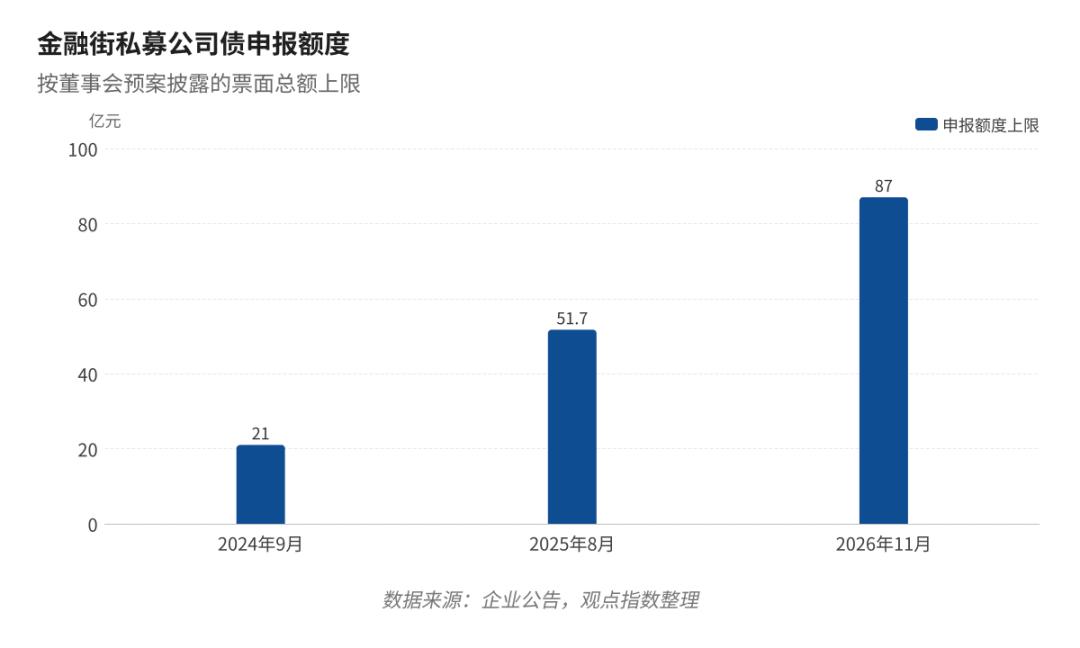
Three Consecutive Years of Rising Quota
The term of this private placement corporate bond shall not exceed 5 years (including 5 years), adopt a fixed interest rate form, be issued in a market-oriented manner, and the final coupon rate shall be subject to the result of book-building; within the valid registration period, the company may issue in tranches within the territory according to the capital market conditions and capital needs; the listing venue is the Shenzhen Stock Exchange; the resolution shall be valid for 24 months from the date of review and approval by the shareholders' meeting.
The announcement clarifies that this matter still needs to be submitted to the company's shareholders' meeting for review, and can only be implemented after being reviewed or registered by the regulatory authority. The final scale and the use of raised funds shall be subject to the approval of the shareholders' meeting and the regulatory authority. In other words, 8.7 billion yuan is the upper limit of the application, not the funds already received, nor the final issuance scale.
As of the end of June 2026, Financial Street had total assets of 110.599 billion yuan, down 3.97% from the end of the previous year; the asset-liability ratio was 79.13%, down 2.37 percentage points from the end of the previous year; the current ratio was 4.41, and the quick ratio was 1.40. The asset side is shrinking, and although the leverage ratio has fallen slightly, it is still at a relatively high level in the industry.
Putting the 8.7 billion yuan back into the debt pool, according to the 2026 annual follow-up rating report, the company's total debt at the end of 2025 was 76.321 billion yuan, net debt was 59.927 billion yuan, short-term debt was 2.015 billion yuan, and monetary funds in the same period were 16.614 billion yuan. In contrast, the declared quota this time is equivalent to about 10% of the total debt at the end of last year.
The short-term funding gap is not the main target of this financing. The company disclosed on the investor interaction platform that as of the end of the first quarter of 2026, the total of short-term borrowings and non-current liabilities due within one year was about 1.7 billion yuan, and the balance of monetary funds was about 6.8 billion yuan. In contrast, the declared quota of 8.7 billion yuan far exceeds the current short-term debt scale, targeting the outstanding bonds and put arrangements that will mature intensively in subsequent years.
What is actually replaced is time. Rolling over old debt with new issuances does not change the net liability exposure, but only shifts the repayment obligation from the near term to the long term; the arrangement of issuing bonds in tranches and receiving funds in batches also allows the company to choose the right time to enter the market when interest rates are falling.
Trade-off Between Maturity Term and Cost
The maximum maturity term being reduced from 10 years to 5 years is a relatively obvious change in the new plan. Long-term funds can extend the debt duration and reduce the pressure of concentrated short-term repayment, but they have higher pricing and greater sales difficulty; the 5-year term is the mainstream grade in real estate enterprise bonds with a wider subscription base. This adjustment can be understood as moving closer to market acceptance, and it may also mean that the availability of long-term funds has changed.
In the 2026 annual follow-up rating, the institution maintained the company's main credit rating at AAA with a stable rating outlook, citing reasons including shareholder support, cash flow from self-owned properties and unobstructed financing channels, while warning of industry risks, inventory pressure and operating performance pressure. Rating is the basis of pricing and the premise of this round of low-cost debt rollover.
Public information shows that the "24 Jinjie 06" issued by Financial Street in July 2024 has a size of 500 million yuan, a term of 7 years, and a coupon rate of 2.70%; the "23 Jinjie 01" issued in April 2023 has a size of 1 billion yuan and a coupon rate of 2.95%; while the "22 Jinjie 06" and "22 Jinjie 04" issued in 2022 have coupon rates of 3.53% and 3.54% respectively. For the same issuer and similar varieties, the issuance cost has fallen by about 80 basis points in two years.
If this issuance can fall in the range of 2.7% to 3.0%, and replace the 3.5% tranche bonds issued around 2022, the interest expenditure will be substantially saved.
In addition, private placement is targeted at professional investors, with a relatively simplified review and registration process, but the investor scope is narrow, the secondary liquidity is weak, and the issuance interest rate usually has a premium compared with public issuance; for the issuer, this is to exchange certain cost for efficiency and certainty.
The mid-year report data shows that in the first half of 2026, Financial Street achieved an operating revenue of 4.613 billion yuan, down 0.89% year on year; the net profit attributable to shareholders of listed companies was -87 million yuan, reducing losses by 91.41% compared with -1.008 billion yuan in the same period of the previous year, but still not turning positive; the net profit after deducting non-recurring gains and losses was -140 million yuan. The commercial and asset operation sector has become the main source of loss reduction with a relatively high gross profit margin.
In the same period, the net cash flow generated from operating activities was 587 million yuan, down 63.43% year on year; the contract liabilities decreased by 48.40% compared with the end of the previous year. The slowdown in sales collection means that the ability to repay debt endogenously through operating cash flow is weakening, and the supporting role of external financing increases correspondingly.
At the shareholder level, Beijing Financial Street Investment (Group) Co., Ltd. holds 31.14% of the shares, being the largest shareholder, and its state-owned capital background helps maintain the availability of financing channels.
In the past two years, the increment of onshore bond financing for real estate enterprises has mainly flowed to high-quality entities, and the use of raised funds is highly concentrated on rolling over old debts with new issuances, with negative net financing being the norm. Financial Street's three consecutive years of applying for rollover quota through private placement is a sample of this structure, but the use is limited to debt repayment; the expansion of the scale corresponds to the expansion of maturing scale, rather than new investment.
This determines the follow-up observation priorities. First, the progress of shareholders' meeting review and regulatory registration determines when this quota can be used; second, the scale and coupon rate of the first tranche of issuance will test the market's pricing for this entity; third, the distribution of outstanding bonds maturing and being put around 2027 determines whether the 8.7 billion yuan quota is fully reserved at one time or used year by year.
The surface is another round of rolling over old debts with new issuances, and the essence is to exchange maturity term for space. The 8.7 billion yuan can make the repayment time point more leisurely, but the 79.13% asset-liability ratio and the 63.43% year-on-year decline in operating cash flow will not change due to a single issuance; the real variable still lies in the speed of sales collection and the realization of existing assets.
This article is from the WeChat Official Account "View", the author is View New Media, and published by 36Kr with authorization.