Having poached a former Volvo executive, XPeng forays into South Korea.
XPeng is accelerating its pace of entering the South Korean market.
After registering its South Korean subsidiary last year, XPeng officially appointed Lee Man-sik as the general manager of the company a few days ago.
Lee Man-sik has more than 30 years of experience in the automotive industry, 23 of which he spent at Volvo Car Korea, responsible for sales and marketing operations, leading the establishment of Volvo Korea's dealer system, brand communication, product strategy and other key work. He is also regarded as the key figure that helped Volvo become a mainstream premium imported brand in South Korea.
It is worth noting that many mainstream local media in South Korea have followed up and reported on this personnel change, which is not common in the past.
Industry insiders pointed out that Lee Man-sik's rich localized experience will help XPeng take a key step in the South Korean market, and at the same time send an important signal: XPeng does not intend to simply export vehicles to South Korea, but plans to integrate into and take root in the local market, especially at this node when structural changes are taking place in the South Korean automotive market.
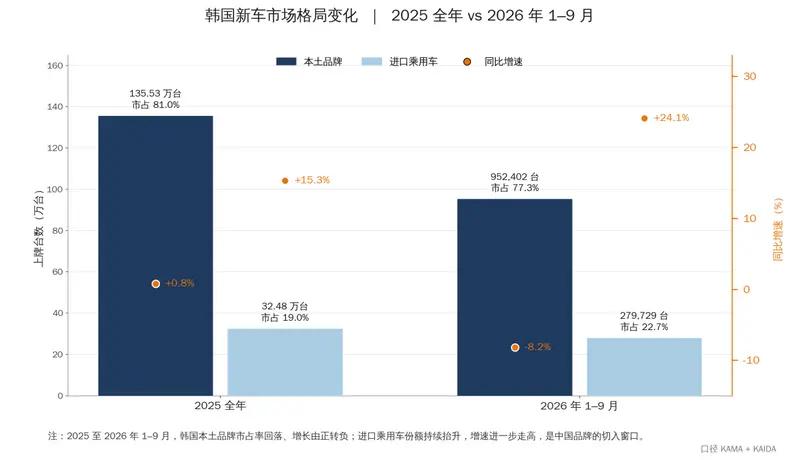
In the overall new car market of South Korea, Hyundai and Kia are still the absolute main players. The total new car sales in South Korea reached 1.6801 million units in the whole year of 2025, of which local brands accounted for 1.3553 million units, taking up 81.0% (year-on-year +0.8%), while imported vehicles reached 324,800 units, accounting for 19.0% (year-on-year +15.3%).
The market pattern has clearly differentiated since 2026. From January to September this year, the total sales of local brands reached 952,402 units, accounting for about 77.3% of the total market, but the local camp declined by 8.2% year on year; while the total sales of all imported passenger vehicles reached 279,729 units, accounting for about 22.7% of the overall new car market, with a year-on-year increase of 24.1%, the growth rate of imported vehicles is far higher than that of local vehicles.
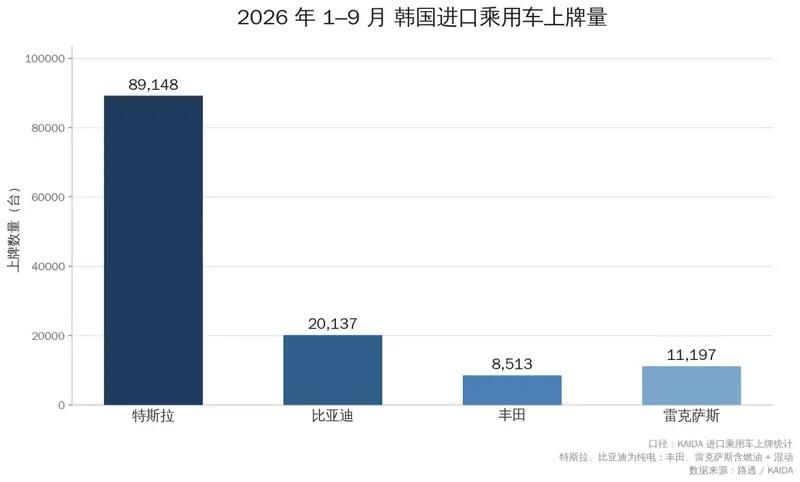
Segmented to the imported pure electric vehicle track in South Korea, from January to September this year, Tesla ranked first with 89,148 registered units, and BYD ranked second with 20,137 units, which exceeded the combined sales of Japanese brands Toyota and Lexus, followed by traditional luxury brands such as Mercedes-Benz and BMW.
In addition to BYD, Zeekr, a brand under Geely, has started accepting reservations in South Korea in June this year. According to Reuters, Chery also plans to enter the South Korean market next year.
Local media said that the successive entry of Chinese brands has already made some South Korean automakers feel worried.
Data shows that in the first 9 months of this year, the market share of Chinese brands in South Korea's imported passenger vehicles reached 7.20%, which has surpassed that of Japanese brands (7.05%).
Facing the warming imported vehicle track in South Korea, XPeng's "rooted" operation strategy also comes from the methodology precipitated by years of overseas expansion. XPeng's globalization exploration first started in 2021, starting from Norway, focusing on complete vehicle export.
After accumulating experience through trial operation, XPeng gradually entered the expansion cycle, began to lay out networks in multiple regions simultaneously, deployed markets in Southeast Asia, the Middle East and Australia, reduced costs and expanded the market by leveraging mature dealer networks. Europe, as the core main battlefield, also achieved steady growth in sales. At the end of 2024, XPeng became the first Chinese new energy vehicle startup to deliver more than 10,000 units in Europe.
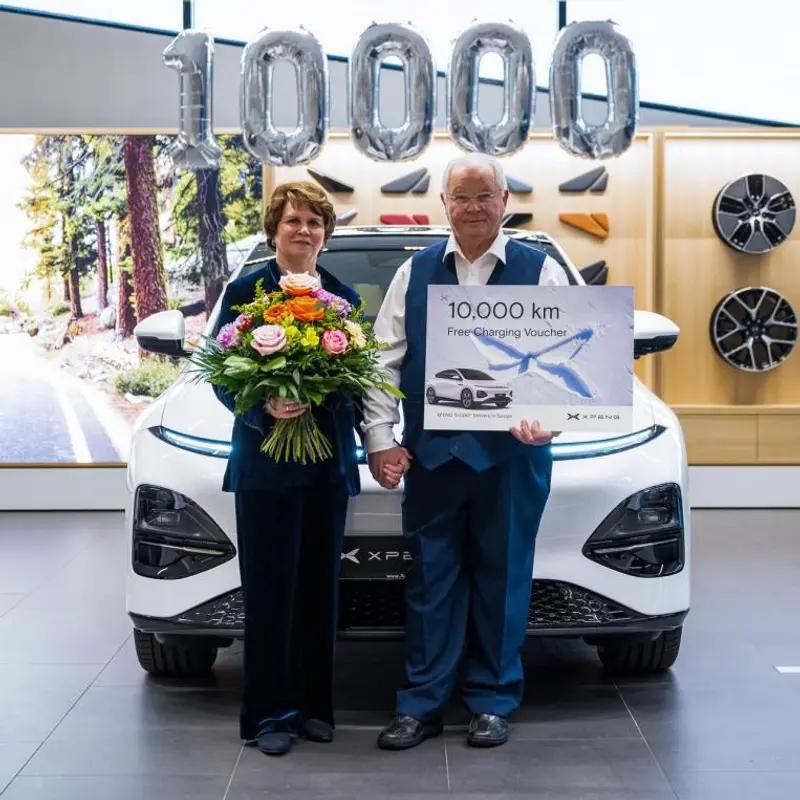
(Commemoration of 10,000 units delivered in Europe: The lucky owner couple Ekkehard was presented with a free charging coupon with a 10,000-kilometer quota)
With the continuous increase of overseas sales, XPeng's overseas expansion logic has been upgraded again, putting more emphasis on system capabilities, the core strategy is: localized manufacturing, building factories around the world.
At the previous Paris Automotive Summit, He Xiaopeng once said, "XPeng is not only exporting products, but also opening up the full set of engineering capabilities of complete vehicles, electrical and electronic architecture, and intelligent driving to global partners, realizing technology export."
In July 2025, XPeng launched its first overseas assembly base - the Indonesia factory, and in September it established the Magna Steyr Graz plant in Austria: it directly produces G6/G9 locally in Europe to avoid tariffs and shorten the delivery cycle. It also built a R&D center in Munich, which is mainly responsible for intelligent driving localization and data compliance.
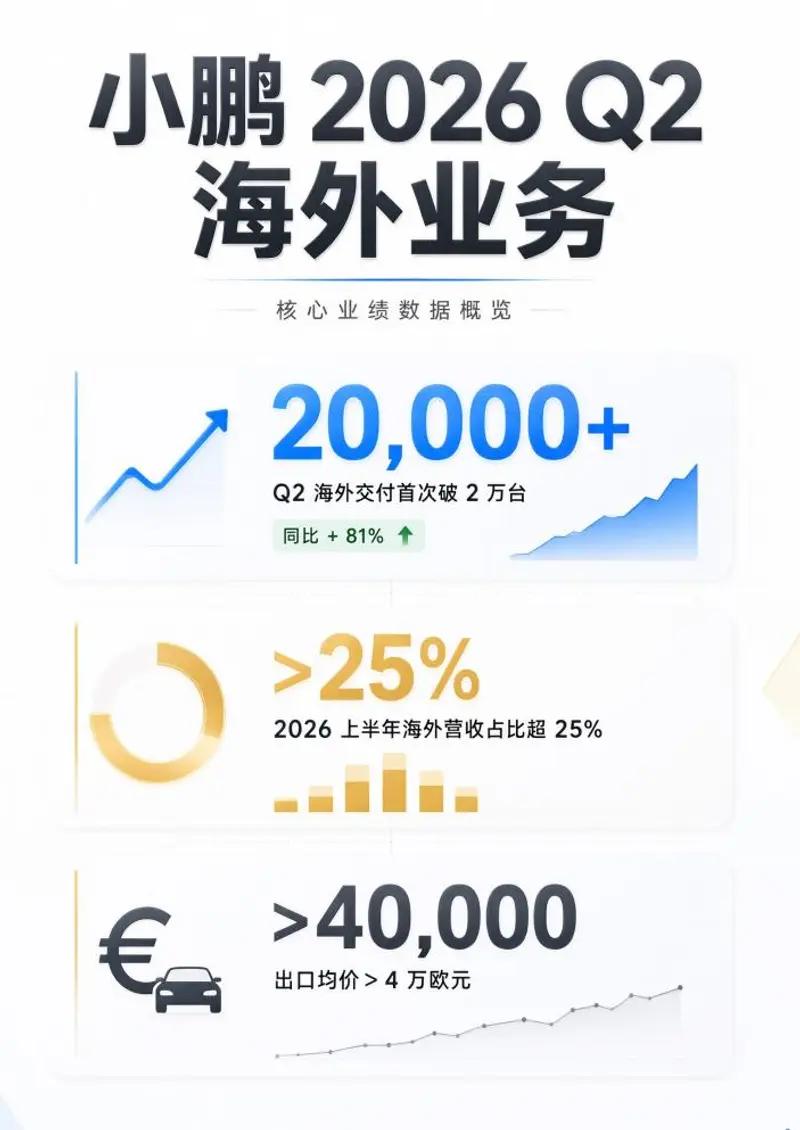
Relying on this localized layout, XPeng's overseas scale continues to expand. In the second quarter of 2026, its overseas single-quarter delivery exceeded 20,000 units, and the proportion of overseas revenue exceeded 25%; the long-term goal is a 50:50 ratio between domestic and overseas markets, and the overseas target is 1 million units by 2030.
XPeng is one of the most steady players among Chinese new energy vehicle startups in overseas expansion. The recruitment of Lee Man-sik for the South Korean market is, to some extent, a preliminary preparation for technology export in the South Korean market. However, whether Lee Man-sik can help XPeng cross the local trust threshold is the key to the success or failure of this battle in South Korea.