The company merged its HR and IT departments. What was the result?
What would happen if an enterprise merged its HR and IT functions into a single department? Everything that unfolded in the following case is far beyond most people's imagination. This case could be of great reference value for Chinese business owners, executives and HR professionals who are currently struggling amid the AI wave.
American biotechnology company Moderna was founded in 2010 and listed on NASDAQ in 2018 (ticker: MRNA). The company's peak performance was almost entirely driven by a single product — the COVID-19 vaccine Spikevax (mRNA-1273). In a way, the COVID-19 pandemic gave them the opportunity to thrive.
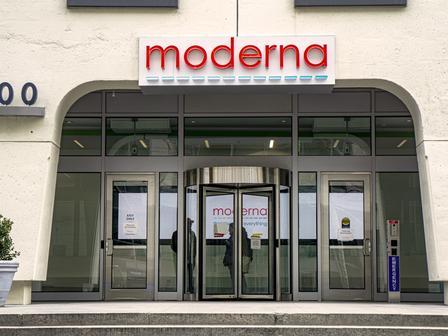
In 2021, Moderna's revenue soared to 18.5 billion US dollars, with a net profit as high as 12.2 billion US dollars. In August of that year, Moderna's stock price hit an all-time high of 484 US dollars, and its market capitalization once approached 200 billion US dollars, briefly surpassing century-old pharmaceutical companies like Merck. The times create heroes. In the popular parlance of today, they have also achieved "extraordinary results".
But the good times did not last long. After the pandemic, Moderna's revenue plummeted to the level of several billion US dollars, and the company fell into a loss spiral. Naturally, it also began to try business adjustments, scaling back resources from infectious disease vaccine business and focusing on the field of tumor treatment. The company is well aware that business adjustments cannot bring financial results immediately, so its current strategy has become extremely clear — before revenue recovers, it will first reduce the organization's operating costs, improve decision-making efficiency, enable the enterprise to operate healthily in the long term, and wait for the turnaround opportunity brought by business transformation.
Compared with the previous "extraordinary results", this strategy of "staying afloat" does not seem to be exciting, but it is an "examination question" that most enterprises in reality have to face. As a result, they not only got high scores in this "exam", but also relied precisely on "AI technology + organizational transformation".
01
Chilly Winds Blow, True Intentions Unfold
Modern's organizational transformation is not a one-off radical operation, but a progressive chain from technical preparation, power restructuring to headcount reduction. AI is not only the catalyst for the transformation, but also becomes the "building material" used to fill the manpower gap after the restructuring.
Phase 1 — Preparation Period (2023 to mid-2024). The goal is to make AI become "air" in the form of tools, penetrating into the daily operation of the enterprise.
In early 2023, Moderna began to cooperate with OpenAI and launched a custom internal version of ChatGPT — mChat, which is an API-based internal chatbot. But it is not just a chat window, but also a generative AI assistant and work platform for employees, as well as the unified entry and intelligent scheduling layer for the entire AI system. This powerful and easy-to-use tool quickly covered more than 80% of employees without encountering much resistance.
In November 2023, Moderna held a digital investor event, where Brad Miller, then CIO, publicly set the tone: "We must become a real-time AI company, embedding AI into every aspect of the company." Against the booming trend of AI, this statement did not cause any objection, and naturally most employees did not oppose it.
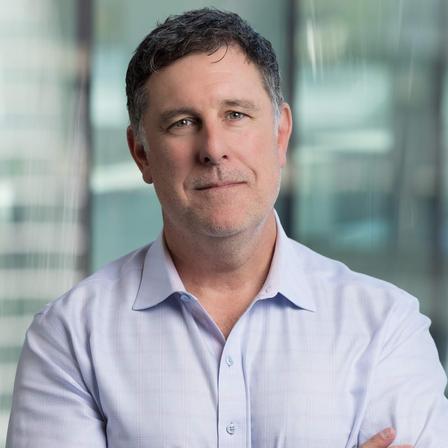
Figure: Brad Miller
The significance of this step is that it turns "human-AI division of labor" from an abstract strategic topic into a practical tool that employees use every day, laying a cognitive foundation for the subsequent "work architect" style of decision-making.
Phase 2 — Top-level Power Restructuring Period (Autumn 2024 to November 2024). Its goal is to tear down the partition wall between HR and IT, and start to introduce the concept of "human-AI collaboration". This step is the key action of the transformation, fully reflecting the management's wisdom in promoting change.
In autumn 2024, Moderna first announced a plan to cut R&D expenditure by 1.1 billion US dollars by 2027. The signal of cost contraction was released, and the "chill" began to spread across the organization.
In November 2024, Moderna officially established the position of Chief People and Digital Technology Officer (CPDTO), and merged the HR and IT departments into one department that reports to this position. Tracey Franklin, the former CHRO, was promoted to this position. SEC filings record her role as "overseeing talent strategy and digital transformation initiatives". In essence, the new power Franklin obtained is to define two key issues at the same time: "whether the work is done by humans or by AI" and "what the technical system supporting this work looks like".
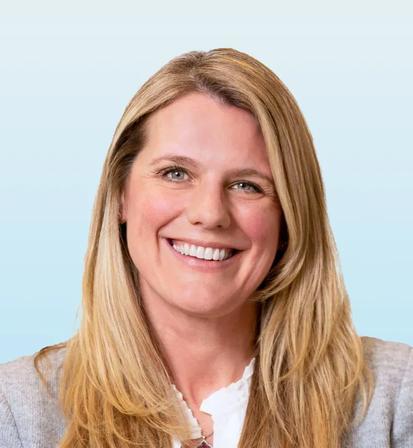
Figure: Tracey Franklin
Phase 3 — Headcount Reduction and AI Filling Period (2025). Its goal is to restructure the organization with the concept of human-AI collaboration to achieve cost reduction and efficiency improvement. In fact, after the merger of HR and IT functions was completed, headcount reduction and AI deployment accelerated almost simultaneously, forming a clear causal chain.
In January 2025, Bancel, then CEO, announced at the JPM Healthcare Conference that the goal was to cut 1 billion US dollars in cash costs in 2025, adding another wave of "chill" to the organization.
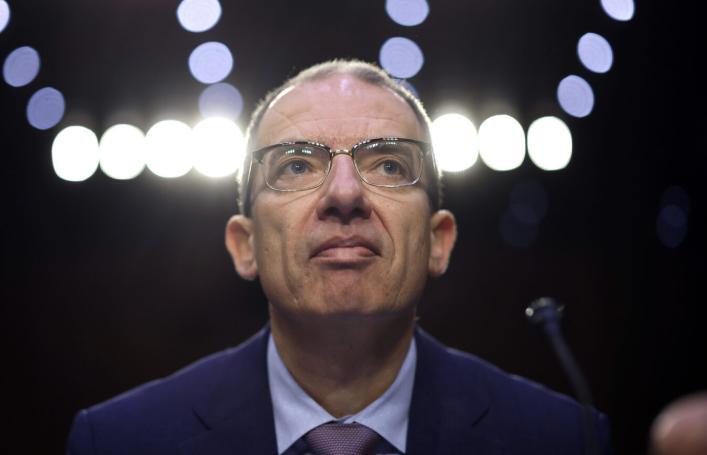
Figure: Stéphane Bancel
In February 2025, the digital technology department cut 10% of its staff, about 50 people. Brad Miller, who served as CIO, left the company at the same time, and his position was essentially merged into the authority of the CPDTO. You read that right, this Brad Miller is the one who previously vowed that Moderna would "become a real-time AI company", but he was swept away by the company's "AI-enabled" wave, which is really lamentable. At this point, Franklin no longer has any insulation layer in controlling IT functions, and can manage them more freely.
Around April 2025, Moderna created 750 custom GPTs; by mid-2025, this number had exceeded 3,000, covering multiple functions including legal affairs, R&D, manufacturing, commercial operations and HR. A typical application in HR scenarios is to use "HR agents" to replace junior HR analysts, automatically routing employee questions to the corresponding professional GPTs.
As AI increasingly becomes a digital employee, layoffs seem to be logical. On July 31, 2025, Moderna announced a global layoff of about 10%, aiming to reduce the total number of employees from about 5,800 at the end of 2024 to less than 5,000. The CEO called it a "difficult but necessary step" in a memo. At this point, the company's idea of "replacing people with AI" has been fully made public.
Information from 2026 shows that Moderna's layoffs and cost compression are still ongoing, with the goal of reducing cash costs to about 4.2 billion US dollars, and the long-term goal of achieving cash break-even in 2028. But the experiment of the organizational model has ended, and these cost reduction and efficiency improvement actions are mostly carried out along the verified organizational path.
02
The Logic Behind the "Counterintuitive Merger"
The operational closed loop of Moderna's three-year organizational transformation is clearly visible:
First introduce AI tools and let them penetrate into work. Then, continuously release the "chill" signal to make organizational transformation imminent, so that all adjustment actions become understandable. At the same time, merge HR and IT, so that the same person has the scheduling power of both "reducing headcount" and "deploying AI"; then use AI to fill the functional vacancies left by the eliminated positions.
The end result is that the roughly 800 positions cut have been turned into thousands of deployed GPTs, and the company is getting closer and closer to an "Agentic Organization". In particular, the agents that have penetrated into the enterprise fully support several workflows, and even become digital employees (not just tools), a state that naturally makes a large number of enterprises envy.
What did Moderna do right? "Introducing AI tools", "releasing chill signals", and "large-scale layoffs" are actions that all enterprises are willing to and can do, which are not the key to the success of organizational transformation. The real key logic is — by merging the HR and IT departments, the concept of human-AI collaboration has become a reality.
According to reports, internal discussions about ChatGPT in the company made the CEO realize that AI is blurring the boundary between "people" and "technology", which promoted this merger. Precisely because of this merger, the core logic of Moderna's organizational construction has been upgraded from "workforce planning" to "work planning".
Traditional "workforce planning" follows this path: business needs growth → HR calculates "how many people are needed" → IT responds to "what systems are needed". In this chain, HR and IT answer their own questions separately.
Innovative "work planning" means: instead of asking "how many people are needed" first, we first ask "should this work be done by humans, by AI, or by human-AI collaboration". In other words, "how work gets done" replaces "how positions are filled (by people)". Following this logic, Franklin summed up the positioning of her new role as a "work architect". She is responsible for architecting work, focusing on how tasks, information and decisions flow through the organization, and achieving the best efficiency through the combination of people and technology.
Obviously, in the logic of "work planning", HR and IT must be merged, because this planning involves both people and technology, and cannot be done separately by two disconnected departments. It is worth noting that after the merger, HR employees still do HR work, and IT employees still do IT work. Franklin explained — "I didn't turn HR people into IT people, and vice versa." In other words, what is torn down is the artificial division at the decision-making level, not the professional capabilities themselves. In the final analysis, different functions remain different, and the "professionalism" of functions will always exist.
The "work architect" mechanism is not a patch on the old pyramid, but requires first tearing down the department walls that exist due to "human information processing bottlenecks" at the structural level. What Moderna did is exactly the latter — it used a radical organizational restructuring to forcibly weld the decision-making loops of "people" and "technology" to the same node, and then created the institutional conditions for the question of "who should complete this work" to be answered uniformly.
Can Moderna's organizational transformation be replicated?
To a certain extent, yes. Human-AI collaboration is a new trend, which naturally requires a new top-level architecture to be implemented. Moderna's path from merging functional departments to refreshing the team has just set an example for other enterprises. In fact, in the current process of enterprises' "AI transformation", the contradiction between human resources and IT functions has become increasingly intensified.
But from another perspective, Moderna's operation has quite high barriers.
On the one hand, this operation highly depends on Tracey Franklin's unique personal capabilities. She has a deep HR background and sufficient technical understanding of the company's AI and digital strategy, which is quite rare among CHROs. Franklin herself has a clear positioning for leaders. She believes that she does not need to be an expert in any field, and her core responsibilities are to set direction, allocate capital, remove obstacles, and shape culture.
On the other hand, CEO Stéphane Bancel's high-level cognition of both AI and organization has formed a mature concept of human-AI collaboration, which determines that he can provide full support and even personally step forward in the transformation. According to media reports, it was precisely during the process of cooperating with OpenAI to introduce AI tools that Bancel realized that AI is deeply entangled in traditional work design and organizational structure, so he made up his mind to merge the two functions.
Moreover, there is deep trust between Stéphane Bancel and Tracey Franklin, which is also the key to making this organizational transformation possible. The perfect partnership between the CEO and CPDTO is even more rare to find in other enterprises. A Harvard Business School case clearly records that in 2019, Bancel personally recruited Franklin, who previously worked at Merck as Chief People and Strategy Officer. At that time, he called Franklin a "great partner" in the statement. After that, they went through the outbreak of the COVID-19 pandemic together, and experienced the process of the company expanding from 830 people to 4,000 people, precipitating trust and common language. During this process, Franklin also gained a deep understanding of the company's culture, talent pain points and Bancel's management style.
03
What is the Effect of the Organizational Transformation?
To evaluate whether an organizational transformation is successful, we should look at it from a comprehensive perspective.
For human employees, they may not welcome such a transformation.
Anonymous ratings on Glassdoor quantify the decline in corporate culture: only 40% of employees are willing to recommend Moderna as a workplace to their friends (based on aggregated Glassdoor reviews). In an informal vote of 86 people in the Gartner Peer Community, 23% explicitly opposed the merger of HR and IT, and only 38% supported it.
A former employee on Glassdoor directly pointed out the damage of "quiet layoffs" to morale: "The corporate culture continues to erode due to market uncertainty and a year of quiet layoffs. The management has not made efforts to publicly explain the layoffs to employees, which has killed morale and trust."
Another comment from a former lead software engineer depicts the intensity of organizational turbulence: "The company is laying off people every quarter. No project manager stays on the team for more than 3 months... In three months, we lost our CIO, VP, interim VP and manager. After the new VP came, he broke up the team I spent two years building. It is impossible to stay motivated in such a chaotic environment that clearly does not care about its employees."
A June 2025 report in The Boston Globe was headlined directly: "People inside Moderna are afraid". A biologist who was laid off in the article described the dilemma after the layoff — he applied for about 40 positions, only got 6 interviews, and no offers. AI is leaving people with nowhere to go, and Moderna is the initiator wielding the layoff scythe.
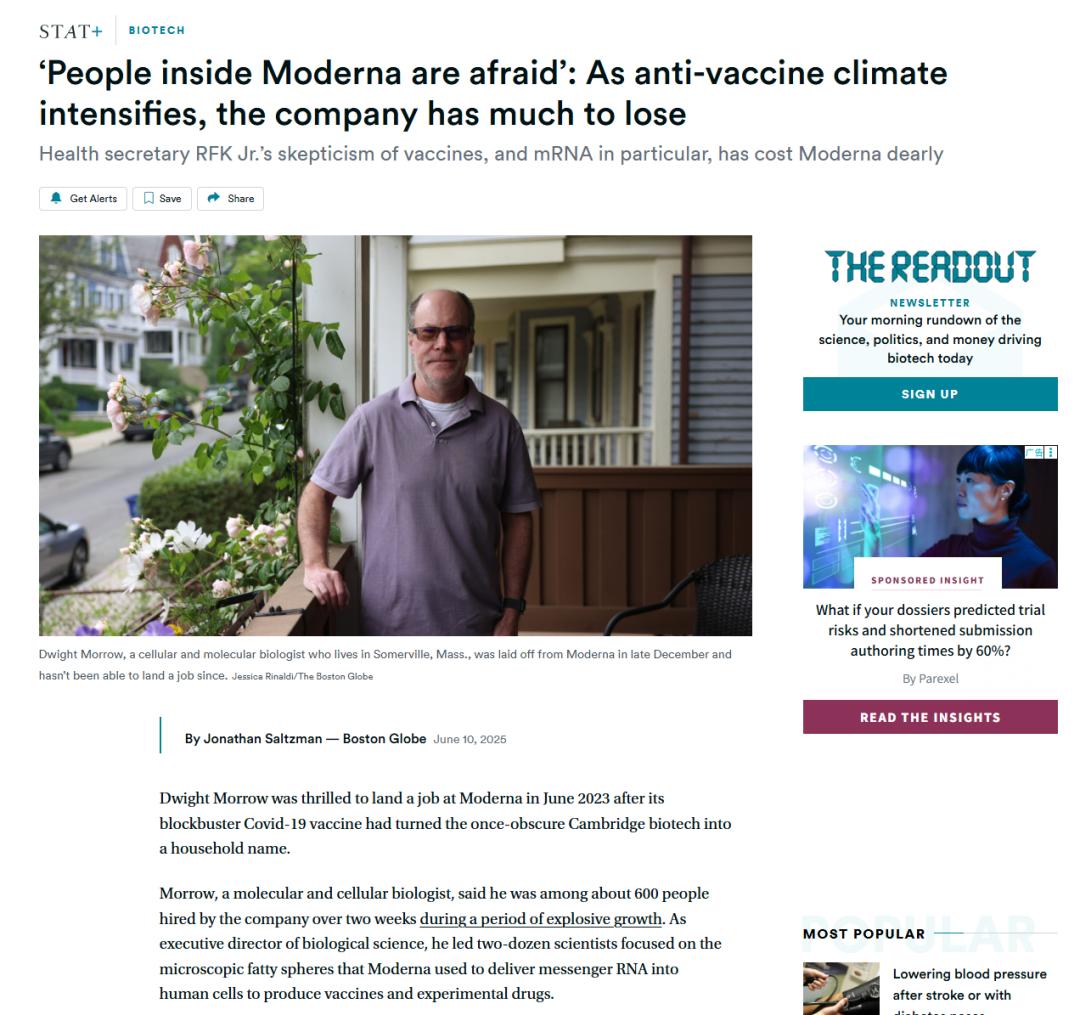
Figure: A report published in The Boston Globe in June 2