Masayoshi Son is in a precarious situation.
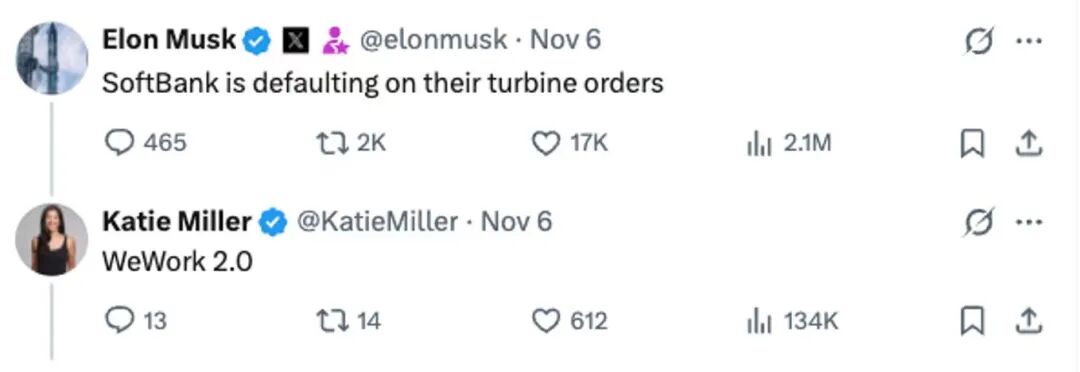
"SoftBank is defaulting on their turbine orders."
Elon Musk's short explosive disclosure directly sent SoftBank's stock price into a tailspin — it plummeted by over 10% at close last Friday, and Masayoshi Son's personal net worth shrank by about 3.9 billion US dollars (equivalent to over 260 billion RMB).
Up to now, neither Masayoshi Son nor SoftBank has made any response. But some people have already described this scene as WeWork 2.0, which is the biggest failure in Son's career so far.
At the same time, the US stock market's AI infrastructure sector has evaporated by about 2 trillion US dollars, chip stocks have fallen to their lowest level since 2020, and even Anthropic, the largest IPO in history, has had its valuation cut repeatedly.
Under all kinds of emotions, the market is quietly worried: will this become the first domino to topple the entire AI market?
Elon Musk Calls Out: SoftBank Starts Defaulting
The cause is that Katie Miller, former advisor to Elon Musk and podcast host, reposted a financial news report —
According to Bloomberg, after the midterm elections, the prospects of many data center projects are uncertain, and a mysterious seller is trying to sell off about 500 million US dollars of data center loans in one go. This anonymous seller is auctioning more than a dozen loans, including a 25 million US dollar financing for the large "Stargate" data center project located in New Mexico.
The venture capital circle is no stranger to "Stargate", which is a super project jointly promoted by OpenAI, SoftBank and Oracle, and also a proud work after Trump took office.
Back in January 2025, OpenAI officially announced the "Stargate" project, stating that the Stargate project is a new company that plans to invest 500 billion US dollars in the next four years to build new AI infrastructure for OpenAI in the United States. The first phase will immediately invest 10 billion US dollars.
At that time, Musk dismissed it, and repeatedly posted that "they can't actually get the money at all." Until this time, when Katie Miller brought up the old story again, Musk immediately followed up the post, pointing directly to SoftBank's "default".
Why is this order so critical?
The incident began with SoftBank's plan to build an ultra-large AI data center on the land of a former uranium enrichment facility in Ohio, supporting about 33 billion US dollars of natural gas power generation facilities with a total power generation capacity of 9.2 GW. In May this year, SoftBank confirmed that it had ordered gas turbines from manufacturers such as GE Vernova to supply power to the project. This power will be used for data centers leased by OpenAI, and the first batch of facilities is planned to be put into operation in 2028.
The market generally believes that gas turbines are the heart of this data center, and also the most difficult capital expenditure to withdraw from halfway. Once this part loosens, the entire chain will be affected.
Musk's accusation hits the most vulnerable link in this AI infrastructure narrative — the money may not be able to keep up.
The cracks may appear earlier than expected. In September this year, Oracle sent a force majeure notice to the park developer: if the project cannot be put into operation as planned in 2028, it hopes to postpone the payment of rent.
Up to now, SoftBank has not made a public response to the accusation, and executives of GE Vernova, the core supplier of gas turbines, also stated shortly ago that they have not seen customers cancel orders due to financing problems. The incident has fallen into a fog of conflicting accounts.
The Trouble Has Only Just Begun
In this round of AI wave, Masayoshi Son chose to go all-in.
His most notable investment is undoubtedly in OpenAI. In February this year, OpenAI completed a financing of 110 billion US dollars, with a pre-money valuation as high as 730 billion US dollars (nearly 5 trillion RMB), setting the record for the largest single financing in the history of global venture capital. Among them, Masayoshi Son invested 30 billion US dollars in one go.
Where did the money come from? To invest in OpenAI, SoftBank pledged Arm shares to raise about 20 billion US dollars, pledged the shares of its Japanese telecom subsidiary to raise about 7.7 billion US dollars, and signed a 400 billion US dollar bridge loan, the largest in Asian history, in March this year, which will mature in March 2027.
In other words, what Masayoshi Son bet on is not just cash, but SoftBank's entire balance sheet, as well as a high-interest debt with an interest rate close to 10%.
In order to raise more money, he liquidated his position in NVIDIA, reduced his holdings in T-Mobile, and sold all his Alibaba shares. The cash he got was immediately invested in OpenAI.

Up to now, SoftBank has invested a total of more than 64 billion US dollars in OpenAI, holding about 13% of the shares. This is the largest single bet in Masayoshi Son's history, which can be called a huge gamble.
If OpenAI's valuation keeps rising and its IPO proceeds as scheduled, this may become another brilliant stroke in Masayoshi Son's life.
But the wind has changed. With the ceiling of AI valuation falling, OpenAI's IPO has been postponed to 2027.
This means that SoftBank's heavy position cannot be realized through the public market in the short term, while the interest on the debt supporting this position is calculated quarterly and daily.
The pressure was quickly transmitted to the bond market: SoftBank's 5-year credit default swap (CDS) spread soared to 466 basis points, the highest level since October 2022. The market is worried: will SoftBank's financial situation become the next risk point on the AI chain?
Recalling the shareholders' meeting in June this year, Masayoshi Son refuted the AI bubble theory: "Any talk about a bubble is an insult to artificial intelligence", and said he would create a superintelligence "10,000 times smarter than humans". He defined this huge gamble as "a revolution 50 times larger than the dot-com bubble".
This is very much like a classic Masayoshi Son moment: raising leverage to bet on an endgame he firmly believes in. From Alibaba to WeWork, he has never been a steady player, but this time it's AI, and it's still a question mark whether this set of tactics still works.
Ring the Alarm Bell
At this moment, the sentiment in the global AI industry is complex.
More macro pressure comes from the other side of the ocean. After the US midterm elections, the market's expectations for slower data center construction and tighter AI supervision rose sharply, and the technology sector immediately ushered in a fierce sell-off — over the past week, the Nasdaq 100 Index plummeted by 6.4%, and the market value evaporated by 2.3 trillion US dollars in a single day, setting a historical record.
During this period, Microsoft gradually terminated some leases, and super PE institutions such as Blackstone intensively suspended and transferred data center assets, all reflecting the market's concerns about the AI bubble and over-construction.
The cold water also poured on Anthropic. After the plunge of AI tech stocks, Anthropic's valuation has been cut again. It is reported that the valuation range currently being discussed by potential investors has dropped to 1.2 trillion to 1.3 trillion US dollars, and some investors even consider pushing the valuation down to 1.1 trillion US dollars.
At the beginning of October, this artificial intelligence company was still preparing for an IPO with a target valuation of 2 trillion US dollars. As sentiment spreads, the primary market's tolerance for valuations of AI startups is shrinking rapidly.
Looking back at the past two years, under the FOMO sentiment, the primary market collectively joined a competition, and those craziness are still vivid: a number of AI companies with no products, no revenue, and even no clear business model easily entered the unicorn ranks with their valuations. Even Sam Altman of OpenAI rarely stated that there is indeed a bubble in some parts of the AI field, and some "stupid" startups can easily get large sums of money.
Now, the tide is starting to turn.
But the pace of AI's progress will not stop due to a round of valuation correction. History is the best reference: the dot-com bubble in 2000 buried countless companies, but failed to bury the Internet — what the bubble burst is not the technology, but leverage and pseudo-demand, and those pseudo-narratives that are separated from the foundation of commercialization and rely solely on storytelling.
Those pseudo-high valuations with no products, no revenue and no clear business model will be the first to be cleaned up by this ebb tide; while companies that truly integrate their models into production lines and turn intelligence into ubiquitous utilities like water and electricity will gain a healthier financing environment after the panic recedes.
As the tide rises and falls, no one can truly stay out of it.
This article is from the WeChat Official Account "Pedaily" (ID: pedaily2012), written by Zhou Jiali, and published with authorization from 36Kr.