Onlooker Zhang Chaoyang
The internet once gave Charles Zhang an entire era.
He founded Sohu, propelled the portal website to become the entry point of China's internet, and was once one of the most influential internet entrepreneurs.
But in the AI era, he said: "We cannot afford to do it."
Recently, at the World Internet Conference held in Wuzhen, Charles Zhang talked about Sohu's situation after missing the mobile internet wave. The man who once defined the industry now has to admit that he does not have enough chips to catch up with the next wave.
From leading an era to admitting he cannot catch up with the next one, Charles Zhang's situation is quite thought-provoking.
I. He once stood at the peak of the wave
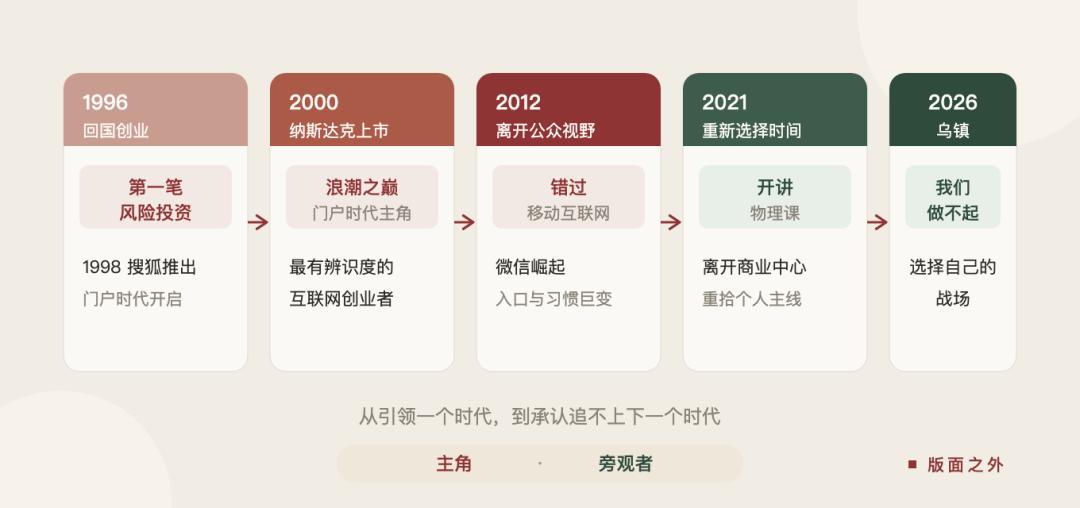
In 1996, Charles Zhang returned to China to start his business.
At that time, China's internet was still in its infancy. The domestic venture capital system was not yet mature, and the internet was far from being a widely recognized promising business. To raise funds for his startup project, he traveled frequently between China and the United States, pitching to investors about the possibilities of the internet in China.
In November 1996, Charles Zhang obtained his first venture capital investment. Two years later, Sohu was officially launched.
This investment changed the trajectory of Charles Zhang's life, and also made Sohu one of the representative companies that introduced venture capital in the early stage of China's internet.
At that time, there was no clear business map for the internet. Charles Zhang had to judge for himself what users really wanted to get from the web.
He chose information aggregation and navigation. Sohu's initial product form was exactly to help users find information in the immature Chinese internet. Later, portal websites gradually became the mainstream entry point of China's internet, and Sohu also entered its best development period.
In 2000, Sina took the lead in listing on NASDAQ, followed by NetEase and Sohu one after another, and the portal era of Chinese internet truly arrived.
Charles Zhang also became one of the most recognizable internet entrepreneurs of that era. He frequently appeared in the media and public view, talking about the internet, business, and a new kind of upcoming life.
At that time, he did not need to explain why he wanted to do internet business, because he was participating in creating a brand new industry.
But being the winner of one era does not mean you can keep winning forever.
The portal era brought Sohu traffic, brand reputation and industry status, but did not give it a ticket to the next era.
II. The success of the portal became the burden of transformation
Charles Zhang has talked about the opportunities Sohu missed more than once later.
From search to video, and then to information distribution, Sohu did not fail to develop new products, and once had good resources and talents. But the problem is that the advantages accumulated in the portal era did not naturally turn into competitiveness in the next era.
In the portal era, users opened websites and information was organized by channels and editors. In the search era, users began to actively look for answers; after the arrival of the mobile internet, algorithms and mobile applications reorganized information distribution.
What changed is not only the product form, but also the way users obtain information, and the competition logic of internet companies.
The experience of Sogou is very illustrative.
At that time, Wang Xiaochuan, who was in charge of the search business at Sohu, promoted Sogou to cut in from input method, gradually develop browser and search business, and build product entry through the "three-stage rocket" strategy. This idea was not recognized by Charles Zhang at the very beginning, and he had concerns about developing browsers. Later, with Wang Xiaochuan's persistent promotion, Sogou gradually launched input method, browser and search products, and also obtained investment from Tencent.
In 2021, Tencent completed the privatization of Sogou, and Sohu sold its shares and obtained about 1.18 billion US dollars in cash.
The story of Sogou is a bit complicated. It proves that Sohu is not short of new product ideas internally, and has the ability to build successful businesses. But this product capability did not finally precipitate into Sohu's own new entry point.
Toutiao is another kind of regret.
Facing this product that later changed the way of information distribution, Charles Zhang once commented on it as "unoriginal" in the early stage. In the portal era, Sohu already had news client and content distribution capabilities, and algorithm recommendation seemed to be just an extension of its existing business.
But later facts proved that what really changed the industry was not an additional function on the news client, but the logic of information distribution had changed.
Putting these two stories together exactly presents two dilemmas in Sohu's transformation: one is that some people inside the company have seen new opportunities, but failed to turn them into the core advantages of the company; the other is that when facing new products, they are still used to measuring them with the experience of the old era.
Around 2012, this change became more obvious.
With the accelerated popularization of smartphones, the rapid growth of WeChat, and mobile applications began to become the main entry point for users to access the internet. The traffic order built around the PC homepage in the past is being broken by new products on the mobile phone screen.
Just in this year, Charles Zhang chose to step out of the public view, suspend his work, and enter a long period of rest.
In January 2013, when he returned to the public view again, he posted a Weibo post:
"After more than a year of seclusion, I re-enter the earth and find three things: 1. Everyone is using WeChat; 2. Everyone is talking about The Voice of China and Liang Bo; 3. Public sentiment has changed."
This Weibo post is often regarded as a footnote to the turning point of an era later.
Of course, Sohu missing the mobile internet cannot be simply attributed to Charles Zhang's departure. The previous product judgments and business layouts have already exposed problems in the transformation. But when he returned to the scene, the internet entry points and user habits had undergone tremendous changes.
A person who once stood at the front of the wave found that the familiar competition rules he knew had failed.
III. Away from the business center, he picked up the physics textbook again
After Charles Zhang returned to the public view again, he did not immediately find the next business growth curve.
Many years later, he divided his time to another thing.
On November 5, 2021, Charles Zhang gave his first physics class on Sohu Video.
The founder of an internet company began to deduce formulas in front of the camera, talking about Newtonian mechanics, thermodynamics and quantum physics. He fixed the live broadcast every week, kept updating the courses, and later compiled them into books.
This scene is somewhat contrasting.
At that time, the internet industry was still looking for new growth points, and short videos, live broadcasts and algorithm recommendations were constantly changing the content market. It was more than a year before ChatGPT became popular all over the world, and AI had not yet become the keyword that swept the entire industry as it is today.
But the physics class was not a new hobby he suddenly found.
Charles Zhang graduated from the Department of Physics of Tsinghua University, then went to the United States for further study, obtained his doctorate at the Massachusetts Institute of Technology, and continued to engage in postdoctoral research. Physics used to be the main line of his life before he entered the internet industry.
It's just that starting a business and running Sohu took up a long period of his life. Now, he divides his time to physics again.
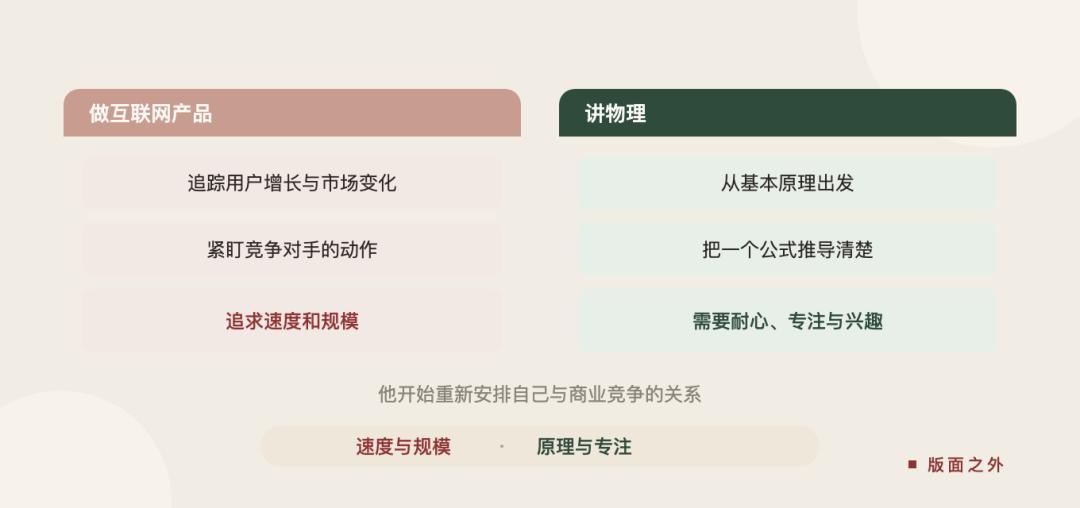
The significance of this matter is not that an internet boss starts giving lectures, but that he has re-chosen how to spend his time.
Making internet products requires tracking user growth, market changes and the actions of competitors; teaching physics requires starting from basic principles and deducing a formula clearly. The former pursues speed and scale, while the latter requires patience, concentration, and interest in knowledge itself.
Of course, this is not simply a retreat from the business world to personal interests, but that he has begun to rearrange his relationship with business competition. Even if he is no longer at the center of the industry, he can still do what he likes and is good at.
IV. In the AI era, choose your own battlefield
By 2026, Charles Zhang is standing in front of the technology wave once again.
This time it is AI.
Different from the mobile internet, the competition of large models requires continuous investment in computing power, data and R&D resources. For companies like Sohu, whether to enter this competition is not only a technical judgment, but also a resource judgment.
When Charles Zhang said "We cannot afford to do it" in Wuzhen, he was actually acknowledging the realistic constraints left by several rounds of competition in the past.
But he did not close the door to AI because of this. Sohu has already used AI technology in physics class content production and game business, but has not chosen to bring the company into a war of competing for basic model resources with leading enterprises.
He is more willing to talk about another less popular topic: real-person social networking.
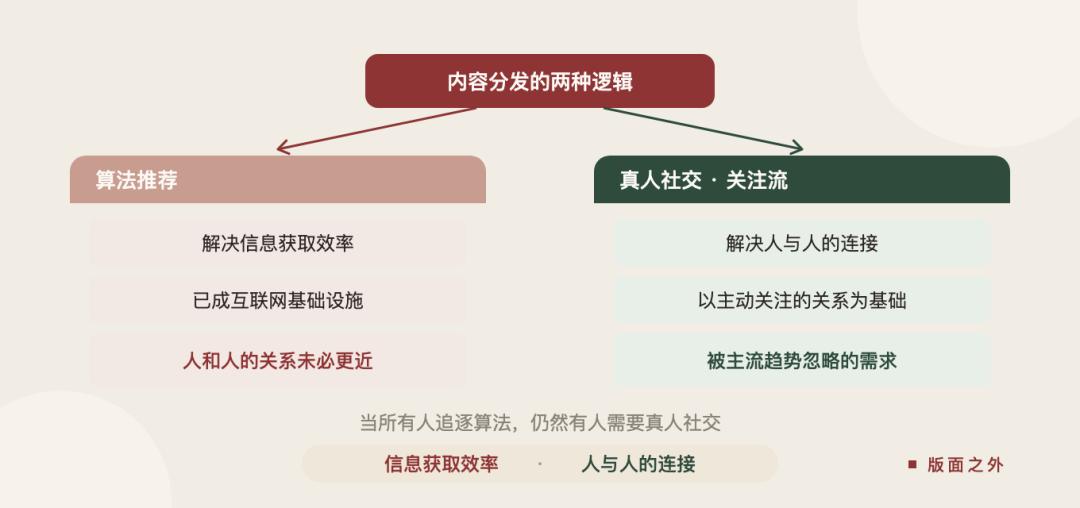
During his stay in Wuzhen, Charles Zhang repeatedly introduced the "Follow Feed" of Sohu Video. This product does not rely on algorithms to recommend content to users, but is based on the interpersonal relationships that users actively follow, and spreads information through forwarding, commenting and interaction.
Nowadays, when algorithm recommendation has become the internet infrastructure, this design seems to be against the trend.
Charles Zhang's explanation is that algorithms solve the efficiency of information acquisition, while social networking solves the connection between people. Users can quickly see the content they like through algorithms, but they may not get real communication as a result. Information is getting richer and richer, but the relationship between people is not necessarily getting closer.
This is also the opportunity he mentioned: when everyone is chasing algorithms, there are still people who need real-person social networking.
The "Follow Feed" has been polished for many years, and Charles Zhang calls it an important strategic direction for Sohu in the next stage. It has not yet formed a large enough user scale, and commercialization is not the top priority at present.
This is a risky attempt. Whether real-person social networking can regain scale in the algorithm-dominated content market still needs market verification. But at least in terms of product selection, Charles Zhang is no longer obsessed with copying the proven successful models in the industry.
The same is true for short dramas.
Facing the boom of the domestic short drama market, he reminded the outside world not to equate the popularity in the Chinese market directly with the global trend. In his view, American users still have stable demand for long dramas, movies and live performances, and short dramas may not cover all crowds.
His judgment may not be completely accurate. Overseas short drama platforms have already achieved commercial performance in the US market, and short dramas are not a phenomenon that only exists in China. But what Charles Zhang really wants to express may not be that short dramas have no future, but that the market should not have only one content form.
From algorithms to short dramas, and then to large models, what he repeatedly emphasizes is actually the same thing: technology and popular trends can change the market, but it does not mean that all old demands will disappear.
In the past, he needed to judge what would become the next internet entry point. Now, he is more willing to look for those demands ignored by the mainstream trend.
V. The bystander still wants to stay on the field
What Charles Zhang is doing now is somewhat out of step with the mainstream narrative of the internet industry.
Major manufacturers are competing for model capabilities, computing power scale and Agent entry points, but he chooses not to participate in this resource competition; short video platforms compete for users' time by relying on algorithms, but he is trying to reorganize content with follow relationships; when the industry increasingly emphasizes efficiency and automation, he still spends a lot of time teaching physics.
These things may not bring new growth to Sohu, nor can they necessarily prove that his judgment is correct. But they reveal a change: Charles Zhang no longer tries to adapt himself to every round of industry competition, but begins to choose which things are worth continuing to do.
This does not mean that he has found a new answer. Whether the Follow Feed can form stable user relationships, and whether the physics class can be transformed into continuous content influence, still need time to test. An entrepreneur's personal interest cannot replace the commercial achievements of a company.
To some extent, Charles Zhang has accepted the distance between himself and the era.
There is regret in this acceptance. After all, he once had a very good starting point, and once stood in the most imaginative position of China's internet.
But there is also relief in this acceptance.
Every era has its own protagonist. The stage is changing, and the people standing in the center are always changing.
For a person who once stood at the center of the times, accepting that he is no longer the protagonist may also be another kind of rare freedom.
Words beyond the layout:
The business world is used to measuring a person's value by growth.
Standing on the cusp of the trend, judgment is magnified. When leaving the cusp, past achievements are easily revalued.
But the rise and fall of a company is not always synchronized with a person's value. The market can eliminate a business model, but it may not eliminate a person's curiosity about the world.
Compared with always betting on the next trend, whether you can still retain the ability to judge, interest and act after losing your advantages may be another more difficult test.
This article is from the WeChat official account "Beyond the Layout", author: Huahua, published with authorization from 36Kr.