The first entrepreneur who spent tens of millions on AI-powered film production has paid a massive tuition fee.
The production, licensing and delivery process of AI feature films has been fully validated, but audience payment and word-of-mouth conversion are yet to be completed.
"Just get it done, make sure it hits theaters!"
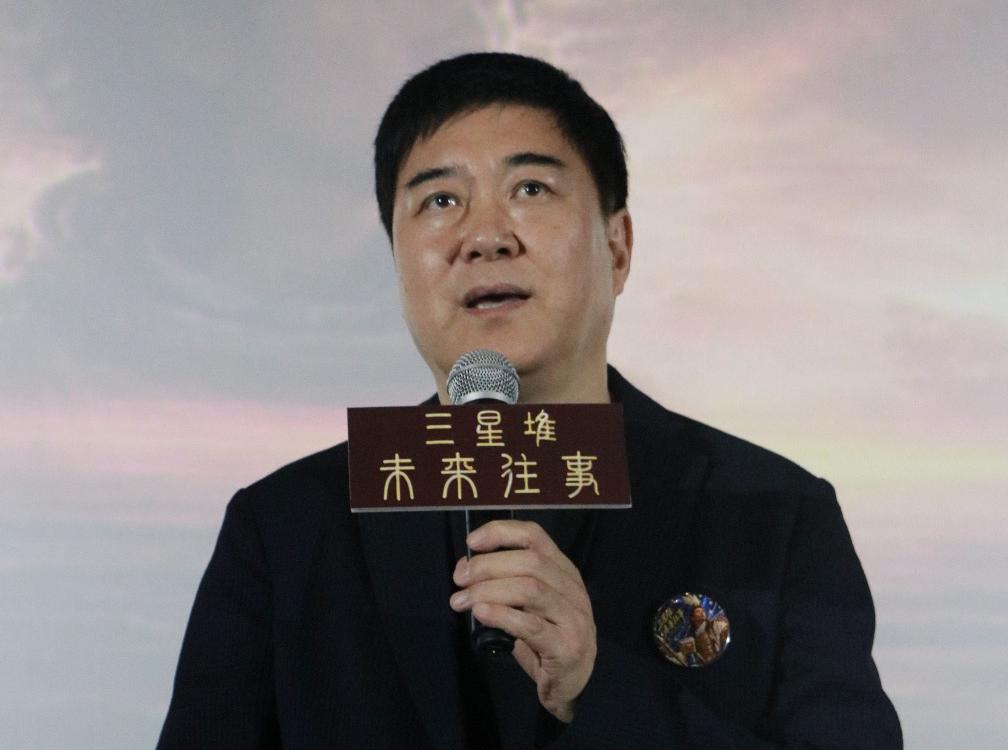
On October 15, halfway through the interview, Jiang Defu, CEO of Bona Pictures (hereinafter referred to as "Bona"), picked up another call in a hurried tone. At that moment, there were only 8 days left before the public release of *Sanxingdui: Past and Future*, but there were still glitches in the film packaging, and the sequence frames, file formats and theater screening adaptation needed to be reprocessed. As the film's producer and chief producer, he has more than 30 years of experience in the industry, and the blockbusters he led and participated in include the *The Battle at Lake Changjin* series, *The Captain* and others. He has not encountered such a "tense" moment for a very long time.
"After we finish this time, we will have the experience and know how to do it," he explained after hanging up the phone.
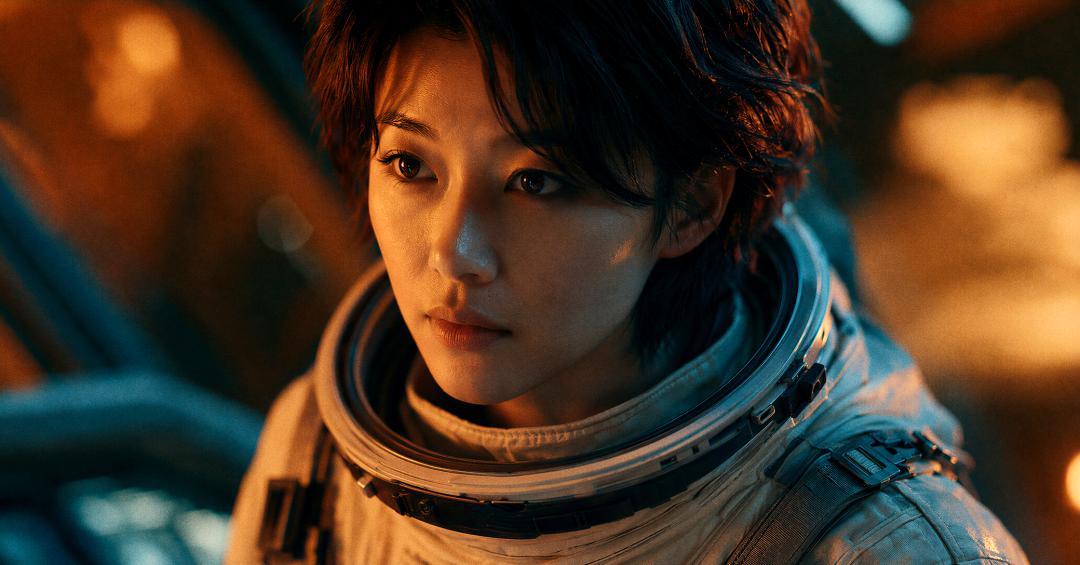
*Sanxingdui: Past and Future* is the first domestic theatrical film produced with AI technology, that has obtained the "Dragon Seal" (i.e., the public screening license issued by the National Film Administration) and been officially released in cinemas. The film tells a story of the cross-time encounter between the ancient Shu civilization and a future crisis: humans in the future receive an incomplete space warning. Archaeologist Jiang Cheng and his partner search for Sanxingdui cultural relics to complete the information, while the experience of the female astronaut Xiling who travels back to ancient Shu gradually reveals the source of the crisis.
Source: Interviewee
After the National Day holiday box office window, the weekly box office for two consecutive weeks in late October was less than 200 million yuan. On October 23, the first day of public release of *Sanxingdui: Past and Future*, its screening share was about 2.9%, and the attendance rate was less than 1%. Data from Beacon Professional Edition shows that as of the evening of November 3, the cumulative box office was only 1.698 million yuan, with about 59,000 viewers.
But a few weeks earlier, after the release of the release schedule announcement, Bona Pictures hit the 10% daily limit on three trading days: September 28, October 9 and October 12, and its total market value rose from about 8.7 billion yuan to 10.5 billion yuan. The company issued two announcements to warn that there is uncertainty in the box office revenue of the film.
On October 26, the first trading day after the film's release, Bona hit the 10% daily limit down. Audience feedback is mixed: some viewers who watched the special screening thought the scenes of the divine bird descending and ancient Shu sacrificial ceremonies were "stunning" and were willing to give the film 8 points; others thought the characters' expressions were stiff and the narrative plot was disjointed, saying "it is equivalent to turning a dozens-of-episodes AI short drama into a feature film".
Investors began to ask questions on stock forums: How many more films does Bona need to make as tuition fees?
The entire sector is being re-priced due to AI. In recent months, A-share AI short drama and AI comic drama concept stocks have triggered a wave of daily 10% limit ups. On November 2, the short drama game sector index rose by more than 8%, and nearly 40 stocks hit the 10% daily limit or rose by more than 10%, including Mango Super Media, Huace Film & TV, Shanghai Film and Bona Pictures.
In the past six months, AI has also subverted the original logic of the film and television industry, especially for short dramas. The National Radio and Television Administration disclosed that 430,000 micro short dramas were launched nationwide in the first 8 months of 2026, of which AI-generated dramas accounted for more than 90%. Cinemas are also rapidly losing audiences. In the first half of 2026, the national box office dropped by 40.6% year-on-year, and the number of movie viewers decreased by 200 million.
Although audiences are already living in AI-generated film and television content, they are still very "demanding" towards AI products. Jiang Defu once received a message saying: Since this is an AI film, it should be free. Audiences naturally believe that the cost saved by AI should be passed on to them. The question has become specific: At this stage, who will pay for AI content?
In fact, the production process of this film was not easy. According to introduction, Bona assembled a team of nearly 100 people for this film, with a total investment of over 10 million yuan in two years. The team generated more than 1.2 million base images and went through hundreds of full-film iterations.
Before the release, Yu Dong, founder of Bona, said in an interview that "Film + AI" and "AI + Film" will develop in parallel: the former assists real-scene shooting, while the latter produces AI-native feature films. Six days later, he emphasized that the pictures that are acceptable on small screens may turn into mosaics when projected on the big screen, and films still require complete craftsmanship, genuine emotions and delicate expression.
Yu Dong does not regard AI as a substitute for live-action films. What he cares more about is whether Bona can use AI to change the cost of projects, production cycles and the utilization method of content assets.
On October 30, Bona released its third quarterly report. In the first three quarters, its operating revenue was 767 million yuan, down 21.07% year-on-year; the net loss attributable to shareholders was 246 million yuan, narrowing by 77.85% year-on-year; the net cash flow from operating activities turned positive to 158 million yuan. Cost contraction and cash flow improvement are real progress, but the revenue scale is indeed shrinking.
To a certain extent, this film is more like an "experiment". Since he founded Bona in 1999, Yu Dong has turned many new projects into continuous production capabilities. Private distribution, Hong Kong film cooperation, and new mainstream blockbusters have all evolved from a single attempt to Bona's long-term advantages. This time, the problem he faces may be more complicated: can the experience left by the first AI film help Bona get out of the financial pressure brought by its blockbuster strategy?
AI "Secondary Line"
Bona started experimenting with AI very early. For this film company that has gone through several rounds of technology cycles, AI was just a new wave at the beginning.
At least Jiang Defu is no stranger to this: the market always rejects first, then adapts. At the beginning of this century, when Chinese films were transitioning from film to digital, he took digital copies to theaters, but no one was willing to screen them, and no one was willing to install digital equipment. But just a few years later, digital projection became the industry standard. From this, he formed an experience: the immaturity and rejection of technology in the early stage cannot directly prove that the direction is wrong.
Bona's AI exploration started earlier than the setback of *Operation Jiaolong*. In 2022, relevant Sichuan provincial authorities put forward a cooperation intention to Bona. Sanxingdui cultural relics are widely known, but the ancient Shu civilization lacks complete written records, which is both familiar and mysterious, leaving room for film imagination.
The team initially considered a live-action sci-fi film, but scenes such as ancient Shu battlefields, large-scale sacrificial ceremonies and future worlds required high investment, and the story framework could not be determined for a long time. Jiang Defu kept asking the team at that time: "How to shoot? Who is the audience?" The project was therefore suspended.
In 2023, generative AI began to enter the public view. He and his team came up with a "lighter" solution: first use AI to make a trailer, and directly turn the direction the team imagined into pictures. In the past, when directors made preview clips, they edited together shots from domestic and foreign films to tell investors "I want to shoot in this style". As they accumulated more and more materials, he decided to go a step further: why not make it a short drama, release it for free on Douyin, and see the audience's reaction. At the end of 2023, Bona established the AIGMS Production Center to turn this kind of exploration into organizational capability.
In July 2024, the AI short drama *Sanxingdui: Future Revelation* was launched on Douyin. Jiang Defu watched the finished film himself and did not give a high evaluation. "I can't even pass my own test, I said this is not good, how can we show it to others?" But shortly after its launch, the views hit 160 million, and later accumulated to more than 200 million.
He revealed that the team originally wanted to shoot the second season, but by mid-2024, the speed of model iteration accelerated significantly, and Yu Dong made the decision to push this IP to the feature film level. "Don't just look at today, look at the day after tomorrow," Jiang Defu said.
Jiang Defu Source: Interviewee
Bona began to expand recruitment for the AIGMS team. There are four criteria for interviews: proficiency in AI tools, experience working with film crews, editing skills, and writing ability. The nearly 100 people recruited include game developers and former TV station staff. But after all the people were recruited, the problems just started. The content submitted by the first batch of people looked good in individual scenes, but they could not be connected no matter how they were strung together. Everyone only worked on their own few scenes, had different understandings of the story, and the rhythm, style and continuity did not match. Jiang Defu then trained the new employees on director thinking for several months.
Another incident left a deep impression on him. He sent people to several companies that had announced they would make AI films to learn, and the people who came back reported: "Mr. Jiang, I'm downstairs, the door is locked, and there's no one inside."
"They are just hyping the concept." Jiang Defu originally thought he was catching up, but that day he found out that there was no one ahead at all.
*Sanxingdui: Past and Future* almost subverted the traditional production process. Before the interview, a Bona staff member told the reporter that there was no real live-action director in the film, and it was Bona's AI team behind it. Jiang Defu explained: "We are the first to eat crabs, and we don't want to put too much pressure on one single person."
There is another more practical reason: in traditional film crews, when the director explains the scene, actors can deliver performances beyond the script; AI cannot, and even when the technology is immature, it cannot perform according to the director's requirements, and cannot even achieve actions like blinking or shedding tears.
No one can be sure which path will work, so it turned into "collective creation". Jiang Defu, chief producer Quji Xiaojiang, screenwriters and heads of various departments held meetings together to finalize every single shot.
Bona initially followed the 17 professional divisions of traditional film crews: screenwriter, director, production, cinematography, art, lighting, etc., all included, but the team soon stumbled on a very simple scene.
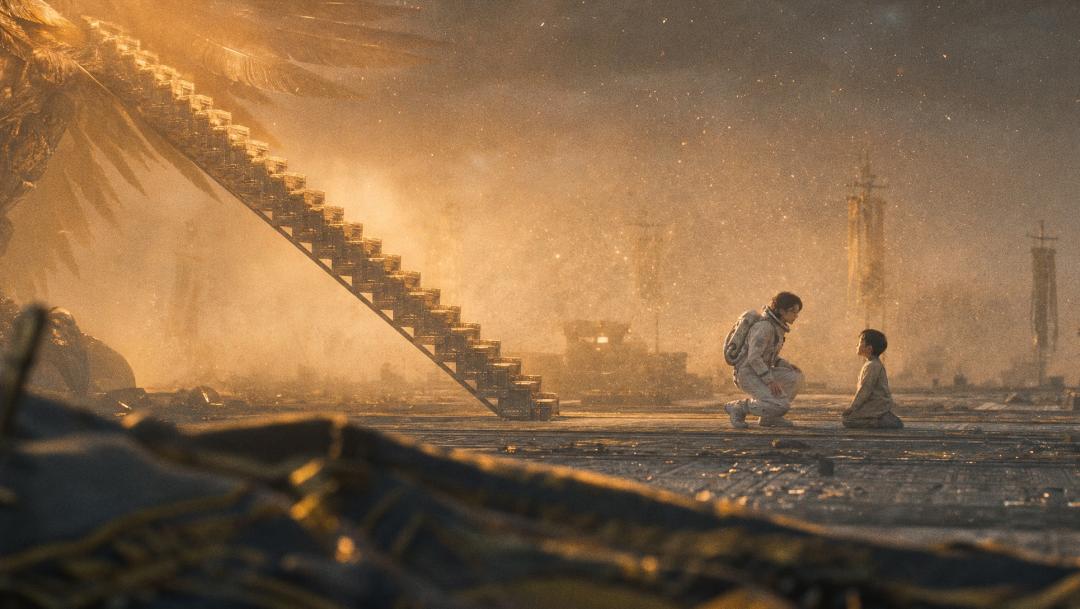
The script wrote: The woman walks up to the boy, bends down and hugs him. In live-action shooting, this shot can be completed in one take. The model at that time could not handle two people getting close and their arms overlapping, and the picture would blur into a mess. The staff modified the prompt words repeatedly and generated dozens of versions, but could not get a usable picture. They had to go back to the screenwriter, and several people reworked the scene: the woman walks in, stops, the two look at each other for a while, then the shot cuts to the boy's reaction. Rewriting the script after generating the storyboard and content, then starting all over again, and going back to modify the script during the editing phase, almost never happened in the traditional film production process before.
Source: Interviewee
Another time, the staff wanted to create a "divine bird" perspective: the shot moves from far to near, gliding over the city gate. The model could never achieve this effect. He repeatedly watched the failed generated materials and found that some deviated from the original idea, but gave him an unexpected angle. Later, the team summed up an experience: do not preset a standard answer, first see what AI outputs.
What is more labor-intensive is content consistency. A character must have the same pores, moles and expressions in different shots; when the bronze mask is viewed from another angle, the patterns must be connected; where the character in the previous shot is looking, the next shot must follow up. These things that are naturally maintained by actors, props and space in live-action shooting now need to be checked frame by frame. Several people in the team were divided into groups, after one group finished checking, another group checked again until no flaws could be found, which they called the "wheel battle".
There are also new problems on the screening side. The film can be made in 2K, 4K, and 48fps, but when projected on the big screen, the characters will shake slightly and the picture will drop frames. In two years, the team changed the technical support model twice. About half of the shots in the trailers released in March and May this year were replaced in the final release version. There were still shots being modified just a few days before the release.
"Film is the art of regret," Jiang Defu quoted this famous saying when talking about this. But the 2.9% screening share on the first day means that most audiences cannot see this film; without large-scale promotion, word-of-mouth has no chance to penetrate the limited screenings.
The first work thus left two different results: the production, licensing and delivery process of AI feature films has been fully validated; audience payment and word-of-mouth conversion are yet to be completed.
In 2025, Bona's AI film and television revenue was 2.387 million yuan; the 2026 semi-annual report shows that this revenue in the first half of the year was 1.9323 million yuan, accounting for only 0.42% of the company's total revenue. *Sanxingdui: Past and Future* did not change much.
Place Big Bets
Before AI, Bona had placed many bets.
In 1999, Yu Dong founded Bona with 30,000 yuan of savings and 270,000 yuan borrowed money. The first film he distributed was *Tell Me Your Secret*, which no one was willing to take after shooting. Yu Dong gave a 1.2 million yuan guaranteed minimum distribution, paid 300,000 yuan deposit first, and traveled from city to city with the contract. The final box office of the film was about 10 million yuan, and Bona earned about 500,000 yuan.
The experience at the beginning of the entrepreneurship shaped Bona's background: dare to be the first, and dare to take risks.
In 2001, Yu Dong obtained the mainland distribution right of the Hong Kong film *My Brothers and Sisters*. According to the usual practice, theaters in various cities arranged screenings in turn, and it would take a long time to cover the whole market. Yu Dong broke the rotation scheduling mechanism, coordinated more than 20 cities to release the film at the same time, and turned this small-budget film into a social topic, with a box office of over 20 million yuan.
The next year, in order to get the mainland distribution right of *The Touch* starring Michelle