Young people flocking to the semiconductor industry: two years of industry dividends that outstrip what others can gain in their entire lifetime.
20 minutes before the job fair closes, the booths of major internet giants have long been empty. Mango thought she was about to be shut out by the semiconductor sector.
But the reality made her freeze in place.
All booths of semiconductor companies are not only crowded with people, but the HR staff are completely swamped by students. The stack of resumes in the hands of an HR from a leading company is taller than their head, and there is another mountain of resumes piled up on the adjacent table.
Before coming, Mango already guessed that the semiconductor industry might be extremely popular. After all, in terms of market performance, ChangXin raked in 54.435 billion yuan in the third quarter alone, a single quarter's profit equivalent to 10 years of Baidu's total earnings; in terms of starting salary, the average starting salary for semiconductor R&D positions reaches 523,000 yuan per year, far exceeding the 353,000 yuan for core business positions in the internet sector……
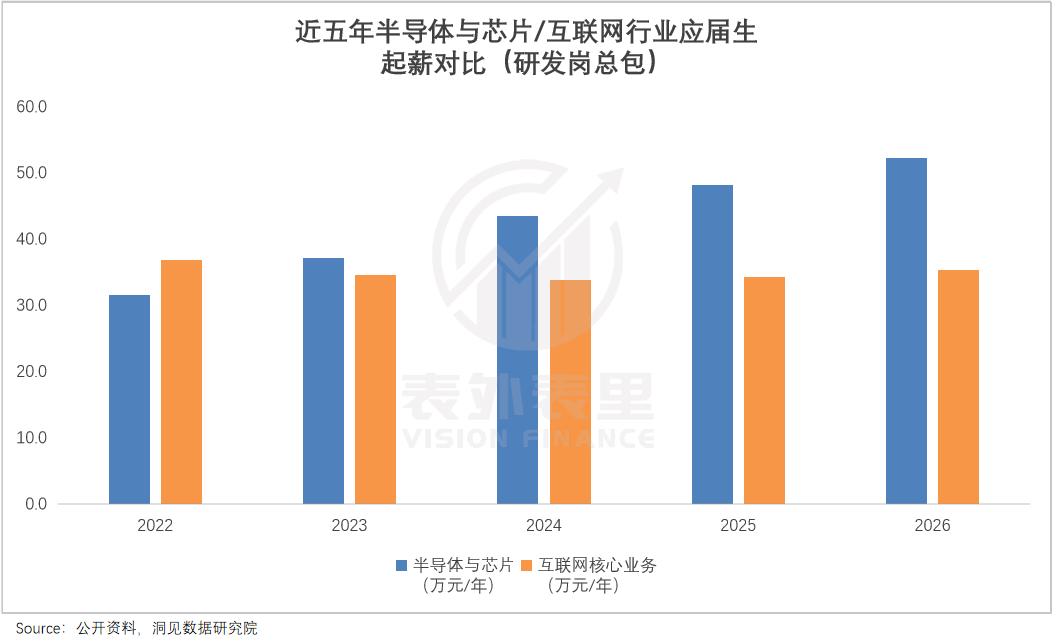
But she never expected that the semiconductor sector would be so hot that she could not even squeeze in to hand in a resume.
At a time when employees of major tech companies are facing "structural downsizing", civil service recruitment is mired in "risk-averse involution", and many popular tracks are cooling down, campus recruitment in the semiconductor industry still presents a thriving scene that usually appears in a period of economic upturn.
In the eyes of job seekers, this train is not the internet-style "short-term get-rich-quick myth". The industry attribute of high investment and long iteration determines that this is a kind of slow dividend, and getting on board means getting a "ticket" that appreciates sustainably.
The dividend of buying a house in four years has long had its price marked
"Xiaojie, if there are suitable positions in China, remember to refer them to me."
While sorting out materials, a message from a foreign colleague popped up suddenly. Fortunes change: the colleague who once persuaded Xiaojie to stay in Europe now actually wants to come to China for career development.
Eight years ago, Xiaojie was still studying in Europe. At that time, the China-US trade war had not yet begun. For every 3 yuan China spent on imported chips, more than 2 yuan went to foreign suppliers. Without say in the industry, there was no promising future, so people back then would "rather be a small fish in a big pond abroad than a top performer in the domestic industry".
However, this situation changed in less than a year. In 2019, global semiconductor revenue dropped by 12.1%, while mainland China bucked the trend and achieved a growth rate of 19.7%, with integrated circuit sales revenue reaching 756.23 billion yuan. The China-US trade war blocked technological exchanges, but it also forced the rise of local leading enterprises.
When Xiaojie graduated, domestic salaries were basically on par with those in Europe and the United States. Today in Germany, the maximum annual salary for a senior IC design position is only 140,000 euros (equivalent to about 1.04 million yuan), while the domestic market already offers up to 1.4 million yuan for the same position. Xiaojie's own salary has long been higher than that of the vast majority of his foreign colleagues.
The dividend train of the semiconductor industry is still growing rapidly, and it has not even had time to close its carriage doors before starting to frantically "recruit people" downward. In this track that is extremely short of talent, the traditional education background hierarchy is being rewritten.
A classmate around him failed even the resume screening of major tech companies in the autumn recruitment. This classmate holds a master's degree from a 985 university, which is far more prestigious than Xiaolai's 211 university degree.
The semiconductor dividend has attracted not only counterparts majoring in microelectronics like Xiaolai, but also a large number of students from majors that are only "marginally related" to the sector. "The lecture hall is packed full of people, there is no space to stand at all."
This is just the situation in one university, what if we add other universities? This means that the people competing with Xiaolai for the same position may not be a dozen or dozens, but thousands upon thousands.
But the whole process went far more smoothly than expected. In less than a month, Xiaolai received an offer for a R&D position at a leading semiconductor company, with an annual salary of more than 300,000 yuan. This figure is basically the treatment reserved for PhD graduates in other majors.
Although luck played a part, the fact that microelectronics graduates get offers almost effortlessly was confirmed by the good news that all his classmates in the same major got semiconductor offers quickly.
The huge scale of the industry even allows "unpromising" majors to get a share of the pie.
Xiaojie has a deep understanding of this. This year, Naura set the annual starting salary for new material PhD graduates directly at 300,000 yuan. "With a little effort, buying a house in a second-tier city after working for three or four years is not a dream."
Seeing this, Xiaojie's friend working at a major internet company exclaimed with envy: "This level of salary is only available to core R&D staff in our company, but the semiconductor industry is giving it directly to new graduates from marginally related majors."
In Silan Microelectronics' 2027 campus recruitment, the proportion of positions open to majors such as chemical engineering and materials, which are traditionally considered "unpromising", directly exceeded 50%.
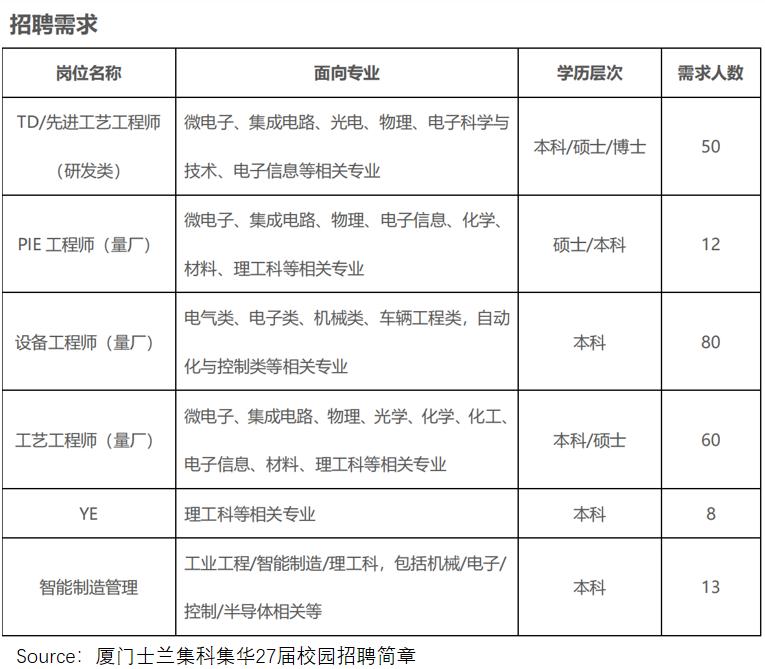
Kaixin, a master's student majoring in chemical engineering, one of the so-called "unpromising" majors, easily got 5 offers in the autumn recruitment. The proportion of his classmates who successfully joined semiconductor companies is as high as 80% to 90%.
However, the seats on this train are always exchanged at equal value.
Xiaoyue, a materials master's student who has already got her share of the "cake", has become the envy of everyone around her.
But before she could enjoy the high salary, she experienced extreme high pressure first. One midnight, Xiaoyue had worked overtime for nearly six hours, too tired to even lift her hand. But a complaint call from the client blew up the whole workshop.
The company's equipment affected the client's products, which in this industry may lead to the company not getting any orders in the future. "Once you are denied by a client, you will be banned from participating in their projects in the future, and your career will be ruined."
Everyone in the team was forced to work overnight to "troubleshoot the problem". The team leader never relaxed his frowning brows, kept bowing and apologizing to the client, and Xiaoyue had never seen him being so humble. Since then, Xiaoyue has been walking on eggshells doing everything, on call 24 hours a day.
Even if the production line is running smoothly, Xiaoyue cannot escape overtime. Clients are continuously ramping up production capacity, and the capacity expansion targets of ChangXin and ChangJiang Storage have soared from 120,000 wafers per month to 150,000 wafers per month. This means Xiaoyue's average monthly overtime hours will increase by 6 to 10 hours just to keep up with the demand.
At the same time, client products are iterating continuously, and equipment upgrades must keep pace. ChangXin even adopted the crazy pace of "one version per week". Every two months, Xiaoyue is forced to work overtime due to a new round of "version upgrades".
Continuous high pressure coupled with irregular work and rest completely broke down Xiaoyue's health. She suffered from eczema outbreaks and severe hairline recession. She could no longer bear this "work-related injury", so she resigned decisively and fled the semiconductor industry overnight.
But not long after escaping from the "storm", Xiaoyue chose to return to the semiconductor industry again.
Get on board first then pick your seat, be a friend of time
Graduating in December, Mango, a PhD graduate, faced an awkward situation: she could not apply for campus recruitment positions in many enterprises. Her classmates either signed employment contracts early, or rushed to send out applications widely to try their luck. Instead of spamming resumes everywhere, she sent all her resumes to semiconductor companies.
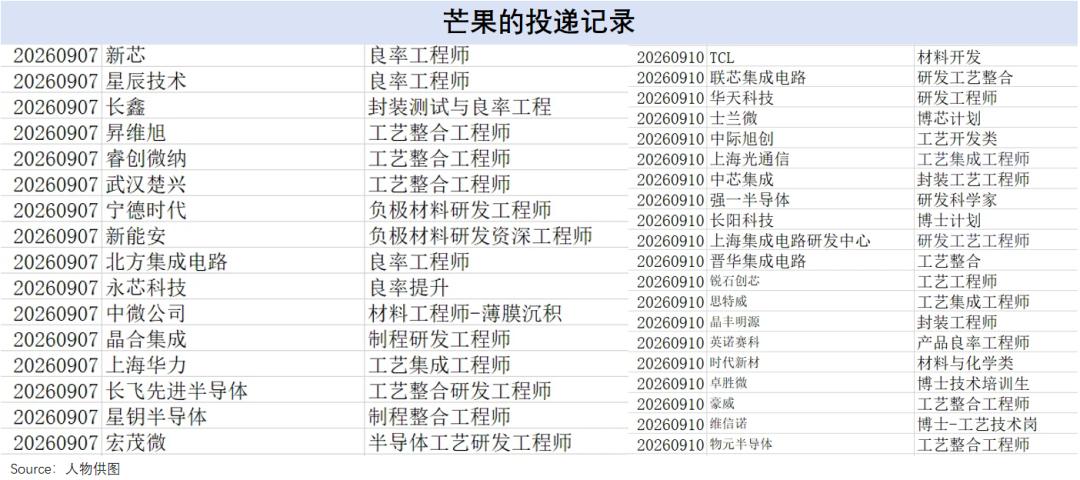
PhD graduates have a relatively narrow range of career choices to begin with. Mango also considered other paths: university faculty positions follow the "up or out" rule; traditional chemical engineering companies offer mediocre starting salaries and require exposure to toxic reagents. In comparison, the semiconductor industry offers starting salaries of 300,000 to 400,000 yuan, and the working environment is clean and safe.
But what attracts her most is that the semiconductor industry "relies heavily on experience, and there is no 35-year-old age crisis".
Take the process engineer position that Mango applied for the most as an example. The career path for this position is a slow-burning upward curve:
Newly graduated engineers can only be responsible for a single process module such as photolithography and thin film on the production line in the first few years, monitoring equipment, recording data and running processes. Only after working for 5 years can they independently take charge of a project or product line, and solve relatively complex technical problems.
Only after working for more than 8 years can they truly enter the golden period of their career: they will have accumulated systematic methodologies, become technical authorities in a certain field, and be able to solve "problems that no one has ever solved before".
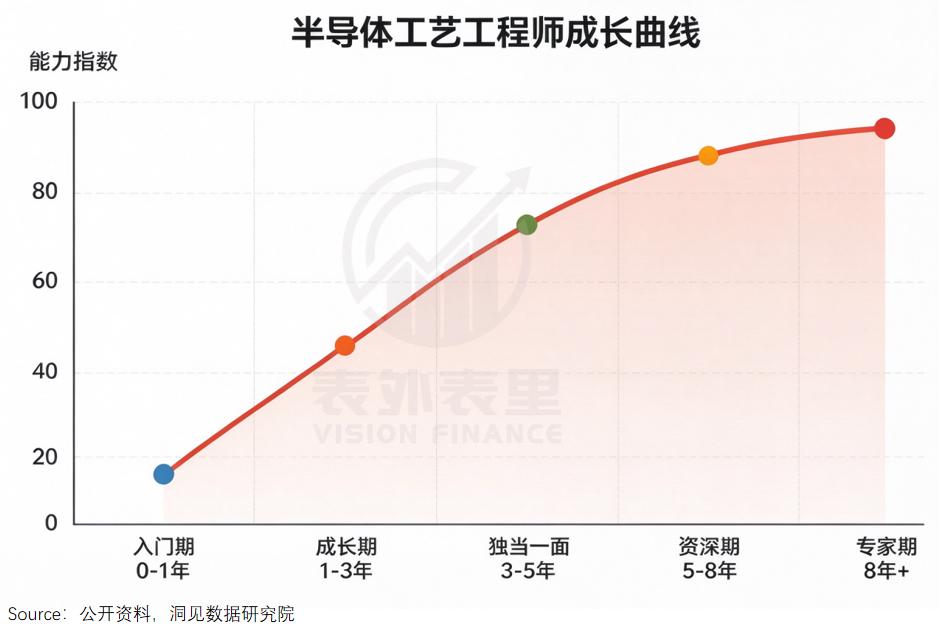
There is even a saying circulating in the industry: A process expert with more than 8 years of experience has more than 10 times the problem-solving ability of a new graduate.
This is a completely different logic from the internet industry.
The internet industry delivers functions: a requirement is split into several interfaces and pages. Young people learn new frameworks faster and write code faster, so they have natural advantages in cost-effectiveness, and people over 35 are naturally eliminated.
The semiconductor industry is a capital-intensive industry. The investment in a single wafer fab is counted in tens of billions of yuan, and the debugging of the production line and the ramp-up of yield often take years. This industry rhythm determines that enterprises naturally need a stable team that can take root for a long time and continuously accumulate process knowledge, rather than replaceable "plug-and-play" manpower.
But the problem is precisely that it takes too long to cultivate such talents.
With the explosion of downstream AI computing power and the exponential growth of domestic substitution demand, the entire industry is expanding rapidly. The current talent gap across the entire integrated circuit industry chain has exceeded 300,000 people, and it is expected to expand to 500,000 by 2030.
But the gap is unevenly distributed. "There is no shortage of people on the manufacturing production lines, what is missing are high-end R&D talents," Xiaojie said helplessly.
His internal referral recruitment post on social platforms has been up for several months, but no suitable candidate has come to him. During this year's campus recruitment of his company, postgraduates from several top microelectronics universities almost got the R&D positions as long as they submitted resumes, because there are far too few people who meet the requirements.
China's semiconductor industry started late and has a weak foundation. Universities cannot produce so many ready-made talents in a short period of time, and academic research may not keep up with the iteration of production lines. It takes at least three to five years to cultivate an engineer who can work independently on the production line. Xiaojie estimates that this structural mismatch will last for a very long time.
However, the absence of the 35-year-old age crisis and the talent shortage do not mean that the timing of entering the industry is not important.
Last year during the golden September and silver October recruitment season, two of Hezi's junior fellow students who are master's graduates easily got R&D positions at leading semiconductor enterprises.
This year it was Hezi's turn to graduate. He started submitting applications in June, but his resumes went nowhere. He finally got interviews, and went through rounds of grueling assessments. In the end he got an offer from a leading enterprise, but the position was changed from R&D to mass production, which required him to work on the production line in the factory.
After some hesitation, he accepted the offer. Compared with the temporary hard work, he values the company's platform, geographical location and the career development path of the position.
More importantly, almost everyone around him wants to enter the semiconductor industry. "If I let this offer go, I don't know if I can get a better one", so Hezi chose to get on board first then pick his seat.
Although the industrial cycle has its ups and downs, Hezi knows that the semiconductor dividend is far from reaching its inflection point.
Reviewing the development law of China's domestic industries, from televisions and automobiles to real estate, it usually takes 15 to 20 years for an industry to grow from scratch and then participate in global competition. The semiconductor industry, counted from the 2018 trade war that choked China's tech sector, is less than 10 years old. In the next 5 to 10 years, AI computing power, HBM and advanced packaging will still be huge booming tracks.
This is a huge track with long-term growth potential, and those who get on board early will eventually get the compound interest of time.
(Special thanks to editor Yang Jing for her support to this article.)
This article is from the WeChat Official Account "Biaowai Biaoli" (ID: excel-ers), written by Chen Zijie and Zhou Huiyu, edited by Reno, and published with authorization from 36Kr.