With a per capita volume of 48 cups, it is selling far more explosively than coffee.
In early autumn, the weather gradually cools down.
On her way to work, Luo Xu, a white-collar worker born after 2000, orders a cup of coffee for herself as usual. After a brief hesitation, she still chooses "regular ice". When heading home in the evening, she detours to a convenience store to buy a drink to go with her dinner. As soon as she enters the store, the hot drink cabinet is fully stocked, but she walks straight to the iced cup cabinet and takes a grape iced cup.
This batch of iced cups was just restocked by the store clerk in the morning. After the beginning of autumn, iced cups still sell well, and "replenishment is required almost every day".
There is no doubt that iced cups are one of the hottest single products in 2026. On Xiaohongshu, the "iced cup" topic has triggered 415,000 discussions with 120 million views. The 2025 White Paper on Chinese Urban Consumer Behavior shows that the per capita annual consumption of iced cups in first-tier cities reaches 48 cups, which is nearly twice the per capita coffee consumption.
A cup of ice is like a mirror, reflecting eating habits, intergenerational differences and life changes.
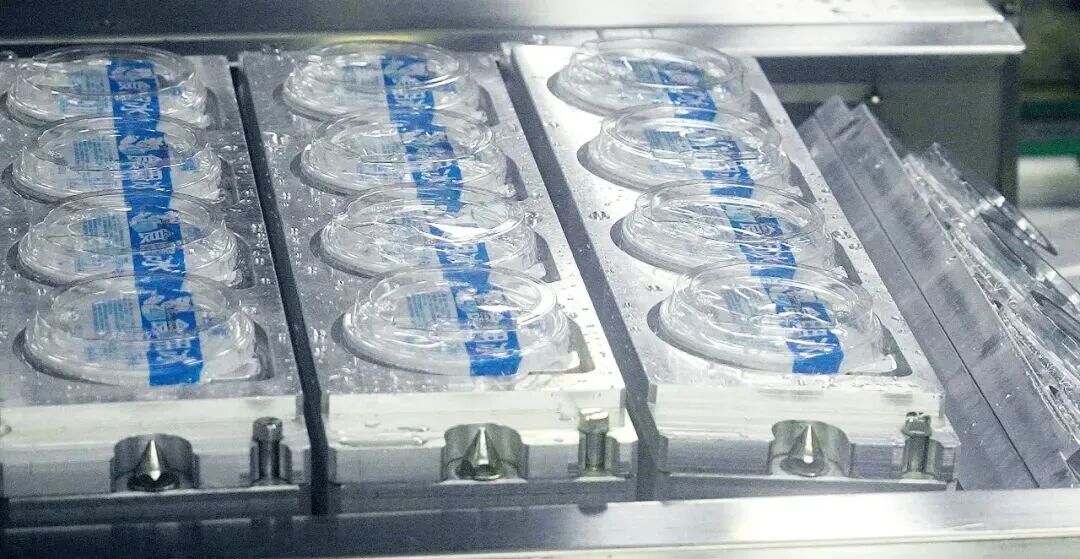
Iced cup production workshop Photo / Provided by the interviewee
Occupying the C position in convenience stores
Since January this year, the production capacity of Guangzhou Binglida factory has been at full load. Workers work in two shifts, 10 production lines are almost non-stop, and the daily average ice production has reached 300 tons.
At first glance, making a cup of ice seems very easy — just freeze water, which can also be done at home.
Luo Xu once bought an ice tray to make ice by herself, but the result made her give up. Not to mention the troublesome process, the ice she froze was not only white with bubbles and cracks, but also a little "puffy". "Almost the moment I poured the drink into the cup, the ice cubes began to melt and shrink, and disappeared after a few sips."
In response, Liao Bilin, general manager of Binglida, explained to China Newsweek that there is actually a big difference between commercial edible ice and the ice frozen at home.
Iced cups mainly include three links: "water making", "ice making" and "ice processing". The first is the water making link. When the source water enters the factory, it will go through filtration of quartz sand and activated carbon in turn to remove impurities and peculiar smells to obtain pure water.
Then comes the most important ice making link. Since water does not exist in the form of single molecules in the natural state, but in the form of "water molecular clusters", ice formed under such structure will have a disordered arrangement problem. To put it simply, it will produce bubbles and white spots in the ice, which is also the reason why the finished ice made at home is not good.
The factory production line simulates the water flow state in the natural environment to make the water flow slowly in the mold, so that the ice can gradually "grow". "The ice obtained in this way is harder, more transparent, and more resistant to melting," said Liao Bilin.
As for the ice processing link, ice cubes are cut and filled in a low temperature environment according to product requirements. The whole process takes a lot of time. Liao Bilin revealed that for 50kg of raw ice, the slow freezing time alone takes about 16 hours.
In recent years, iced cups have gradually occupied the C position in the cold drink area of convenience stores. In 2023, Luo Xu went out for an internship, and there was a Lawson convenience store downstairs of the community she rented, where she often bought iced cups. She remembered that at that time, iced cups were squeezed in the same freezer with ice cream, with very little space. Today, iced cups are often placed in the main display areas on the first and second layers of the freezer.
The same is true for convenience stores such as 7-Eleven, FamilyMart and Bianlifeng. Iced cups already have their own exclusive freezers. Among them, 160g iced cups take up one third of the space, and the rest of the area is filled with 220g large-capacity iced cups, flavored iced cups and bagged ice.
Clerks generally said that the display change of iced cups was gradually completed in the past 3 years — from being squeezed together with ice cream, to the space expanding little by little, and finally having an exclusive freezer.
After iced cups become easily available, consumers have begun to play tricks. Walking into convenience stores, you can see "cocktail making guides" posted everywhere; online platforms also have many bundled packages of "alcohol + drink + iced cup", priced at 20 to 30 yuan.
Freshippo has also set up special cocktail bars in offline stores. According to Freshippo, the cocktail bars were piloted in April this year, and rolled out across the country on a large scale in May. They are basically placed in important areas of the stores, with prices ranging from 19.9 yuan to 49.9 yuan.
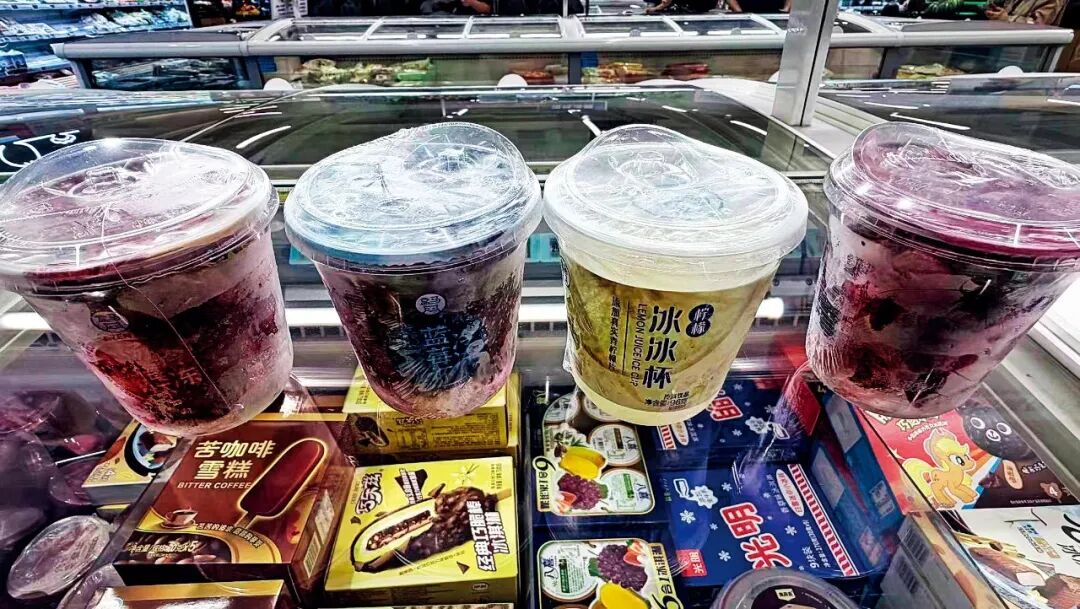
Flavored iced cups on the market Photo by Gao Yue
From supporting role to leading role
Iced cups are not new things. Before becoming the leading role, it had been a supporting role for many years.
Bingjixiang entered the edible ice field in 2012. At first, it supplied production ice for food enterprises, and later served catering brands such as Mixue Bingcheng to provide raw edible ice. As early as 2017, Sun Lei, chairman of Bingjixiang, found that "iced cups have become daily consumer goods in Japan and South Korea, which is a long-term sustainable and promising category".
Therefore, Bingjixiang began to try to make iced cups, but at that time domestic consumers had insufficient awareness and acceptance of iced cups. "The factory's daily average ice production was only about 50 tons," Sun Lei told China Newsweek.
It was not until 2022 and 2023 that Sun Lei clearly felt that the development of freshly made tea and coffee had increased the public's acceptance of iced drinks. According to data from the China Chain Store & Franchise Association, the number of freshly made tea stores exceeded 486,000 in 2022, and the industry began to enter a mature period. Then in 2023, Cotti Coffee and Luckin Coffee successively launched price wars, the price of a cup of freshly ground coffee was pressed to single digits, and more and more people formed the habit of "drinking a cup of iced coffee every day".
As a result, iced cups have become a cost-effective alternative for many people. Sun Lei revealed that from 2023 to now, the production and sales volume of Bingjixiang has doubled every year, and the company has gradually expanded from a regional enterprise to the whole country. Up to now, Bingjixiang has 19 fully automatic production lines, the daily average ice production has increased to 450 tons, and the daily output of pure water iced cups alone has reached more than 1.2 million cups.
It was two events in 2024 that made iced cups truly break through the circle.
In 2024, Nongfu Spring successively launched 160g and 190g iced cups, making iced cups a product with brand endorsement. In the same year, Mixue Bingcheng launched "1-yuan iced cup", which directly broke through the 3-9 yuan price range of convenience store iced cups. The entry of these two giants made iced cups as an independent product be put into consumers' shopping carts separately.
As proof, data from offline retail monitoring agency Mai Shangying shows that iced cups entered the upward channel since the second quarter of 2024, and the year-on-year growth rate once exceeded 700% in the second and third quarters of 2025.
Iced cups, which have become the leading role, have gradually derived many innovative forms. Bingjixiang launched a lemon iced cup as early as 2023. "At first we used frozen lemon slices, but found that the aroma was not enough. After internal improvement, we later switched to fresh An Yue lemon slices," Sun Lei said. "This product has always performed well in sales. According to the sales scale this year, the monthly lemon purchase volume can reach 100 tons."
During the World Cup this year, Bingjixiang launched a football-shaped slow-melting iced cup. Sun Lei said that the sales of this football iced cup exceeded 5 million cups. Bingjixiang built a new high-end pure ice workshop and continued production from the third quarter of last year to the first quarter of this year to ensure the supply of core channels.
As the consumer mindset of iced cups deepens and the number of buyers increases, the price has also come down.
Taking Freshippo's 160g iced cup as an example, the original price was 4.9 yuan in 2021, then dropped to 3.5 yuan and 2.9 yuan, and this year it has dropped to 2.5 yuan.
Now this kind of "involution" of low price has become a common trend in the industry. According to data from Mai Shangying, from the second quarter of 2024 to the second quarter of 2026, the proportion of iced cup products priced below 3 yuan is gradually increasing.
Sun Lei said that behind the price reduction is the change of power. Before 2023, the supply of the iced cup industry was less than the demand, and the production factories had the pricing power. By 2024, it entered the stage of full competition, and the ex-factory price of iced cups decreased by 10%-20% every year. By 2026, due to the oversupply of the iced cup market, the channels have the pricing power. "Normally, these three stages take 5-8 years, but in China it only took three years to complete."
What you buy is not only an iced cup, but also an experience
Whether it is Sun Lei, Liao Bilin or Luo Xu, they all have a common feeling: people buy not only ice, but also an experience.
According to the Nielsen IQ consumer survey, 69% of iced cup consumers will use them to DIY drinks. On Xiaohongshu, the "convenience store cocktail" topic has 816,000 discussions with 550 million views.
Luo Xu is a typical case. She has several fixed collocations: for the "sweet drink" with meals, she likes to use grape juice with grape iced cup; when she wants to get slightly drunk alone, she uses low-alcohol Fruit Cubes with peach-flavored sparkling water, or Meijian rice wine with grapefruit-flavored Vitamin C water.
For her, in the past, when she bought drinks in convenience stores or went to izakaya for drinks, she could only choose finished products from shelves and menus, and the sweetness, ice amount and ratio were mostly fixed. Now she has the right to define a cup of drink, "whatever I want to drink depends on my mood".
Ran Meng, a post-2000s working in the advertising industry, regards her daily lunch break as a time to relax — she takes a walk in the park first, and then goes to the convenience store to make a drink. Compared with the moment of tasting the flavor, she prefers the DIY experience process.
"Sometimes just follow the cocktail recipe step by step, you can replicate the same drink as in the bar. Even these recipes have a high fault tolerance rate. If there is too much alcohol, add more drink; if the taste is too sweet, add more alcohol. The whole process will not make you anxious at all. You can also make some innovations, add fresh fruit or ice cream, and you will hardly make mistakes."
Now Ran Meng has almost become the "drink mixing master" in her social circle. When colleagues go to the convenience store to buy iced cups together, she will recommend formulas according to everyone's preferences.
Practitioners quickly captured consumers' demand for experience.
Liao Bilin shared that in recent years, camping and outdoor sports have become a trend, and people often have the need to take photos and check in. "If a plastic bottle appears in the photo, it may ruin the atmosphere, but if an iced cup with rich colors and nice shape appears, it will be more suitable." Therefore, many enterprises have launched "ton ton buckets" specially for outdoor needs, which are not only sealed to prevent tipping, but also beautiful and have social attributes.
In addition, Freshippo's special-shaped iced cup in the shape of Freshippo's mascot, and the "cat paw" iced cups and "bear-shaped" coffee iced cups in some convenience stores, all target this kind of self-pleasuring experience.
In the eyes of practitioners, to some extent, buying an iced cup is the same as opening a blind box, and you get the same sense of satisfaction after opening it.
No joy without ice
From the time when Luo Xu, Ran Meng and others drink ice, it almost reflects the changes of a generation of consumers' living habits.
Luo Xu recalled that when she was in middle school, freshly made tea began to become popular. Milk tea shops opened in her school, and many brands were distributed around her home. At that time, adding ice to milk tea was the default option, and many products even noted that "without ice, the flavor will be affected". Since then, she has been used to drinking one or two cups of iced milk tea every week.
Later when she went to college, when she attended classes daily or stayed in the library during the final week, she and her classmates were almost inseparable from iced Americano. Even if the weather occasionally turned cold and she wanted to switch to normal temperature, she always felt "it doesn't taste right" and would switch back to "add ice".
However, in her family, drinking ice is controversial. The common sense of her parents' generation is: drink more hot water, and cold food is bad for health. But Luo Xu has been eating ice since she was a child, from iced cola, iced milk to iced milk tea and iced cups. The tradition of "drinking more hot water" has been broken much easier than imagined.
In the view of Wang Zhendong, chairman of Shanghai Feiyue Investment Management, there is a physiological basis for drinking ice. He explained to China Newsweek that human taste buds have different perception of different flavors at different temperatures, and sour flavors usually perform better when iced. "Ice will make the sour flavor brighter, and the sweetness will not be too cloying, but more refreshing." This is true for specialty coffee, as well as fruit tea with sour and sweet as the main tone.
Wang Zhendong also observed that the development of freshly made tea and coffee has increased the public's frequency of drinking ice, but the personal budget is limited, so people will try to reduce the unit consumption price, which forms a consumption motivation to figure out how to drink drinks cheaply, such as buying iced cups to make drinks by themselves.
Many industry insiders revealed that the main audience groups of freshly made tea, coffee and iced cups almost overlap. For the post-1995s and post-2000s who love ice so much that they can't live without it, it seems natural to fall in love with iced cups in order to drink iced drinks more conveniently and cheaply.
This normalized habit of drinking ice is making iced cups cross seasons.
Freshippo revealed that the seasonal characteristics of iced cups are far less obvious than ice cream. Normally, the consumption proportion of ice cream in peak season and off season is 70% and 30%, while that of iced cups tends to be 60% and 40%.
The industry generally believes that once this habit of no joy without ice continues to develop, the Chinese market may be similar to Japan and South Korea, making iced cups a mass consumer product. According to data from Zhiyanzhan Industrial Research Institute, the annual consumption of convenience store iced cups