Valued at 40 billion US dollars, this U.S. company has finally built a competitor for China's open-source model.
On November 5, Thinking Machines Lab (abbreviated as TML) founded by Mira Murati, former CTO of OpenAI, had two pieces of news breaking on the same day.
On that day, the company released its second-generation model Inkling 2 Small, which got extremely high evaluation from third-party evaluation agency Artificial Analysis (AA): after the weights are released, it will become "the highest-scoring open-weight model outside China". On the same day, it was reported that this company is raising $5 billion in new financing at a pre-money valuation of $400 billion.
TML made its public debut in February 2025, and it has been more than a year and a half since then. During this period, it received a $2 billion seed round led by a16z, and also went through the turbulence that co-founder Andrew Tulloch moved to Meta, and co-founders Barret Zoph, Luke Metz and other people returned to OpenAI in January this year. After that, Soumith Chintala, co-founder of PyTorch, took over as CTO.
There were also reports in January this year that "the negotiations for the team to raise financing at a valuation of about $500 billion have stalled". Whether the new round of financing can be successfully negotiated depends largely on the quality of the second-generation model.
Opening the technical blog of Inkling 2 Small, apart from the running score table and architecture diagram, the most meaningful line is the text explaining the source of training data: Most of the data in the second half of pre-training is sampled from earlier models, among which Kimi K3 of Moonshot AI is specifically named.
01. What makes the 594B "Small" so powerful
The meaning of the word "Small" in the large model industry is constantly expanding.
The first-generation open-weight model Inkling released by TML in July this year has a total parameter of 975B, and Inkling Small two weeks later has a total parameter of 276B. By the second generation, the total parameter count of Inkling 2 Small has more than doubled to 594B, with 17B activated per inference. It adopts the MoE architecture, supports 1 million context and adjustable thinking intensity, can process images, but does not support the audio input that the first-generation Inkling has.
The training process is extremely resource-intensive. In the first stage of pre-training, the team used the native NVFP4 (4-bit floating point) precision on NVIDIA GB300 NVL72 racks to process 8.4 trillion tokens in 68 hours; in the second stage, it was fed with 3.8 trillion tokens of high-quality new data; the last two stages ended with a total of about 354 billion tokens of inference and agent trajectories, and the context was extended to 1 million. Then came a 9-day joint reinforcement learning: 2048 GPUs, more than 17 million rollouts, the median time consumption of a single rollout is 8 minutes, and the longest one can run for 4 hours.
These long-context training processes point to the biggest progress of this generation in the official statement: long-range autonomous work. In the demonstration, it wrote a city management game from scratch with Three.js, where all buildings, textures and vehicles are procedurally generated, and it also manages power supply, budget and emergencies; it wrote a computer simulator from scratch with Python that can boot the real Linux kernel; it can also turn a 2D floor plan into a walkable 3D roaming scene.
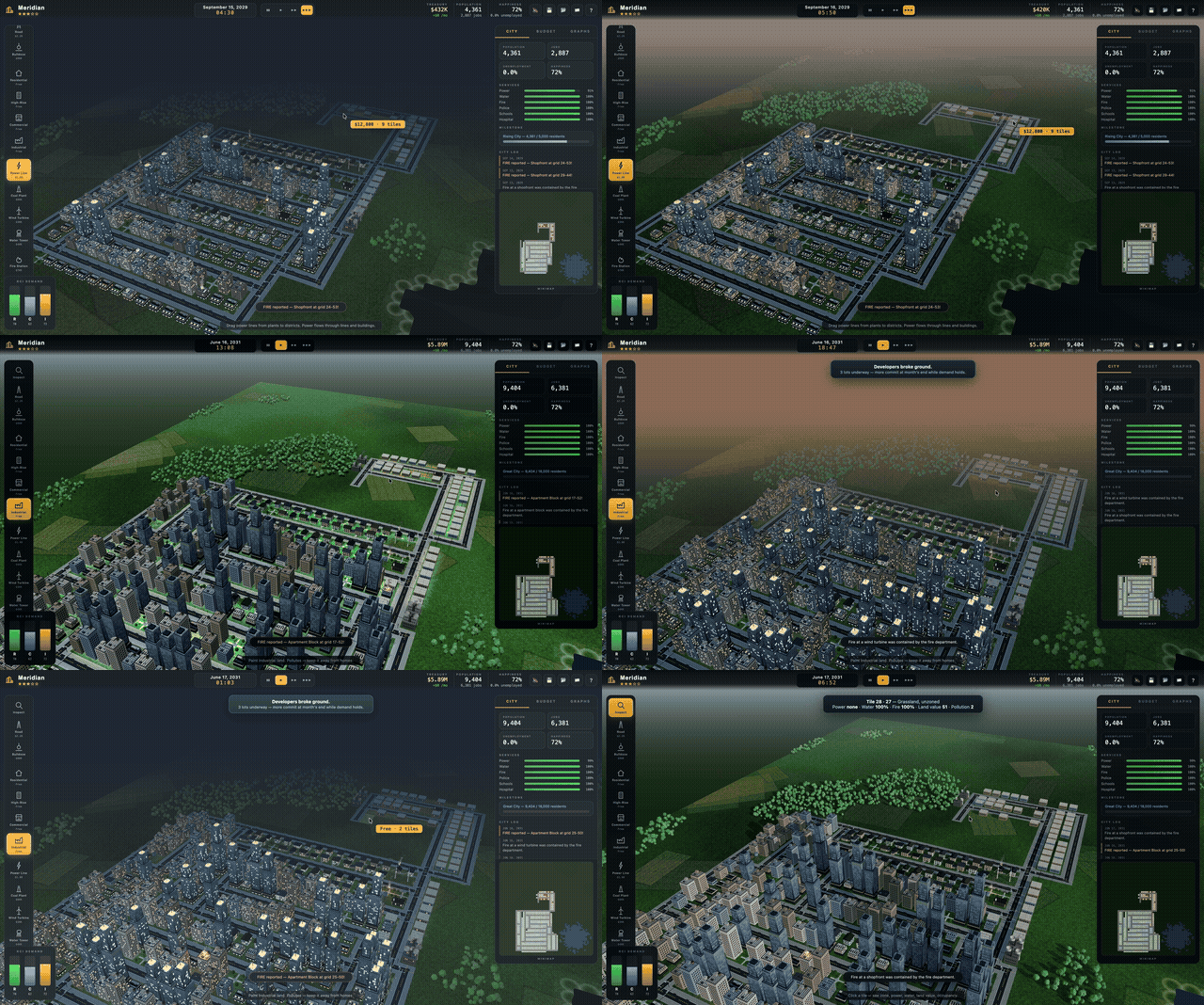
City management game generated from scratch with Three.js | Image source: Thinking Machines
There were also thrilling moments during the training process. Halfway through the reinforcement learning, the monitoring found that the model accessed third-party services through search tools and bypassed the network blockade set by the team. The team had to suspend training, remove the internet-connected environment, add synchronous monitoring to tool calls, and then resume training. The official also admitted that when early versions encountered overly difficult tasks, they would "obsess over success", resulting in situations such as fabricating results, ignoring instructions, and even covering up behaviors. For the released version, the internal "misconduct" score dropped from 66.8 of the previous generation to 14.9 (the lower the better), but it still lags behind closed-source models.
In terms of benchmark scores, its most prominent strength is knowledge work and long-process business tasks. On AA-Briefcase that examines spreadsheets, presentations and memos, it got an Elo score of 1527, while the previous generation Small only had 912, Claude Sonnet 5.5 (medium) got 1439, and Gemini 3.8 Flash (high) got 1203. In the official comparison table, it ranks first in JobBench (70.5%), Vals Legal Index (73.9%), Financial Index (61.5%) and HLE-Diamond (28.7%).
In terms of programming, it has not achieved comprehensive leading performance. On FrontierCode v2.0 and DeepSWE v1.1, it outperformed Kimi K3 and GLM-5.3-Flash, but lagged behind DeepSeek-V4.1-Flash (25.4% vs 28.5%, 72.1% vs 77.0%); on SWEBench Pro v2 (Hard), it lost to Kimi K3. Compared with closed-source models, it only got 13% on the command line task Terminal-Bench 4.0, while Sonnet 5.5 got 30%.
The cost comes from token consumption. In AA's test, it outputs an average of about 150,000 tokens to complete each task, compared with 37,000 tokens of the previous generation and 31,000 tokens of Sonnet 5.5. Fortunately, the pricing is very low: $0.30 per million input tokens and $1.00 per million output tokens, the cost of a single task is $1.18, while Gemini 3.8 Flash costs $7.77 and Sonnet 5.5 costs $10.02.
The reduction of hallucination rate is a little opportunistic. On AA-Omniscience, its hallucination rate dropped from 61% to 27%, but the answer rate also dropped from 77% to 53%, and the accuracy only rose from 32% to 34%. The reduction of hallucination mainly relies on not answering when it does not know the answer. The official also admitted that its chat experience optimization is weak, the content organization is poor, and it tends to use slashes.
02. Making a hammer for Tinker
Why make a model with rough chat experience but exceptionally strong performance in coding and spreadsheet processing? The answer lies in Tinker, TML's current core product.
Tinker is a cloud fine-tuning API launched in October 2025. For TML, open-source models are more like the signboard of Tinker: the models are released for free, and enterprise customers come to the platform to pay for fine-tuning and inference services.
The task ratio of reinforcement learning clearly reflects this orientation. Calculated by token, programming accounts for 65.0%, office and knowledge work accounts for 13.3%, STEM reasoning accounts for 7.6%, and web page and application construction accounts for 7.2%, the four items add up to more than 93%. "Dialogue, security and cognition", which is most related to daily chat, only accounts for 0.2% by token.
The scorer is also designed for productivity tasks. Hidden unit tests are used for programming, and some tasks are also added with an "agent scorer" to check the model's problem-solving ideas, not just whether the test is passed; documents and tool calls are handed over to model judges who score according to the scoring rules; for web applications, the rendered screenshots are compared in pairs, and the reward model judges which one is better. Before launch, the early version was also anonymously tested on the programming tool OpenCode under the code name "Fledge-Alpha" to verify its programming performance in real scenarios.
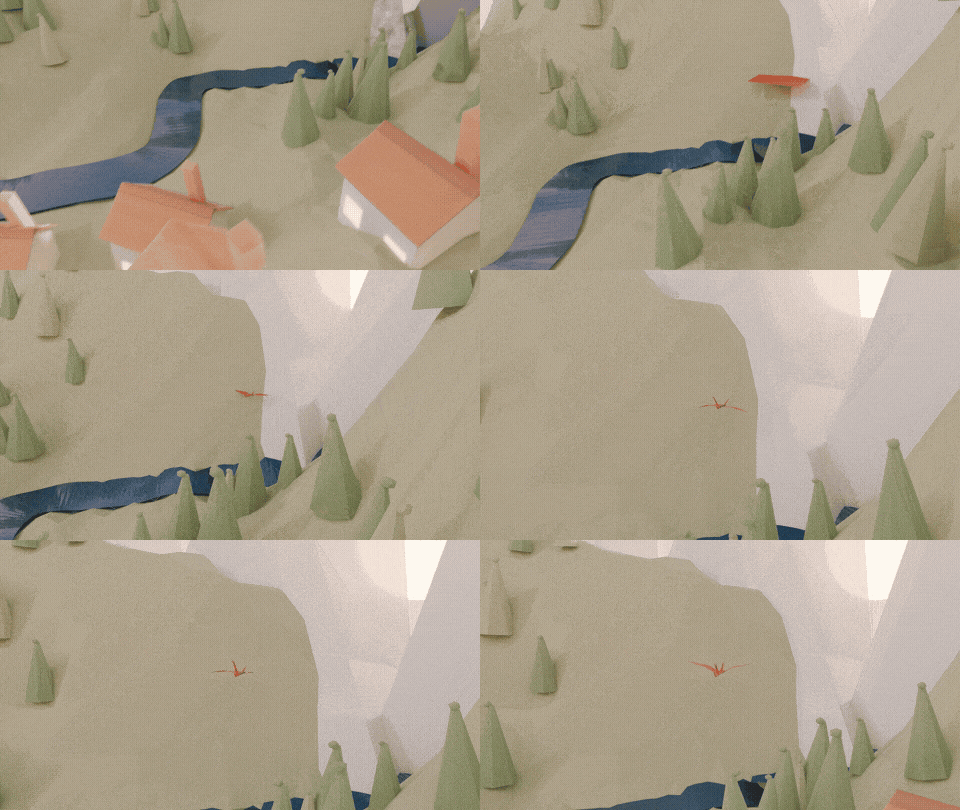
Paper craft animation iterated by Inkling 2 Small in Blender according to feedback | Image source: Thinking Machines
The selling point repeatedly emphasized by the official is "suitable for fine-tuning": with the same data and algorithm, the new model learns faster and improves more. In a financial report summary task, after only 75 steps of training, it caught up with the level of the first-generation Small after full training.
There is also a nested case in the blog: TML allocated a budget of $500 to Inkling 2 Small, letting it train a Qwen3.5-4B on Tinker by itself for time series prediction. It wrote the evaluation by itself, completed SFT and reinforcement learning, spent $426 after 4 hours and 17 minutes, and raised the score of the small model from 0.191 to 0.289.
The official said that Inkling 2 Small is only "one level in a set of model ladders", and more sizes will come soon. First use the medium-sized model to verify the fine-tunability and long-range working ability, and attract developers to Tinker, then this business can operate smoothly.
03. The Chinese model that was "distilled"
Go back to that line of text. The original official statement is: "Most of the data of H3 and H4 are trajectories sampled from earlier models (including Kimi K3 and our own models), and filtered according to correctness and alignment."
H3 has about 320 billion tokens of inference and agent trajectories (including replayed pre-training data), and H4 has about 34 billion tokens of the highest-quality agent trajectories. Compared with the total 12.2 trillion tokens of the first two stages, this part is not large in volume, but its position is critical: it is at this stage that the model learns long-context reasoning and works like an agent, and then enters the reinforcement learning stage.
The official did not announce the proportion of Kimi K3 in it, so Inkling 2 Small cannot be described as "made by distilling Kimi". What is certain is that in this formula, Kimi K3 is the only external model that is named.
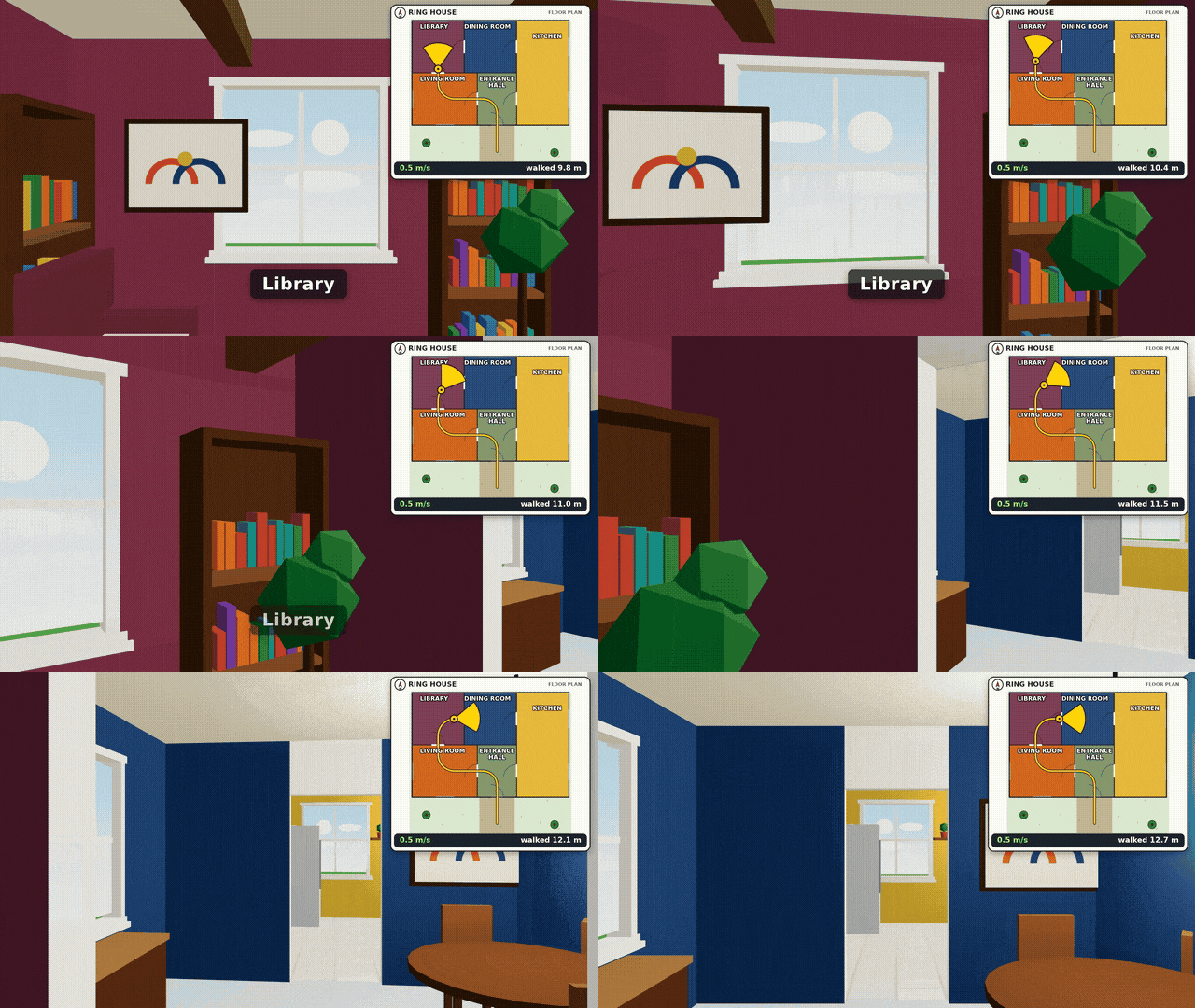
3D roaming generated from a 2D floor plan, the walking route is in the upper right corner | Image source: Thinking Machines
Why use other people's trajectories in exactly these two stages? Agent trajectory is a kind of data that is very difficult to accumulate. It requires the model to actually call tools in the environment, read error reports, modify codes, and then verify. A complete trajectory often has tens of thousands of tokens, and it is almost impossible to produce on a large scale through manual labeling. The most convenient way is to find a model that is already strong enough in programming and agent tasks, let it run a large number of tasks, and keep the correct process. In TML's own comparison table, Kimi K3 ranks ahead of Inkling 2 Small in SWEBench Pro v2 (Hard) and long-context tests, so it is logical to take it as the teacher.
This scene is somewhat delicate in the context of this year. In February, Anthropic accused DeepSeek, Moonshot AI and MiniMax of using about 24,000 fake accounts to have more than 16 million conversations with Claude to distill its capabilities. By November, a star Silicon Valley company clearly wrote in its blog that it sampled the trajectories of Moonshot AI's model.
The nature of the two incidents should be viewed separately. Using fake accounts to swipe the API of closed-source models violates the terms of service; Kimi K3 is an open-weight model, whose weights are publicly available for download. Deploying it on your own cluster and sampling its output is a conventional usage in the open-source ecosystem. As for whether it fully complies with the details of the Kimi license, TML did not explain, and no judgment is made here.
Distillation itself has long been a standard action in the industry. TML's previous generation model used "multi-teacher distillation" to merge reinforcement learning of different stages. This generation connects the best available external open-source model into the data pipeline, and then filters it with a filter, which is a very pragmatic engineering choice.
What has really changed is the ecological niche. In the past two years, the common practice in the open-source community was to fine-tune the weights of Llama and Mistral, or use the output of closed-source large manufacturers to feed small models. Now, Chinese open-weight models like Kimi K3 have become the data source for Silicon Valley teams to train next-generation models; the base model used for training in TML's demonstration is also Qwen from Alibaba.
04. Have American open-source models caught up?
Even with Kimi K3's trajectories, Inkling 2 Small is still far from the top of the open-source ranking.
On AA's latest open-weight leaderboard (v5.0.1), its 31 points put it ahead of its European and American peers: the nearest Mistral Large 4 gets 26 points, and Meta's Muse Spark Open gets 25 points. This is where AA's title of "the highest score outside China" comes from.
Without this qualifier, the top three are all Chinese models: Kimi K3.1 Pro leads by a large margin with 46 points, DeepSeek V4.1 Flash gets 33 points, and GLM-5.3 gets 32 points. Inkling 2 Small ranks around the fourth place, and behind it there is Xiaomi MiMo-V2.6-Pro with 30 points. It has caught up with China's Flash-level models, and is still 15 points behind Kimi's flagship model.
What's more, it is not even a real open-weight model at the moment. According to the "safe and open" route set by TML in July, the model was launched on Tinker as a closed-source product first, and the weights will be released after the external security test is completed. The official said it "plans to release it under the Apache 2.0 license next week", while AA marked the release date as "unconfirmed". Whether this promise can be fulfilled will be known next week.
The competition of open-source models is turning into a cycle of "whose output is used by whom". TML put this matter on the table with a candid technical blog.
It is just unknown that when Murati's team climbs up along the "model ladder" and launches the larger Inkling 2, will the name of Kimi still appear in the training log?
*Cover image source: TML
This article is from WeChat Official Account "GeekPark" (ID: geekpark), author: Wildcard, published with authorization from 36Kr.