Are old hotels destined to be "undying old relics that never fade away"?
Some time ago, I saw a post on WeChat Moments that a friend had his eye on a building in the core area of a third-tier city. It was a well-established 4-star hotel opened in 2018 with a prime location, and the owner's quotation was temptingly low.
The top comment in the comment section was from a hotel investor, who wrote: If you take over the hotel, how much will the renovation cost? If you don't renovate it, how many people will stay here? Young people won't even glance at it.
If you think about it carefully, that's exactly the situation of old hotels: they can't sell rooms at a good price and can't retain guests. Some people call them "zombie hotels", and some even refer to them by a derogatory term that roughly means "old things that refuse to die".
But Hotel Management Finance believes that the term "old things that refuse to die" actually has two layers of meaning: one is that the property has no value and just lingers on without making progress; the other is that despite its age, it still has the potential to radiate new vitality.
The problem with old hotels is not just their age, but that they use their "seniority" as an excuse to stand still and make no progress.
Closing stores, de-branding, liquidation and being eliminated are not the inevitable end that all old hotels will face across the board.
01 A large number of "aging hotels" are collectively eliminated
Young people nowadays do not simply "refuse to stay" in old hotels, they even detest them and get annoyed just looking at them.
The complaints about old hotels on Xiaohongshu are so numerous that they can almost compile a complete book of "Scandals of Dilapidated Old Hotels".
A hotel in Wuhan renovated in 2018 has mold spots all around the shower switch, and guests will be hit by the distinct smell of old houses as soon as they walk into the room corridor, which is jokingly described by netizens as "feeling like staying at my grandpa's house";
A hotel in Beijing has severe sewer odors and facilities that bear traces of long history, which is called "one of the smelliest 5-star hotels in Beijing" by guests;
There are also some hotels that claim to be quasi-4-star, but their guest rooms are filled with old furniture from the 1980s with peeling paint. The old air conditioners that hide dirt and the carpets stained with patches of grime make people avoid them at first sight.
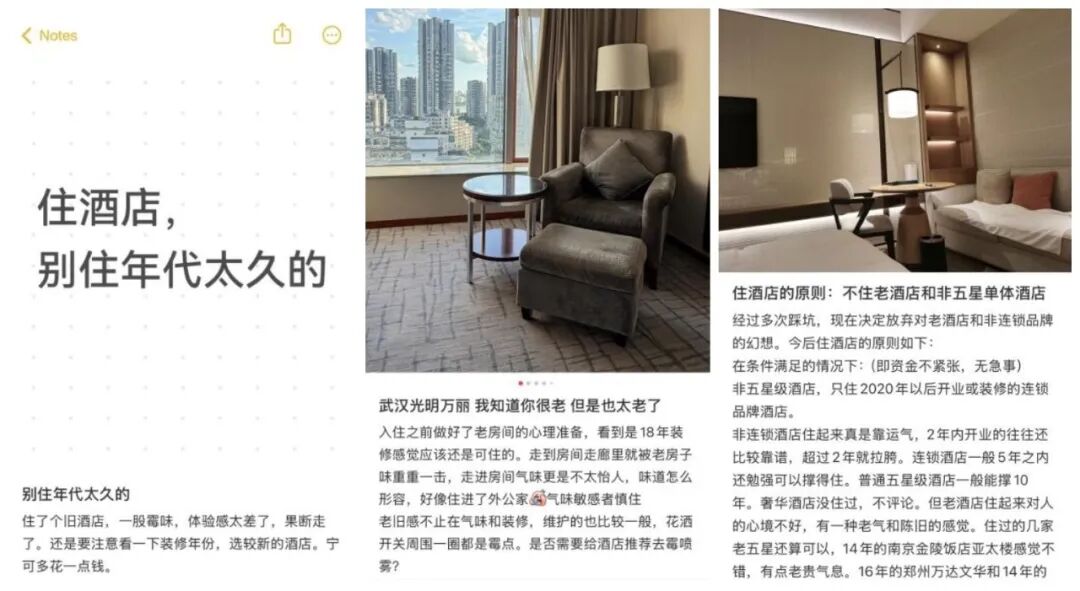
Source: Xiaohongshu
Some people may say, why are consumers nowadays so picky?
This is not consumers being overly picky. In the era where consumption upgrading and rational consumption go hand in hand, the standard for "good" is being constantly upgraded.
On the one hand, in recent years, the industry supply has grown at a high speed. The decoration and facilities of newly opened hotels all pursue advancement. Intelligent guest control systems, branded bedding, and self-service laundry rooms have almost become standard configurations even in budget chain hotels.
However, old hotels are still receiving guests relying on their old advantages from ten years ago. The first thing guests see when they enter the door is outdated decor and peeling furniture with chipping debris, and the smell they smell is stuffy moldy odor and peculiar smell that cannot be dispelled even after ventilation.
This gap cannot be glossed over with a simple line like "We are a star-rated hotel with a great location" or "We have profound historical heritage".
Moreover, in the current era of rational consumption, no one will sacrifice their own experience and willingly pay for the hotel's superficial reputation and emotional nostalgia.
Not only consumers are complaining, hotel groups have also noticed this problem.
For example, Huazhu Group plans to open 2200-2300 new hotels in 2026, optimize its store structure at the same time, and close 600-700 low-efficiency stores.
This "decluttering" carried out by leading groups is not passive elimination, but actively clearing out low-efficiency sites while expanding, concentrating business resources on high-performing stores, taking into account both expansion quality and profitability, and achieving two-way improvement in scale and efficiency.
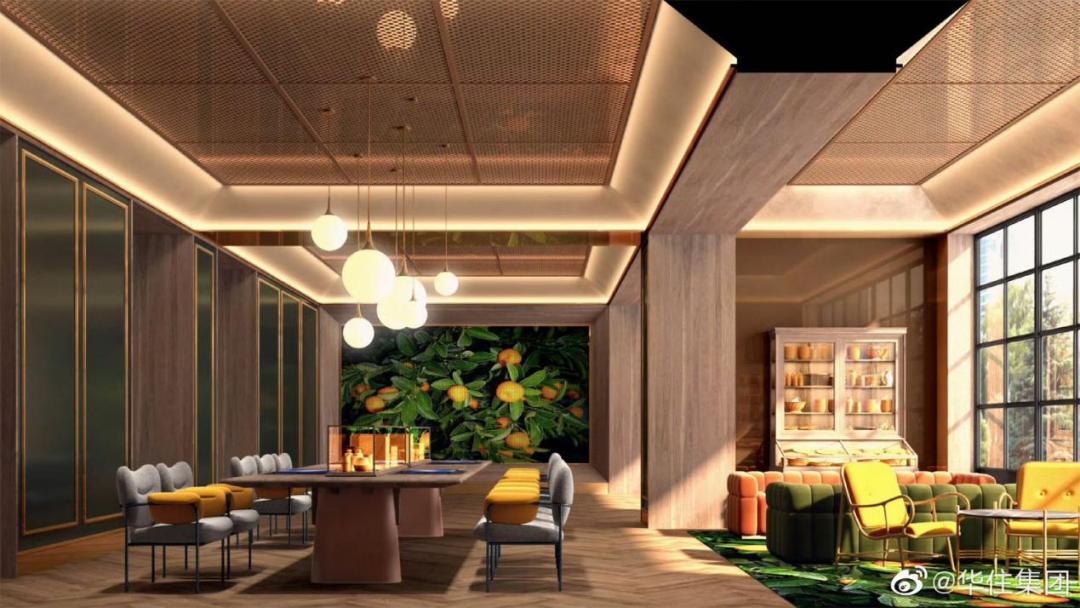
Source: Weibo
According to industry statistics, stock brand hotels that have been in operation for more than five years across the country account for 69.3%. In 2025 alone, 1054 hotels completed de-branding, and more than 3600 mid-range and above hotels ceased operations.
Although these data do not prove that every exit of all hotels is directly related to "dilapidation", they are enough to reflect a reality: product renewal and asset disposal of stock hotels have become an unavoidable issue for the industry.
02 Are old hotels destined to be completely written off?
Some old and dilapidated hotels are far from what they used to be, and have even reached their "twilight years". But it would be too arbitrary to write off all old hotels with one stroke.
At the very least, for some old hotels, they hold two trump cards that new hotels cannot buy even with money.
The first one is geographical location.
No one is born old. Even the most elderly person was once vibrant, and so are old hotels. Some hotels look shabby and run-down now, but back in the day they were the go-to accommodation choices in their respective regions.
In particular, some old landmark hotels are mostly located in prime locations in the city center, with inherent mature location advantages and potential customer base. They are right next to subway entrances downstairs and around the corner from commercial districts. This spatial advantage gained over time is a scarce resource that no new development project can easily replicate.
JLL's judgment in 2026 also proves this point: The core strategy of stock renewal is to focus on assets in core areas that can be renovated and upgraded.
Moreover, old hotels have taken root in local areas for many years, and usually have in-depth understanding of the local regional culture, consumption habits and customer structure. This localization advantage is difficult for new entrants to obtain in a short period of time.
In addition, the teams of old hotels are relatively more familiar with their own customer needs. As long as they put effort into services and adjust price strategies appropriately, they do have their own advantages.
Luoyang Huayang International Hotel is a positive case in point.
As a well-established independent hotel, Luoyang Huayang International Hotel, which opened in 2005, has a history of 20 years. But this very hotel has now become a "must-stay check-in spot" for Luoyang tourism, with related topics on Douyin recording over 60 million views.
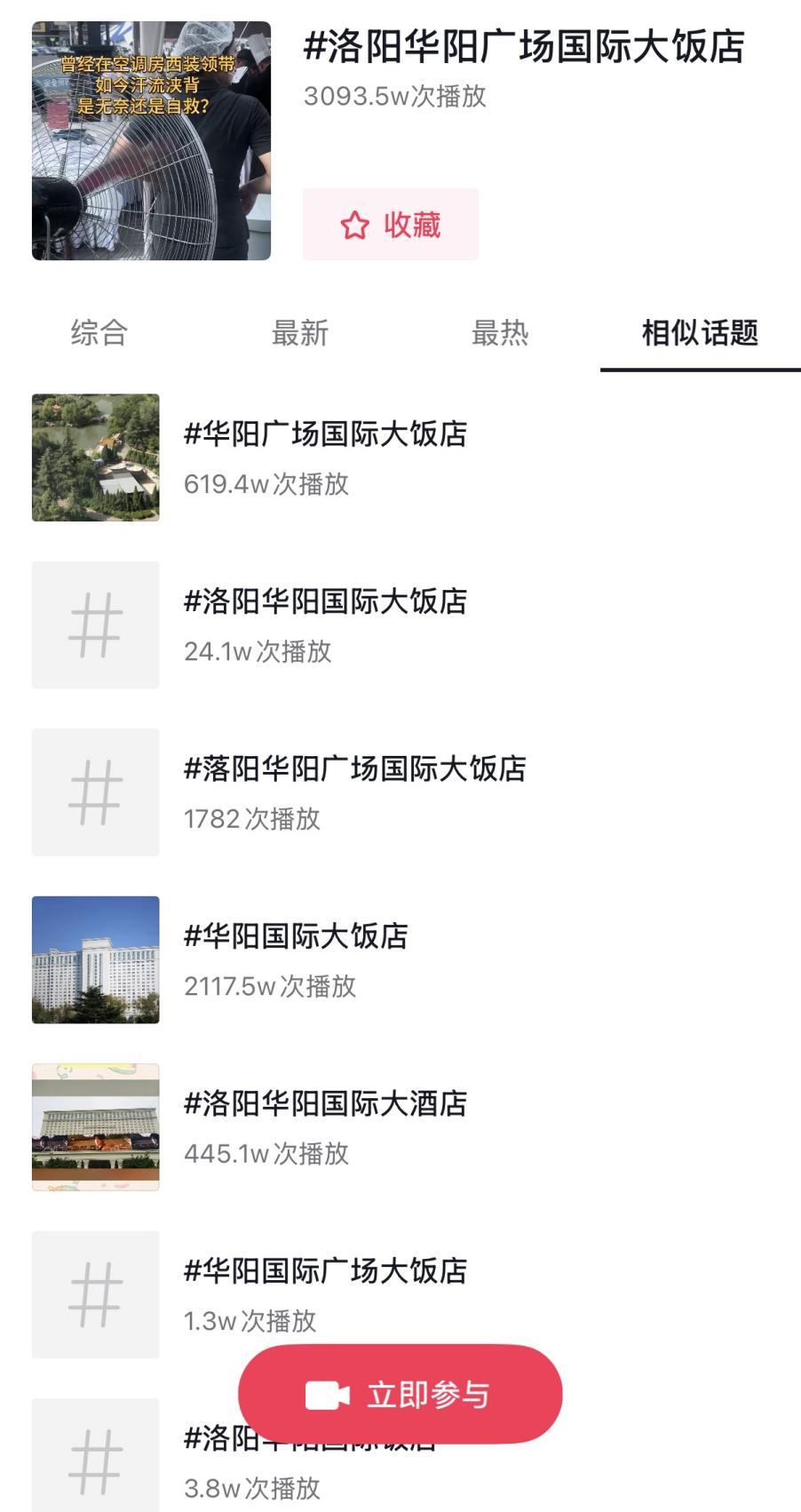
Source: Douyin
Xiaohongshu is full of spontaneous recommendations from guests. With a price of more than 400 yuan per night, guests say "the service alone is worth 399 yuan", and it has been given a nickname by guests: "Pang Donglai in the hotel industry".
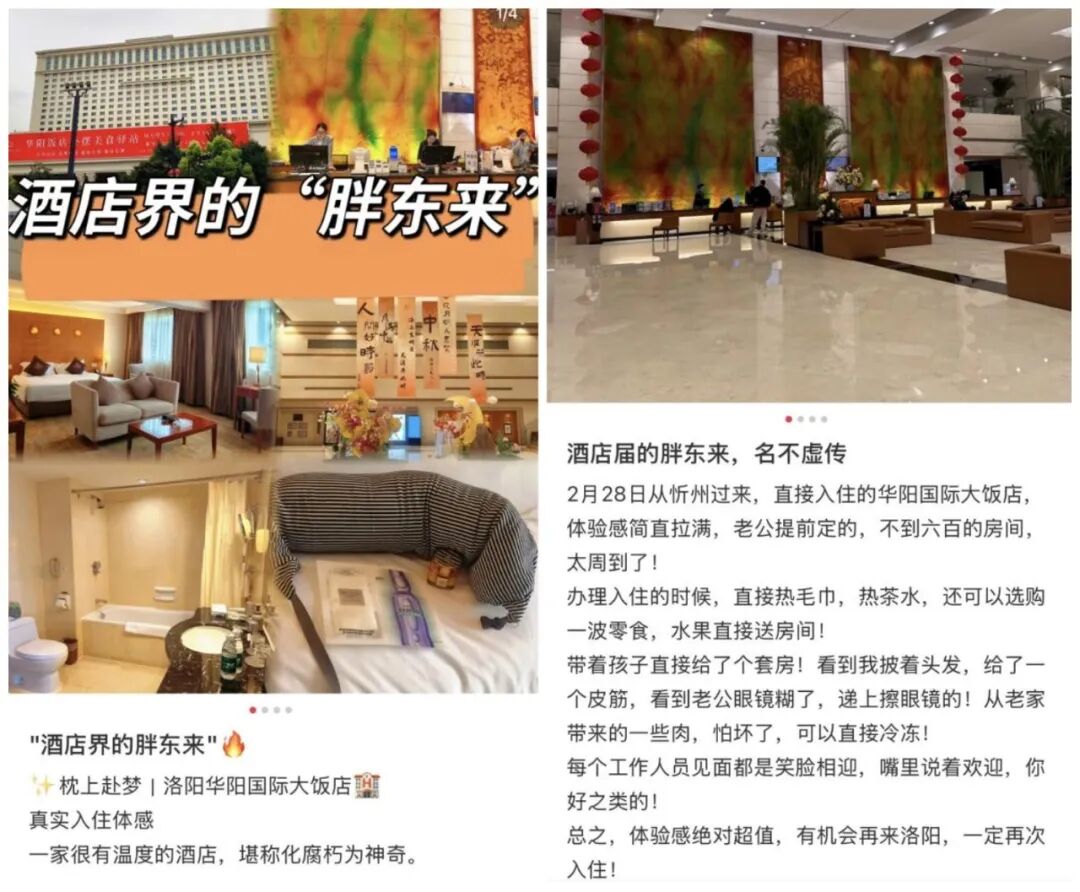
Source: Xiaohongshu
What on earth makes it stand out?
In terms of hardware decoration, it really has no obvious advantages. Some netizens complained on social platforms that "the guest room appliances are slightly old", "the decoration style is rather traditional", "the shower head is outdated"... Compared with newly built mid-to-high end chain hotels, the gap in hardware is clearly visible.
But in terms of services, different from the passive response service of traditional hotels, Huayang's "family-style" service goes far beyond the hardware specifications of star rating standards:
A guest spent 40 yuan taking a taxi from the station to the hotel, and the front desk registered and reimbursed the fee directly;
A guest on a business trip with a laptop returned to the room at night and found a foldable laptop stand on the table;
A guest who delayed check-out by 3 hours due to itinerary adjustment was offered a free late check-out;
There are also handwritten Luoyang travel guides, small gifts such as mobile phone holders, optional pillows and bedding, free car washing......
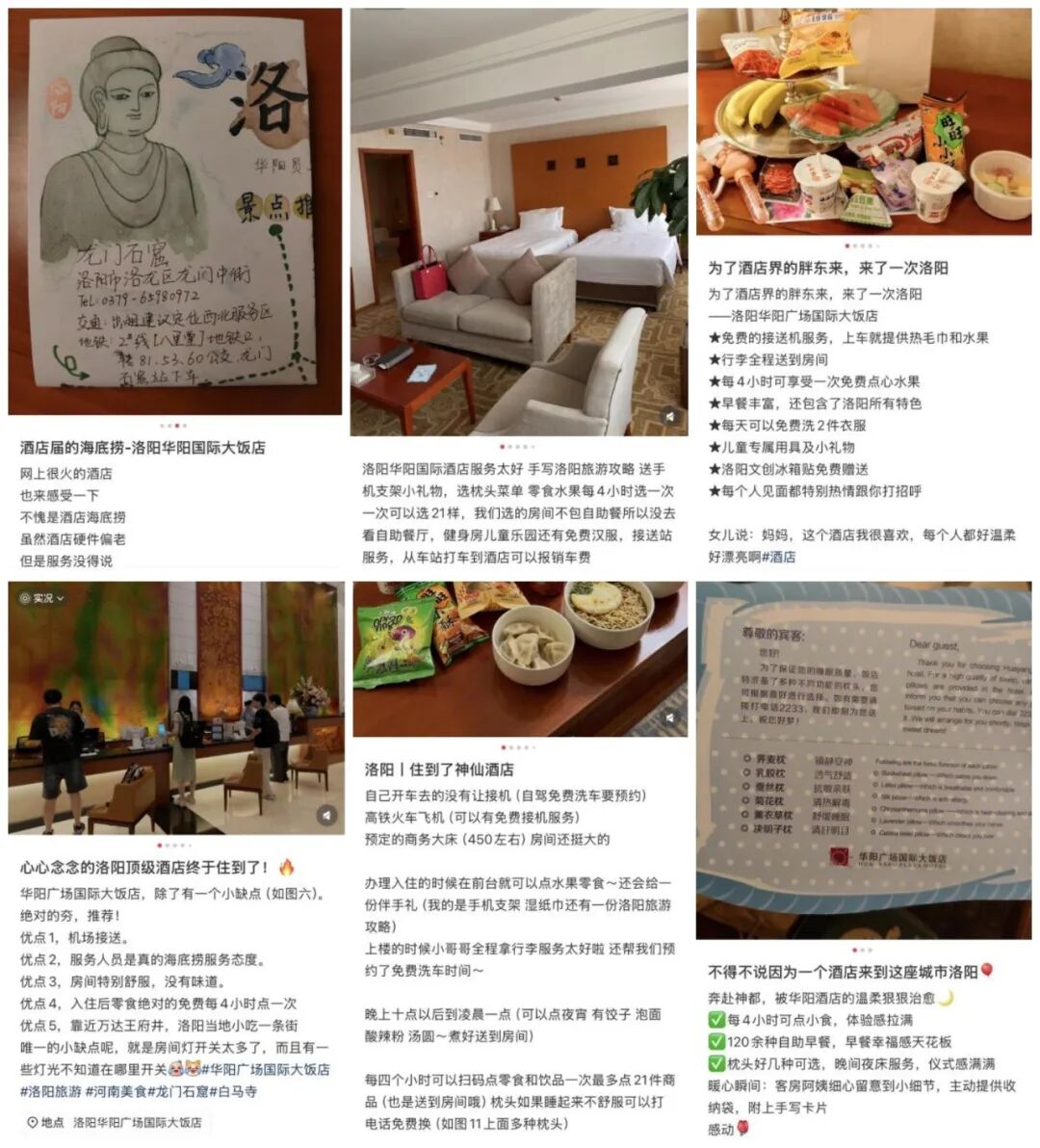
Source: Xiaohongshu
None of these services were requested by the guests in advance.
Therefore, when some people say that the renovation of old hotels must involve large-scale demolition and reconstruction, this is actually not a mandatory requirement.
Just like Luoyang Huayang Hotel, what wins it good reviews from consumers is not luxurious decoration and cutting-edge technology, but its services. What it earns is not the premium brought by decoration, but more of the human sentiment compound profit after the fixed cost is diluted by high occupancy rate.
However, not every old hotel can have the luck of Huayang. Some hotels with chaotic property rights, structural defects, and renovation costs higher than reconstruction costs really have no need for renovation.
03 In the stock era of hotels, every square meter must generate the profit it is supposed to make
It is human instinct to love the new and dislike the old, and the fact that consumers "prefer staying in new hotels rather than old ones" has always been the default consensus in the hotel industry. But the current development trend of the industry no longer allows people to keep "loving the new" blindly.
Data from JLL clearly shows that the supply of hotel rooms in China has increased significantly in the past decade, but the number of new hotel rooms added in the next five years will decrease, the total supply will tend to be stable and the annual growth rate will continue to slow down.
In the incremental era, the strategy of many hotel groups was to expand rapidly, seize the market by occupying as much territory as possible. As long as the scale was large enough, even with small profits but quick turnover, they could cover costs with incremental growth and outperform peers by scale advantage.
But the logic of the stock era is not to chase scale and expand volume, but to compete for efficiency, to make sure every square meter generates the profit it deserves.
Zhang Shurong, CEO of Huazhu Group High-end Quality Division, once said, "The essence of stock renewal is not to renovate the space, but to reconstruct the logic of asset value. If you only understand it as a one-time renovation, you will easily fall into the dilemma of 'increased input but uncertain return'."
Everyone understands this truth, but how to implement it specifically?
For the vast majority of small and medium-sized hotels or independent hotels with insufficient capital strength, the most feasible solution at present is to spend money on the key points without carrying out large-scale construction.
Many old hotel owners get a headache as soon as they hear the word "renovation", because the first thing that comes to their mind is suspending business, pouring a lot of money into it, and tearing everything down to rebuild from scratch.
In fact, that's not necessarily the case. There is a simplest and most useful method: first go through all the bad reviews from the past year, and start with the points that are complained about the most. In most cases, the top complaints may not be "old decoration", but poor sound insulation, slow hot water supply, poor hygiene, and uncomfortable mattresses.
Another point is the public area, which is a gold mine that is easily wasted.
An urban business hotel that has been open for more than ten years originally had a spacious lobby, and its all-day dining restaurant on the second floor was almost idle except for lunch and dinner hours.
The hotel added movable partitions and mobile furniture to the idle all-day dining restaurant, so that it can be switched to co-working space and private dining booths after breakfast. It also converted the corner of the lobby into a coffee stall. After the renovation, the per-square-meter efficiency increased by 35%, and the proportion of non-guest consumption rose from 3% to 18%.
All these renovations were carried out while the hotel was operating as usual, and the non-room revenue can be increased without a large budget.
If the hardware of public areas and guest rooms cannot keep up, the catering business is another card that can be played to gain advantages.
Wuhan Jinguanyuan Sishen Hotel converted its nearly 1000 square meters of idle banquet hall into an indoor "outdoor-style supermarket", with more than 200 freshly made dishes, 1.5-yuan steamed buns, and home-style stir-fries priced at more than ten yuan, attracting over 1000 visitors on weekdays.
The kitchen is still the same kitchen, the chefs are still the same group of chefs, just by changing the scenario, the idle space and manpower are fully utilized.
In this way, this well-established hotel that has been operating for 16 years successfully transformed and ushered in the second spring of its development cycle.
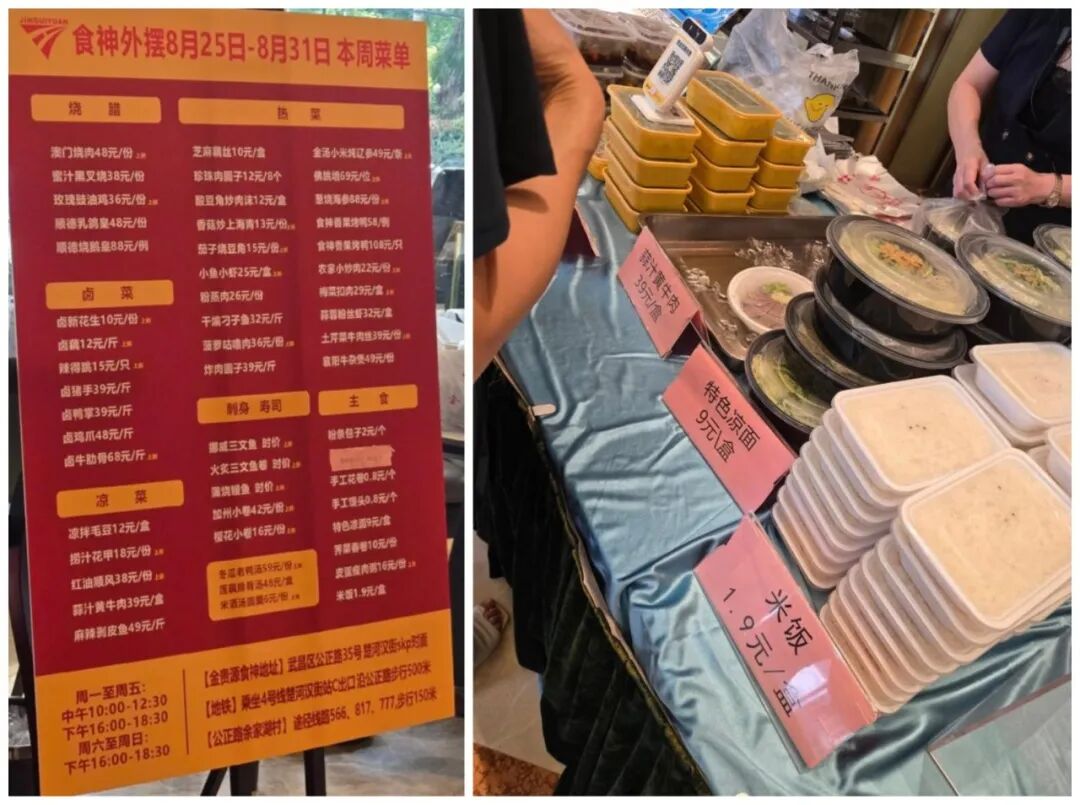
Source: Xiaohongshu
Hotel Management Finance believes that whether it is Luoyang Huayang Hotel or Wuhan Jinguanyuan Sishen Hotel, their strategies may not be copied to all old hotels, but at least they prove one thing: when hardware depreciation is inevitable, service value is the permanent passport for the hotel industry.
For those old, shabby hotels jokingly called "old things that refuse to die", "old" is a fact that cannot be changed; "refusing to die" is a choice, and there are options available.
If you carry out large-scale batch renovation blindly, once the occupancy rate drops, it will easily lead to idle resources and cost waste.
Therefore, instead of betting all the costs at once on an uncertain renovation result, old hotels might as well adopt the mode of "small-step trial and error, improving while operating", use a small number of room types for pilot operation to observe feedback, and then make gradual optimization according to data and guest reputation.
After all, only by fitting customer needs, conforming to industry trends and taking into account their own revenue is the key to long-term development.