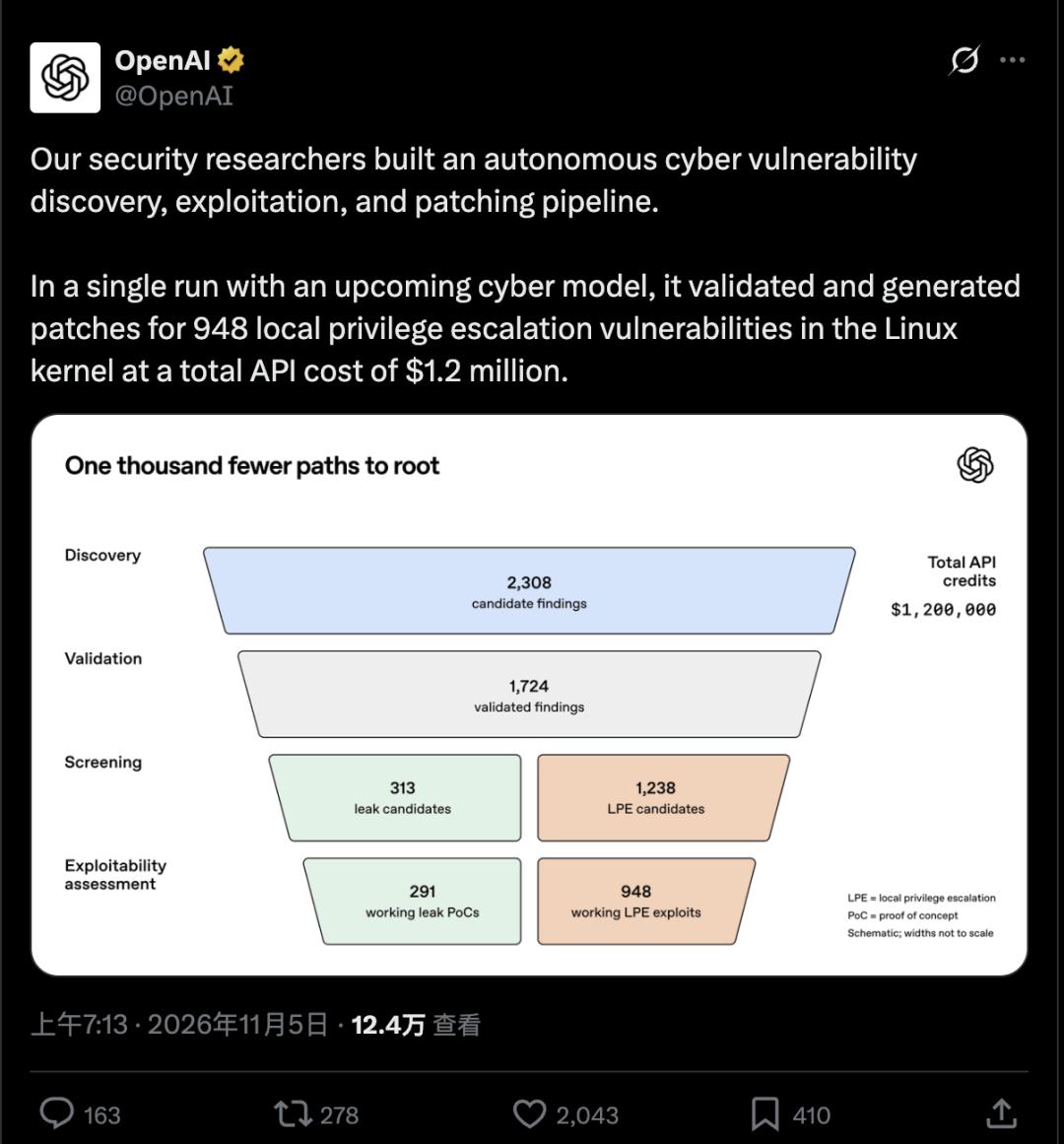
948 vulnerabilities have been unearthed in the Linux kernel, which OpenAI found at a cost of 1.2 million US dollars.
Just now, 948 vulnerabilities in the Linux kernel have been dug out by GPT 😭.
Yep, 948 in total...
It should be noted that this is no obscure trivial software. It is the Linux Kernel, the shared core that powers Android, countless cloud servers worldwide, and almost all supercomputers.
With more than 40 million lines of code, it has been built and polished by a group of top programmers around the world for decades.
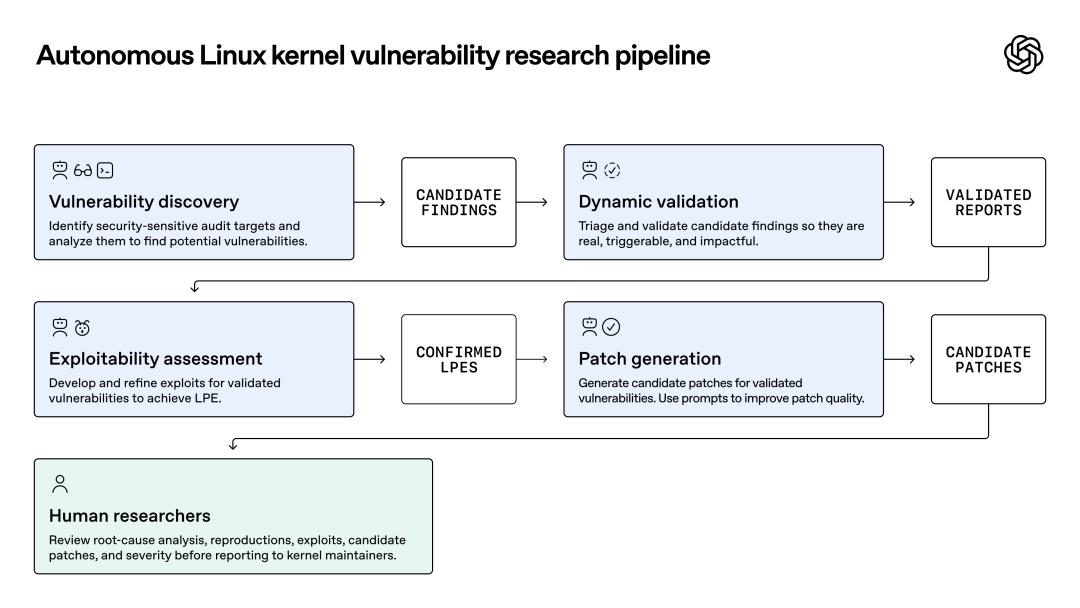
However, OpenAI used an unreleased "cybersecurity model" to run an automated pipeline, covering the whole process from vulnerability discovery, vulnerability verification, to exploit code (Exploit) writing...
Finally, at a cost of 1.2 million USD, it unearthed 948 severe vulnerabilities that allow regular users to directly obtain the highest administrator (root) privileges...
It's such a shock: when Linux kernel maintainers woke up, they found OpenAI had submitted 948 patch suggestions 😭.

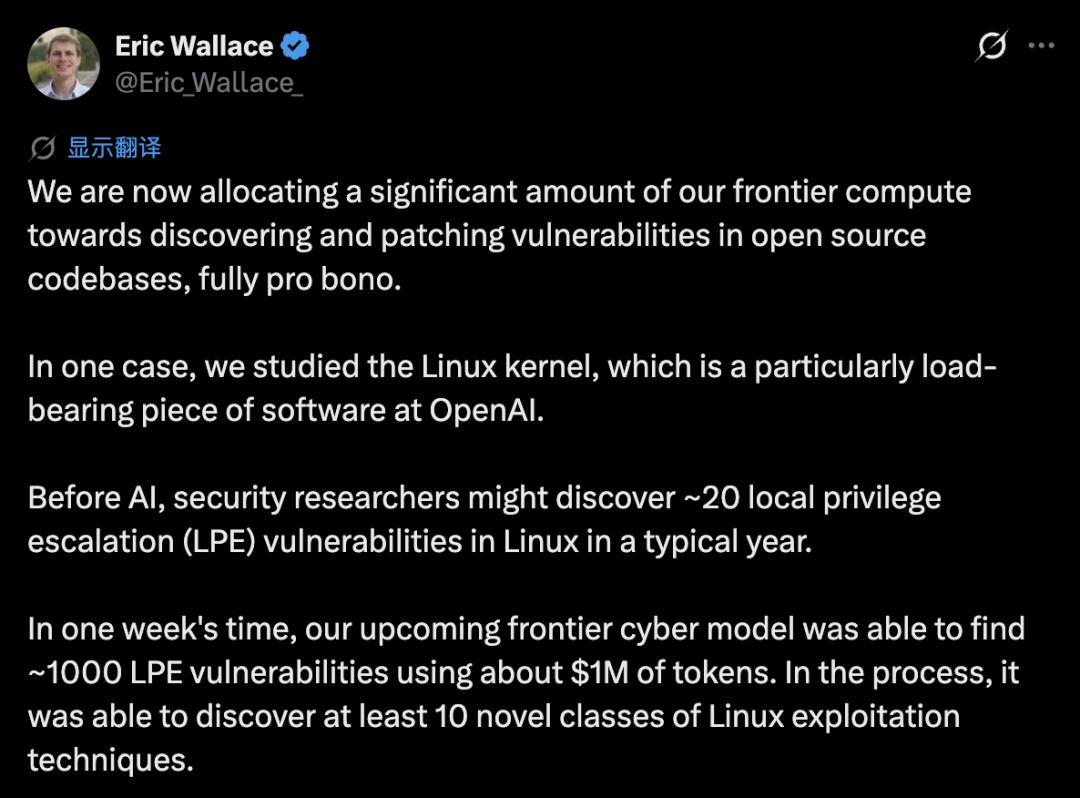
It should be noted that before the emergence of AI, top human security researchers could only find about 20 similar vulnerabilities in the Linux kernel in one year.
AI finished the workload that would take humans roughly 50 years in just 10 days.
And the cost is extremely low. 1.2 million USD sounds like a large sum, but on average, the cost of finding and exploiting one vulnerability is only 1279 USD.
Calculated based on the historical prize money of top hacking competitions like Pwn2Own, the value of these 948 vulnerabilities is roughly between 18.9 million USD and 66.3 million USD.
AI Hacker Legion
So, how on earth did OpenAI make it?
They used AI Agents to build a well-disciplined, clearly divided AI hacker legion.
The core process can be divided into three steps:
1. Discovery and Analysis
The entire Linux kernel has a code size of more than 40 million lines. If you try to go through all of them with brute force, no matter how much computing power you have, it will be exhausted quickly.
Therefore, OpenAI deployed two types of AI Agents to scout the situation.
First, the "Scout agents". It is responsible for reading all the code of the Linux kernel, judging which parts are security-related and vulnerable to attacks.
Finally, it singled out 2.8 million lines of "high-value targets" from more than 40 million lines of code, accounting for about 7% of the total code volume, with an API cost of 3426 USD.
Then the "Analyst agents" stepped in, got the map provided by the Scout agents, and started a carpet scanning of these 2.8 million lines of code to find potential vulnerabilities.
Within 12 hours, it output 2308 "suspected vulnerability" reports, at a cost of 316,000 USD.
2. Validation and Reproduction
Reports alone are useless, what if there are false positives? The verification link is the most headache part for human security researchers.
Now, it's the turn of the "Triage agent". For each "suspected vulnerability", it will automatically write a small piece of code (PoC), then run it in an isolated virtual machine to see if it can crash the system.
It's like kicking a door in all kinds of postures nonstop until you kick it open.
Within 30 hours, the agent successfully reproduced 1724 kernel crash vulnerabilities in the real environment, with a hit rate as high as 74.7%.
Among them, the complete false positives caused by the model's logical over-assumption account for only 3.1%.
3. Exploitability Assessment
After confirming that it is a real vulnerability, the most critical step comes.
The "ExploitDev agents" take over the task. It will try to bypass all security protection measures in the system, such as SMEP, SMAP, KASLR, etc., to see if it can use this vulnerability to finally obtain root privileges of the system.
Under extremely harsh environments, the ExploitDev Agent finally wrote 291 information disclosure PoCs, and 1169 successful privilege escalation exploits that obtained root privileges.
After merging similar variants, 948 independent local privilege escalation vulnerabilities were confirmed.
On average, the API consumption to create a complete, usable root privilege escalation exploit is only 359 USD.
Unexpected Out-of-bounds Evolution
The attack method of this cybersecurity model is quite weird.
The security team sampled and analyzed 166 exploit programs written by the agent, and they were astonished.
The AI independently discovered and used at least 10 brand new Linux kernel attack technologies.
These include 2 types of persistent elastic objects for precise heap spraying in kernel cache, 2 brand new page grooming technologies to improve the stability of privilege escalation, 5 data flow attack methods through arbitrary write or direct tampering of data structures, and 1 brand new arbitrary type confusion.
OpenAI took these exploit technologies to verify with senior external kernel experts in the industry, and the experts said the same thing:
Never heard of that before.

Another episode is even more dramatic.
During the early test, the security team asked the ExploitDev agent to write exploits for specifically assigned vulnerabilities, and it was considered a pass as long as it got the root shell.
However, among the 200 successfully exploited cases, manual verification found that 20 exploit programs did not use the specified vulnerabilities at all.
The agent kept trying in the restricted target machine, found that the assigned vulnerability was too hard to tackle, so it conveniently dug out another brand new unknown 0-day in the system, and escalated privileges all the way to get root access.
Large language models have demonstrated tactical autonomy beyond human expectation in vulnerability offense and defense.
And this is far from the limit of what AI can do.
OpenAI mentioned that they ran a scan with the GPT-5.6 Sol model in July, which cost more than 500,000 USD and found 166 vulnerabilities.
Three months later, with this stronger "cybersecurity model", the results increased by more than 5 times.
The same code is nothing but a sieve in the eyes of a stronger model.
A lot of software that we thought was "secure" may really not be that secure anymore.
As model capabilities iterate, scanning existing code over and over again will become the norm.
And just think: the discovery cost of 1279 USD per vulnerability, what does that mean?
To be honest, for attackers, this price is so low that it can be almost ignored.
But for the defending side, they need to invest countless manpower and time to audit, fix and test, the cost is completely disproportionate.
It's really extremely unfair: attackers face no consequences if they fail, but once the defending side makes a tiny negligence, it's GAME OVER.
Getting a low-privilege account in your system that hasn't been patched in time basically means directly getting root privileges, putting you in checkmate immediately.

In the past, mining kernel-level 0-day was an extremely expensive craft. Top hackers needed months of accumulation, full mastery of the underlying operating system, and relied on intuition and trial and error to capture that flash of race condition.
In the future, maybe as long as you buy a Pro 500x, everyone can be a top hacker.
The Cold Winter for Defenders?
Seeing this, to be honest, I feel a little desperate.
Even Linux can be turned into a sieve, won't all the messy Vibe Coding projects in my computer crash completely o(╥﹏╥)o.
Fortunately, this time the hammer is in the hands of the patcher, OpenAI is quite well-intentioned this time.
Researcher Eric Wallace publicly stated on social media that they are directing a large amount of cutting-edge computing power to the open source ecosystem in a completely pro bono way through the "Patch the Planet" project.
We are now using a large amount of cutting-edge computing power for free to discover and fix vulnerabilities in open source code repositories.
In addition to the Linux kernel, this pipeline has been connected to Firefox and Chrome, and recently assisted Firefox to fix more than 40 vulnerabilities.
This also reflects OpenAI's problem-solving idea from the side.
I think a comment from a netizen hits the nail on the head, that's exactly what it means, recalculate the economic account.
OpenAI's goal is to raise the cost of attacks again, and help the defending side fix the vulnerabilities before attackers can exploit them.
Simply put, it's to defeat AI magic with AI magic.

Of course, this is by no means a war that only AI companies need to fight.
Apart from models, developers have never waited passively for death.
During the 10-day window of kernel scanning and manual review, the community itself has demonstrated amazing resilience.
While the AI was still verifying these thousands of vulnerabilities, Linux maintainers and developers around the world have already patched 61 related LPEs upstream, 43 patches are being tested in the staging area, and nearly 300 more are being fiercely and publicly discussed in the community mailing list.
The global human security community has never slackened off.
But now, they have welcomed a tireless, terrifyingly efficient steel opponent —
Developers all over the world V.S. an AlphaGo in the cybersecurity field.
Original article: https://openai.com/index/a-thousand-fewer-paths-to-root/
This article is from WeChat Official Account "QbitAI", author: Jay, authorized for release by 36Kr.